Truck Loading Spout
ProductOverview
A Truck Loading Spout is a telescoping chute that lowers from a silo or surge bin into an open truck or rail car and loads bulk material into it while containing the dust. Loading dusty solids into a truck by dropping them through open air creates a plume that drifts off site, is lost product, becomes a nuisance and health hazard, and for combustible powders is a deflagration risk. The loading spout solves this with two nested chutes: an inner cone stack that guides material down, and an outer sleeve that draws the displaced dusty air back up to a filter. The spout telescopes, lowering deep into an empty truck and retracting as the pile rises, so material always falls a short distance and the dust stays enclosed.
These spouts sit at the outloading point of cement plants, grain terminals, mineral processors, and plastics plants, anywhere bulk solids are transferred from fixed storage into road or rail transport at high rates.
Telescoping chute
The Telescoping Tube is the defining feature. A stack of nested steel Inner Cone forms the inner material chute, each cone overlapping the next so they collapse like a camera bellows when the spout retracts and extend into a long tube when it lowers. Cone Spacer Ring link adjacent cones and set the small gap between the inner chute and the surrounding Outer Bellows. Material falls down the inside; the annular space between inner and outer walls is the path the dusty air is drawn up. The whole stack hangs from three Suspension Chain chains for stability.
The double-wall geometry is what makes the spout dust-tight. Material flows inside, displaced air and entrained dust flow up the outside, and the two never mix in open air.
Raising and lowering
The Hoist Mechanism follows the rising pile. A Winch driven by a braked Hoist Motor winds three Hoist Cable ropes on a single grooved Cable Drum, so all three lift at the same rate and the spout stays vertical. It lowers deep into an empty truck so the first material drops only a short distance, then raises at 3 to 6 m/min as the load builds, keeping the spout tip just above the pile throughout. Short, constant fall height is the second half of dust control: most loading dust is generated by material slamming into a pile from a height, so keeping that height small keeps dust low at the source.
Dust capture
The Dust Filter is integral to the spout head rather than ducted away. An Extraction Fan pulls the air displaced by incoming material up through the annulus between the cones and into Filter Cartridge elements. Pulse-Jet Valve jets periodically clean the cartridges with reverse air bursts, and a Dust Return Chute chute drops the cleaned-off dust back into the inner cone so it rejoins the load. Nothing is wasted: the only thing that leaves is filtered air.
Outlet and sealing
The Discharge Cone is the business end. An Outlet Cone, wear-lined for abrasive materials, delivers the stream into the truck, and a Material Deflector spreads it so the load builds a level pile across the bed rather than a single peak that has to be raked out. For closed loading into hatched tankers or covered trucks, a flexible Skirt Seal seats over the hatch and contains the dust completely. Open loading into a flatbed or tipper relies on the telescoping action and extraction alone.
Level detection and stopping
The Level System decides when the truck is full. A Capacitance Probe capacitance sensor at the cone tip detects when material reaches the spout and signals the hoist to lift. A hanging Tilt Paddle Switch paddle tilts when buried by the pile, signaling that the truck has reached capacity and stopping the feed. A Radar Level Sensor can profile the pile height across the whole bed for even, complete loading. Reliable cutoff matters because an overfilled truck spills on the road and is over its legal axle weight, while an underfilled one wastes a trip.
Positioning under the source
The Positioner mounts the spout. An Inlet Adapter connects the spout head to the silo outlet or feeder above. A Slewing Arm on a Slew Bearing, driven by a Slew Motor, swings the spout aside between trucks or over different loading bays, so one spout can serve several positions or be parked clear when not in use.
Control and operation
The Control System automate the loading cycle. A Controller in the Control Panel lowers the spout into the empty truck, starts the extraction fan and the feed, raises the spout as the level probe reports the rising pile, and stops the load on the full signal. A Operator Pendant lets the operator or driver position the spout and start a load from the ground. A standard interlock prevents material feed unless the dust filter fan is running.
Materials and variants
Spouts are carbon steel with abrasion-resistant liners for cement, clinker, and minerals, and stainless for food-grade grain, sugar, or chemicals. Open-type spouts with a skirt suit flatbed and tipper trucks; closed-type spouts that seal to a hatch suit pneumatic tankers and covered hoppers. Capacity scales with cone bore, from small 250 mm spouts loading 50 tons per hour to large 600 mm units exceeding 1000 tons per hour at bulk terminals. Marine and rail-car versions extend the travel and add longer slewing arms to reach across a wide hold or a row of wagons.
Truck Loading Spout parts and their functions
7 top-level parts · 140 parts in total · full bill of materials below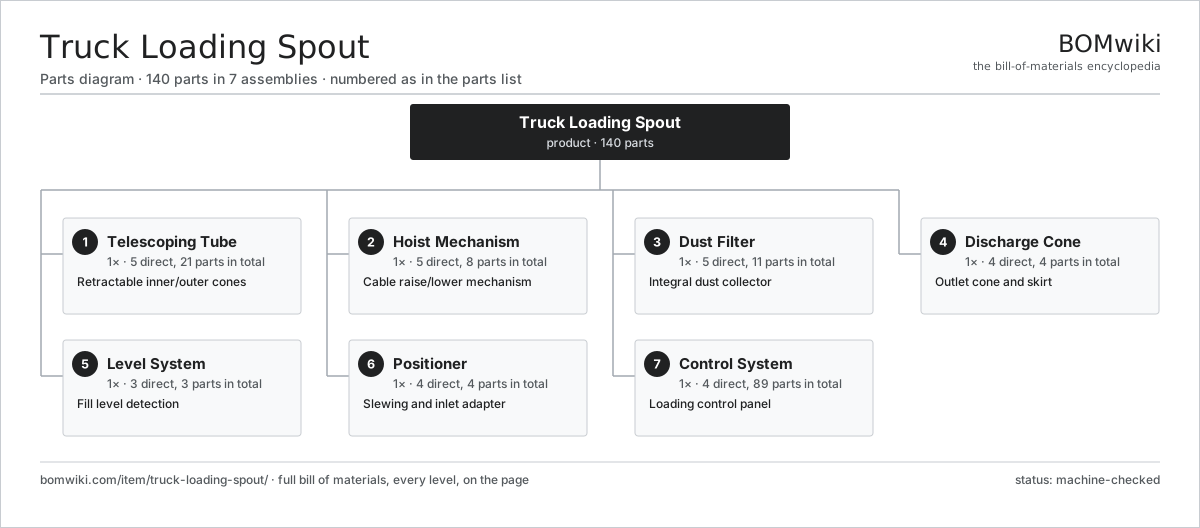
| # | Part | Qty | What it does |
|---|---|---|---|
| 1 | Telescoping Tube 5 parts | 1× | Retractable inner/outer cones |
| 2 | Hoist Mechanism 5 parts | 1× | Cable raise/lower mechanism |
| 3 | Dust Filter 5 parts | 1× | Integral dust collector |
| 4 | Discharge Cone 4 parts | 1× | Outlet cone and skirt |
| 5 | Level System 3 parts | 1× | Fill level detection |
| 6 | Positioner 4 parts | 1× | Slewing and inlet adapter |
| 7 | Control System 4 parts | 1× | Loading control panel |
3D model
No 3D model yet. Have a CAD file of this? Add a 3D model — STL renders right on this page; STEP, FreeCAD, and OpenSCAD sources are welcome too (openly licensed, like all 3D models on BOMwiki).
Build & assembly graph
expand / collapse · shared sub-assemblies converge · links to related products · est. labourTap an assembly to expand/collapse · tap a part to open it · use “Open page” for any node · drag to pan, scroll to zoom.
Bill of materials for Truck Loading Spout
7 top-level lines · 41 rows shown · 140 parts total · indented to 3 levels| # | Item / sub-assembly | Part no. | Qty/assy | Ext. qty | Parts | Type |
|---|---|---|---|---|---|---|
| 1 | Telescoping Tube 5 parts | truck-loading-spout-telescoping-tube | 1× | 1 | 21 | assembly |
| 1.1 | Inner Cone | truck-loading-spout-inner-cones | 8× | 8 | · | part |
| 1.2 | Outer Bellows | truck-loading-spout-outer-bellows | 1× | 1 | · | part |
| 1.3 | Suspension Chain | truck-loading-spout-suspension-chain | 3× | 3 | · | part |
| 1.4 | Cone Spacer Ring | truck-loading-spout-cone-rings | 8× | 8 | · | part |
| 1.5 | Fastener Set | fastener-set | 1× | 1 | · | part |
| 2 | Hoist Mechanism 5 parts | truck-loading-spout-hoist | 1× | 1 | 8 | assembly |
| 2.1 | Winch | truck-loading-spout-winch | 1× | 1 | · | part |
| 2.2 | Hoist Cable | truck-loading-spout-hoist-cable | 3× | 3 | · | part |
| 2.3 | Cable Drum | truck-loading-spout-cable-drum | 1× | 1 | · | part |
| 2.4 | Hoist Motor | truck-loading-spout-hoist-motor | 1× | 1 | · | part |
| 2.5 | Ball Bearing | ball-bearing | 2× | 2 | · | part |
| 3 | Dust Filter 5 parts | truck-loading-spout-dust-filter | 1× | 1 | 11 | assembly |
| 3.1 | Filter Cartridge | truck-loading-spout-filter-cartridge | 4× | 4 | · | part |
| 3.2 | Pulse-Jet Valve | truck-loading-spout-pulse-valve | 4× | 4 | · | part |
| 3.3 | Extraction Fan | truck-loading-spout-extraction-fan | 1× | 1 | · | part |
| 3.4 | Dust Return Chute | truck-loading-spout-dust-return | 1× | 1 | · | part |
| 3.5 | Pressure Sensor | pressure-sensor | 1× | 1 | · | part |
| 4 | Discharge Cone 4 parts | truck-loading-spout-discharge-cone | 1× | 1 | 4 | assembly |
| 4.1 | Outlet Cone | truck-loading-spout-outlet-cone | 1× | 1 | · | part |
| 4.2 | Skirt Seal | truck-loading-spout-skirt-seal | 1× | 1 | · | part |
| 4.3 | Material Deflector | truck-loading-spout-deflector | 1× | 1 | · | part |
| 4.4 | O-Ring Set | oring-set | 1× | 1 | · | part |
| 5 | Level System 3 parts | truck-loading-spout-level-system | 1× | 1 | 3 | assembly |
| 5.1 | Capacitance Probe | truck-loading-spout-level-probe | 1× | 1 | · | part |
| 5.2 | Tilt Paddle Switch | truck-loading-spout-tilt-switch | 1× | 1 | · | part |
| 5.3 | Radar Level Sensor | truck-loading-spout-radar-sensor | 1× | 1 | · | part |
| 6 | Positioner 4 parts | truck-loading-spout-positioner | 1× | 1 | 4 | assembly |
| 6.1 | Slewing Arm | truck-loading-spout-slew-arm | 1× | 1 | · | part |
| 6.2 | Slew Bearing | truck-loading-spout-slew-bearing | 1× | 1 | · | part |
| 6.3 | Inlet Adapter | truck-loading-spout-inlet-adapter | 1× | 1 | · | part |
| 6.4 | Slew Motor | truck-loading-spout-slew-motor | 1× | 1 | · | part |
| 7 | Control System 4 parts | truck-loading-spout-controls | 1× | 1 | 89 | assembly |
| 7.1 | Control Panel | truck-loading-spout-control-panel | 1× | 1 | · | part |
| 7.2 | Controller 4 parts | truck-loading-spout-controller | 1× | 1 | 86 | assembly |
| 7.2.1 | Bare PCB | pcb-bare | 1× | 1 | · | part |
| 7.2.2 | Microcontroller | mcu | 1× | 1 | · | part |
| 7.2.3 | SMD Passive (R/C/L) | smd-passives | 80× | 80 | · | part |
| 7.2.4 | Relay | relay | 4× | 4 | · | part |
| 7.3 | Operator Pendant | truck-loading-spout-pendant | 1× | 1 | · | part |
| 7.4 | Wire Bundle | wire-bundle | 1× | 1 | · | part |
Related products
same domain, ranked by shared parts Articulated Forklift
2,417 parts · shares 3 with this page
Articulated Forklift
2,417 parts · shares 3 with this page
 Bag Dump Station
134 parts · shares 3 with this page
Bulk Bag Discharger
178 parts · shares 3 with this page
Coal Yard Stacker
571 parts · shares 3 with this page
Bag Dump Station
134 parts · shares 3 with this page
Bulk Bag Discharger
178 parts · shares 3 with this page
Coal Yard Stacker
571 parts · shares 3 with this page
 Container Handler
552 parts · shares 3 with this page
Container Handler
552 parts · shares 3 with this page
 Counterbalance Forklift
612 parts · shares 3 with this page
Counterbalance Forklift
612 parts · shares 3 with this page
Sourcing: possible vendors
Prices, MOQ, and lead times are algorithmic estimates, not quotes, and not claims about these companies. Company mappings are curated by keyword; est. price band $2k–$300k. How estimates work| Vendor | HQ | Specialty | MOQ | Lead time |
|---|---|---|---|---|
| toyota-industries.com ↗ | Kariya, JP | Forklifts & logistics | 20 units | 10–16 wks |
| kiongroup.com ↗ | Frankfurt, DE | Forklifts (Linde, STILL) | 20 units | 10–16 wks |
| jungheinrich.com ↗ | Hamburg, DE | Warehouse trucks | 20 units | 10–16 wks |
| crown.com ↗ | New Bremen, US | Forklifts | 20 units | 10–16 wks |
|
🇨🇳Hangcha
hcforklift.com ↗
|
Hangzhou, CN | Forklifts & material handling | 20 units | 10–16 wks |
1,005-word article