Weigh Belt Feeder
ProductOverview
A weigh belt feeder meters bulk material by weighing it continuously as it moves. Material lays on a short conveyor belt, a weigh bridge under the belt measures the load per unit length, a sensor reports the belt speed, and the controller multiplies the two to get the mass flow rate. By trimming the belt speed the feeder holds that rate at a setpoint, so it delivers a known tonnes-per-hour rather than just an estimated volume. This makes it the workhorse for dosing additives into a process, proportioning ingredients in a blend, and billing material across a boundary where accuracy matters.
The feeder is built around a Belt & Pulleys that carries the material, a Weigh Bridge that weighs it, a stiff Main Frame that holds the geometry stable, and a Belt Drive that moves the belt and reports its speed. An Inlet & Skirting lays an even bed, Belt Cleaning keeps the belt true, the Weighing Instruments turn the signals into a reading, the Control & Integration holds the rate, and an Enclosure protects it all.
How it works
Mass flow is the product of belt loading and belt speed. The Weigh Bridge supports a short span of belt on Weigh Idler idlers whose load passes into Load Cell cells, giving the weight of material per metre of belt. The Belt Speed Sensor on the drive gives the true belt speed. The Weigh Transmitter multiplies load per metre by speed to get tonnes per hour and integrates it over time for an accumulated total. The Control & Integration then compares the rate to the setpoint and trims the Variable-Frequency Drive belt speed to correct any error, closing the loop so the delivered rate stays on target as the upstream head and material density change.
Accuracy depends on a stable, even bed. The Inlet & Skirting uses a Shear Gate to strike off the material to a fixed depth, so the belt carries a steady load rather than the surging flow coming out of the bin.
Weigh bridge
The Weigh Bridge is the precision heart of the feeder. The Weigh Frame carries the weigh idlers and rests on the load cells, and Flexure Pivot flexure pivots constrain it to pure vertical motion so the cells see only the belt load and no side or drag forces. The Load Cell cells are OIML-rated strain-gauge units, paired so the reading is the average across the belt width. Because the measured weight is small compared with the dead weight of the belt and idlers, the bridge is zeroed regularly and calibrated against a known weight or a chain reference.
Frame, drive, and inlet
A weigh feeder is only as good as its mechanical stability, so the Main Frame is a stiff weldment with Leveling Foot feet that level the machine and a Screw Take-Up that keeps belt tension constant for repeatable tracking. The Belt Drive uses an inverter-fed Drive Motor through a helical reducer, with the Belt Speed Sensor reading belt speed from a belt-driven wheel rather than the motor, so belt slip does not corrupt the calculation. The Inlet & Skirting lays the bed: the Inlet Chute delivers material, the Shear Gate sets the depth, and Skirt Board boards with Skirt Seal seals contain it without dragging on the belt.
Cleaning and accuracy
Material stuck to the belt, called carryback, comes round again and adds phantom weight, so the Belt Cleaning group is part of the accuracy chain. A Primary Scraper removes the bulk of the carryback at the head pulley, a Secondary Scraper cleans the residual fines, and a Brush Roller clears sticky residue. A clean belt returns to the weigh bridge carrying only its own constant tare, which keeps the zero stable between calibrations.
Instruments and control
The Weighing Instruments convert raw signals into useful numbers. The Weigh Transmitter, built on an Microcontroller processor, integrates load and speed and serves the rate and total. A Operator Display with an LCD Panel shows rate, total, and calibration status, fed through a Junction Box that protects and sums the load-cell wiring. The Control & Integration panel closes the rate loop with its Controller Board and trims the Variable-Frequency Drive, and it reports rate and total to the plant over analogue, pulse, and fieldbus links so the feeder can take a remote setpoint and contribute to a recipe.
Variants and use
Weigh belt feeders dose additives such as lime, gypsum, or pigment into a process, proportion aggregate and binder in concrete and asphalt plants, control coal feed to boilers, and meter ore to a mill. They differ from a loss-in-weight feeder, which weighs a draining hopper, by weighing the material in motion, which suits higher rates and continuous flow. Accuracy classes from about one percent down to a fraction of a percent are set by the load-cell quality, the stiffness of the Weigh Bridge, and how well the bed is controlled, and a fully enclosed version with the Enclosure protects the weighing span where dust or weather would otherwise drift the reading.
Weigh Belt Feeder parts and their functions
9 top-level parts · 324 parts in total · full bill of materials below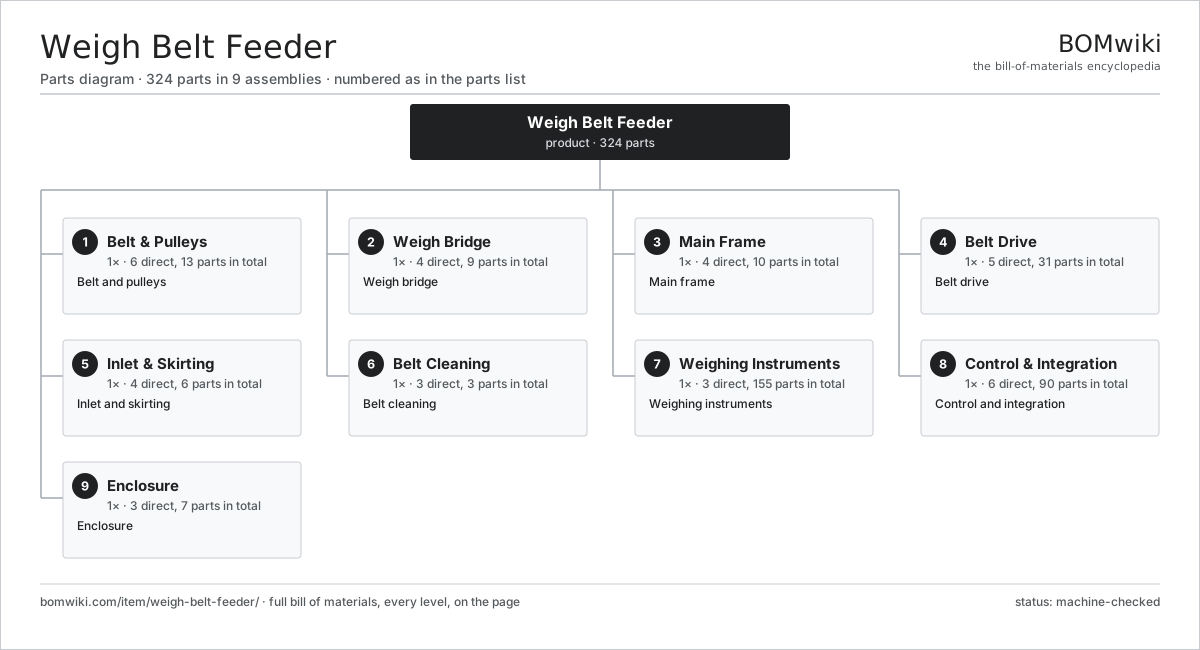
| # | Part | Qty | What it does |
|---|---|---|---|
| 1 | Belt & Pulleys 6 parts | 1× | Belt and pulleys |
| 2 | Weigh Bridge 4 parts | 1× | Weigh bridge |
| 3 | Main Frame 4 parts | 1× | Main frame |
| 4 | Belt Drive 5 parts | 1× | Belt drive |
| 5 | Inlet & Skirting 4 parts | 1× | Inlet and skirting |
| 6 | Belt Cleaning 3 parts | 1× | Belt cleaning |
| 7 | Weighing Instruments 3 parts | 1× | Weighing instruments |
| 8 | Control & Integration 6 parts | 1× | Control and integration |
| 9 | Enclosure 3 parts | 1× | Enclosure |
3D model
No 3D model yet. Have a CAD file of this? Add a 3D model — STL renders right on this page; STEP, FreeCAD, and OpenSCAD sources are welcome too (openly licensed, like all 3D models on BOMwiki).
Build & assembly graph
expand / collapse · shared sub-assemblies converge · links to related products · est. labourTap an assembly to expand/collapse · tap a part to open it · use “Open page” for any node · drag to pan, scroll to zoom.
Bill of materials for Weigh Belt Feeder
9 top-level lines · 61 rows shown · 324 parts total · indented to 3 levels| # | Item / sub-assembly | Part no. | Qty/assy | Ext. qty | Parts | Type |
|---|---|---|---|---|---|---|
| 1 | Belt & Pulleys 6 parts | weigh-belt-feeder-belt | 1× | 1 | 13 | assembly |
| 1.1 | Conveyor Belt | weigh-belt-feeder-conveyor-belt | 1× | 1 | · | part |
| 1.2 | Drive Pulley | weigh-belt-feeder-drive-pulley | 1× | 1 | · | part |
| 1.3 | Tail Pulley | weigh-belt-feeder-tail-pulley | 1× | 1 | · | part |
| 1.4 | Carrying Idler | weigh-belt-feeder-carry-idler | 4× | 4 | · | part |
| 1.5 | Return Idler | weigh-belt-feeder-return-idler | 2× | 2 | · | part |
| 1.6 | Ball Bearing | ball-bearing | 4× | 4 | · | part |
| 2 | Weigh Bridge 4 parts | weigh-belt-feeder-weigh-bridge | 1× | 1 | 9 | assembly |
| 2.1 | Weigh Idler | weigh-belt-feeder-weigh-idler | 2× | 2 | · | part |
| 2.2 | Load Cell | weigh-belt-feeder-load-cell | 2× | 2 | · | part |
| 2.3 | Weigh Frame | weigh-belt-feeder-weigh-frame | 1× | 1 | · | part |
| 2.4 | Flexure Pivot | weigh-belt-feeder-flexure | 4× | 4 | · | part |
| 3 | Main Frame 4 parts | weigh-belt-feeder-frame | 1× | 1 | 10 | assembly |
| 3.1 | Frame Weldment | weigh-belt-feeder-frame-weldment | 1× | 1 | · | part |
| 3.2 | Screw Take-Up | weigh-belt-feeder-takeup | 1× | 1 | · | part |
| 3.3 | Leveling Foot | weigh-belt-feeder-leveling-foot | 4× | 4 | · | part |
| 3.4 | Fastener Set | fastener-set | 4× | 4 | · | part |
| 4 | Belt Drive 5 parts | weigh-belt-feeder-drive | 1× | 1 | 31 | assembly |
| 4.1 | Drive Motor 4 parts | weigh-belt-feeder-drive-motor | 1× | 1 | 25 | assembly |
| 4.1.1 | Stator Assembly 3 parts + deeper › | stator-assembly | 1× | 1 | 3 | assembly |
| 4.1.2 | Rotor Assembly 4 parts + deeper › | rotor-assembly | 1× | 1 | 19 | assembly |
| 4.1.3 | Ball Bearing | ball-bearing | 2× | 2 | · | part |
| 4.1.4 | Motor Frame | weigh-belt-feeder-motor-frame | 1× | 1 | · | part |
| 4.2 | Gearbox Housing | gearbox-housing | 1× | 1 | · | part |
| 4.3 | Helical Gear Pair | gear-pair | 2× | 2 | · | part |
| 4.4 | Oil Seal | oil-seal | 2× | 2 | · | part |
| 4.5 | Belt Speed Sensor | weigh-belt-feeder-speed-sensor | 1× | 1 | · | part |
| 5 | Inlet & Skirting 4 parts | weigh-belt-feeder-inlet | 1× | 1 | 6 | assembly |
| 5.1 | Inlet Chute | weigh-belt-feeder-inlet-chute | 1× | 1 | · | part |
| 5.2 | Shear Gate | weigh-belt-feeder-shear-gate | 1× | 1 | · | part |
| 5.3 | Skirt Board | weigh-belt-feeder-skirt-board | 2× | 2 | · | part |
| 5.4 | Skirt Seal | weigh-belt-feeder-skirt-seal | 2× | 2 | · | part |
| 6 | Belt Cleaning 3 parts | weigh-belt-feeder-cleaning | 1× | 1 | 3 | assembly |
| 6.1 | Primary Scraper | weigh-belt-feeder-primary-scraper | 1× | 1 | · | part |
| 6.2 | Secondary Scraper | weigh-belt-feeder-secondary-scraper | 1× | 1 | · | part |
| 6.3 | Brush Roller | weigh-belt-feeder-brush-roller | 1× | 1 | · | part |
| 7 | Weighing Instruments 3 parts | weigh-belt-feeder-instruments | 1× | 1 | 155 | assembly |
| 7.1 | Weigh Transmitter 4 parts | weigh-belt-feeder-weigh-transmitter | 1× | 1 | 98 | assembly |
| 7.1.1 | Bare PCB | pcb-bare | 1× | 1 | · | part |
| 7.1.2 | Microcontroller | mcu | 1× | 1 | · | part |
| 7.1.3 | SMD Passive (R/C/L) | smd-passives | 90× | 90 | · | part |
| 7.1.4 | Connector | connector | 6× | 6 | · | part |
| 7.2 | Operator Display 2 parts | weigh-belt-feeder-display | 1× | 1 | 56 | assembly |
| 7.2.1 | LCD Panel | lcd-panel | 1× | 1 | · | part |
| 7.2.2 | Display Board 4 parts + deeper › | weigh-belt-feeder-display-board | 1× | 1 | 55 | assembly |
| 7.3 | Junction Box | weigh-belt-feeder-junction-box | 1× | 1 | · | part |
| 8 | Control & Integration 6 parts | weigh-belt-feeder-control | 1× | 1 | 90 | assembly |
| 8.1 | Variable-Frequency Drive | weigh-belt-feeder-vfd | 1× | 1 | · | part |
| 8.2 | Controller Board 4 parts | weigh-belt-feeder-control-board | 1× | 1 | 76 | assembly |
| 8.2.1 | Bare PCB | pcb-bare | 1× | 1 | · | part |
| 8.2.2 | Microcontroller | mcu | 1× | 1 | · | part |
| 8.2.3 | SMD Passive (R/C/L) | smd-passives | 70× | 70 | · | part |
| 8.2.4 | Connector | connector | 4× | 4 | · | part |
| 8.3 | Power Supply | power-supply | 1× | 1 | · | part |
| 8.4 | Relay | relay | 3× | 3 | · | part |
| 8.5 | Wire Bundle | wire-bundle | 1× | 1 | · | part |
| 8.6 | Connector | connector | 8× | 8 | · | part |
| 9 | Enclosure 3 parts | weigh-belt-feeder-enclosure | 1× | 1 | 7 | assembly |
| 9.1 | Sheet Metal Panel | sheet-panel | 4× | 4 | · | part |
| 9.2 | Access Door | weigh-belt-feeder-access-door | 2× | 2 | · | part |
| 9.3 | Dust Seal | weigh-belt-feeder-dust-seal | 1× | 1 | · | part |
Related products
same domain, ranked by shared parts Articulated Forklift
2,417 parts · shares 4 with this page
Articulated Forklift
2,417 parts · shares 4 with this page
 Bag Palletizer
951 parts · shares 4 with this page
Coal Yard Stacker
571 parts · shares 4 with this page
Bag Palletizer
951 parts · shares 4 with this page
Coal Yard Stacker
571 parts · shares 4 with this page
 Cross-Belt Sorter
25,040 parts · shares 4 with this page
Cross-Belt Sorter
25,040 parts · shares 4 with this page
 Layer Palletizer
857 parts · shares 4 with this page
Order Picker
708 parts · shares 4 with this page
Layer Palletizer
857 parts · shares 4 with this page
Order Picker
708 parts · shares 4 with this page
Sourcing: possible vendors
Prices, MOQ, and lead times are algorithmic estimates, not quotes, and not claims about these companies. Company mappings are curated by keyword; est. price band $2k–$300k. How estimates work| Vendor | HQ | Specialty | MOQ | Lead time |
|---|---|---|---|---|
| toyota-industries.com ↗ | Kariya, JP | Forklifts & logistics | 20 units | 10–16 wks |
| kiongroup.com ↗ | Frankfurt, DE | Forklifts (Linde, STILL) | 20 units | 10–16 wks |
| jungheinrich.com ↗ | Hamburg, DE | Warehouse trucks | 20 units | 10–16 wks |
| crown.com ↗ | New Bremen, US | Forklifts | 20 units | 10–16 wks |
|
🇨🇳Hangcha
hcforklift.com ↗
|
Hangzhou, CN | Forklifts & material handling | 20 units | 10–16 wks |
959-word article