Inclined Belt Conveyor
ProductOverview
An inclined belt conveyor lifts bulk or packaged material from one level to another on a continuous rubber belt running up a slope. Where a flat conveyor only needs to overcome friction, an incline must also hold the load against gravity, so the belt is usually cleated or troughed deeply and the drive is sized for the lift as well as the run. It is the standard way to move aggregate, grain, ore, wood chips, or boxes up out of a pit, onto a stockpile, or between floors, because it moves a high tonnage steadily with a single drive and little attention.
The conveyor is a loop of Conveyor Belt running over a Inclined Frame, turned by the Pulleys and supported by the Idler Rollers. A Drive Unit powers the head pulley, the Take-up and Brake system keeps the belt taut and stops it running back, the Loading and Discharge equipment feeds and clears product, and the Electrical and Controls panel runs and protects the machine.
The belt
The Conveyor Belt is the load-carrying element and the most heavily worked part. Its Belt Carcass of fabric plies carries the tension, and bonded Belt Cover rubber protects that carcass from abrasion and impact. On a slope a smooth belt would let product slide back, so molded Belt Cleat bars cross the belt to hold each pocket of material, and for loose bulk on steeper angles corrugated Sidewall walls contain it at the edges. The belt is shipped as a length and closed into a loop with a Belt Splice, either vulcanized for strength or mechanical for quick field repair. Cleating and sidewalls are what let an inclined belt run at angles a plain belt cannot.
Frame, pulleys, and idlers
The Inclined Frame sets the slope and spans between levels. A welded Frame Truss carries the run on adjustable Support Leg supports, with a Bed Pan under the belt and Skirt Board boards at the load point. The belt turns around the Pulleys: a driven Head Pulley at the top, built from a crowned Pulley Shell on a Pulley Shaft and faced with Pulley Lagging for grip, and an idle Tail Pulley at the bottom, with Snub Pulley rolls increasing the wrap for traction. Between the pulleys the belt rides on Idler Rollers. A Troughing Idler set of three rolls bends the belt into a trough so it holds more material, Impact Idler rolls cushion the loading point, Return Idler rolls carry the empty belt back, and Training Idler units steer the belt to keep it centered.
Drive, tension, and run-back protection
The Drive Unit turns the head pulley through a Drive Motor and a geared reducer joined by a Coupling, sized to lift the loaded belt and overcome friction. Tension matters more on an incline than on the flat, because a slack belt slips on the drive pulley and sags between idlers. The Take-up and Brake system uses a Screw Take-up to pull the tail pulley back and hold the belt taut. The danger unique to inclines is run-back: if power fails with a loaded belt, gravity will drag the load back down. To prevent that, a Backstop one-way clutch locks the drive against reverse rotation, and a Disc Brake holds the belt when it is stopped deliberately. These two devices are what make a steep loaded conveyor safe to stop.
Loading, discharge, and cleaning
Material joins and leaves the belt through the Loading and Discharge equipment. A Feed Hopper drops product onto the center of the belt at the tail, where impact idlers and skirts settle it without spilling, and at the top a Discharge Chute directs it off the head pulley to the next stage. Fine or sticky material clings to the belt after discharge, so a Belt Scraper blade cleans the carry-back off before the belt returns, which keeps the return idlers and pulleys from building up. Outdoor conveyors add a Weather Hood to shield the carry run from rain and wind.
Controls and safety
The Electrical and Controls system runs and protects the conveyor from a Control Panel. A Soft-Start Drive soft-starts the motor so a loaded belt is not jerked into motion, which would shock the splice and the structure. A Speed Switch watches the belt and trips the drive if it slips or stalls, a sign the belt is overloaded or jammed, and Pull-Cord Switch switches strung along the length let anyone stop the conveyor in an emergency. On a long incline these safeties matter, since a slipping or run-back belt can be dangerous.
Use and limits
Inclined belt conveyors handle a wide range of bulk and packaged goods wherever material must change levels. Plain belts manage gentle slopes up to about eighteen degrees before product begins to slide, while cleated and sidewall belts push that to thirty-five degrees and beyond, at the cost of a more specialized belt. They move large tonnages cheaply with one drive, but they are fixed installations sized for a particular angle and material, so a steeper lift or a different product often needs a different belt. For very steep or vertical lifts a bucket elevator takes over, while for level transport over distance a flat troughed conveyor is simpler. Within the slope range it serves, the inclined belt is the workhorse of quarries, grain handling, mines, and plant transfer.
Inclined Belt Conveyor parts and their functions
8 top-level parts · 229 parts in total · full bill of materials below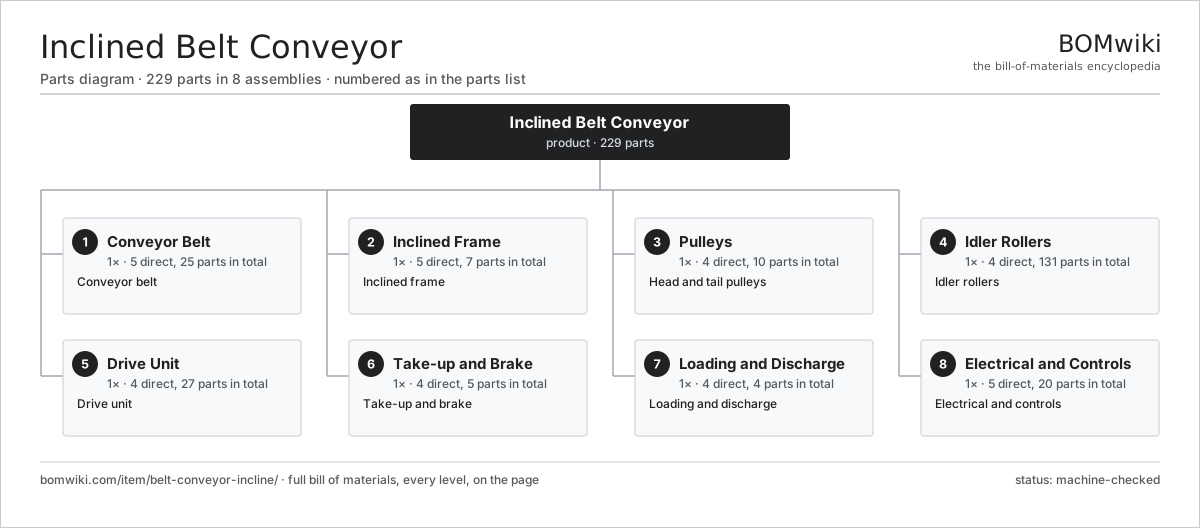
| # | Part | Qty | What it does |
|---|---|---|---|
| 1 | Conveyor Belt 5 parts | 1× | Conveyor belt |
| 2 | Inclined Frame 5 parts | 1× | Inclined frame |
| 3 | Pulleys 4 parts | 1× | Head and tail pulleys |
| 4 | Idler Rollers 4 parts | 1× | Idler rollers |
| 5 | Drive Unit 4 parts | 1× | Drive unit |
| 6 | Take-up and Brake 4 parts | 1× | Take-up and brake |
| 7 | Loading and Discharge 4 parts | 1× | Loading and discharge |
| 8 | Electrical and Controls 5 parts | 1× | Electrical and controls |
3D model
No 3D model yet. Have a CAD file of this? Add a 3D model — STL renders right on this page; STEP, FreeCAD, and OpenSCAD sources are welcome too (openly licensed, like all 3D models on BOMwiki).
Build & assembly graph
expand / collapse · shared sub-assemblies converge · links to related products · est. labourTap an assembly to expand/collapse · tap a part to open it · use “Open page” for any node · drag to pan, scroll to zoom.
Bill of materials for Inclined Belt Conveyor
8 top-level lines · 58 rows shown · 229 parts total · indented to 3 levels| # | Item / sub-assembly | Part no. | Qty/assy | Ext. qty | Parts | Type |
|---|---|---|---|---|---|---|
| 1 | Conveyor Belt 5 parts | belt-conveyor-incline-belt | 1× | 1 | 25 | assembly |
| 1.1 | Belt Carcass | belt-conveyor-incline-belt-carcass | 1× | 1 | · | part |
| 1.2 | Belt Cover | belt-conveyor-incline-belt-cover | 1× | 1 | · | part |
| 1.3 | Belt Cleat | belt-conveyor-incline-cleat | 20× | 20 | · | part |
| 1.4 | Sidewall | belt-conveyor-incline-sidewall | 2× | 2 | · | part |
| 1.5 | Belt Splice | belt-conveyor-incline-splice | 1× | 1 | · | part |
| 2 | Inclined Frame 5 parts | belt-conveyor-incline-frame | 1× | 1 | 7 | assembly |
| 2.1 | Frame Truss | belt-conveyor-incline-truss | 1× | 1 | · | part |
| 2.2 | Support Leg | belt-conveyor-incline-leg | 2× | 2 | · | part |
| 2.3 | Bed Pan | belt-conveyor-incline-bed-pan | 1× | 1 | · | part |
| 2.4 | Skirt Board | belt-conveyor-incline-skirt | 2× | 2 | · | part |
| 2.5 | Fastener Set | fastener-set | 1× | 1 | · | part |
| 3 | Pulleys 4 parts | belt-conveyor-incline-pulleys | 1× | 1 | 10 | assembly |
| 3.1 | Head Pulley 4 parts | belt-conveyor-incline-head-pulley | 1× | 1 | 6 | assembly |
| 3.1.1 | Pulley Shell | belt-conveyor-incline-pulley-shell | 1× | 1 | · | part |
| 3.1.2 | Pulley Shaft | belt-conveyor-incline-pulley-shaft | 1× | 1 | · | part |
| 3.1.3 | Ball Bearing | ball-bearing | 2× | 2 | · | part |
| 3.1.4 | Oil Seal | oil-seal | 2× | 2 | · | part |
| 3.2 | Tail Pulley | belt-conveyor-incline-tail-pulley | 1× | 1 | · | part |
| 3.3 | Snub Pulley | belt-conveyor-incline-snub-pulley | 2× | 2 | · | part |
| 3.4 | Pulley Lagging | belt-conveyor-incline-lagging | 1× | 1 | · | part |
| 4 | Idler Rollers 4 parts | belt-conveyor-incline-idlers | 1× | 1 | 131 | assembly |
| 4.1 | Troughing Idler 3 parts | belt-conveyor-incline-trough-idler | 12× | 12 | 10 | assembly |
| 4.1.1 | Idler Roll | belt-conveyor-incline-idler-roll | 3× | 36 | · | part |
| 4.1.2 | Ball Bearing | ball-bearing | 6× | 72 | · | part |
| 4.1.3 | Idler Bracket | belt-conveyor-incline-idler-bracket | 1× | 12 | · | part |
| 4.2 | Return Idler | belt-conveyor-incline-return-idler | 6× | 6 | · | part |
| 4.3 | Impact Idler | belt-conveyor-incline-impact-idler | 3× | 3 | · | part |
| 4.4 | Training Idler | belt-conveyor-incline-training-idler | 2× | 2 | · | part |
| 5 | Drive Unit 4 parts | belt-conveyor-incline-drive | 1× | 1 | 27 | assembly |
| 5.1 | Drive Motor 3 parts | belt-conveyor-incline-motor | 1× | 1 | 24 | assembly |
| 5.1.1 | Stator Assembly 3 parts + deeper › | stator-assembly | 1× | 1 | 3 | assembly |
| 5.1.2 | Rotor Assembly 4 parts + deeper › | rotor-assembly | 1× | 1 | 19 | assembly |
| 5.1.3 | Ball Bearing | ball-bearing | 2× | 2 | · | part |
| 5.2 | Gearbox Housing | gearbox-housing | 1× | 1 | · | part |
| 5.3 | Coupling | belt-conveyor-incline-coupling | 1× | 1 | · | part |
| 5.4 | Helical Gear Pair | gear-pair | 1× | 1 | · | part |
| 6 | Take-up and Brake 4 parts | belt-conveyor-incline-tension | 1× | 1 | 5 | assembly |
| 6.1 | Screw Take-up | belt-conveyor-incline-screw-takeup | 1× | 1 | · | part |
| 6.2 | Backstop | belt-conveyor-incline-backstop | 1× | 1 | · | part |
| 6.3 | Disc Brake | belt-conveyor-incline-brake | 1× | 1 | · | part |
| 6.4 | Coil Spring | coil-spring | 2× | 2 | · | part |
| 7 | Loading and Discharge 4 parts | belt-conveyor-incline-loading | 1× | 1 | 4 | assembly |
| 7.1 | Feed Hopper | belt-conveyor-incline-feed-hopper | 1× | 1 | · | part |
| 7.2 | Discharge Chute | belt-conveyor-incline-discharge-chute | 1× | 1 | · | part |
| 7.3 | Belt Scraper | belt-conveyor-incline-belt-scraper | 1× | 1 | · | part |
| 7.4 | Weather Hood | belt-conveyor-incline-cover-hood | 1× | 1 | · | part |
| 8 | Electrical and Controls 5 parts | belt-conveyor-incline-electrical | 1× | 1 | 20 | assembly |
| 8.1 | Control Panel 5 parts | belt-conveyor-incline-control-panel | 1× | 1 | 15 | assembly |
| 8.1.1 | Bare PCB | pcb-bare | 1× | 1 | · | part |
| 8.1.2 | Microcontroller | mcu | 1× | 1 | · | part |
| 8.1.3 | Relay | relay | 4× | 4 | · | part |
| 8.1.4 | Power Supply | power-supply | 1× | 1 | · | part |
| 8.1.5 | Connector | connector | 8× | 8 | · | part |
| 8.2 | Soft-Start Drive | belt-conveyor-incline-vfd | 1× | 1 | · | part |
| 8.3 | Speed Switch | belt-conveyor-incline-speed-switch | 1× | 1 | · | part |
| 8.4 | Pull-Cord Switch | belt-conveyor-incline-pull-cord | 2× | 2 | · | part |
| 8.5 | Wire Bundle | wire-bundle | 1× | 1 | · | part |
Related products
same domain, ranked by shared parts Articulated Forklift
2,417 parts · shares 2 with this page
Articulated Forklift
2,417 parts · shares 2 with this page
 Bag Palletizer
951 parts · shares 2 with this page
Bag Palletizer
951 parts · shares 2 with this page
 Hydraulic Dock Leveler
60 parts · shares 2 with this page
Narrow Belt Sorter
518 parts · shares 2 with this page
Hydraulic Dock Leveler
60 parts · shares 2 with this page
Narrow Belt Sorter
518 parts · shares 2 with this page
 Overhead Trolley Conveyor
2,614 parts · shares 2 with this page
Pallet Shuttle System
208 parts · shares 2 with this page
Overhead Trolley Conveyor
2,614 parts · shares 2 with this page
Pallet Shuttle System
208 parts · shares 2 with this page
Sourcing: possible vendors
Prices, MOQ, and lead times are algorithmic estimates, not quotes, and not claims about these companies. Company mappings are curated by keyword; est. price band $2k–$300k. How estimates work| Vendor | HQ | Specialty | MOQ | Lead time |
|---|---|---|---|---|
| toyota-industries.com ↗ | Kariya, JP | Forklifts & logistics | 20 units | 10–16 wks |
| kiongroup.com ↗ | Frankfurt, DE | Forklifts (Linde, STILL) | 20 units | 10–16 wks |
| jungheinrich.com ↗ | Hamburg, DE | Warehouse trucks | 20 units | 10–16 wks |
| crown.com ↗ | New Bremen, US | Forklifts | 20 units | 10–16 wks |
|
🇨🇳Hangcha
hcforklift.com ↗
|
Hangzhou, CN | Forklifts & material handling | 20 units | 10–16 wks |
1,014-word article