Unit-Load AS/RS
ProductOverview
A unit-load AS/RS stores and retrieves full pallets automatically by running a heavy stacker crane up and down a tall, narrow aisle and inserting each pallet into a numbered cell in high-bay racking. It is the large-load sibling of the mini-load system: the same crane-captive-to-an-aisle architecture, scaled up to lift loads of one to three tonnes to heights of forty metres or more. These systems anchor automated distribution centres, deep-freeze stores, and rack-clad warehouses where the racking is also the building frame. The aim is to use vertical space that manual forklifts cannot reach safely, while removing labour from a cold, tall, or hazardous environment.
The installation comprises a single Stacker Crane serving an aisle flanked by two runs of Rack Structure, a pallet Load Handling Device device, a heavy Rail and Guide Track, and a Pick and Deposit Station linking the aisle to plant conveyors or AGVs. A Control Cabinet, Safety System, and Power System complete it.
The stacker crane
For pallet loads the crane usually has two masts. The Crane Mast pair forms a rigid frame stiff enough to keep the fork accurate at the top of a forty-metre aisle, where the smallest sway becomes a large error. The crane rolls on two Base Bogie units along the floor rail, driven by a Travel Drive, and is steadied at the top by a Top Frame running the ceiling rail. The Hoist Drive raises the Lift Carriage on Hoist Rope sets, either wire rope or toothed belt, sized with a generous safety factor because a pallet hangs from them at full height. Regenerative braking on the hoist returns energy to the supply each time a load descends.
Load handling
The Load Handling Device device places and retrieves the pallet. A Telescopic Fork, typically three nested stages riding on Linear Guide Rail sets, extends sideways into the cell and a short Fork Lift Cylinder stroke lifts the pallet clear of the beams so the Fork Drive can draw it back onto the carriage. Pallet Sensor devices check that the pallet is square and not overhanging before the crane moves, since an overhanging pallet would shear against the rack. Double-deep racking uses a longer telescope to reach a second pallet behind the first, raising density where retrieval order is flexible.
Rack and rails
The Rack Structure is precision steelwork. Its Rack Column and Rack Beam members are built and surveyed to tight tolerance because the crane addresses cells by coordinate and cannot see them. Pallet Guide entries funnel each pallet into its cell, Rack Brace members carry crane dynamics and seismic load, and Rack Tie members join the rows. In a rack-clad building the rack also carries the roof and walls through Roof Tie members, so the rack tolerance sets the whole building geometry. The crane runs on a heavy Ground Rail fixed by Rail Fixing sets, guided overhead by a Top Rail, with End Buffer units and Rail Stop devices limiting overtravel.
Control and interface
The Control Cabinet holds a Crane PLC that converts warehouse orders into crane moves, with a Travel VFD and regenerative Hoist VFD driving the axes. A Position System using laser or barcode measurement gives absolute position on each axis, and a Data Link keeps the crane synchronised with the host so inventory matches reality. Pallets cross between the crane and the plant at the Pick and Deposit Station, where P&D Conveyor sections, a Pallet Checker that rejects damaged or out-of-profile pallets, and a P&D Scanner manage the handover.
Safety, power, and use
Heavy loads at height make safety central. The Safety System encloses the aisle with Perimeter Fence panels and an interlocked Access Gate, guards openings with a Light Curtain, and protects the hoist with a Slack Rope Switch and carriage Fall Arrest Gear gear that grips the mast if a rope fails. Power reaches the crane through a Busbar and Collector set, with an Energy Chain feeding the carriage and a Line Filter managing regenerated braking energy. These systems suit high-volume pallet distribution, deep-freeze storage where labour is costly and uncomfortable, and any site where land price justifies storing pallets vertically rather than spreading them across a low, wide floor.
Rack-clad construction
The most striking unit-load installations are rack-clad buildings, where there is no separate building frame at all. The Rack Structure itself carries the roof and wall cladding through Roof Tie members, so the same steel that holds the pallets also holds up the building. This saves a complete structural frame and pushes storage heights past forty metres, but it ties the building tolerance to the rack tolerance: the rack must be surveyed and aligned as the structure goes up, because the crane will later address every cell by coordinate with no margin to spare. Free-standing rack inside a conventional building is simpler to build and maintain, and is chosen where heights are lower or where the building already exists.
Throughput and dwell time
A unit-load aisle moves fewer loads per hour than a mini-load aisle because each pallet is heavier and the hoist is slower, so the design lever is often the number of aisles rather than the speed of one crane. Warehouse software maximises dual cycles, pairing a store with a retrieve on the same trip, and slots fast-moving pallets near the Pick and Deposit Station to cut travel. Where a single crane cannot keep up, several aisles run in parallel, each with its own captive crane, feeding a shared conveyor or AGV loop.
Maintenance and recovery
Maintenance focuses on the load-bearing parts: the Hoist Rope sets are inspected and replaced on a strict interval because they carry a tonne of pallet at height, the Base Bogie wheels and Ground Rail are checked for wear, and the Telescopic Fork and its Linear Guide Rail sets are serviced as the most heavily cycled mechanism. A jammed pallet or a crane fault locks the whole aisle, so recovery procedures and trained access through the interlocked Access Gate matter as much as routine servicing.
Unit-Load AS/RS parts and their functions
8 top-level parts · 291 parts in total · full bill of materials below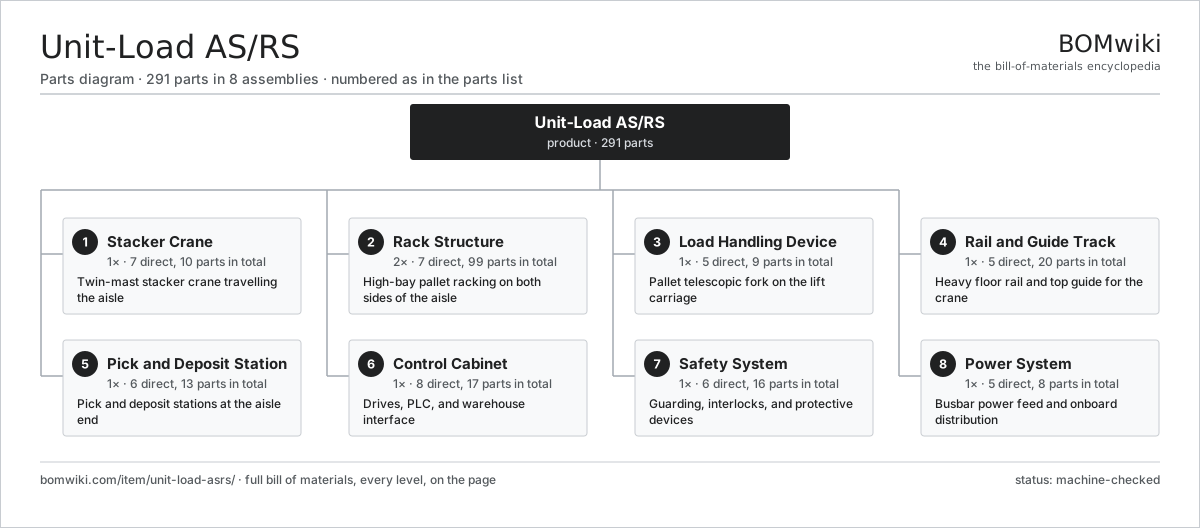
| # | Part | Qty | What it does |
|---|---|---|---|
| 1 | Stacker Crane 7 parts | 1× | Twin-mast stacker crane travelling the aisle |
| 2 | Rack Structure 7 parts | 2× | High-bay pallet racking on both sides of the aisle |
| 3 | Load Handling Device 5 parts | 1× | Pallet telescopic fork on the lift carriage |
| 4 | Rail and Guide Track 5 parts | 1× | Heavy floor rail and top guide for the crane |
| 5 | Pick and Deposit Station 6 parts | 1× | Pick and deposit stations at the aisle end |
| 6 | Control Cabinet 8 parts | 1× | Drives, PLC, and warehouse interface |
| 7 | Safety System 6 parts | 1× | Guarding, interlocks, and protective devices |
| 8 | Power System 5 parts | 1× | Busbar power feed and onboard distribution |
3D model
No 3D model yet. Have a CAD file of this? Add a 3D model — STL renders right on this page; STEP, FreeCAD, and OpenSCAD sources are welcome too (openly licensed, like all 3D models on BOMwiki).
Build & assembly graph
expand / collapse · shared sub-assemblies converge · links to related products · est. labourTap an assembly to expand/collapse · tap a part to open it · use “Open page” for any node · drag to pan, scroll to zoom.
Bill of materials for Unit-Load AS/RS
8 top-level lines · 57 rows shown · 291 parts total · indented to 3 levels| # | Item / sub-assembly | Part no. | Qty/assy | Ext. qty | Parts | Type |
|---|---|---|---|---|---|---|
| 1 | Stacker Crane 7 parts | unit-load-asrs-crane | 1× | 1 | 10 | assembly |
| 1.1 | Crane Mast | unit-load-asrs-mast | 2× | 2 | · | part |
| 1.2 | Travel Drive | unit-load-asrs-travel-drive | 1× | 1 | · | part |
| 1.3 | Hoist Drive | unit-load-asrs-hoist-drive | 1× | 1 | · | part |
| 1.4 | Hoist Rope | unit-load-asrs-hoist-rope | 2× | 2 | · | part |
| 1.5 | Lift Carriage | unit-load-asrs-carriage | 1× | 1 | · | part |
| 1.6 | Base Bogie | unit-load-asrs-base-bogie | 2× | 2 | · | part |
| 1.7 | Top Frame | unit-load-asrs-top-frame | 1× | 1 | · | part |
| 2 | Rack Structure 7 parts | unit-load-asrs-rack-structure | 2× | 2 | 99 | assembly |
| 2.1 | Rack Column | unit-load-asrs-rack-column | 16× | 32 | · | part |
| 2.2 | Rack Beam | unit-load-asrs-rack-beam | 32× | 64 | · | part |
| 2.3 | Rack Brace | unit-load-asrs-rack-brace | 12× | 24 | · | part |
| 2.4 | Pallet Guide | unit-load-asrs-pallet-guide | 24× | 48 | · | part |
| 2.5 | Rack Tie | unit-load-asrs-rack-tie | 8× | 16 | · | part |
| 2.6 | Roof Tie | unit-load-asrs-roof-tie | 4× | 8 | · | part |
| 2.7 | Fastener Set | fastener-set | 3× | 6 | · | part |
| 3 | Load Handling Device 5 parts | unit-load-asrs-load-handling | 1× | 1 | 9 | assembly |
| 3.1 | Telescopic Fork | unit-load-asrs-telescopic-fork | 1× | 1 | · | part |
| 3.2 | Fork Drive | unit-load-asrs-fork-drive | 1× | 1 | · | part |
| 3.3 | Fork Lift Cylinder | unit-load-asrs-fork-lift-cylinder | 1× | 1 | · | part |
| 3.4 | Pallet Sensor | unit-load-asrs-pallet-sensor | 4× | 4 | · | part |
| 3.5 | Linear Guide Rail | linear-guide | 2× | 2 | · | part |
| 4 | Rail and Guide Track 5 parts | unit-load-asrs-rail-track | 1× | 1 | 20 | assembly |
| 4.1 | Ground Rail | unit-load-asrs-ground-rail | 1× | 1 | · | part |
| 4.2 | Top Rail | unit-load-asrs-top-rail | 1× | 1 | · | part |
| 4.3 | Rail Fixing | unit-load-asrs-rail-fixing | 12× | 12 | · | part |
| 4.4 | End Buffer | unit-load-asrs-end-buffer | 4× | 4 | · | part |
| 4.5 | Rail Stop | unit-load-asrs-rail-stop | 2× | 2 | · | part |
| 5 | Pick and Deposit Station 6 parts | unit-load-asrs-pd-station | 1× | 1 | 13 | assembly |
| 5.1 | P&D Conveyor | unit-load-asrs-pd-conveyor | 2× | 2 | · | part |
| 5.2 | Pallet Checker | unit-load-asrs-pallet-checker | 1× | 1 | · | part |
| 5.3 | P&D Scanner | unit-load-asrs-pd-scanner | 2× | 2 | · | part |
| 5.4 | P&D Motor | unit-load-asrs-pd-motor | 4× | 4 | · | part |
| 5.5 | Drive Belt | drive-belt | 2× | 2 | · | part |
| 5.6 | Pallet Stop | unit-load-asrs-pd-stop | 2× | 2 | · | part |
| 6 | Control Cabinet 8 parts | unit-load-asrs-control-cabinet | 1× | 1 | 17 | assembly |
| 6.1 | Crane PLC | unit-load-asrs-plc | 1× | 1 | · | part |
| 6.2 | Travel VFD | unit-load-asrs-travel-vfd | 1× | 1 | · | part |
| 6.3 | Hoist VFD | unit-load-asrs-hoist-vfd | 1× | 1 | · | part |
| 6.4 | Position System | unit-load-asrs-position-system | 2× | 2 | · | part |
| 6.5 | Microcontroller | mcu | 1× | 1 | · | part |
| 6.6 | Data Link | unit-load-asrs-data-link | 1× | 1 | · | part |
| 6.7 | Wire Bundle | wire-bundle | 2× | 2 | · | part |
| 6.8 | Relay | relay | 8× | 8 | · | part |
| 7 | Safety System 6 parts | unit-load-asrs-safety-system | 1× | 1 | 16 | assembly |
| 7.1 | Perimeter Fence | unit-load-asrs-perimeter-fence | 6× | 6 | · | part |
| 7.2 | Access Gate | unit-load-asrs-access-gate | 1× | 1 | · | part |
| 7.3 | Light Curtain | unit-load-asrs-light-curtain | 2× | 2 | · | part |
| 7.4 | Emergency Stop | unit-load-asrs-estop | 4× | 4 | · | part |
| 7.5 | Slack Rope Switch | unit-load-asrs-slack-rope-switch | 2× | 2 | · | part |
| 7.6 | Fall Arrest Gear | unit-load-asrs-fall-arrest | 1× | 1 | · | part |
| 8 | Power System 5 parts | unit-load-asrs-power-system | 1× | 1 | 8 | assembly |
| 8.1 | Power Supply | power-supply | 1× | 1 | · | part |
| 8.2 | Busbar | unit-load-asrs-busbar | 1× | 1 | · | part |
| 8.3 | Collector | unit-load-asrs-collector | 4× | 4 | · | part |
| 8.4 | Energy Chain | unit-load-asrs-energy-chain | 1× | 1 | · | part |
| 8.5 | Line Filter | unit-load-asrs-line-filter | 1× | 1 | · | part |
Related products
same domain, ranked by shared parts Bag Palletizer
951 parts · shares 3 with this page
Bag Palletizer
951 parts · shares 3 with this page
 Layer Palletizer
857 parts · shares 3 with this page
Pallet Shuttle System
208 parts · shares 3 with this page
Layer Palletizer
857 parts · shares 3 with this page
Pallet Shuttle System
208 parts · shares 3 with this page
 Sliding-Shoe Sorter
4,321 parts · shares 3 with this page
Sliding-Shoe Sorter
4,321 parts · shares 3 with this page
 Overhead Trolley Conveyor
2,614 parts · shares 2 with this page
Power-and-Free Conveyor
2,657 parts · shares 2 with this page
Overhead Trolley Conveyor
2,614 parts · shares 2 with this page
Power-and-Free Conveyor
2,657 parts · shares 2 with this page
Sourcing: possible vendors
Prices, MOQ, and lead times are algorithmic estimates, not quotes, and not claims about these companies. Company mappings are curated by keyword; est. price band $2k–$300k. How estimates work| Vendor | HQ | Specialty | MOQ | Lead time |
|---|---|---|---|---|
| toyota-industries.com ↗ | Kariya, JP | Forklifts & logistics | 20 units | 10–16 wks |
| kiongroup.com ↗ | Frankfurt, DE | Forklifts (Linde, STILL) | 20 units | 10–16 wks |
| jungheinrich.com ↗ | Hamburg, DE | Warehouse trucks | 20 units | 10–16 wks |
| crown.com ↗ | New Bremen, US | Forklifts | 20 units | 10–16 wks |
|
🇨🇳Hangcha
hcforklift.com ↗
|
Hangzhou, CN | Forklifts & material handling | 20 units | 10–16 wks |
1,190-word article