Mini-Load AS/RS
ProductOverview
A mini-load AS/RS automates the storage of small unit loads, totes, trays, and cartons, by sending a slender stacker crane up and down a narrow aisle to place and pick them from dense high-bay racking. It is the small-load counterpart to a unit-load (pallet) AS/RS: same crane-in-an-aisle architecture, scaled down to handle boxes weighing tens of kilograms rather than full pallets. The payoff is goods-to-person picking. Instead of operators walking the aisles, the crane brings each tote to a workstation at the aisle end, cutting travel time and packing thousands of stock-keeping units into a small, often unlit, footprint.
The system is built around one Stacker Crane that is captive to its aisle, flanked by two runs of Rack Structure, with a Load Handling Device device on the carriage, a Rail and Guide Track constraining the crane, and a Conveyor Interface linking the aisle to the wider warehouse. A Control Cabinet, Safety System, and Power System make it run.
The stacker crane
The crane is a single vertical Crane Mast, usually extruded aluminium to keep moving mass low, standing on a Crane Base Frame that rides the floor rail and steadied at the top by a Top Guide running the ceiling rail. Two independent motions work together. The Travel Drive runs the crane along the aisle, and the Lift Drive raises the Lift Carriage on the mast, often through a toothed belt. A Counterweight balances the carriage so the hoist motor only has to move the net load. Because both axes accelerate hard, the mast is engineered for stiffness: any sway at the top would smear the fork position at full height and risk clipping a rack cell.
Load handling
At the carriage sits the Load Handling Device device, the part that actually moves a tote in or out of a cell. A Telescopic Fork extends sideways into the rack; a Pull Finger set drops behind the tote and the Fork Drive retracts, dragging the tote onto a Deck Belt on the carriage. Deposit reverses the sequence. Load Sensor devices confirm the tote is square and fully on the deck before the crane moves, since a tote hanging over the edge would foul the rack. Double-deep variants use a longer telescope to reach a second tote behind the first, raising density at the cost of needing to shuffle the front tote to reach the rear one.
Rack and rails
The Rack Structure is not ordinary shelving. Its Rack Upright columns and Shelf Rail levels are built to tight tolerance because the crane addresses each cell by coordinate, not by sight, and a cell out of position would jam the fork. Storage Channel pairs cradle each tote, Rack Brace members keep the structure rigid under the crane's start-stop forces, and Rack Tie members join the two rows over the aisle. The crane itself is held by the Rail and Guide Track: a hardened Floor Rail carries the load, a Ceiling Rail steadies the mast, and Rail End Buffer units absorb energy at the aisle ends as a last-resort stop.
Control and positioning
The Control Cabinet holds a Crane PLC that turns warehouse orders into crane moves, with a Travel VFD and Lift VFD ramping each axis smoothly. Position is closed-loop on a Position Laser that measures absolute distance to a target at the aisle end, giving repeatability of a few millimetres at full reach. A Data Radio keeps the crane talking to the host so the inventory record matches every physical move. The crane hands totes to the warehouse through the Conveyor Interface, where an Infeed Conveyor and Outfeed Conveyor meet a Barcode Scanner that verifies tote identity at the boundary.
Safety, power, and use
The aisle is fully enclosed by the Safety System: Aisle Guard fencing, an interlocked Access Gate, Light Curtain protection at openings, and an Overspeed Governor arresting the carriage if a hoist fault lets it run away. Power reaches the moving crane through a Busbar and Collector Shoe set, with an Energy Chain feeding the carriage. Mini-load systems suit e-commerce fulfilment, spare-parts depots, pharmacy distribution, and any operation with a huge catalogue of small items and tight floor space, where the crane's relentless dual-cycling delivers far more picks per square metre than manual shelving.
Cycle types and throughput
The crane works in two cycle types, and the mix between them sets the throughput rating. A single cycle either stores or retrieves one tote and returns empty. A dual cycle combines the two: the crane carries a tote out to a cell, deposits it, then travels straight to another cell to retrieve a different tote on the way back, so almost no travel is wasted. Warehouse software sequences orders to maximise dual cycling, which is why a unit rated at, say, one hundred dual cycles an hour delivers far more than twice the work of single cycling. Throughput also depends on aisle length and height, since a longer aisle means more travel time per transaction, and on how cleverly fast-moving items are slotted near the pick-and-deposit end.
Maintenance and reliability
Because the crane is the only moving machine in the aisle, its uptime is the system's uptime. Routine maintenance covers the Lift Drive belt tension, the Travel Drive wheels and the Floor Rail they run on, and the Telescopic Fork guides and Pull Finger mechanism that take the most repetitive wear. The Position Laser target and lens are kept clean so positioning stays accurate, and the Rail Cleaner scrapers are checked so debris never lifts a wheel off the rail. Most modern cranes log cycle counts and fault codes through the Data Radio link, letting operators schedule belt and bearing changes before a failure stops the aisle, since an unplanned crane fault locks out every tote behind it until the crane is recovered.
Mini-Load AS/RS parts and their functions
8 top-level parts · 281 parts in total · full bill of materials below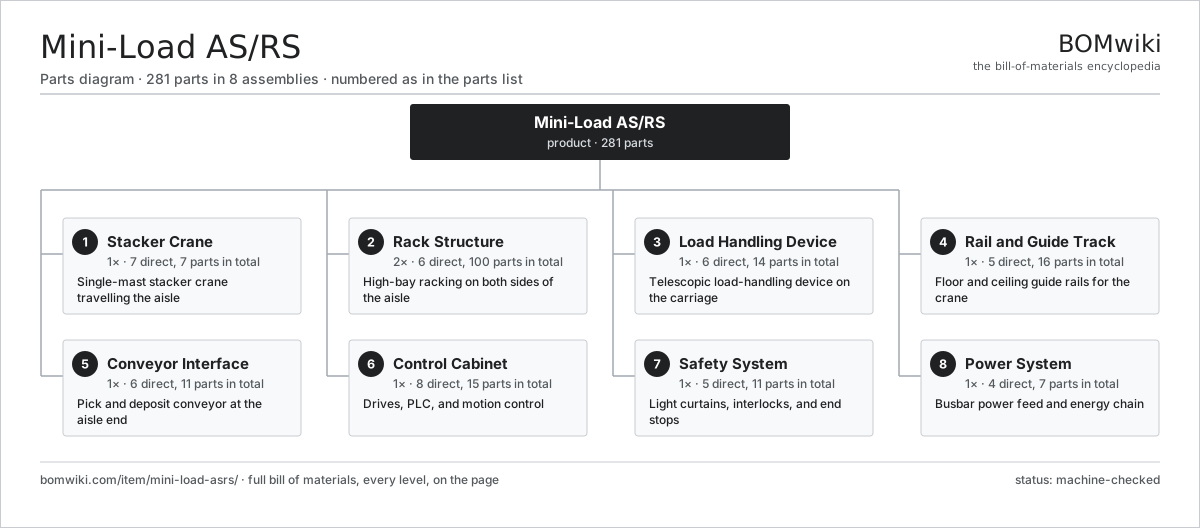
| # | Part | Qty | What it does |
|---|---|---|---|
| 1 | Stacker Crane 7 parts | 1× | Single-mast stacker crane travelling the aisle |
| 2 | Rack Structure 6 parts | 2× | High-bay racking on both sides of the aisle |
| 3 | Load Handling Device 6 parts | 1× | Telescopic load-handling device on the carriage |
| 4 | Rail and Guide Track 5 parts | 1× | Floor and ceiling guide rails for the crane |
| 5 | Conveyor Interface 6 parts | 1× | Pick and deposit conveyor at the aisle end |
| 6 | Control Cabinet 8 parts | 1× | Drives, PLC, and motion control |
| 7 | Safety System 5 parts | 1× | Light curtains, interlocks, and end stops |
| 8 | Power System 4 parts | 1× | Busbar power feed and energy chain |
3D model
No 3D model yet. Have a CAD file of this? Add a 3D model — STL renders right on this page; STEP, FreeCAD, and OpenSCAD sources are welcome too (openly licensed, like all 3D models on BOMwiki).
Build & assembly graph
expand / collapse · shared sub-assemblies converge · links to related products · est. labourTap an assembly to expand/collapse · tap a part to open it · use “Open page” for any node · drag to pan, scroll to zoom.
Bill of materials for Mini-Load AS/RS
8 top-level lines · 55 rows shown · 281 parts total · indented to 3 levels| # | Item / sub-assembly | Part no. | Qty/assy | Ext. qty | Parts | Type |
|---|---|---|---|---|---|---|
| 1 | Stacker Crane 7 parts | mini-load-asrs-crane | 1× | 1 | 7 | assembly |
| 1.1 | Crane Mast | mini-load-asrs-mast | 1× | 1 | · | part |
| 1.2 | Travel Drive | mini-load-asrs-travel-drive | 1× | 1 | · | part |
| 1.3 | Lift Drive | mini-load-asrs-lift-drive | 1× | 1 | · | part |
| 1.4 | Lift Carriage | mini-load-asrs-carriage | 1× | 1 | · | part |
| 1.5 | Crane Base Frame | mini-load-asrs-base-frame | 1× | 1 | · | part |
| 1.6 | Top Guide | mini-load-asrs-top-guide | 1× | 1 | · | part |
| 1.7 | Counterweight | mini-load-asrs-counterweight | 1× | 1 | · | part |
| 2 | Rack Structure 6 parts | mini-load-asrs-rack-structure | 2× | 2 | 100 | assembly |
| 2.1 | Rack Upright | mini-load-asrs-rack-upright | 12× | 24 | · | part |
| 2.2 | Shelf Rail | mini-load-asrs-rack-shelf-rail | 24× | 48 | · | part |
| 2.3 | Rack Brace | mini-load-asrs-rack-brace | 8× | 16 | · | part |
| 2.4 | Storage Channel | mini-load-asrs-storage-channel | 48× | 96 | · | part |
| 2.5 | Rack Tie | mini-load-asrs-rack-tie | 6× | 12 | · | part |
| 2.6 | Fastener Set | fastener-set | 2× | 4 | · | part |
| 3 | Load Handling Device 6 parts | mini-load-asrs-load-handling | 1× | 1 | 14 | assembly |
| 3.1 | Telescopic Fork | mini-load-asrs-telescopic-fork | 1× | 1 | · | part |
| 3.2 | Fork Drive | mini-load-asrs-fork-drive | 1× | 1 | · | part |
| 3.3 | Pull Finger | mini-load-asrs-pull-finger | 4× | 4 | · | part |
| 3.4 | Deck Belt | mini-load-asrs-deck-belt | 2× | 2 | · | part |
| 3.5 | Load Sensor | mini-load-asrs-load-sensor | 2× | 2 | · | part |
| 3.6 | Ball Bearing | ball-bearing | 4× | 4 | · | part |
| 4 | Rail and Guide Track 5 parts | mini-load-asrs-rail-track | 1× | 1 | 16 | assembly |
| 4.1 | Floor Rail | mini-load-asrs-floor-rail | 1× | 1 | · | part |
| 4.2 | Ceiling Rail | mini-load-asrs-ceiling-rail | 1× | 1 | · | part |
| 4.3 | Rail Clamp | mini-load-asrs-rail-clamp | 8× | 8 | · | part |
| 4.4 | Rail End Buffer | mini-load-asrs-rail-end-buffer | 4× | 4 | · | part |
| 4.5 | Rail Cleaner | mini-load-asrs-rail-cleaner | 2× | 2 | · | part |
| 5 | Conveyor Interface 6 parts | mini-load-asrs-conveyor-interface | 1× | 1 | 11 | assembly |
| 5.1 | Infeed Conveyor | mini-load-asrs-infeed-conveyor | 1× | 1 | · | part |
| 5.2 | Outfeed Conveyor | mini-load-asrs-outfeed-conveyor | 1× | 1 | · | part |
| 5.3 | Transfer Table | mini-load-asrs-transfer-table | 1× | 1 | · | part |
| 5.4 | Barcode Scanner | mini-load-asrs-barcode-scanner | 2× | 2 | · | part |
| 5.5 | Conveyor Motor | mini-load-asrs-conveyor-motor | 4× | 4 | · | part |
| 5.6 | Drive Belt | drive-belt | 2× | 2 | · | part |
| 6 | Control Cabinet 8 parts | mini-load-asrs-control-cabinet | 1× | 1 | 15 | assembly |
| 6.1 | Crane PLC | mini-load-asrs-plc | 1× | 1 | · | part |
| 6.2 | Travel VFD | mini-load-asrs-travel-vfd | 1× | 1 | · | part |
| 6.3 | Lift VFD | mini-load-asrs-lift-vfd | 1× | 1 | · | part |
| 6.4 | Position Laser | mini-load-asrs-position-laser | 2× | 2 | · | part |
| 6.5 | Microcontroller | mcu | 1× | 1 | · | part |
| 6.6 | Data Radio | mini-load-asrs-data-radio | 1× | 1 | · | part |
| 6.7 | Wire Bundle | wire-bundle | 2× | 2 | · | part |
| 6.8 | Relay | relay | 6× | 6 | · | part |
| 7 | Safety System 5 parts | mini-load-asrs-safety-system | 1× | 1 | 11 | assembly |
| 7.1 | Light Curtain | mini-load-asrs-light-curtain | 2× | 2 | · | part |
| 7.2 | Aisle Guard | mini-load-asrs-aisle-guard | 4× | 4 | · | part |
| 7.3 | Access Gate | mini-load-asrs-access-gate | 1× | 1 | · | part |
| 7.4 | Emergency Stop | mini-load-asrs-estop | 3× | 3 | · | part |
| 7.5 | Overspeed Governor | mini-load-asrs-overspeed-governor | 1× | 1 | · | part |
| 8 | Power System 4 parts | mini-load-asrs-power-system | 1× | 1 | 7 | assembly |
| 8.1 | Power Supply | power-supply | 1× | 1 | · | part |
| 8.2 | Busbar | mini-load-asrs-busbar | 1× | 1 | · | part |
| 8.3 | Collector Shoe | mini-load-asrs-collector-shoe | 4× | 4 | · | part |
| 8.4 | Energy Chain | mini-load-asrs-energy-chain | 1× | 1 | · | part |
Related products
same domain, ranked by shared parts Bag Palletizer
951 parts · shares 2 with this page
Bag Palletizer
951 parts · shares 2 with this page
 Cross-Belt Sorter
25,040 parts · shares 2 with this page
Cross-Belt Sorter
25,040 parts · shares 2 with this page
 Dilute-Phase Conveying System
509 parts · shares 2 with this page
Dilute-Phase Conveying System
509 parts · shares 2 with this page
 Layer Palletizer
857 parts · shares 2 with this page
Layer Palletizer
857 parts · shares 2 with this page
 Mobile Pallet Racking
928 parts · shares 2 with this page
Narrow Belt Sorter
518 parts · shares 2 with this page
Mobile Pallet Racking
928 parts · shares 2 with this page
Narrow Belt Sorter
518 parts · shares 2 with this page
Sourcing: possible vendors
Prices, MOQ, and lead times are algorithmic estimates, not quotes, and not claims about these companies. Company mappings are curated by keyword; est. price band $2k–$300k. How estimates work| Vendor | HQ | Specialty | MOQ | Lead time |
|---|---|---|---|---|
| toyota-industries.com ↗ | Kariya, JP | Forklifts & logistics | 20 units | 10–16 wks |
| kiongroup.com ↗ | Frankfurt, DE | Forklifts (Linde, STILL) | 20 units | 10–16 wks |
| jungheinrich.com ↗ | Hamburg, DE | Warehouse trucks | 20 units | 10–16 wks |
| crown.com ↗ | New Bremen, US | Forklifts | 20 units | 10–16 wks |
|
🇨🇳Hangcha
hcforklift.com ↗
|
Hangzhou, CN | Forklifts & material handling | 20 units | 10–16 wks |
1,153-word article