Powered Roller Conveyor
ProductOverview
A powered roller conveyor moves packages along a line by spinning a bank of rollers under them, so the load rides on driven rollers rather than being pushed or carried on a belt. Because the rollers turn, the conveyor can transport, hold, and accumulate boxes without an operator touching them, which is why it forms the backbone of distribution centers, packing lines, and order-fulfillment systems. It suits firm, flat-bottomed loads such as cartons and plastic totes, and it can be zoned so that product queues up gently behind a stop instead of jamming.
The conveyor is built around a Frame and Supports that carries a Roller Bank. A Drive Unit turns the rollers through a Roller Transmission of chains or bands, while a Zone Control system manages accumulation. Side rails and covers in the Side Guides and Guards keep loads on the bed and operators clear, and the Electrical and Controls panel powers and protects the whole run.
Frame and supports
The Frame and Supports sets the geometry of the bed. Two Side Channel rails, roll-formed from steel, hold the roller axles and give the bed its stiffness, tied square by several Cross Member braces. The whole section rests on Floor Stand supports whose Stand Leg tubes and Height Adjuster adjusters set the conveyor height and level it to neighboring equipment, with Foot Pad feet spreading the load on the floor. A level, square frame is what keeps packages tracking straight, since any twist makes loads drift toward one rail.
Rollers and how they carry the load
The Roller Bank is the working surface. Each Conveyor Roller is a galvanized Roller Tube spinning on two Ball Bearing units held in Bearing End Cap caps, located in the frame by a spring-loaded Roller Axle. The rollers sit at a fixed pitch close enough that even the shortest carton always rests on at least three rollers, so it cannot fall between them. A Roller Sprocket pressed onto each roller end takes drive from below. Because the load rides on free-spinning tubes, the conveyor can move heavy boxes with little friction and can let them coast when the drive to a section is released.
Drive and transmission
Motion starts at the Drive Unit. A Gearmotor, an induction motor geared down through a Gearbox Housing, turns a Drive Sprocket at line speed, and a Chain Take-up keeps its chain tensioned as it wears. From there the Roller Transmission passes drive along the bed. In chain-driven beds a Roller Chain links each roller sprocket to the next so the whole bank turns together, routed by Chain Idler sprockets and covered by a Chain Guard. Lighter beds use a O-Band between adjacent rollers, a urethane O-ring that drives the next roller but slips if a load is held, which protects the motor and allows accumulation. The choice of transmission sets how much load the conveyor handles and how it accumulates.
Zone accumulation control
The feature that makes a powered roller conveyor more than a moving floor is zero-pressure accumulation. The Zone Control divides the bed into zones, each watched by a Photo-Eye that reports whether a carton is present. A Zone Card runs the logic for its zone, and when the zone ahead is full it releases a Zone Clutch so its rollers stop, letting the carton sit still. As soon as the zone ahead clears, the card re-engages and the carton moves on. The result is that boxes queue up nose to tail without pressing on each other, so nothing gets crushed and the line can buffer surges without stopping upstream.
Guides, electrical, and safety
Loads are kept centered by the Side Guides and Guards. A Side Guide runs along each edge on adjustable Guide Bracket mounts, a End Stop holds the last package, and Pinch Guard covers protect fingers at the sprockets. The Electrical and Controls section powers everything from a Control Panel through a VFD that ramps the motor for smooth starts, while E-Stop Pull pull-cords let anyone drop power along the run. Variable speed also lets the conveyor match the rate of feeders and palletizers it connects to.
Layouts and use
Powered roller conveyor is modular, so straight sections, powered curves, merges, and diverts combine into a complete handling system. It carries product between floors, accumulates it ahead of a packing or palletizing station, and sorts it onto spurs at diverts. It works best with rigid, flat-bottomed loads, which is why distribution centers run it for cartons and totes while routing soft bags or irregular items onto a belt conveyor instead. With zone control and variable speed, a roller line can run gently and stop and start without damaging product, which is what makes it the standard transport in warehouses and order fulfillment.
Powered Roller Conveyor parts and their functions
7 top-level parts · 464 parts in total · full bill of materials below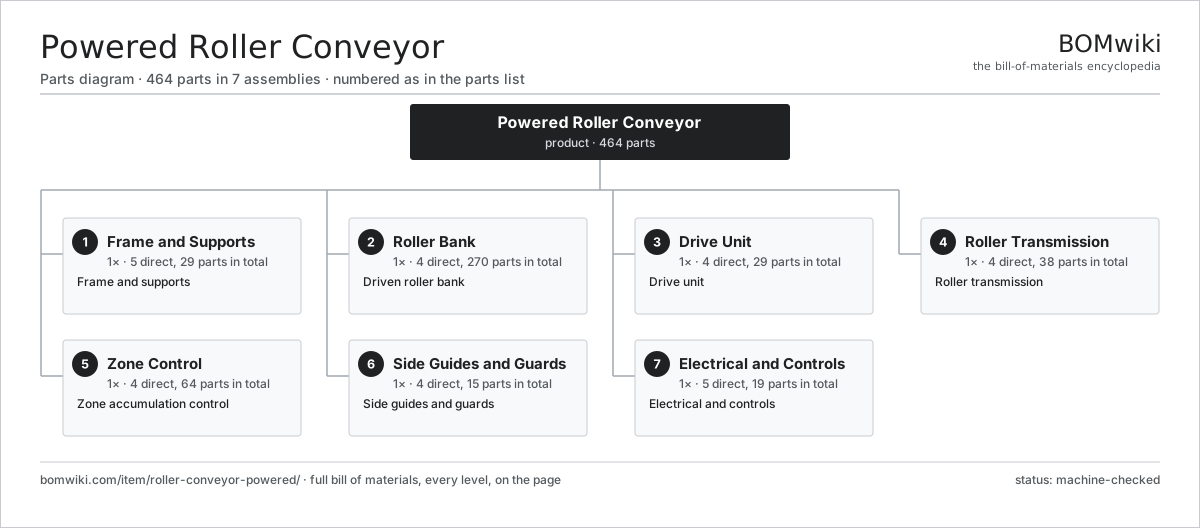
| # | Part | Qty | What it does |
|---|---|---|---|
| 1 | Frame and Supports 5 parts | 1× | Frame and supports |
| 2 | Roller Bank 4 parts | 1× | Driven roller bank |
| 3 | Drive Unit 4 parts | 1× | Drive unit |
| 4 | Roller Transmission 4 parts | 1× | Roller transmission |
| 5 | Zone Control 4 parts | 1× | Zone accumulation control |
| 6 | Side Guides and Guards 4 parts | 1× | Side guides and guards |
| 7 | Electrical and Controls 5 parts | 1× | Electrical and controls |
3D model
No 3D model yet. Have a CAD file of this? Add a 3D model — STL renders right on this page; STEP, FreeCAD, and OpenSCAD sources are welcome too (openly licensed, like all 3D models on BOMwiki).
Build & assembly graph
expand / collapse · shared sub-assemblies converge · links to related products · est. labourTap an assembly to expand/collapse · tap a part to open it · use “Open page” for any node · drag to pan, scroll to zoom.
Bill of materials for Powered Roller Conveyor
7 top-level lines · 54 rows shown · 464 parts total · indented to 3 levels| # | Item / sub-assembly | Part no. | Qty/assy | Ext. qty | Parts | Type |
|---|---|---|---|---|---|---|
| 1 | Frame and Supports 5 parts | roller-conveyor-powered-frame | 1× | 1 | 29 | assembly |
| 1.1 | Side Channel | roller-conveyor-powered-side-channel | 2× | 2 | · | part |
| 1.2 | Cross Member | roller-conveyor-powered-cross-member | 6× | 6 | · | part |
| 1.3 | Floor Stand 2 parts | roller-conveyor-powered-floor-stand | 4× | 4 | 4 | assembly |
| 1.3.1 | Stand Leg | roller-conveyor-powered-stand-leg | 2× | 8 | · | part |
| 1.3.2 | Height Adjuster | roller-conveyor-powered-height-bolt | 2× | 8 | · | part |
| 1.4 | Foot Pad | roller-conveyor-powered-foot-pad | 4× | 4 | · | part |
| 1.5 | Fastener Set | fastener-set | 1× | 1 | · | part |
| 2 | Roller Bank 4 parts | roller-conveyor-powered-roller-bank | 1× | 1 | 270 | assembly |
| 2.1 | Conveyor Roller 3 parts | roller-conveyor-powered-roller | 30× | 30 | 5 | assembly |
| 2.1.1 | Roller Tube | roller-conveyor-powered-roller-tube | 1× | 30 | · | part |
| 2.1.2 | Bearing End Cap | roller-conveyor-powered-bearing-housing | 2× | 60 | · | part |
| 2.1.3 | Ball Bearing | ball-bearing | 2× | 60 | · | part |
| 2.2 | Roller Axle | roller-conveyor-powered-roller-axle | 30× | 30 | · | part |
| 2.3 | Ball Bearing | ball-bearing | 60× | 60 | · | part |
| 2.4 | Roller Sprocket | roller-conveyor-powered-sprocket | 30× | 30 | · | part |
| 3 | Drive Unit 4 parts | roller-conveyor-powered-drive | 1× | 1 | 29 | assembly |
| 3.1 | Gearmotor 4 parts | roller-conveyor-powered-gearmotor | 1× | 1 | 25 | assembly |
| 3.1.1 | Stator Assembly 3 parts + deeper › | stator-assembly | 1× | 1 | 3 | assembly |
| 3.1.2 | Rotor Assembly 4 parts + deeper › | rotor-assembly | 1× | 1 | 19 | assembly |
| 3.1.3 | Ball Bearing | ball-bearing | 2× | 2 | · | part |
| 3.1.4 | Helical Gear Pair | gear-pair | 1× | 1 | · | part |
| 3.2 | Gearbox Housing | gearbox-housing | 1× | 1 | · | part |
| 3.3 | Chain Take-up | roller-conveyor-powered-take-up | 1× | 1 | · | part |
| 3.4 | Drive Sprocket | roller-conveyor-powered-drive-sprocket | 2× | 2 | · | part |
| 4 | Roller Transmission 4 parts | roller-conveyor-powered-transmission | 1× | 1 | 38 | assembly |
| 4.1 | Roller Chain | roller-conveyor-powered-roller-chain | 1× | 1 | · | part |
| 4.2 | O-Band | roller-conveyor-powered-o-band | 30× | 30 | · | part |
| 4.3 | Chain Idler | roller-conveyor-powered-idler | 6× | 6 | · | part |
| 4.4 | Chain Guard | roller-conveyor-powered-chain-guard | 1× | 1 | · | part |
| 5 | Zone Control 4 parts | roller-conveyor-powered-zone-control | 1× | 1 | 64 | assembly |
| 5.1 | Photo-Eye | roller-conveyor-powered-photo-eye | 8× | 8 | · | part |
| 5.2 | Zone Card 4 parts | roller-conveyor-powered-zone-card | 8× | 8 | 4 | assembly |
| 5.2.1 | Bare PCB | pcb-bare | 1× | 8 | · | part |
| 5.2.2 | Microcontroller | mcu | 1× | 8 | · | part |
| 5.2.3 | SMD Passive (R/C/L) | smd-passives | 1× | 8 | · | part |
| 5.2.4 | Relay | relay | 1× | 8 | · | part |
| 5.3 | Zone Clutch | roller-conveyor-powered-clutch | 8× | 8 | · | part |
| 5.4 | Connector | connector | 16× | 16 | · | part |
| 6 | Side Guides and Guards 4 parts | roller-conveyor-powered-guides | 1× | 1 | 15 | assembly |
| 6.1 | Side Guide | roller-conveyor-powered-side-guide | 2× | 2 | · | part |
| 6.2 | Guide Bracket | roller-conveyor-powered-guide-bracket | 8× | 8 | · | part |
| 6.3 | End Stop | roller-conveyor-powered-end-stop | 1× | 1 | · | part |
| 6.4 | Pinch Guard | roller-conveyor-powered-pinch-guard | 4× | 4 | · | part |
| 7 | Electrical and Controls 5 parts | roller-conveyor-powered-electrical | 1× | 1 | 19 | assembly |
| 7.1 | Control Panel 4 parts | roller-conveyor-powered-control-panel | 1× | 1 | 14 | assembly |
| 7.1.1 | Bare PCB | pcb-bare | 1× | 1 | · | part |
| 7.1.2 | Microcontroller | mcu | 1× | 1 | · | part |
| 7.1.3 | Relay | relay | 4× | 4 | · | part |
| 7.1.4 | Connector | connector | 8× | 8 | · | part |
| 7.2 | VFD | roller-conveyor-powered-vfd | 1× | 1 | · | part |
| 7.3 | E-Stop Pull | roller-conveyor-powered-estop | 2× | 2 | · | part |
| 7.4 | Power Supply | power-supply | 1× | 1 | · | part |
| 7.5 | Wire Bundle | wire-bundle | 1× | 1 | · | part |
Related products
same domain, ranked by shared parts Articulated Forklift
2,417 parts · shares 2 with this page
Articulated Forklift
2,417 parts · shares 2 with this page
 Bag Palletizer
951 parts · shares 2 with this page
Coal Yard Stacker
571 parts · shares 2 with this page
Bag Palletizer
951 parts · shares 2 with this page
Coal Yard Stacker
571 parts · shares 2 with this page
 Cross-Belt Sorter
25,040 parts · shares 2 with this page
Dense-Phase Conveying System
446 parts · shares 2 with this page
Cross-Belt Sorter
25,040 parts · shares 2 with this page
Dense-Phase Conveying System
446 parts · shares 2 with this page
 Dilute-Phase Conveying System
509 parts · shares 2 with this page
Dilute-Phase Conveying System
509 parts · shares 2 with this page
Sourcing: possible vendors
Prices, MOQ, and lead times are algorithmic estimates, not quotes, and not claims about these companies. Company mappings are curated by keyword; est. price band $2k–$300k. How estimates work| Vendor | HQ | Specialty | MOQ | Lead time |
|---|---|---|---|---|
| toyota-industries.com ↗ | Kariya, JP | Forklifts & logistics | 20 units | 10–16 wks |
| kiongroup.com ↗ | Frankfurt, DE | Forklifts (Linde, STILL) | 20 units | 10–16 wks |
| jungheinrich.com ↗ | Hamburg, DE | Warehouse trucks | 20 units | 10–16 wks |
| crown.com ↗ | New Bremen, US | Forklifts | 20 units | 10–16 wks |
|
🇨🇳Hangcha
hcforklift.com ↗
|
Hangzhou, CN | Forklifts & material handling | 20 units | 10–16 wks |
907-word article