Drag Chain Conveyor
ProductOverview
A drag chain conveyor moves bulk material by dragging it along the floor of an enclosed trough. An endless chain fitted with flight bars runs through the trough, and the flights push a continuous column of material from the inlet to the discharge. Because the material moves as a slow-moving plug rather than tumbling on a belt, the conveyor is dust-tight, gentle on the chain, and able to climb steep inclines that a belt could not hold. It suits ash from boilers, cement and fly ash, biomass, grain, and other dusty or hot materials where containment matters more than speed.
The machine is built around an Enclosed Trough that contains the load, an Chain & Flights assembly that does the dragging, a Head Drive at the discharge end, and an Tail & Take-Up that tensions the chain. Material enters and leaves through the Inlet & Outlets spouts, the trough is protected by Wear Liners, the Safety & Monitoring sensors guard against jams and breakage, and the Control Panel panel runs the drive. The whole assembly sits on Support Feet.
How it works
The chain pulls a slice of material along the trough floor. As the Drag Chain passes the inlet, material falls in front of the flights and the Flight Bar bars drag it forward in a packed bed. The flights occupy most of the trough cross-section, so the material moves at chain speed with almost no relative motion between grains, which keeps degradation and dust generation low. At the discharge end the material falls out through the Discharge Outlet as the chain turns around the head sprocket and the empty flights return on the upper or lower run, separated from the load by a Divider Plate.
The slow speed is deliberate. Drag chain conveyors run at a fraction of a metre per second, so wear is concentrated on the trough floor and the flight edges rather than spread over a fast-moving belt. The carrying capacity comes from the deep, fully filled trough rather than from speed, which makes the machine compact and quiet.
Chain and flights
The Chain & Flights assembly is the working heart. The Drag Chain is a case-hardened forged or welded-link chain sized for the pull load plus the friction of dragging the material bed. Flight bars are bolted to special Attachment Link links at a regular pitch, and each Flight Bar is made from abrasion-resistant plate because its leading edge does the work of moving the material. A Connecting Link lets a crew break the loop to remove worn flights or shorten the chain after stretch.
Drive and take-up
The Head Drive sits at the discharge end so the chain is pulled, not pushed, keeping the loaded run in tension where it is strongest. A Drive Motor feeds a helical reducer that turns the Head Shaft and its Head Sprocket. At the far end the Tail & Take-Up carries an idler sprocket on a Screw Take-Up screw that sets and maintains chain tension. Correct tension is critical: too loose and the chain jumps the sprocket teeth, too tight and the chain and bearings wear quickly.
Trough, liners, and enclosure
The Enclosed Trough is a bolted steel casing that fully encloses the material, which is why these conveyors are favoured for hot ash and dusty cement products. Each Trough Section bolts end to end with a gasketed Trough Cover on top to keep the path dust-tight. Inside, Wear Liners protect the high-wear surfaces: a Floor Liner under the dragged bed and a Side Liner along the walls, both bolted in as sacrificial wear plates so they can be replaced without scrapping the trough.
Safety and monitoring
Because the chain is hidden inside the trough, the Safety & Monitoring group provides the only window into its health. A Speed Sensor on the tail shaft trips the drive if the chain slips or breaks, a Plug Switch catches a material plug before the drive overloads, and Bearing Temperature Sensor RTDs warn of bearing overheating. A Pull-Cord Stop running the length of the machine gives operators an emergency stop from any point. The Control Panel panel ties these together: its Controller Board carries an Microcontroller that sequences the start, watches the sensors through Relay outputs, and trips the drive on any fault.
Variants and use
Drag chain conveyors are common in power plants moving bottom ash and fly ash, in cement plants conveying clinker dust and raw meal, in biomass and waste-to-energy plants handling wood chips and refuse-derived fuel, and in grain handling where containment limits dust. Horizontal, inclined, and L-shaped configurations are built by combining straight trough runs with bends. The enclosed dust-tight design is chosen over belt or screw conveyors when the material is hot, abrasive, or must be contained, and the Inlet & Outlets arrangement can be set up with multiple gated outlets to distribute material to several destinations along one run.
Drag Chain Conveyor parts and their functions
9 top-level parts · 273 parts in total · full bill of materials below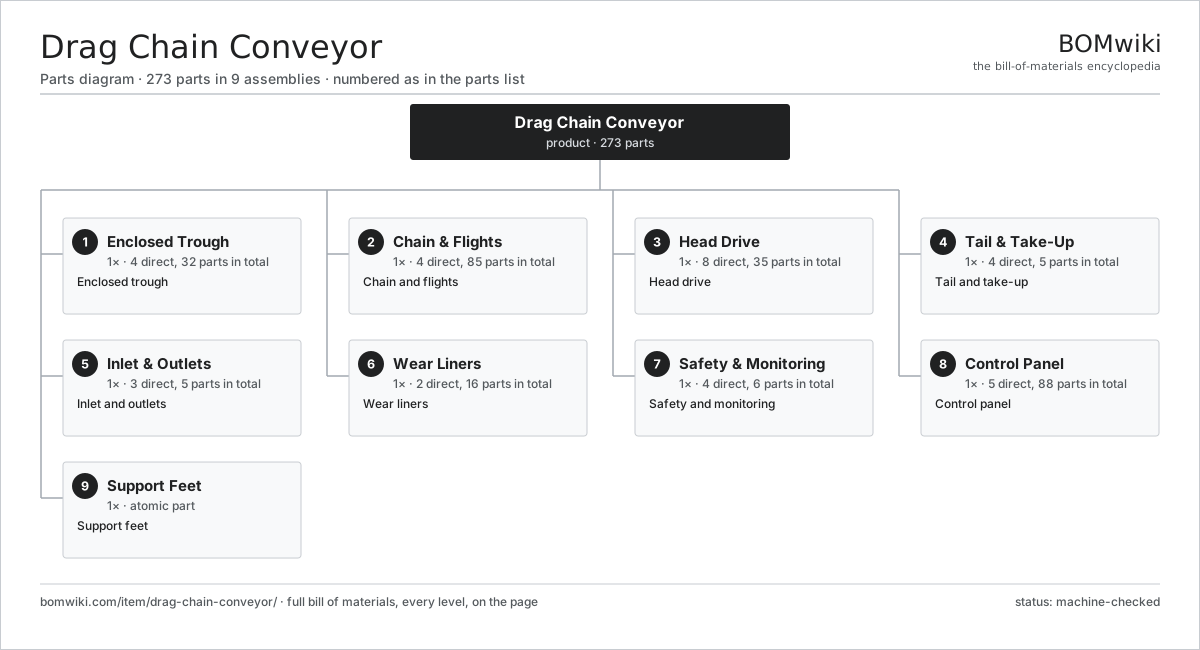
| # | Part | Qty | What it does |
|---|---|---|---|
| 1 | Enclosed Trough 4 parts | 1× | Enclosed trough |
| 2 | Chain & Flights 4 parts | 1× | Chain and flights |
| 3 | Head Drive 8 parts | 1× | Head drive |
| 4 | Tail & Take-Up 4 parts | 1× | Tail and take-up |
| 5 | Inlet & Outlets 3 parts | 1× | Inlet and outlets |
| 6 | Wear Liners 2 parts | 1× | Wear liners |
| 7 | Safety & Monitoring 4 parts | 1× | Safety and monitoring |
| 8 | Control Panel 5 parts | 1× | Control panel |
| 9 | Support Feet | 1× | Support feet |
3D model
No 3D model yet. Have a CAD file of this? Add a 3D model — STL renders right on this page; STEP, FreeCAD, and OpenSCAD sources are welcome too (openly licensed, like all 3D models on BOMwiki).
Build & assembly graph
expand / collapse · shared sub-assemblies converge · links to related products · est. labourTap an assembly to expand/collapse · tap a part to open it · use “Open page” for any node · drag to pan, scroll to zoom.
Bill of materials for Drag Chain Conveyor
9 top-level lines · 51 rows shown · 273 parts total · indented to 3 levels| # | Item / sub-assembly | Part no. | Qty/assy | Ext. qty | Parts | Type |
|---|---|---|---|---|---|---|
| 1 | Enclosed Trough 4 parts | drag-chain-conveyor-trough | 1× | 1 | 32 | assembly |
| 1.1 | Trough Section | drag-chain-conveyor-trough-section | 8× | 8 | · | part |
| 1.2 | Trough Cover | drag-chain-conveyor-cover | 8× | 8 | · | part |
| 1.3 | Divider Plate | drag-chain-conveyor-divider | 8× | 8 | · | part |
| 1.4 | Fastener Set | fastener-set | 8× | 8 | · | part |
| 2 | Chain & Flights 4 parts | drag-chain-conveyor-chain-flights | 1× | 1 | 85 | assembly |
| 2.1 | Drag Chain | drag-chain-conveyor-chain | 1× | 1 | · | part |
| 2.2 | Flight Bar | drag-chain-conveyor-flight | 40× | 40 | · | part |
| 2.3 | Attachment Link | drag-chain-conveyor-attachment | 40× | 40 | · | part |
| 2.4 | Connecting Link | drag-chain-conveyor-connector-link | 4× | 4 | · | part |
| 3 | Head Drive 8 parts | drag-chain-conveyor-drive | 1× | 1 | 35 | assembly |
| 3.1 | Drive Motor 4 parts | drag-chain-conveyor-drive-motor | 1× | 1 | 25 | assembly |
| 3.1.1 | Stator Assembly 3 parts + deeper › | stator-assembly | 1× | 1 | 3 | assembly |
| 3.1.2 | Rotor Assembly 4 parts + deeper › | rotor-assembly | 1× | 1 | 19 | assembly |
| 3.1.3 | Ball Bearing | ball-bearing | 2× | 2 | · | part |
| 3.1.4 | Motor Frame | drag-chain-conveyor-motor-frame | 1× | 1 | · | part |
| 3.2 | Gearbox Housing | gearbox-housing | 1× | 1 | · | part |
| 3.3 | Helical Gear Pair | gear-pair | 2× | 2 | · | part |
| 3.4 | Oil Seal | oil-seal | 2× | 2 | · | part |
| 3.5 | Head Sprocket | drag-chain-conveyor-head-sprocket | 1× | 1 | · | part |
| 3.6 | Head Shaft | drag-chain-conveyor-head-shaft | 1× | 1 | · | part |
| 3.7 | Ball Bearing | ball-bearing | 2× | 2 | · | part |
| 3.8 | Drive Coupling | drag-chain-conveyor-coupling | 1× | 1 | · | part |
| 4 | Tail & Take-Up 4 parts | drag-chain-conveyor-tail | 1× | 1 | 5 | assembly |
| 4.1 | Tail Sprocket | drag-chain-conveyor-tail-sprocket | 1× | 1 | · | part |
| 4.2 | Tail Shaft | drag-chain-conveyor-tail-shaft | 1× | 1 | · | part |
| 4.3 | Ball Bearing | ball-bearing | 2× | 2 | · | part |
| 4.4 | Screw Take-Up | drag-chain-conveyor-takeup | 1× | 1 | · | part |
| 5 | Inlet & Outlets 3 parts | drag-chain-conveyor-inlet-outlet | 1× | 1 | 5 | assembly |
| 5.1 | Feed Inlet | drag-chain-conveyor-inlet | 1× | 1 | · | part |
| 5.2 | Discharge Outlet | drag-chain-conveyor-outlet | 2× | 2 | · | part |
| 5.3 | Slide Gate | drag-chain-conveyor-slide-gate | 2× | 2 | · | part |
| 6 | Wear Liners 2 parts | drag-chain-conveyor-liners | 1× | 1 | 16 | assembly |
| 6.1 | Floor Liner | drag-chain-conveyor-floor-liner | 8× | 8 | · | part |
| 6.2 | Side Liner | drag-chain-conveyor-side-liner | 8× | 8 | · | part |
| 7 | Safety & Monitoring 4 parts | drag-chain-conveyor-safety | 1× | 1 | 6 | assembly |
| 7.1 | Speed Sensor | drag-chain-conveyor-speed-sensor | 1× | 1 | · | part |
| 7.2 | Plug Switch | drag-chain-conveyor-plug-sensor | 1× | 1 | · | part |
| 7.3 | Bearing Temperature Sensor | drag-chain-conveyor-temp-sensor | 2× | 2 | · | part |
| 7.4 | Pull-Cord Stop | drag-chain-conveyor-pullcord | 2× | 2 | · | part |
| 8 | Control Panel 5 parts | drag-chain-conveyor-control | 1× | 1 | 88 | assembly |
| 8.1 | Controller Board 4 parts | drag-chain-conveyor-control-board | 1× | 1 | 76 | assembly |
| 8.1.1 | Bare PCB | pcb-bare | 1× | 1 | · | part |
| 8.1.2 | Microcontroller | mcu | 1× | 1 | · | part |
| 8.1.3 | SMD Passive (R/C/L) | smd-passives | 70× | 70 | · | part |
| 8.1.4 | Connector | connector | 4× | 4 | · | part |
| 8.2 | Power Supply | power-supply | 1× | 1 | · | part |
| 8.3 | Relay | relay | 4× | 4 | · | part |
| 8.4 | Wire Bundle | wire-bundle | 1× | 1 | · | part |
| 8.5 | Connector | connector | 6× | 6 | · | part |
| 9 | Support Feet | drag-chain-conveyor-supports | 1× | 1 | · | part |
Related products
same domain, ranked by shared parts Articulated Forklift
2,417 parts · shares 2 with this page
Articulated Forklift
2,417 parts · shares 2 with this page
 Bag Palletizer
951 parts · shares 2 with this page
Coal Yard Stacker
571 parts · shares 2 with this page
Bag Palletizer
951 parts · shares 2 with this page
Coal Yard Stacker
571 parts · shares 2 with this page
 Cross-Belt Sorter
25,040 parts · shares 2 with this page
Dense-Phase Conveying System
446 parts · shares 2 with this page
Cross-Belt Sorter
25,040 parts · shares 2 with this page
Dense-Phase Conveying System
446 parts · shares 2 with this page
 Dilute-Phase Conveying System
509 parts · shares 2 with this page
Dilute-Phase Conveying System
509 parts · shares 2 with this page
Sourcing: possible vendors
Prices, MOQ, and lead times are algorithmic estimates, not quotes, and not claims about these companies. Company mappings are curated by keyword; est. price band $2k–$300k. How estimates work| Vendor | HQ | Specialty | MOQ | Lead time |
|---|---|---|---|---|
| toyota-industries.com ↗ | Kariya, JP | Forklifts & logistics | 20 units | 10–16 wks |
| kiongroup.com ↗ | Frankfurt, DE | Forklifts (Linde, STILL) | 20 units | 10–16 wks |
| jungheinrich.com ↗ | Hamburg, DE | Warehouse trucks | 20 units | 10–16 wks |
| crown.com ↗ | New Bremen, US | Forklifts | 20 units | 10–16 wks |
|
🇨🇳Hangcha
hcforklift.com ↗
|
Hangzhou, CN | Forklifts & material handling | 20 units | 10–16 wks |
914-word article