Cross-Belt Sorter
ProductOverview
A cross-belt sorter carries each item on a short powered belt mounted crosswise on a moving carrier, and to sort an item it simply runs that belt sideways to fire the item off the loop into a chute. Because the discharge is an active belt rather than a tip or a push, it places items gently and precisely, handles flat and flimsy goods that other sorters struggle with, and sorts to both sides of the loop. That combination makes it the preferred machine for e-commerce and returns operations, where the item mix runs from stiff cartons to limp polybags and the destination count is high.
The sorter is built from a Track Loop the carriers run on, a Cross-Belt Carriers of carts, a Belt Cells cell on each cart, a Linear Induction Drive that propels the loop, the Induction Stations stations that load items, the Discharge Chutes that catch them, and a Sortation Control that runs the sort.
The loop and carriers
The Track Loop is a closed circuit of Rail Section rail and banked Curve Section curves on Support Leg legs. Around it runs the Cross-Belt Carriers, a chain of Carrier Cart carts joined by Cart Coupling couplings. Each cart rolls on polyurethane-treaded Running Wheel wheels on Ball Bearing bearings, stays centred on Guide Wheel guide wheels, and its cast Cart Frame carries one belt cell. The carts run nose to tail so the loop is a continuous string of addressable cells.
The cross belt cell
The defining part is the Belt Cells on each cart. A short Cell Belt runs across the cart, at right angles to the direction of travel, wrapped around Cell Roller rollers and driven by a compact Cell Belt Motor. While the cart circulates the cell belt holds the item still. When the cart reaches the assigned chute, an on-cart Cell Control Board spins the cell belt hard for a fraction of a second, and the belt accelerates the item sideways and flings it cleanly into the chute. Because the belt can run either way, the cart can discharge to a chute on the left or the right, which is how the machine sorts to both sides of the loop. The active belt is also what lets the sorter handle delicate and irregular items: it carries them along on grip rather than balance, and sets them off rather than tipping or shoving them.
Propelling the loop
The carrier train is moved by the same contactless method as other loop sorters. Wayside Linear Motor Stator linear motor stators set up a travelling field that drags the Reaction Plate under each cart, so the train is pushed without contact. The stators wind a Laminated Core laminated core and are fed by a Linear Motor Drive that holds the train at speed, while a Speed Encoder reads cart position so the loop speed and the cell discharges stay in time. Keeping the train at a steady, known speed is what lets a cell fire its item over the chute at exactly the right instant.
Loading items on
Items join the loop at the Induction Stations stations. A Induction Belt accelerates the item to loop speed while a Barcode Scanner reads its label and a Dimensioning Unit confirms it fits one cell. A Photoeye checks the next cell is empty, and the induction belt and the cell belt run together to slide the item onto the cell in step with the moving loop. The sort decision is set here, and from this point the control tracks which cell holds which item.
Chutes and discharge
The Discharge Chutes run along both sides of the loop. When a cell fires, the item flies through a Divert Plate into a sloped Chute that carries it to a bin or packing station, and a Chute-Full Sensor tells the control when that destination is full so it pauses sorting there. Putting chutes on both sides doubles the destinations the machine serves in a given length of loop, which is a large part of why cross-belt sorters reach high destination counts.
Control and use
The Sortation Control runs the sort. A Sort Controller holds the label-to-chute map, tracks every cell around the loop, and decides which cell fires at which chute and in which direction. It commands the carts through wayside Cart Comms Board boards as each cart enters a chute zone, over a network joined by a Network Switch, and shows status on an LCD Panel screen. Cross-belt sorters scale from compact single-loop units in mid-size fulfilment centres to long high-throughput loops in parcel hubs, and they are often paired with an upstream Induction Stations bank of several stations to keep the high loop speed fully fed. Their strength is the active cell belt, which sorts a mixed, hard-to-handle item stream gently and accurately to a large number of destinations.
Cross-Belt Sorter parts and their functions
7 top-level parts · 25,040 parts in total · full bill of materials below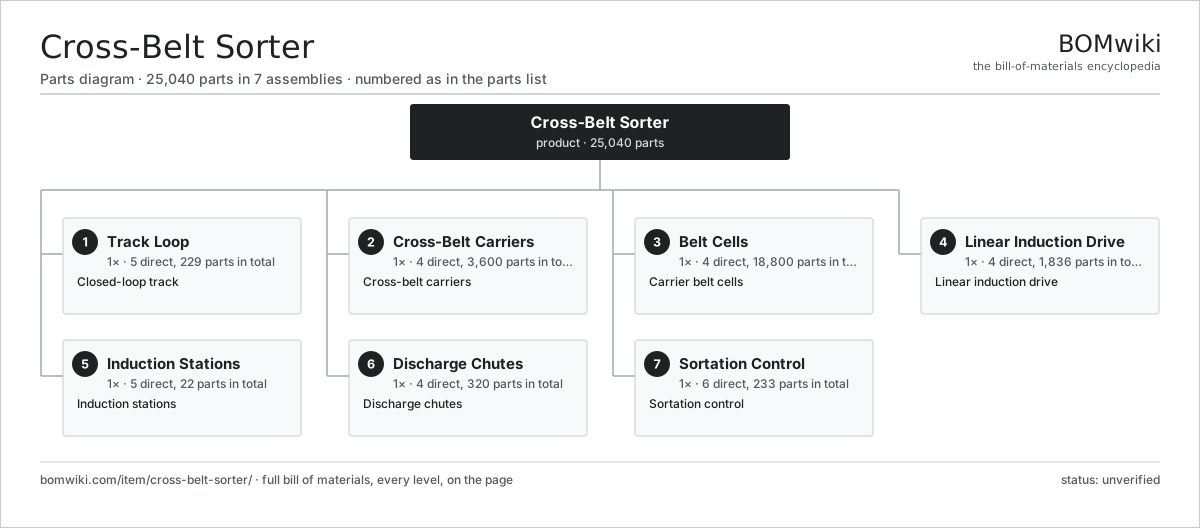
| # | Part | Qty | What it does |
|---|---|---|---|
| 1 | Track Loop 5 parts | 1× | Closed-loop track |
| 2 | Cross-Belt Carriers 4 parts | 1× | Cross-belt carriers |
| 3 | Belt Cells 4 parts | 1× | Carrier belt cells |
| 4 | Linear Induction Drive 4 parts | 1× | Linear induction drive |
| 5 | Induction Stations 5 parts | 1× | Induction stations |
| 6 | Discharge Chutes 4 parts | 1× | Discharge chutes |
| 7 | Sortation Control 6 parts | 1× | Sortation control |
3D model
No 3D model yet. Have a CAD file of this? Add a 3D model — STL renders right on this page; STEP, FreeCAD, and OpenSCAD sources are welcome too (openly licensed, like all 3D models on BOMwiki).
Build & assembly graph
expand / collapse · shared sub-assemblies converge · links to related products · est. labourTap an assembly to expand/collapse · tap a part to open it · use “Open page” for any node · drag to pan, scroll to zoom.
Bill of materials for Cross-Belt Sorter
7 top-level lines · 68 rows shown · 25,040 parts total · indented to 3 levels| # | Item / sub-assembly | Part no. | Qty/assy | Ext. qty | Parts | Type |
|---|---|---|---|---|---|---|
| 1 | Track Loop 5 parts | cross-belt-sorter-track-loop | 1× | 1 | 229 | assembly |
| 1.1 | Rail Section | cross-belt-sorter-rail-section | 80× | 80 | · | part |
| 1.2 | Curve Section | cross-belt-sorter-curve-section | 8× | 8 | · | part |
| 1.3 | Support Leg | cross-belt-sorter-support-leg | 60× | 60 | · | part |
| 1.4 | Rail Joint | cross-belt-sorter-rail-joint | 80× | 80 | · | part |
| 1.5 | Fastener Set | fastener-set | 1× | 1 | · | part |
| 2 | Cross-Belt Carriers 4 parts | cross-belt-sorter-carrier-train | 1× | 1 | 3,600 | assembly |
| 2.1 | Carrier Cart 4 parts | cross-belt-sorter-carrier-cart | 200× | 200 | 11 | assembly |
| 2.1.1 | Cart Frame | cross-belt-sorter-cart-frame | 1× | 200 | · | part |
| 2.1.2 | Running Wheel | cross-belt-sorter-running-wheel | 4× | 800 | · | part |
| 2.1.3 | Ball Bearing | ball-bearing | 4× | 800 | · | part |
| 2.1.4 | Guide Wheel | cross-belt-sorter-guide-wheel | 2× | 400 | · | part |
| 2.2 | Cart Coupling | cross-belt-sorter-coupling | 200× | 200 | · | part |
| 2.3 | Running Wheel | cross-belt-sorter-running-wheel | 800× | 800 | · | part |
| 2.4 | Guide Wheel | cross-belt-sorter-guide-wheel | 400× | 400 | · | part |
| 3 | Belt Cells 4 parts | cross-belt-sorter-cell-belt | 1× | 1 | 18,800 | assembly |
| 3.1 | Cell Belt | cross-belt-sorter-cell-belt-band | 200× | 200 | · | part |
| 3.2 | Cell Belt Motor 4 parts | cross-belt-sorter-cell-motor | 200× | 200 | 25 | assembly |
| 3.2.1 | Stator Assembly 3 parts + deeper › | stator-assembly | 1× | 200 | 3 | assembly |
| 3.2.2 | Rotor Assembly 4 parts + deeper › | rotor-assembly | 1× | 200 | 19 | assembly |
| 3.2.3 | Motor Housing | motor-housing | 1× | 200 | · | part |
| 3.2.4 | Ball Bearing | ball-bearing | 2× | 400 | · | part |
| 3.3 | Cell Roller | cross-belt-sorter-cell-roller | 400× | 400 | · | part |
| 3.4 | Cell Control Board 5 parts | cross-belt-sorter-cell-board | 200× | 200 | 66 | assembly |
| 3.4.1 | Bare PCB | pcb-bare | 1× | 200 | · | part |
| 3.4.2 | Microcontroller | mcu | 1× | 200 | · | part |
| 3.4.3 | Gate Driver IC | gate-driver-ic | 1× | 200 | · | part |
| 3.4.4 | Power MOSFET | mosfet | 3× | 600 | · | part |
| 3.4.5 | SMD Passive (R/C/L) | smd-passives | 60× | 12,000 | · | part |
| 4 | Linear Induction Drive 4 parts | cross-belt-sorter-drive | 1× | 1 | 1,836 | assembly |
| 4.1 | Linear Motor Stator 3 parts | cross-belt-sorter-lim-stator | 12× | 12 | 5 | assembly |
| 4.1.1 | Stator Assembly 3 parts + deeper › | stator-assembly | 1× | 12 | 3 | assembly |
| 4.1.2 | Laminated Core | cross-belt-sorter-lim-core | 1× | 12 | · | part |
| 4.1.3 | Wire Bundle | wire-bundle | 1× | 12 | · | part |
| 4.2 | Reaction Plate | cross-belt-sorter-reaction-plate | 200× | 200 | · | part |
| 4.3 | Linear Motor Drive 5 parts | cross-belt-sorter-lim-drive | 12× | 12 | 131 | assembly |
| 4.3.1 | Bare PCB | pcb-bare | 1× | 12 | · | part |
| 4.3.2 | Power MOSFET | mosfet | 6× | 72 | · | part |
| 4.3.3 | Gate Driver IC | gate-driver-ic | 3× | 36 | · | part |
| 4.3.4 | Power Inductor | power-inductor | 1× | 12 | · | part |
| 4.3.5 | SMD Passive (R/C/L) | smd-passives | 120× | 1,440 | · | part |
| 4.4 | Speed Encoder | cross-belt-sorter-speed-encoder | 4× | 4 | · | part |
| 5 | Induction Stations 5 parts | cross-belt-sorter-induction | 1× | 1 | 22 | assembly |
| 5.1 | Induction Belt | cross-belt-sorter-induction-belt | 4× | 4 | · | part |
| 5.2 | Barcode Scanner | cross-belt-sorter-barcode-scanner | 4× | 4 | · | part |
| 5.3 | Dimensioning Unit | cross-belt-sorter-dimensioner | 2× | 2 | · | part |
| 5.4 | Photoeye | cross-belt-sorter-photoeye | 8× | 8 | · | part |
| 5.5 | Drive Belt | drive-belt | 4× | 4 | · | part |
| 6 | Discharge Chutes 4 parts | cross-belt-sorter-chutes | 1× | 1 | 320 | assembly |
| 6.1 | Chute | cross-belt-sorter-chute | 80× | 80 | · | part |
| 6.2 | Chute-Full Sensor | cross-belt-sorter-chute-full-sensor | 80× | 80 | · | part |
| 6.3 | Divert Plate | cross-belt-sorter-divert-plate | 80× | 80 | · | part |
| 6.4 | Sheet Metal Panel | sheet-panel | 80× | 80 | · | part |
| 7 | Sortation Control 6 parts | cross-belt-sorter-control | 1× | 1 | 233 | assembly |
| 7.1 | Sort Controller 4 parts | cross-belt-sorter-sort-controller | 1× | 1 | 158 | assembly |
| 7.1.1 | Bare PCB | pcb-bare | 1× | 1 | · | part |
| 7.1.2 | Microcontroller | mcu | 1× | 1 | · | part |
| 7.1.3 | Connector | connector | 16× | 16 | · | part |
| 7.1.4 | SMD Passive (R/C/L) | smd-passives | 140× | 140 | · | part |
| 7.2 | Cart Comms Board 4 parts | cross-belt-sorter-comms-board | 1× | 1 | 70 | assembly |
| 7.2.1 | Bare PCB | pcb-bare | 1× | 1 | · | part |
| 7.2.2 | Microcontroller | mcu | 1× | 1 | · | part |
| 7.2.3 | Connector | connector | 8× | 8 | · | part |
| 7.2.4 | SMD Passive (R/C/L) | smd-passives | 60× | 60 | · | part |
| 7.3 | LCD Panel | lcd-panel | 1× | 1 | · | part |
| 7.4 | Power Supply | power-supply | 2× | 2 | · | part |
| 7.5 | Network Switch | cross-belt-sorter-network-switch | 1× | 1 | · | part |
| 7.6 | Wire Bundle | wire-bundle | 1× | 1 | · | part |
Related products
same domain, ranked by shared parts Sliding-Shoe Sorter
4,321 parts · shares 9 with this page
Sliding-Shoe Sorter
4,321 parts · shares 9 with this page
 Tilt-Tray Sorter
6,031 parts · shares 9 with this page
Tilt-Tray Sorter
6,031 parts · shares 9 with this page
 Vertical Spiral Conveyor
2,482 parts · shares 9 with this page
Order Picker
708 parts · shares 7 with this page
Vertical Spiral Conveyor
2,482 parts · shares 9 with this page
Order Picker
708 parts · shares 7 with this page
 Overhead Trolley Conveyor
2,614 parts · shares 7 with this page
Power-and-Free Conveyor
2,657 parts · shares 7 with this page
Overhead Trolley Conveyor
2,614 parts · shares 7 with this page
Power-and-Free Conveyor
2,657 parts · shares 7 with this page
Sourcing: possible vendors
Prices, MOQ, and lead times are algorithmic estimates, not quotes, and not claims about these companies. Company mappings are curated by keyword; est. price band $2k–$300k. How estimates work| Vendor | HQ | Specialty | MOQ | Lead time |
|---|---|---|---|---|
| toyota-industries.com ↗ | Kariya, JP | Forklifts & logistics | 20 units | 10–16 wks |
| kiongroup.com ↗ | Frankfurt, DE | Forklifts (Linde, STILL) | 20 units | 10–16 wks |
| jungheinrich.com ↗ | Hamburg, DE | Warehouse trucks | 20 units | 10–16 wks |
| crown.com ↗ | New Bremen, US | Forklifts | 20 units | 10–16 wks |
|
🇨🇳Hangcha
hcforklift.com ↗
|
Hangzhou, CN | Forklifts & material handling | 20 units | 10–16 wks |
930-word article