Dense-Phase Conveying System
ProductOverview
A dense-phase conveying system moves bulk powder slowly and gently by pushing it through the pipe as slugs or a sliding bed rather than suspending it in fast air. It runs at high pressure and low velocity, which is the opposite of dilute phase. A blow tank fills with a measured batch of powder, seals, pressurizes from a compressed air supply, and forces the charge into the pipeline. An air injection system feeds extra air along the route to keep the slugs moving, and a vented receiving bin takes the material at the far end.
The reason to accept the extra cost and complexity of a pressure vessel is the low velocity. At 2 to 8 m/s the particles are barely thrown around, so abrasive materials like cement, alumina, and silica wear the pipe far less, and fragile materials like coffee beans, pasta, and plastic pellets arrive intact instead of shattered. Blends stay mixed instead of separating by size. The high solids loading ratio, often 50 or more kilograms of powder per kilogram of air, also means far less air is moved per tonne, so for long distances the running cost can be lower than dilute phase despite the bigger compressor.
The blow tank cycle
Dense phase is usually a batch process built around the blow tank. The cycle runs in steps. First the dome valve at the top opens and the vessel fills with powder, weighed by load cells. The dome valve then closes, sealing the opening with an inflatable seal that grips the disc tight enough to hold conveying pressure. Compressed air enters and pressurizes the charge, with fluidizing pads aerating the powder in the cone so it flows out like a liquid. The discharge valve opens and the batch is pushed into the line. When the tank empties, the vent valve drops the pressure and the cycle repeats. A continuous version uses two tanks alternating so one fills while the other conveys.
Compressed air supply
Dense phase needs clean dry air at real pressure, so the air supply is built around a screw compressor where two meshing screw rotors compress air continuously inside the housing. The air passes a refrigerant dryer and coalescing filters because any moisture would cake the powder, then fills an air receiver tank that buffers the demand surges of each conveying pulse. A pressure regulator sets the working pressure.
Pipeline and air injection
The pipeline is heavy-wall pipe with cast wear-back bends that carry a thick outer wall at each impact point. Because the flow is slow, a slug can stall and pack into a blockage if the pressure behind it cannot shift it. To prevent that, the air injection system places booster valves and nozzles at intervals along the pipe. When a pressure sensor sees pressure building behind a stalled slug, the solenoid bank fires a shot of air from the manifold to break the slug into shorter, movable pieces. This active management is what lets dense phase reach distances of several hundred metres.
Receiving and control
At the destination the slug flow enters the receiving bin, where the carrier air escapes through a vent filter cleaned by pulse-jet valves, and the product drops out through the discharge valve. The whole sequence is run by the control system: a PLC times the fill, pressurize, convey, and vent steps, a weigh controller reads the load cells to dose each batch, and an HMI panel gives the operator the cycle status and pressure trace.
Variants and selection
Designers choose dense phase over dilute phase when the material cannot take the velocity, when the route is long, or when keeping a blend intact matters. The penalty is the pressure vessel, the code stamping, the larger compressor, and a batch cycle that needs more controls. Hybrid systems exist that start dense and transition to dilute as the slug breaks up, and pressure-vessel feeders can be swapped for continuous screw pumps where a steady flow is wanted. The same blow-tank principle scales from small lab transmitters up to bulk handling at cement and power plants. Twin-vessel arrangements run one tank filling while the other conveys, smoothing the batch process into a near-continuous flow, and bottom-discharge versions suit free-flowing powders while top-discharge versions suit cohesive ones. The choice of conveying mode is rarely about speed alone; it follows from how the specific material behaves under pressure, how far it has to travel, and how much wear or breakage the process can tolerate.
Dense-Phase Conveying System parts and their functions
6 top-level parts · 446 parts in total · full bill of materials below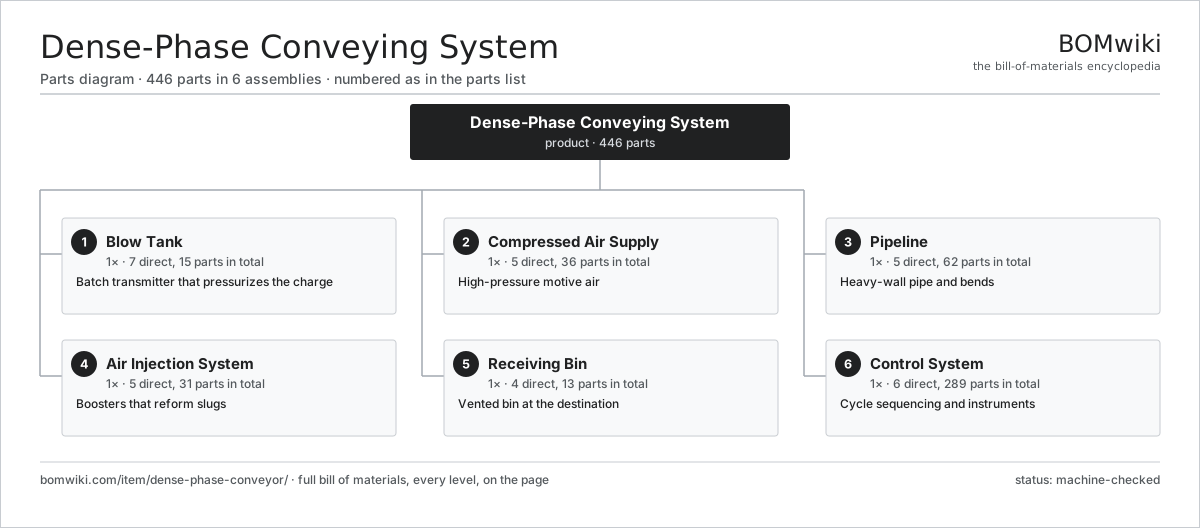
| # | Part | Qty | What it does |
|---|---|---|---|
| 1 | Blow Tank 7 parts | 1× | Batch transmitter that pressurizes the charge |
| 2 | Compressed Air Supply 5 parts | 1× | High-pressure motive air |
| 3 | Pipeline 5 parts | 1× | Heavy-wall pipe and bends |
| 4 | Air Injection System 5 parts | 1× | Boosters that reform slugs |
| 5 | Receiving Bin 4 parts | 1× | Vented bin at the destination |
| 6 | Control System 6 parts | 1× | Cycle sequencing and instruments |
3D model
No 3D model yet. Have a CAD file of this? Add a 3D model — STL renders right on this page; STEP, FreeCAD, and OpenSCAD sources are welcome too (openly licensed, like all 3D models on BOMwiki).
Build & assembly graph
expand / collapse · shared sub-assemblies converge · links to related products · est. labourTap an assembly to expand/collapse · tap a part to open it · use “Open page” for any node · drag to pan, scroll to zoom.
Bill of materials for Dense-Phase Conveying System
6 top-level lines · 64 rows shown · 446 parts total · indented to 3 levels| # | Item / sub-assembly | Part no. | Qty/assy | Ext. qty | Parts | Type |
|---|---|---|---|---|---|---|
| 1 | Blow Tank 7 parts | dense-phase-conveyor-pressure-vessel | 1× | 1 | 15 | assembly |
| 1.1 | Vessel Body | dense-phase-conveyor-vessel-body | 1× | 1 | · | part |
| 1.2 | Dome Valve 4 parts | dense-phase-conveyor-dome-valve | 1× | 1 | 5 | assembly |
| 1.2.1 | Dome Disc | dense-phase-conveyor-dome-disc | 1× | 1 | · | part |
| 1.2.2 | Inflatable Seal | dense-phase-conveyor-inflatable-seal | 1× | 1 | · | part |
| 1.2.3 | Dome Rotary Actuator | dense-phase-conveyor-dome-actuator | 1× | 1 | · | part |
| 1.2.4 | O-Ring Set | oring-set | 2× | 2 | · | part |
| 1.3 | Fluidizing Pad | dense-phase-conveyor-fluidizing-pad | 2× | 2 | · | part |
| 1.4 | Vessel Discharge Valve | dense-phase-conveyor-discharge-valve | 1× | 1 | · | part |
| 1.5 | Vessel Vent Valve | dense-phase-conveyor-vent-valve | 1× | 1 | · | part |
| 1.6 | Load Cell | dense-phase-conveyor-load-cell | 3× | 3 | · | part |
| 1.7 | Pressure Sensor | pressure-sensor | 2× | 2 | · | part |
| 2 | Compressed Air Supply 5 parts | dense-phase-conveyor-compressed-air-supply | 1× | 1 | 36 | assembly |
| 2.1 | Screw Air Compressor 6 parts | dense-phase-conveyor-air-compressor | 1× | 1 | 31 | assembly |
| 2.1.1 | Screw Rotor | dense-phase-conveyor-screw-rotor | 2× | 2 | · | part |
| 2.1.2 | Compressor Housing | dense-phase-conveyor-compressor-housing | 1× | 1 | · | part |
| 2.1.3 | Stator Assembly 3 parts + deeper › | stator-assembly | 1× | 1 | 3 | assembly |
| 2.1.4 | Rotor Assembly 4 parts + deeper › | rotor-assembly | 1× | 1 | 19 | assembly |
| 2.1.5 | Ball Bearing | ball-bearing | 4× | 4 | · | part |
| 2.1.6 | Oil Seal | oil-seal | 2× | 2 | · | part |
| 2.2 | Refrigerant Air Dryer | dense-phase-conveyor-air-dryer | 1× | 1 | · | part |
| 2.3 | Air Receiver Tank | dense-phase-conveyor-air-receiver | 1× | 1 | · | part |
| 2.4 | Pressure Regulator | dense-phase-conveyor-pressure-regulator | 1× | 1 | · | part |
| 2.5 | Coalescing Air Filter | dense-phase-conveyor-air-filter | 2× | 2 | · | part |
| 3 | Pipeline 5 parts | dense-phase-conveyor-pipeline | 1× | 1 | 62 | assembly |
| 3.1 | Heavy-Wall Conveying Pipe | dense-phase-conveyor-conveying-pipe | 16× | 16 | · | part |
| 3.2 | Cast Wear-Back Bend | dense-phase-conveyor-bend | 8× | 8 | · | part |
| 3.3 | Flanged Coupling | dense-phase-conveyor-flange-coupling | 24× | 24 | · | part |
| 3.4 | Pipeline Isolation Valve | dense-phase-conveyor-isolation-valve | 2× | 2 | · | part |
| 3.5 | Pipe Support | dense-phase-conveyor-pipe-support | 12× | 12 | · | part |
| 4 | Air Injection System 5 parts | dense-phase-conveyor-air-injection | 1× | 1 | 31 | assembly |
| 4.1 | Booster Check Valve | dense-phase-conveyor-booster-valve | 6× | 6 | · | part |
| 4.2 | Air Injection Nozzle | dense-phase-conveyor-injection-nozzle | 6× | 6 | · | part |
| 4.3 | Air Manifold | dense-phase-conveyor-air-manifold | 1× | 1 | · | part |
| 4.4 | Solenoid Valve Bank 2 parts | dense-phase-conveyor-solenoid-bank | 1× | 1 | 12 | assembly |
| 4.4.1 | Solenoid Valve | dense-phase-conveyor-solenoid-valve | 6× | 6 | · | part |
| 4.4.2 | Connector | connector | 6× | 6 | · | part |
| 4.5 | Pressure Sensor | pressure-sensor | 6× | 6 | · | part |
| 5 | Receiving Bin 4 parts | dense-phase-conveyor-receiver | 1× | 1 | 13 | assembly |
| 5.1 | Bin Body | dense-phase-conveyor-bin-body | 1× | 1 | · | part |
| 5.2 | Vent Filter 2 parts | dense-phase-conveyor-vent-filter | 1× | 1 | 9 | assembly |
| 5.2.1 | Filter Bag | dense-phase-conveyor-filter-bag | 6× | 6 | · | part |
| 5.2.2 | Pulse-Jet Valve | dense-phase-conveyor-pulse-valve | 3× | 3 | · | part |
| 5.3 | Bin Discharge Valve | dense-phase-conveyor-bin-discharge | 1× | 1 | · | part |
| 5.4 | Level Sensor | dense-phase-conveyor-level-sensor | 2× | 2 | · | part |
| 6 | Control System 6 parts | dense-phase-conveyor-control-system | 1× | 1 | 289 | assembly |
| 6.1 | PLC Controller 4 parts | dense-phase-conveyor-plc | 1× | 1 | 158 | assembly |
| 6.1.1 | Bare PCB | pcb-bare | 1× | 1 | · | part |
| 6.1.2 | Microcontroller | mcu | 1× | 1 | · | part |
| 6.1.3 | Connector | connector | 16× | 16 | · | part |
| 6.1.4 | SMD Passive (R/C/L) | smd-passives | 140× | 140 | · | part |
| 6.2 | Weigh Controller 4 parts | dense-phase-conveyor-weigh-controller | 1× | 1 | 58 | assembly |
| 6.2.1 | Bare PCB | pcb-bare | 1× | 1 | · | part |
| 6.2.2 | Microcontroller | mcu | 1× | 1 | · | part |
| 6.2.3 | Connector | connector | 6× | 6 | · | part |
| 6.2.4 | SMD Passive (R/C/L) | smd-passives | 50× | 50 | · | part |
| 6.3 | HMI Touch Panel 4 parts | dense-phase-conveyor-hmi | 1× | 1 | 63 | assembly |
| 6.3.1 | Bare PCB | pcb-bare | 1× | 1 | · | part |
| 6.3.2 | Microcontroller | mcu | 1× | 1 | · | part |
| 6.3.3 | LCD Panel | lcd-panel | 1× | 1 | · | part |
| 6.3.4 | SMD Passive (R/C/L) | smd-passives | 60× | 60 | · | part |
| 6.4 | Power Supply | power-supply | 1× | 1 | · | part |
| 6.5 | Relay | relay | 8× | 8 | · | part |
| 6.6 | Wire Bundle | wire-bundle | 1× | 1 | · | part |
Related products
same domain, ranked by shared parts Articulated Forklift
2,417 parts · shares 5 with this page
Coal Yard Stacker
571 parts · shares 5 with this page
Articulated Forklift
2,417 parts · shares 5 with this page
Coal Yard Stacker
571 parts · shares 5 with this page
 Heavy Lift Gantry Crane
274 parts · shares 5 with this page
Order Picker
708 parts · shares 5 with this page
Heavy Lift Gantry Crane
274 parts · shares 5 with this page
Order Picker
708 parts · shares 5 with this page
 Reach Truck
832 parts · shares 5 with this page
Reach Truck
832 parts · shares 5 with this page
 Straddle Lift Crane
672 parts · shares 5 with this page
Straddle Lift Crane
672 parts · shares 5 with this page
Sourcing: possible vendors
Prices, MOQ, and lead times are algorithmic estimates, not quotes, and not claims about these companies. Company mappings are curated by keyword; est. price band $2k–$300k. How estimates work| Vendor | HQ | Specialty | MOQ | Lead time |
|---|---|---|---|---|
| toyota-industries.com ↗ | Kariya, JP | Forklifts & logistics | 20 units | 10–16 wks |
| kiongroup.com ↗ | Frankfurt, DE | Forklifts (Linde, STILL) | 20 units | 10–16 wks |
| jungheinrich.com ↗ | Hamburg, DE | Warehouse trucks | 20 units | 10–16 wks |
| crown.com ↗ | New Bremen, US | Forklifts | 20 units | 10–16 wks |
|
🇨🇳Hangcha
hcforklift.com ↗
|
Hangzhou, CN | Forklifts & material handling | 20 units | 10–16 wks |
944-word article