Push-Back Racking
ProductOverview
A push-back rack stores pallets two to six deep on nested carts that ride inclined rails, and it loads and unloads from a single front aisle. When a fork truck sets a pallet onto the front position, the next pallet it loads pushes that one back onto a cart, which rolls up the incline; loading deeper pallets pushes the whole nested set further back. When pallets are removed, gravity returns the carts and pallets forward one position at a time. Because loading and picking share one aisle and the last pallet in is the first one out, push-back is a last in, first out system that trades stock rotation for high density and single-aisle access.
Push-back fills the gap between selective racking and deep pallet flow. It is denser than selective racking, since each lane holds several pallets, and unlike pallet flow it needs only one aisle, which saves floor space. It does not rotate stock, so it suits goods where age is not critical: packaging, non-perishables, seasonal stock and buffer storage.
Frame and Structure
The load is carried by the Upright Frame assemblies, built from heavy Upright Post uprights joined by Frame Brace members on welded Base Plate plates. A Column Guard protects the aisle-end posts, which take the brunt of fork truck contact since all work happens at the front. The Load Beam assemblies span each bay, carrying the rail ends through Beam Connector joints locked by a Beam Safety Pin.
The Bracing Set set squares the deep frames, and the Floor Anchor Set fixes them to the slab. Anchoring resists both the push of loading and the rolling return of loaded carts, which together apply repeated horizontal loads to the structure.
Inclined Rails and Carts
Each Inclined Rail is a pair of Rail Channel members sloped about 4 to 6 percent toward the pick face, fixed by Rail Bracket supports and protected by a Rail Wear Pad where carts return. The slope is set so a loaded cart returns under gravity at a controlled pace once the pallet ahead is removed.
The Nested Cart carts are the heart of the system. Each Cart Frame is sized to nest inside the next-larger cart, so a four-deep lane holds three carts that telescope into one another plus the front cradle position. Each cart rolls on four Cart Wheel units carried on Ball Bearing sets, kept tracking by a Cart Side Guide and limited by a Cart Travel Stop. As deeper pallets are loaded, the carts nest tighter and climb the rails; as pallets are removed, they unnest and roll forward.
Front Position
The first pallet does not sit on a cart. It rests in the Front Pallet Cradle cradle, a fixed Cradle Support Rail position at the pick face squared by a Cradle Guide and held by a Cradle Stop. Picking the front pallet lets the next cart roll down into the cradle position, presenting the next pallet at the same place every time.
Stops, Bumpers and Loading
The Front Stop & Bumper assembly manages the load face. A Front Pallet Stop holds the lead pallet against rolling out, a Load Face Bumper absorbs the impact of loading, and Pallet Entry Guide rails square each entering pallet. Because every pallet is loaded and picked from the same aisle, the fork truck operator never drives into the lane, which is what makes push-back faster to work than drive-in racking of similar depth.
Cart Travel and Return
The behaviour that defines push-back is how the carts move under load. As the operator loads the second pallet, its weight pushes the front cart and pallet back up the incline, and the second pallet drops onto the next cart. Loading the third pallet pushes both rear pallets further back, and so on until the lane is full. Each cart climbs only as far as the pallet behind drives it, so the carts queue up the slope in nested order. On removal the sequence reverses: lifting the front pallet out frees the next cart, which rolls down the Inclined Rail into the Front Pallet Cradle cradle, and the carts behind index forward one position. The Cart Travel Stop on each cart limits its travel so the carts cannot overrun their rail section or collide at speed. Because the carts always present the next pallet at the same cradle height and position, the operator works every pick at one fixed point.
Designing the slope is the central trade-off. Too shallow and the carts will not reliably return when the front pallet is removed, leaving a gap; too steep and a freed loaded cart returns too fast and strikes the front stop. The slope is set against the expected pallet weight range, and the Rail Wear Pad takes the repeated contact where carts settle at the front.
Materials, Variants and Use
Posts, beams and rails are structural or heavy roll-formed steel, powder coated or galvanized. Carts are welded steel with steel wheels. Lane depth is usually limited to about six pallets because deeper lanes need more nested cart sizes and steeper rails, which raise return speed and cost.
Push-back racking is chosen where density and single-aisle access matter and stock rotation does not: packaging and supply buffers, seasonal and slow-moving stock, and reserve storage feeding a pick area. It earns its place where deep pallet flow would be over-built and selective racking would waste floor area, giving several pallets of depth per lane while keeping every lane reachable from one aisle.
Push-Back Racking parts and their functions
8 top-level parts · 331 parts in total · full bill of materials below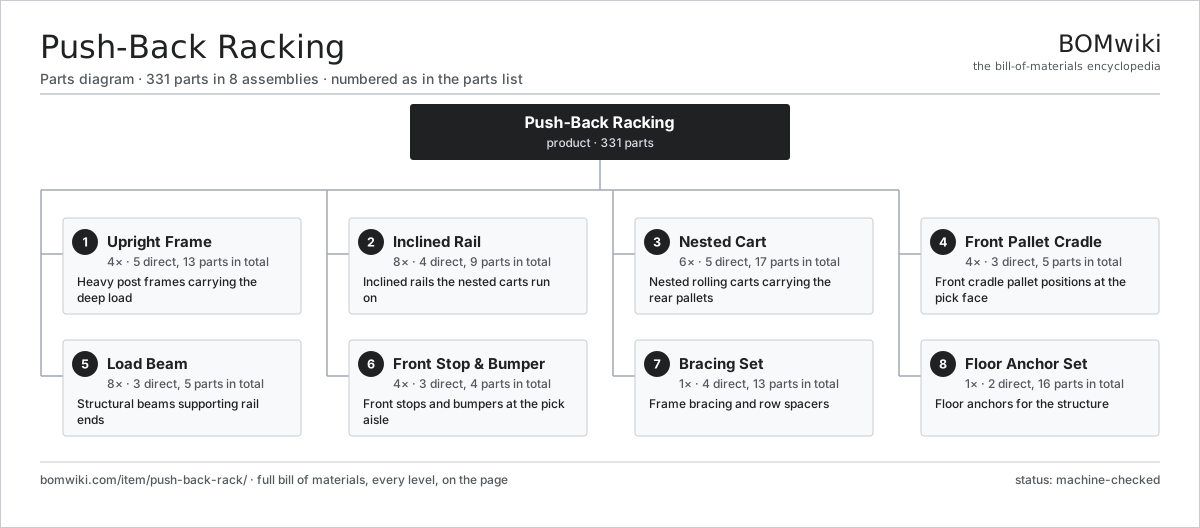
| # | Part | Qty | What it does |
|---|---|---|---|
| 1 | Upright Frame 5 parts | 4× | Heavy post frames carrying the deep load |
| 2 | Inclined Rail 4 parts | 8× | Inclined rails the nested carts run on |
| 3 | Nested Cart 5 parts | 6× | Nested rolling carts carrying the rear pallets |
| 4 | Front Pallet Cradle 3 parts | 4× | Front cradle pallet positions at the pick face |
| 5 | Load Beam 3 parts | 8× | Structural beams supporting rail ends |
| 6 | Front Stop & Bumper 3 parts | 4× | Front stops and bumpers at the pick aisle |
| 7 | Bracing Set 4 parts | 1× | Frame bracing and row spacers |
| 8 | Floor Anchor Set 2 parts | 1× | Floor anchors for the structure |
3D model
No 3D model yet. Have a CAD file of this? Add a 3D model — STL renders right on this page; STEP, FreeCAD, and OpenSCAD sources are welcome too (openly licensed, like all 3D models on BOMwiki).
Build & assembly graph
expand / collapse · shared sub-assemblies converge · links to related products · est. labourTap an assembly to expand/collapse · tap a part to open it · use “Open page” for any node · drag to pan, scroll to zoom.
Bill of materials for Push-Back Racking
8 top-level lines · 37 rows shown · 331 parts total · indented to 3 levels| # | Item / sub-assembly | Part no. | Qty/assy | Ext. qty | Parts | Type |
|---|---|---|---|---|---|---|
| 1 | Upright Frame 5 parts | push-back-rack-upright-frame | 4× | 4 | 13 | assembly |
| 1.1 | Upright Post | push-back-rack-post | 2× | 8 | · | part |
| 1.2 | Frame Brace | push-back-rack-frame-brace | 6× | 24 | · | part |
| 1.3 | Base Plate | push-back-rack-base-plate | 2× | 8 | · | part |
| 1.4 | Column Guard | push-back-rack-column-guard | 2× | 8 | · | part |
| 1.5 | Fastener Set | fastener-set | 1× | 4 | · | part |
| 2 | Inclined Rail 4 parts | push-back-rack-inclined-rail | 8× | 8 | 9 | assembly |
| 2.1 | Rail Channel | push-back-rack-rail-channel | 2× | 16 | · | part |
| 2.2 | Rail Bracket | push-back-rack-rail-bracket | 4× | 32 | · | part |
| 2.3 | Rail Wear Pad | push-back-rack-rail-wear-pad | 2× | 16 | · | part |
| 2.4 | Fastener Set | fastener-set | 1× | 8 | · | part |
| 3 | Nested Cart 5 parts | push-back-rack-cart-set | 6× | 6 | 17 | assembly |
| 3.1 | Cart Frame | push-back-rack-cart-frame | 1× | 6 | · | part |
| 3.2 | Cart Wheel | push-back-rack-cart-wheel | 4× | 24 | · | part |
| 3.3 | Cart Side Guide | push-back-rack-cart-guide | 2× | 12 | · | part |
| 3.4 | Cart Travel Stop | push-back-rack-cart-stop | 2× | 12 | · | part |
| 3.5 | Ball Bearing | ball-bearing | 8× | 48 | · | part |
| 4 | Front Pallet Cradle 3 parts | push-back-rack-front-cart | 4× | 4 | 5 | assembly |
| 4.1 | Cradle Support Rail | push-back-rack-cradle-rail | 2× | 8 | · | part |
| 4.2 | Cradle Stop | push-back-rack-cradle-stop | 1× | 4 | · | part |
| 4.3 | Cradle Guide | push-back-rack-cradle-guide | 2× | 8 | · | part |
| 5 | Load Beam 3 parts | push-back-rack-load-beam | 8× | 8 | 5 | assembly |
| 5.1 | Load Beam | push-back-rack-beam | 1× | 8 | · | part |
| 5.2 | Beam Connector | push-back-rack-beam-connector | 2× | 16 | · | part |
| 5.3 | Beam Safety Pin | push-back-rack-safety-pin | 2× | 16 | · | part |
| 6 | Front Stop & Bumper 3 parts | push-back-rack-stop-bumper | 4× | 4 | 4 | assembly |
| 6.1 | Front Pallet Stop | push-back-rack-front-stop | 1× | 4 | · | part |
| 6.2 | Load Face Bumper | push-back-rack-bumper | 1× | 4 | · | part |
| 6.3 | Pallet Entry Guide | push-back-rack-pallet-guide | 2× | 8 | · | part |
| 7 | Bracing Set 4 parts | push-back-rack-bracing | 1× | 1 | 13 | assembly |
| 7.1 | Row Spacer | push-back-rack-row-spacer | 4× | 4 | · | part |
| 7.2 | Diagonal Brace | push-back-rack-diagonal-brace | 4× | 4 | · | part |
| 7.3 | Horizontal Tie | push-back-rack-horizontal-tie | 4× | 4 | · | part |
| 7.4 | Fastener Set | fastener-set | 1× | 1 | · | part |
| 8 | Floor Anchor Set 2 parts | push-back-rack-anchor-set | 1× | 1 | 16 | assembly |
| 8.1 | Floor Anchor Bolt | push-back-rack-anchor-bolt | 8× | 8 | · | part |
| 8.2 | Anchor Washer | push-back-rack-anchor-washer | 8× | 8 | · | part |
Sourcing: possible vendors
Prices, MOQ, and lead times are algorithmic estimates, not quotes, and not claims about these companies. Company mappings are curated by keyword; est. price band $2k–$300k. How estimates work| Vendor | HQ | Specialty | MOQ | Lead time |
|---|---|---|---|---|
| toyota-industries.com ↗ | Kariya, JP | Forklifts & logistics | 20 units | 10–16 wks |
| kiongroup.com ↗ | Frankfurt, DE | Forklifts (Linde, STILL) | 20 units | 10–16 wks |
| jungheinrich.com ↗ | Hamburg, DE | Warehouse trucks | 20 units | 10–16 wks |
| crown.com ↗ | New Bremen, US | Forklifts | 20 units | 10–16 wks |
|
🇨🇳Hangcha
hcforklift.com ↗
|
Hangzhou, CN | Forklifts & material handling | 20 units | 10–16 wks |
1,010-word article