Walkie Stacker
ProductOverview
A walkie stacker is the smallest powered machine that can both move a pallet and stack it onto racking. An operator walks behind it, steering with a tiller, while the truck carries the load and does the lifting electrically. It fills the gap between a hand pallet truck, which can only move loads at floor level, and a ride-on forklift, which is larger, heavier, and needs a trained driver. Warehouses, retail backrooms, and small distribution sites use stackers to put away and pick stock from the first few levels of shelving in tight spaces. The machine is built from a compact Chassis, a Mast Assembly, a Drive Unit, a Lift System, a Battery System, a Tiller Control, and an Electrical System.
Chassis and stability
The Chassis is a small welded Frame that packs the drive, battery, and lift pump into a footprint not much larger than a pallet. Because the truck has no heavy counterweight, it gets its forward stability another way: a pair of Straddle Leg legs run forward under the load, each ending in a Load Wheel. Those legs put a wheel ahead of the load's center so it cannot tip forward, which is why a stacker can lift a full pallet while weighing only a fraction of an equivalent counterbalance forklift. The load wheels use Polyurethane Tire non-marking poly treads suited to clean indoor floors.
Mast and forks
The Mast Assembly raises the load. A two-stage mast nests an Inner Mast Channel channel inside an Outer Mast Channel channel, and an Lift Cylinder working through a Lift Chain chain raises the Fork Carriage up to several meters. The carriage rides on Mast Roller rollers and carries two light Fork tines on the Carriage Plate. The mast is sized for putting away the lower racking levels, so it is lighter and shorter than a forklift mast but works the same way.
Drive unit
The Drive Unit is a single steered wheel doing all the propulsion and steering. An AC Traction Motor drives the Drive Wheel through a Drive Gearbox reduction, and an Encoder on the motor lets the controller hold a smooth set speed. AC motors are now standard here because they need no brushes to wear and give precise low-speed control for inching into a rack. An Electromagnetic Brake spring-applied brake holds the truck whenever power is off, so the stacker cannot roll on a slope.
Lift system
Lifting is electrohydraulic. The Lift System is a self-contained power pack: an Lift Motor spins an Lift Pump gear pump that draws oil from the Lift Reservoir and pushes it into the lift cylinder only while the operator holds the lift button. Lowering does not use the pump; instead a Lowering Valve meters oil back out of the cylinder under the load's own weight, giving a controlled descent. This on-demand design saves battery energy because the pump runs only during a lift.
Battery and electrical system
The Battery System is the energy source for everything. Older trucks use a lead-acid block, but lithium is now common because it charges faster and can be topped up between shifts. The Traction Battery feeds the Electrical System, whose Traction Controller drives both motors from the battery through power MOSFETs. A Battery Management watches the lithium cells, a Onboard Charger refills the pack from a wall outlet, and a DC Contactor switches the main line. The operator sees charge and faults on a Status Display, enables the truck with a Key Switch, and can cut power with an Emergency Stop.
Tiller control and safety
The operator runs the truck entirely from the Tiller Control. The Tiller Arm swivels to steer the drive wheel, and the Tiller Head carries buttons for lift, lower, and horn plus a Speed Butterfly thumb wheel that sets travel speed and direction. Two safety features define the machine. A Tiller Spring returns the tiller to the upright position when released, which applies the brake, so the truck stops if the operator lets go. And a Belly Switch on the head reverses the truck for a moment if the operator backs into it, preventing the operator from being pinned against a wall or rack. Both are required because the operator walks in the truck's path rather than riding on it.
Variants and use
Capacities run from about 1,000 kg up to 1,600 kg, with lift heights from 2.5 m to 5.5 m. Straddle models use the leg-and-load-wheel layout for open pallets, while reach and counterbalance variants handle closed-bottom pallets or stacking without legs in the aisle. A platform-equipped version lets the operator ride for longer travel. Buyers are operations that move and stack moderate volumes in confined space: shops, pharmacies, parts stores, and the put-away end of small warehouses where a full forklift would be too big.
Walkie Stacker parts and their functions
7 top-level parts · 541 parts in total · full bill of materials below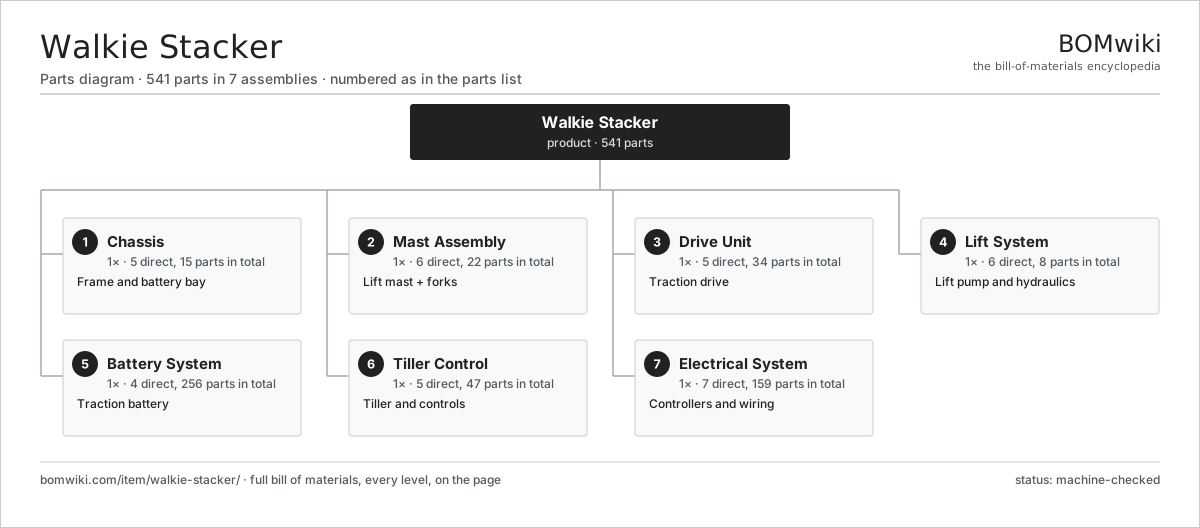
| # | Part | Qty | What it does |
|---|---|---|---|
| 1 | Chassis 5 parts | 1× | Frame and battery bay |
| 2 | Mast Assembly 6 parts | 1× | Lift mast + forks |
| 3 | Drive Unit 5 parts | 1× | Traction drive |
| 4 | Lift System 6 parts | 1× | Lift pump and hydraulics |
| 5 | Battery System 4 parts | 1× | Traction battery |
| 6 | Tiller Control 5 parts | 1× | Tiller and controls |
| 7 | Electrical System 7 parts | 1× | Controllers and wiring |
3D model
No 3D model yet. Have a CAD file of this? Add a 3D model — STL renders right on this page; STEP, FreeCAD, and OpenSCAD sources are welcome too (openly licensed, like all 3D models on BOMwiki).
Build & assembly graph
expand / collapse · shared sub-assemblies converge · links to related products · est. labourTap an assembly to expand/collapse · tap a part to open it · use “Open page” for any node · drag to pan, scroll to zoom.
Bill of materials for Walkie Stacker
7 top-level lines · 83 rows shown · 541 parts total · indented to 3 levels| # | Item / sub-assembly | Part no. | Qty/assy | Ext. qty | Parts | Type |
|---|---|---|---|---|---|---|
| 1 | Chassis 5 parts | ws-chassis | 1× | 1 | 15 | assembly |
| 1.1 | Frame | ws-frame | 1× | 1 | · | part |
| 1.2 | Straddle Leg | ws-straddle-leg | 2× | 2 | · | part |
| 1.3 | Load Wheel 3 parts | ws-load-wheel | 2× | 2 | 4 | assembly |
| 1.3.1 | Polyurethane Tire | ws-poly-tire | 1× | 2 | · | part |
| 1.3.2 | Ball Bearing | ball-bearing | 2× | 4 | · | part |
| 1.3.3 | Wheel Axle | ws-wheel-axle | 1× | 2 | · | part |
| 1.4 | Sheet Metal Panel | sheet-panel | 3× | 3 | · | part |
| 1.5 | Fastener Set | fastener-set | 1× | 1 | · | part |
| 2 | Mast Assembly 6 parts | ws-mast-assembly | 1× | 1 | 22 | assembly |
| 2.1 | Outer Mast Channel | ws-mast-outer | 2× | 2 | · | part |
| 2.2 | Inner Mast Channel | ws-mast-inner | 2× | 2 | · | part |
| 2.3 | Lift Cylinder 4 parts | ws-lift-cylinder | 1× | 1 | 4 | assembly |
| 2.3.1 | Cylinder Barrel | rtf-cylinder-barrel | 1× | 1 | · | part |
| 2.3.2 | Piston Rod | rtf-piston-rod | 1× | 1 | · | part |
| 2.3.3 | O-Ring Set | oring-set | 1× | 1 | · | part |
| 2.3.4 | Rod Seal | rtf-rod-seal | 1× | 1 | · | part |
| 2.4 | Lift Chain | rtf-lift-chain | 1× | 1 | · | part |
| 2.5 | Fork Carriage 3 parts | ws-fork-carriage | 1× | 1 | 7 | assembly |
| 2.5.1 | Carriage Plate | rtf-carriage-plate | 1× | 1 | · | part |
| 2.5.2 | Fork | ws-fork | 2× | 2 | · | part |
| 2.5.3 | Mast Roller | rtf-mast-roller | 4× | 4 | · | part |
| 2.6 | Mast Roller | rtf-mast-roller | 6× | 6 | · | part |
| 3 | Drive Unit 5 parts | ws-drive-unit | 1× | 1 | 34 | assembly |
| 3.1 | Traction Motor 5 parts | ws-traction-motor | 1× | 1 | 26 | assembly |
| 3.1.1 | Stator Assembly 3 parts + deeper › | stator-assembly | 1× | 1 | 3 | assembly |
| 3.1.2 | Rotor Assembly 4 parts + deeper › | rotor-assembly | 1× | 1 | 19 | assembly |
| 3.1.3 | Motor Housing | ws-motor-housing | 1× | 1 | · | part |
| 3.1.4 | Ball Bearing | ball-bearing | 2× | 2 | · | part |
| 3.1.5 | Encoder | encoder | 1× | 1 | · | part |
| 3.2 | Drive Gearbox 3 parts | ws-drive-gearbox | 1× | 1 | 4 | assembly |
| 3.2.1 | Helical Gear Pair | gear-pair | 1× | 1 | · | part |
| 3.2.2 | Gearbox Housing | gearbox-housing | 1× | 1 | · | part |
| 3.2.3 | Oil Seal | oil-seal | 2× | 2 | · | part |
| 3.3 | Drive Wheel | ws-drive-wheel | 1× | 1 | · | part |
| 3.4 | Electromagnetic Brake | ws-em-brake | 1× | 1 | · | part |
| 3.5 | Ball Bearing | ball-bearing | 2× | 2 | · | part |
| 4 | Lift System 6 parts | ws-lift-system | 1× | 1 | 8 | assembly |
| 4.1 | Lift Motor | ws-lift-motor | 1× | 1 | · | part |
| 4.2 | Lift Pump | ws-lift-pump | 1× | 1 | · | part |
| 4.3 | Lift Reservoir | ws-lift-tank | 1× | 1 | · | part |
| 4.4 | Lowering Valve | ws-lowering-valve | 1× | 1 | · | part |
| 4.5 | Hydraulic Hose | rtf-hydraulic-hose | 3× | 3 | · | part |
| 4.6 | Pressure Sensor | pressure-sensor | 1× | 1 | · | part |
| 5 | Battery System 4 parts | ws-battery-system | 1× | 1 | 256 | assembly |
| 5.1 | Traction Battery 3 parts | ws-battery-pack | 1× | 1 | 108 | assembly |
| 5.1.1 | Li-ion Cell, 18650 | li-cell-18650 | 96× | 96 | · | part |
| 5.1.2 | Nickel Busbar | cell-busbar | 8× | 8 | · | part |
| 5.1.3 | Pack Enclosure 4 parts + deeper › | pack-enclosure | 1× | 1 | 4 | assembly |
| 5.2 | Onboard Charger 4 parts | ws-charger | 1× | 1 | 84 | assembly |
| 5.2.1 | Bare PCB | pcb-bare | 1× | 1 | · | part |
| 5.2.2 | Power Supply | power-supply | 1× | 1 | · | part |
| 5.2.3 | Power Inductor | power-inductor | 2× | 2 | · | part |
| 5.2.4 | SMD Passive (R/C/L) | smd-passives | 80× | 80 | · | part |
| 5.3 | Battery Connector | ws-battery-connector | 1× | 1 | · | part |
| 5.4 | Battery Management 4 parts | ws-bms | 1× | 1 | 63 | assembly |
| 5.4.1 | Bare PCB | pcb-bare | 1× | 1 | · | part |
| 5.4.2 | Microcontroller | mcu | 1× | 1 | · | part |
| 5.4.3 | Analog Front-End IC | afe-ic | 1× | 1 | · | part |
| 5.4.4 | SMD Passive (R/C/L) | smd-passives | 60× | 60 | · | part |
| 6 | Tiller Control 5 parts | ws-tiller-control | 1× | 1 | 47 | assembly |
| 6.1 | Tiller Arm | ws-tiller-arm | 1× | 1 | · | part |
| 6.2 | Tiller Head 4 parts | ws-tiller-head | 1× | 1 | 43 | assembly |
| 6.2.1 | Bare PCB | pcb-bare | 1× | 1 | · | part |
| 6.2.2 | Microcontroller | mcu | 1× | 1 | · | part |
| 6.2.3 | Button Set | ws-button-set | 1× | 1 | · | part |
| 6.2.4 | SMD Passive (R/C/L) | smd-passives | 40× | 40 | · | part |
| 6.3 | Speed Butterfly | ws-throttle-butterfly | 1× | 1 | · | part |
| 6.4 | Belly Switch | ws-belly-switch | 1× | 1 | · | part |
| 6.5 | Tiller Spring | ws-tiller-spring | 1× | 1 | · | part |
| 7 | Electrical System 7 parts | ws-electrical-system | 1× | 1 | 159 | assembly |
| 7.1 | Traction Controller 5 parts | ws-traction-controller | 1× | 1 | 136 | assembly |
| 7.1.1 | Bare PCB | pcb-bare | 1× | 1 | · | part |
| 7.1.2 | Microcontroller | mcu | 1× | 1 | · | part |
| 7.1.3 | Power MOSFET | mosfet | 12× | 12 | · | part |
| 7.1.4 | Gate Driver IC | gate-driver-ic | 2× | 2 | · | part |
| 7.1.5 | SMD Passive (R/C/L) | smd-passives | 120× | 120 | · | part |
| 7.2 | Status Display | ws-display | 1× | 1 | · | part |
| 7.3 | Key Switch | ws-key-switch | 1× | 1 | · | part |
| 7.4 | Emergency Stop | ws-estop | 1× | 1 | · | part |
| 7.5 | DC Contactor | contactor | 1× | 1 | · | part |
| 7.6 | Wire Bundle | wire-bundle | 1× | 1 | · | part |
| 7.7 | Connector | connector | 18× | 18 | · | part |
Related products
same domain, ranked by shared parts Rough-Terrain Forklift
247 parts · shares 11 with this page
Rough-Terrain Forklift
247 parts · shares 11 with this page
 Telescopic Handler
380 parts · shares 9 with this page
Telescopic Handler
380 parts · shares 9 with this page
 Container Handler
552 parts · shares 7 with this page
Container Handler
552 parts · shares 7 with this page
 Tilt-Tray Sorter
6,031 parts · shares 7 with this page
Tilt-Tray Sorter
6,031 parts · shares 7 with this page
 Cross-Belt Sorter
25,040 parts · shares 6 with this page
Cross-Belt Sorter
25,040 parts · shares 6 with this page
Sourcing: possible vendors
Prices, MOQ, and lead times are algorithmic estimates, not quotes, and not claims about these companies. Company mappings are curated by keyword; est. price band $2k–$300k. How estimates work| Vendor | HQ | Specialty | MOQ | Lead time |
|---|---|---|---|---|
| toyota-industries.com ↗ | Kariya, JP | Forklifts & logistics | 20 units | 10–16 wks |
| kiongroup.com ↗ | Frankfurt, DE | Forklifts (Linde, STILL) | 20 units | 10–16 wks |
| jungheinrich.com ↗ | Hamburg, DE | Warehouse trucks | 20 units | 10–16 wks |
| crown.com ↗ | New Bremen, US | Forklifts | 20 units | 10–16 wks |
|
🇨🇳Hangcha
hcforklift.com ↗
|
Hangzhou, CN | Forklifts & material handling | 20 units | 10–16 wks |
858-word article