Bone Conduction Headphones
ProductOverview
Bone conduction headphones transmit audio directly through the temporal bone (mastoid region) via mechanical vibration, bypassing the outer and middle ear entirely. This design allows the listener to hear music or calls while keeping the ear canal open, making ambient sounds audible and providing a critical safety advantage for cyclists, runners, and drivers. The Bone Conduction Headphones architecture uses a titanium band arched over the top of the head, with two bone conduction transducers resting against the temples, coupled to a Bluetooth radio, amplifier, and rechargeable battery.
Unlike conventional headphones where the speaker cone vibrates air and sound enters the ear canal through the outer ear, bone conduction sends vibrations through bone to the inner ear (cochlea) directly. The pathway bypasses conductive hearing loss problems (damaged eardrums or ossicles) that would render conventional headphones useless, making bone conduction a therapeutic aid for some deaf and hard-of-hearing users.
How it works
The left and right Bone Conduction Transducer units are identical electromechanical devices mounted symmetrically at the temples. Each contains a miniature Bone Conduction Driver, a piezoelectric or electromagnetic linear motor generating vibrations at frequencies spanning 20 Hz to 20 kHz. The motor's moving mass is mechanically coupled to a Contact Plate, typically a 10 mm × 20 mm titanium or ceramic surface that couples vibration directly to the temporal bone beneath the skin.
Driving the motor requires substantial current at audio frequencies. The Control & Amplification Board houses a Dual Class-D Amplifier, a stereo class-D amplifier rated 1.5 W per channel, fed by the Audio Codec IC, which decompresses Bluetooth audio (from SBC, AAC, aptX, or LDAC codecs) into left and right analog signals. The codec chains the signal through digital equalization filters that sculpt the frequency response, boosting mid-bass and treble to compensate for the bone conduction pathway's natural roll-off at very low and very high frequencies, ensuring music sounds balanced to the listener's perception.
Wireless audio arrives via the Bluetooth 5.1 Module, a Bluetooth 5.1 transceiver with integrated antenna, operating in the 2.4 GHz ISM band. The radio supports stereo music streaming (A2DP Bluetooth profile) for 6–8 hours from a single Battery Pack charge, and voice-call profiles (HFP/HSP) for take-a-call functionality.
The Microphone Module module, an omnidirectional MEMS microphone with preamp, is mounted on the left temple near the mouth. Its placement catches speech clearly while also capturing ambient room sounds for conference calls. The microphone signal feeds back to the Audio Codec IC, which applies noise cancellation filtering before transmission back through Bluetooth to the phone or computer.
Power is supplied by a Battery Pack, a small 180 mAh 3.7 V LiPo cell stored inside the titanium band itself, managed by the Battery Management IC (battery management system) that monitors cell voltage and temperature, protecting against over-charge and thermal runaway. Charging occurs via a Charging Dock, a magnetic-alignment cradle containing Pogo Pin Contacts that connect the headphone connector pads to a 5 W USB charger, refilling the battery in approximately 2 hours.
The Titanium Headband itself is fashioned from surgical-grade titanium (Grade 5) tubing with a 6 mm outer diameter and 1.5 mm wall, providing exceptional strength-to-weight ratio and biocompatibility. The band is shaped in a gentle arch fitting over the head from temple to temple, with small Ear Loop loops guiding the band to rest precisely at the temples without clamping the ears. Silicone Padding, soft medical-grade silicone gel cushions, underlay the contact points, distributing force over a 20 mm × 10 mm area to prevent localized pressure sores during all-day wear.
Advantages and limitations
The open-ear design makes bone conduction ideal for outdoor activities and safety-critical scenarios: a cyclist or jogger remains aware of traffic, pedestrians, and environmental hazards while enjoying music. For workplace communications, the bone conduction path preserves natural hearing of one's surroundings while allowing clear call audio.
However, bone conduction has inherent limitations. Low-frequency response, bass notes, is challenging because bone's mechanical impedance rises at higher frequencies; producing deep 50 Hz tones requires substantially more current than conventional headphones. The contact point against the temporal bone becomes uncomfortable during very long sessions (> 8 hours) due to sustained pressure. And the technology is unsuitable for silent, public spaces like libraries or offices, where the vibration and audible transducer hum could disturb bystanders.
Typical scenario
A runner enables Bluetooth pairing with their smartphone and starts their morning workout with bone-conduction headphones securely fitted over their head. Music streams wirelessly through the Bluetooth 5.1 Module, driving the Dual Class-D Amplifier and Bone Conduction Driver units. The runner maintains full environmental awareness: approaching car horns, pedestrian chatter, and their own footfalls remain clearly audible through the open ear canal. When an incoming call arrives, the audio transitions seamlessly to voice via the headphone microphone, allowing a hands-free conversation at full running pace without breaking stride or removing any earpieces. The Battery Pack provides 6–8 hours of continuous playtime across many such runs before the user docks the headphones in the Charging Dock for overnight top-up.
Bone Conduction Headphones parts and their functions
8 top-level parts · 34 parts in total · full bill of materials below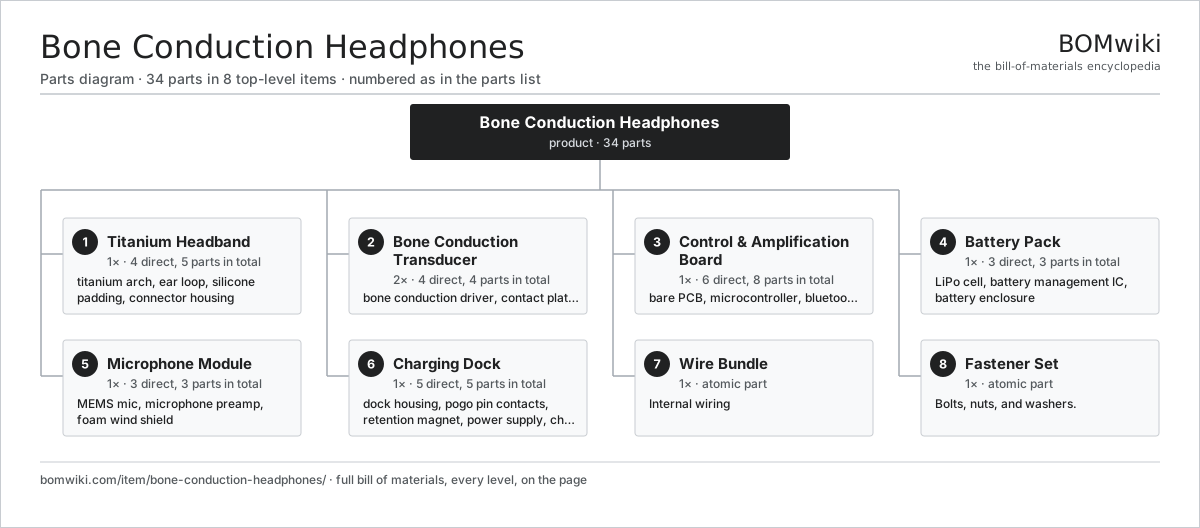
| # | Part | Qty | What it does |
|---|---|---|---|
| 1 | Titanium Headband 4 parts | 1× | Flexible surgical-grade titanium arch with integrated electronics and padding. |
| 2 | Bone Conduction Transducer 4 parts | 2× | Vibration motor and contact interface creating direct mechanical coupling to temporal bone. |
| 3 | Control & Amplification Board 6 parts | 1× | Audio processing, Bluetooth radio, and dual-channel bone conduction amplifier. |
| 4 | Battery Pack 3 parts | 1× | Rechargeable LiPo cell and protection circuitry mounted in one ear temple. |
| 5 | Microphone Module 3 parts | 1× | Omnidirectional MEMS microphone with noise cancellation for call pickup. |
| 6 | Charging Dock 5 parts | 1× | Magnetic alignment cradle with pogo pin contacts and AC adapter. |
| 7 | Wire Bundle | 1× | Internal wiring |
| 8 | Fastener Set | 1× | Bolts, nuts, and washers. |
3D model
No 3D model yet. Have a CAD file of this? Add a 3D model. STL renders right on this page; STEP, FreeCAD, and OpenSCAD sources are welcome too (openly licensed, like all 3D models on BOMwiki).
Build & assembly graph
expand / collapse · shared sub-assemblies converge · links to related products · est. labourTap an assembly to expand/collapse · tap a part to open it · use “Open page” for any node · drag to pan, scroll to zoom.
Bill of materials for Bone Conduction Headphones
8 top-level lines · 33 rows shown · 34 parts total · indented to 3 levels| # | Item / sub-assembly | Part no. | Qty/assy | Ext. qty | Parts | Type |
|---|---|---|---|---|---|---|
| 1 | Titanium Headband 4 parts | bone-conduction-headphones-band | 1× | 1 | 5 | assembly |
| 1.1 | Titanium Arch | bone-conduction-headphones-band-core | 1× | 1 | · | part |
| 1.2 | Ear Loop | bone-conduction-headphones-ear-hook | 2× | 2 | · | part |
| 1.3 | Silicone Padding | bone-conduction-headphones-padding | 1× | 1 | · | part |
| 1.4 | Connector Housing | bone-conduction-headphones-connector-housing | 1× | 1 | · | part |
| 2 | Bone Conduction Transducer 4 parts | bone-conduction-headphones-transducer-assembly | 2× | 2 | 4 | assembly |
| 2.1 | Bone Conduction Driver | bone-conduction-headphones-actuator-motor | 1× | 2 | · | part |
| 2.2 | Contact Plate | bone-conduction-headphones-contactor-plate | 1× | 2 | · | part |
| 2.3 | Motor Mount Bracket | bone-conduction-headphones-mounting-bracket | 1× | 2 | · | part |
| 2.4 | Cable Strain Relief | bone-conduction-headphones-cable-strain-relief | 1× | 2 | · | part |
| 3 | Control & Amplification Board 6 parts | bone-conduction-headphones-control-board | 1× | 1 | 8 | assembly |
| 3.1 | Bare PCB | pcb-bare | 1× | 1 | · | part |
| 3.2 | Microcontroller | mcu | 1× | 1 | · | part |
| 3.3 | Bluetooth 5.1 Module | bone-conduction-headphones-bt-radio | 1× | 1 | · | part |
| 3.4 | Audio Codec IC | bone-conduction-headphones-audio-codec | 1× | 1 | · | part |
| 3.5 | Dual Class-D Amplifier | bone-conduction-headphones-dual-amp | 1× | 1 | · | part |
| 3.6 | Connector | connector | 3× | 3 | · | part |
| 4 | Battery Pack 3 parts | bone-conduction-headphones-battery | 1× | 1 | 3 | assembly |
| 4.1 | LiPo Cell | lipo-cell | 1× | 1 | · | part |
| 4.2 | Battery Management IC | bone-conduction-headphones-bms | 1× | 1 | · | part |
| 4.3 | Battery Enclosure | bone-conduction-headphones-battery-housing | 1× | 1 | · | part |
| 5 | Microphone Module 3 parts | bone-conduction-headphones-microphone | 1× | 1 | 3 | assembly |
| 5.1 | MEMS Mic | bone-conduction-headphones-mems-mic | 1× | 1 | · | part |
| 5.2 | Microphone Preamp | bone-conduction-headphones-mic-preamp | 1× | 1 | · | part |
| 5.3 | Foam Wind Shield | bone-conduction-headphones-wind-shield | 1× | 1 | · | part |
| 6 | Charging Dock 5 parts | bone-conduction-headphones-charging-dock | 1× | 1 | 5 | assembly |
| 6.1 | Dock Housing | bone-conduction-headphones-dock-base | 1× | 1 | · | part |
| 6.2 | Pogo Pin Contacts | bone-conduction-headphones-pogo-pins | 1× | 1 | · | part |
| 6.3 | Retention Magnet | bone-conduction-headphones-magnet-ring | 1× | 1 | · | part |
| 6.4 | Power Supply | power-supply | 1× | 1 | · | part |
| 6.5 | Charging Indicator LED | bone-conduction-headphones-dock-led | 1× | 1 | · | part |
| 7 | Wire Bundle | wire-bundle | 1× | 1 | · | part |
| 8 | Fastener Set | fastener-set | 1× | 1 | · | part |
Something wrong in this list? Report a problem with this BOM.
Related products
same domain, ranked by shared parts Digital Audio Player
267 parts · shares 3 with this page
Digital Audio Player
267 parts · shares 3 with this page
 Game Console
114 parts · shares 3 with this page
Game Console
114 parts · shares 3 with this page
 Electric Arc Lighter
113 parts · shares 2 with this page
FPV Goggles
33 parts · shares 2 with this page
Electric Arc Lighter
113 parts · shares 2 with this page
FPV Goggles
33 parts · shares 2 with this page
 GPS Tracker
225 parts · shares 2 with this page
GPS Tracker
225 parts · shares 2 with this page
 Noise-Cancelling Headphones
165 parts · shares 2 with this page
Noise-Cancelling Headphones
165 parts · shares 2 with this page
Sourcing: possible vendors
Browse the supplier directory → Prices, MOQ, and lead times are algorithmic estimates, not quotes, and not claims about these companies. Company mappings are curated by keyword; est. price band $50–$2k. How estimates work| Vendor | HQ | Specialty | MOQ | Lead time |
|---|---|---|---|---|
|
🇨🇳Foxconn
foxconn.com ↗
|
Shenzhen, CN | Electronics contract mfg | 1,000 units | 8–14 wks |
|
🇺🇸Jabil
jabil.com ↗
|
St. Petersburg, US | Electronics manufacturing | 1,000 units | 8–14 wks |
|
🇺🇸Flex
flex.com ↗
|
Austin, US | Electronics manufacturing | 1,000 units | 8–14 wks |
| celestica.com ↗ | Toronto, CA | Electronics manufacturing | 1,000 units | 8–14 wks |
|
🇺🇸Sanmina
sanmina.com ↗
|
San Jose, US | Electronics manufacturing | 1,000 units | 8–14 wks |
908-word article