Mattress Tufting Machine
ProductOverview
The mattress tufting machine automates one of the final surface-finishing steps in mattress production: quilting buttons or anchors through the mattress layers at a regular grid pattern. This decorative and functional operation holds the internal springs and foam layers together, preventing shift and lumping during use and transport. Industrial tufting machines can process 5–30 mattress rows per hour (depending on grid spacing), compared to hand-tufting which might manage 2–3 mattresses per day.
The machine consists of a rotating mattress platform that clamps the finished mattress, a multi-needle frame (typically 8–32 needles per row) synchronized to penetrate vertically through all layers, a button supply and placement system, and a rear-side anchor crimper that locks the button/anchor in place. Servo-driven XY positioning moves the needle frame to precise grid locations, and a PLC control system coordinates all motion and timing.
How it works
The finished mattress is positioned on the rotating turntable and secured using four pneumatic edge-grip arms with soft foam pads. The electric height adjustment leadscrew raises or lowers the turntable (±100 mm range) to position the mattress surface at the correct height beneath the needle frame. The operator or upstream PLC programs the desired button grid spacing (e.g., 100 mm × 150 mm for a queen mattress) and penetration depth (e.g., 150 mm for a 200 mm thick mattress).
The needle frame consists of a hardened steel bar (50×50 mm section) with precision-drilled holes spaced 50 mm apart along its length. Each hole accommodates one industrial #23 or #24 sewing needle (shank diameter 2–2.5 mm). The needles are held by hardened steel bushings that ensure perfectly straight penetration. Behind each needle is a heavy-duty compression spring pre-compressed to provide upward retraction force after the needle is driven downward.
The large pneumatic drive ram (bore 120–150 mm) is mounted above the needle frame and supplies downward force. When the cylinder extends, it drives all needles downward simultaneously at 6–10 bar pressure, with a stroke of 300 mm. The mechanical depth stop screw limits penetration to the programmed depth (e.g., 150 mm), ensuring needles pass completely through the mattress but stop before exiting the underside.
As the needles descend and penetrate the mattress, the button supply system activates. A vibratory hopper (electromagnetic, 50 Hz) feeds plastic or fabric-covered buttons to a pneumatic pick-and-place arm. The arm's neodymium gripper magnet picks a single button and positions it above the first needle. As the needle reaches maximum penetration, a tapered guide tube aligns the button's center hole with the needle point. The button slides down onto the needle shaft, resting against the mattress surface.
Simultaneously, on the underside of the mattress, a pneumatic rear anchor arm (with its own 4–6-axis articulation) positions a hardened steel crimp die under the needle shaft. A pneumatic solenoid valve triggers the crimp ram, which applies 1000+ N force, crimping a plastic anchor washer over the needle shank. This anchor locks the needle permanently in place, anchoring the button to the mattress core.
After the crimp is complete and pressure is released, the springs push the needles back upward. The proportional pneumatic retract valve controls the speed of retraction, preventing sudden shock. Once the needles are fully retracted, the limit switch detects full retraction and signals the next motion sequence.
The XY positioning system consists of two NEMA 34 stepper motors (X and Y axes) driving the needle frame via preloaded ball screws and profile linear rails. Under PLC control, the stepper motors advance the needle frame to the next grid location (e.g., 100 mm in X, then retract to home, then advance 150 mm in Y). The PLC outputs step/direction pulse trains to stepper drivers, achieving ±0.5 mm positioning accuracy.
Once the needle frame is repositioned, the next row of tufts is formed: buttons are placed via the picker arm, needles penetrate, anchors are crimped, needles retract, and the frame moves to the next location.
After all rows have been tufted from the front, the turntable rotates slowly (1–5 rpm via a stepper motor with 20:1 reducer) to present a new section of the mattress perimeter. The clamping arms are individually retracted and advanced to reposition the mattress for the next set of rows. This process repeats until the entire mattress surface has been quilted.
Operational sequence for one mattress
- Mattress placed on turntable; clamps applied; height adjusted.
- PLC receives grid spacing and depth parameters (e.g., 100×150 mm spacing, 150 mm depth).
- Needle frame positioned to first grid point (home position, e.g., top-left corner).
- Needle drive cylinder extends; all needles penetrate simultaneously.
- Button picker arm places button on first needle.
- Rear anchor arm crimp dies engage and lock button (crimp pulse, 2–3 seconds dwell).
- Needle drive cylinder retracts; springs push needles back up.
- Limit switch detects full retraction; PLC calculates next X position.
- X stepper advances needle frame 100 mm; Y position unchanged (same row).
- Steps 4–8 repeat until end of row.
- Y stepper advances frame 150 mm (next row); X reset to home.
- Steps 4–10 repeat for all rows.
- Turntable rotates 90°; mattress clamping repositioned.
- Repeat grid pattern on new perimeter section.
- After all sides complete, mattress discharged; cycle restarts.
Total cycle time per mattress: 30–120 minutes depending on mattress size and grid density.
Button varieties and placement
Different mattress types use different button styles:
- Plastic buttons (10–25 mm diameter, 2–4 mm thick): Most common for mid-range mattresses. Lightweight, economical, available in colors.
- Fabric-covered buttons (polyester or nylon cover over plastic): Luxury mattresses; match cover colors.
- Metal anchors (zinc-alloy washers, 15–20 mm diameter): Heavy-duty construction; used instead of buttons on some designs.
The gripper and guide tube are adjusted or swapped to accommodate different button sizes. A typical changeover takes 15–30 minutes.
Grid pattern versatility
The PLC program allows arbitrary grid patterns, not just rectangular:
- Square grid: 100×100 mm (uniform aesthetic)
- Rectangular grid: 100×150 mm (varied spacing)
- Offset rows: Each row offset by half-spacing (diamond pattern)
- Custom shapes: Curved or organic button paths (programmed via CAD or HMI)
Pattern changes require only PLC reprogramming; no mechanical modifications.
Precision and reliability
Consistent button placement across 50–150 buttons per mattress (depending on size) depends on:
- Stepper positioning accuracy: ±0.5 mm repeatability via ball screw preload and linear rail guidance.
- Needle penetration depth consistency: Mechanical depth stop and proximity sensor feedback ensure depth variance <2 mm.
- Crimp force uniformity: Pneumatic pressure regulation (6–8 bar proportional valve) ensures all anchors crimp with similar force and lock integrity.
- Spring retraction: All springs must be matched stiffness and preload; worn springs reduce retraction speed and can jam needles.
Maintenance and consumables
- Needle replacement: Needles wear after 500–1000 penetrations (per needle, depending on mattress density and spring stiffness). Dull needles create runs in cover fabric and increase drive pressure. Replacement set costs ~$50–100 and takes 20–30 minutes.
- Spring inspection: Springs fatigue after 2–5 million cycles (1–2 years heavy use). Weakened springs are detected by slower retraction speed; replacement requires disassembly of needle frame.
- Anchor washer supply: Plastic anchors (15–20 mm dia., 3 mm thick) are consumable; cost ~$0.05–0.10 each.
- Button supply: Buttons (~$0.10–0.50 each depending on quality) are bulk-consumed and must be restocked regularly.
- Ball screw lubrication: Annual relubrication (NLGI Grade 2 lithium grease) with ~10 mL per screw extends service life.
Integration with downstream equipment
The mattress exits the tufting machine as a complete, quilted product ready for wrapping or roll-packing. On some production lines, the tufted mattress moves directly to the roll-packing machine for compression and film wrapping, or to the tape edge unit if edge binding is the final step.
Mattress Tufting Machine parts and their functions
8 top-level parts · 50 parts in total · full bill of materials below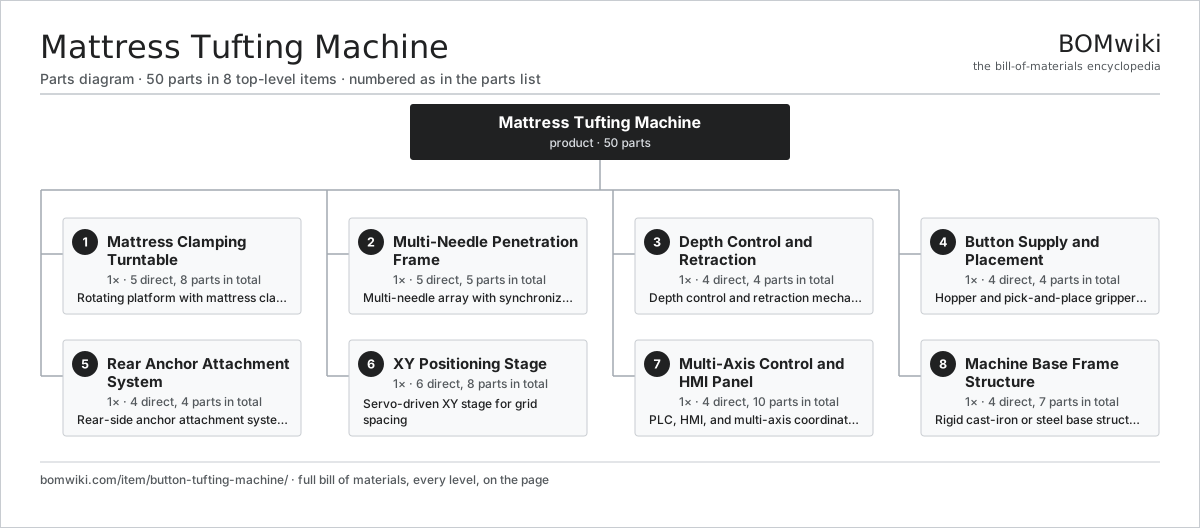
| # | Part | Qty | What it does |
|---|---|---|---|
| 1 | Mattress Clamping Turntable 5 parts | 1× | Rotating platform with mattress clamp |
| 2 | Multi-Needle Penetration Frame 5 parts | 1× | Multi-needle array with synchronized drivers |
| 3 | Depth Control and Retraction 4 parts | 1× | Depth control and retraction mechanism |
| 4 | Button Supply and Placement 4 parts | 1× | Hopper and pick-and-place gripper for buttons |
| 5 | Rear Anchor Attachment System 4 parts | 1× | Rear-side anchor attachment system |
| 6 | XY Positioning Stage 6 parts | 1× | Servo-driven XY stage for grid spacing |
| 7 | Multi-Axis Control and HMI Panel 4 parts | 1× | PLC, HMI, and multi-axis coordination |
| 8 | Machine Base Frame Structure 4 parts | 1× | Rigid cast-iron or steel base structure |
3D model
No 3D model yet. Have a CAD file of this? Add a 3D model. STL renders right on this page; STEP, FreeCAD, and OpenSCAD sources are welcome too (openly licensed, like all 3D models on BOMwiki).
Build & assembly graph
expand / collapse · shared sub-assemblies converge · links to related products · est. labourTap an assembly to expand/collapse · tap a part to open it · use “Open page” for any node · drag to pan, scroll to zoom.
Bill of materials for Mattress Tufting Machine
8 top-level lines · 44 rows shown · 50 parts total · indented to 3 levels| # | Item / sub-assembly | Part no. | Qty/assy | Ext. qty | Parts | Type |
|---|---|---|---|---|---|---|
| 1 | Mattress Clamping Turntable 5 parts | button-tufting-machine-turntable | 1× | 1 | 8 | assembly |
| 1.1 | Large Slewing Ring Bearing | button-tufting-machine-turntable-bearing | 1× | 1 | · | part |
| 1.2 | Turntable Rotation Motor | button-tufting-machine-turntable-motor | 1× | 1 | · | part |
| 1.3 | Cast Iron Turntable Platform | button-tufting-machine-turntable-platform | 1× | 1 | · | part |
| 1.4 | Pneumatic Edge Clamp Cylinder | button-tufting-machine-clamp-air-cylinders | 4× | 4 | · | part |
| 1.5 | Electric Height Adjustment Leadscrew | button-tufting-machine-height-screw | 1× | 1 | · | part |
| 2 | Multi-Needle Penetration Frame 5 parts | button-tufting-machine-needle-frame | 1× | 1 | 5 | assembly |
| 2.1 | Needle Clamp Bar | button-tufting-machine-needle-bar | 1× | 1 | · | part |
| 2.2 | Industrial Sewing Needle Set | button-tufting-machine-needle-set | 1× | 1 | · | part |
| 2.3 | Large Pneumatic Needle Drive Ram | button-tufting-machine-needle-drive-cylinder | 1× | 1 | · | part |
| 2.4 | Heavy-Duty Needle Retract Spring | button-tufting-machine-needle-retract-spring | 1× | 1 | · | part |
| 2.5 | Hardened Steel Needle Guide Bushing | button-tufting-machine-needle-guide-bushing | 1× | 1 | · | part |
| 3 | Depth Control and Retraction 4 parts | button-tufting-machine-needle-penetration | 1× | 1 | 4 | assembly |
| 3.1 | Penetration Depth Stop Screw | button-tufting-machine-depth-adjuster | 1× | 1 | · | part |
| 3.2 | Proportional Pneumatic Retract Control | button-tufting-machine-retract-pilot-valve | 1× | 1 | · | part |
| 3.3 | Needle Penetration Limit Switch | button-tufting-machine-proximity-sensor | 1× | 1 | · | part |
| 3.4 | Needle Hold-Down Clamp Sleeve | button-tufting-machine-hold-clamp | 1× | 1 | · | part |
| 4 | Button Supply and Placement 4 parts | button-tufting-machine-button-feeder | 1× | 1 | 4 | assembly |
| 4.1 | Vibratory Button Feeder Hopper | button-tufting-machine-button-hopper | 1× | 1 | · | part |
| 4.2 | Pneumatic Button Pick-and-Place Arm | button-tufting-machine-singulator | 1× | 1 | · | part |
| 4.3 | Neodymium Magnet Button Gripper | button-tufting-machine-gripper-magnet | 1× | 1 | · | part |
| 4.4 | Tapered Button Guide Tube | button-tufting-machine-button-guide-tube | 1× | 1 | · | part |
| 5 | Rear Anchor Attachment System 4 parts | button-tufting-machine-anchor-crimper | 1× | 1 | 4 | assembly |
| 5.1 | Pneumatic Rear Anchor Arm | button-tufting-machine-rear-clamp-arm | 1× | 1 | · | part |
| 5.2 | Hardened Steel Crimp Die | button-tufting-machine-crimper-die | 1× | 1 | · | part |
| 5.3 | Plastic Anchor Washer Feeder Bin | button-tufting-machine-anchor-hopper | 1× | 1 | · | part |
| 5.4 | Crimp Ram Solenoid Valve | button-tufting-machine-crimp-solenoid | 1× | 1 | · | part |
| 6 | XY Positioning Stage 6 parts | button-tufting-machine-positioning-system | 1× | 1 | 8 | assembly |
| 6.1 | X-Axis NEMA 34 Stepper Motor | button-tufting-machine-x-stepper-motor | 1× | 1 | · | part |
| 6.2 | Y-Axis NEMA 34 Stepper Motor | button-tufting-machine-y-stepper-motor | 1× | 1 | · | part |
| 6.3 | X-Axis Precision Ball Screw | button-tufting-machine-x-ballscrew | 1× | 1 | · | part |
| 6.4 | Y-Axis Precision Ball Screw | button-tufting-machine-y-ballscrew | 1× | 1 | · | part |
| 6.5 | X-Axis Linear Guide Rail | button-tufting-machine-x-linear-rail | 2× | 2 | · | part |
| 6.6 | Y-Axis Linear Guide Rail | button-tufting-machine-y-linear-rail | 2× | 2 | · | part |
| 7 | Multi-Axis Control and HMI Panel 4 parts | button-tufting-machine-control-panel | 1× | 1 | 10 | assembly |
| 7.1 | Microcontroller | mcu | 1× | 1 | · | part |
| 7.2 | LCD Panel | lcd-panel | 1× | 1 | · | part |
| 7.3 | Relay | relay | 6× | 6 | · | part |
| 7.4 | Power Supply | power-supply | 2× | 2 | · | part |
| 8 | Machine Base Frame Structure 4 parts | button-tufting-machine-frame | 1× | 1 | 7 | assembly |
| 8.1 | Ductile Iron Machine Base Casting | button-tufting-machine-base-casting | 1× | 1 | · | part |
| 8.2 | Welded Steel Vertical Column | button-tufting-machine-vertical-column | 1× | 1 | · | part |
| 8.3 | Fastener Set | fastener-set | 1× | 1 | · | part |
| 8.4 | Elastomer Vibration Isolation Foot | button-tufting-machine-vibration-feet | 4× | 4 | · | part |
Something wrong in this list? Report a problem with this BOM.
Sourcing: possible vendors
Browse the supplier directory → Prices, MOQ, and lead times are algorithmic estimates, not quotes, and not claims about these companies. Company mappings are curated by keyword; est. price band $10k–$1M. How estimates work| Vendor | HQ | Specialty | MOQ | Lead time |
|---|---|---|---|---|
|
🇨🇭Rieter
rieter.com ↗
|
Winterthur, CH | Spinning machinery | 10 units | 14–24 wks |
| truetzschler.com ↗ | Mönchengladbach, DE | Textile machinery | 10 units | 14–24 wks |
|
🇧🇪Picanol
picanol.be ↗
|
Ypres, BE | Weaving machines | 10 units | 14–24 wks |
| karlmayer.com ↗ | Obertshausen, DE | Warp knitting machines | 10 units | 14–24 wks |
|
🇨🇭Saurer
saurer.com ↗
|
Arbon, CH | Spinning & embroidery | 10 units | 14–24 wks |
1,543-word article