Industrial Flat Knitting Machine
ProductOverview
An industrial flat knitting machine builds fabric on two flat needle beds set in a shallow V, one facing the other across a narrow gap. A carriage runs back and forth along the beds, and each pass forms one course of stitches across the width. Unlike a circular machine, the flat machine knits a piece that is open at the sides, so it can widen and narrow the fabric by bringing needles in and out of work. That ability to shape the fabric while knitting is why these machines dominate sweater and outerwear panel production: a knitted panel comes off the machine already cut to the shape of a front, back or sleeve, with no fabric wasted in cutting.
The machine has a Needle Bed Assembly that holds the needles, a Cam Carriage that forms the stitches, a Yarn Feed that delivers yarn, a Fabric Takedown that pulls the fabric clear, a Carriage Drive that moves the carriage, and Control Electronics that runs the pattern program.
The needle beds
Each bed is a hardened Bed Plate milled with fine parallel grooves called tricks. A Latch Needle sits in every trick. The latch needle is the heart of weft knitting: it has a hook to catch the yarn and a small pivoting latch that closes over the hook as the old loop slides up, then opens again as the needle rises. Below the needle sits a Needle Jack, a sprung element that lifts the needle butt into the cam track only when the pattern calls for it. A Selector under the jack is the part the electronic actuators act on. Between the needles a row of Sinker elements holds the fabric down so old loops do not lift with the rising needle. A Retaining Comb caps each bed and keeps the parts seated. At a typical 12 gauge a 90 inch machine carries about 1100 needles per bed, so the bed is a precision part stack repeated more than two thousand times.
The cam carriage
The Cam Carriage straddles both beds and carries two to four cam systems, each able to form a course on its own pass. Inside, a Cam Plate holds milled tracks that the needle butts ride through. A Knit Cam first raises a needle so its latch clears the old loop, then lowers it so the hook catches new yarn and draws it through, casting off the old loop. The Stitch Cam is set by a small motor and fixes how deep the needle pulls, which sets loop length and therefore how tight or loose the fabric knits. Ahead of the cams a bank of Selection Actuator elements presses or releases each selector, so the machine decides needle by needle whether to knit, tuck or miss. A Transfer Cam can push a loop from a needle on one bed onto a needle on the other, which is how the machine ribs, cables and narrows for fully fashioned shaping. The carriage rolls on Carriage Roller wheels along the bed rails.
Yarn feed and tension
Yarn comes from cones at the side and runs through a Storage Feeder that meters a small buffer, then a Tension Unit that holds tension steady and absorbs the surges that come as the carrier starts and stops. A Yarn Carrier rides a Carrier Rail above the bed gap and lays yarn into the hooks just ahead of the knit cam. The carriage picks up and parks carriers as the pattern needs, so a single course can switch colors or yarns. A Stop Motion on each end watches for a broken or spent yarn and stops the machine before it knits a fault.
Takedown and shaping
As stitches form, the Fabric Takedown pulls the fabric down out of the gap so the next course has room. A Setup Comb hooks the first courses of a new panel and draws them down until the Takedown Roller pair can grip. A Takedown Servo turns the rollers under closed-loop tension so the loops are not stretched or slack. Even tension matters because it sets stitch shape and panel length. Shaping happens by combining transfer, racking of one bed against the other, and dropping needles out of work at the panel edge, all driven from the same program that runs the cams.
Drive and control
A Servo Motor pulls the carriage along a Drive Pulley and toothed Drive Belt, guided by Linear Guide Rail rails, while a Position Encoder reports position so the controller times selection to the millimeter. The Control Electronics holds the Microcontroller that runs the knit program, the Servo Drive amplifiers for the carriage and takedown, a Power Supply, and the Operator Panel the operator uses to load patterns and set density. The whole machine sits on a Frame Weldment with a Needle Oiler that keeps the needles and cams lubricated and a Lint Blower that clears fly.
Use and variants
Coarse-gauge machines from 3 to 7 gauge knit chunky sweaters and scarves, while fine-gauge machines at 12 to 18 gauge knit jersey-weight tops and technical fabrics. Multi-gauge and so-called complete-garment machines extend the principle to knit a whole tube-and-sleeve garment in one piece with almost no sewing. Because shaping is in software, a run can switch from one size or style to the next with a program change rather than a tooling change, which makes the flat machine the preferred route for short runs and made-to-measure knitwear.
Industrial Flat Knitting Machine parts and their functions
7 top-level parts · 4,009 parts in total · full bill of materials below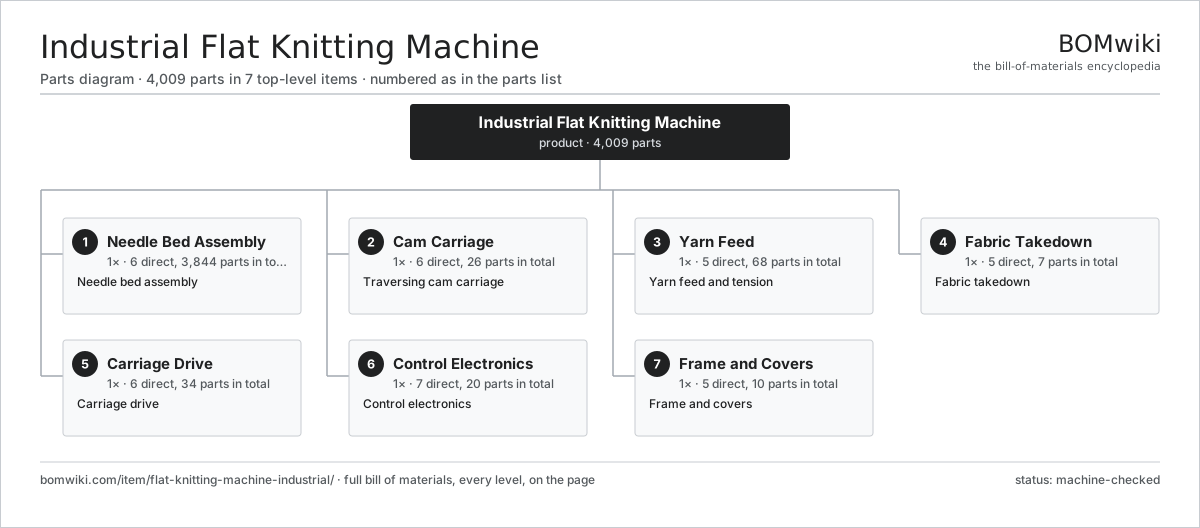
| # | Part | Qty | What it does |
|---|---|---|---|
| 1 | Needle Bed Assembly 6 parts | 1× | Needle bed assembly |
| 2 | Cam Carriage 6 parts | 1× | Traversing cam carriage |
| 3 | Yarn Feed 5 parts | 1× | Yarn feed and tension |
| 4 | Fabric Takedown 5 parts | 1× | Fabric takedown |
| 5 | Carriage Drive 6 parts | 1× | Carriage drive |
| 6 | Control Electronics 7 parts | 1× | Control electronics |
| 7 | Frame and Covers 5 parts | 1× | Frame and covers |
3D model
No 3D model yet. Have a CAD file of this? Add a 3D model. STL renders right on this page; STEP, FreeCAD, and OpenSCAD sources are welcome too (openly licensed, like all 3D models on BOMwiki).
Build & assembly graph
expand / collapse · shared sub-assemblies converge · links to related products · est. labourTap an assembly to expand/collapse · tap a part to open it · use “Open page” for any node · drag to pan, scroll to zoom.
Bill of materials for Industrial Flat Knitting Machine
7 top-level lines · 51 rows shown · 4,009 parts total · indented to 3 levels| # | Item / sub-assembly | Part no. | Qty/assy | Ext. qty | Parts | Type |
|---|---|---|---|---|---|---|
| 1 | Needle Bed Assembly 6 parts | flat-knitting-machine-industrial-bed | 1× | 1 | 3,844 | assembly |
| 1.1 | Bed Plate | flat-knitting-machine-industrial-bed-plate | 2× | 2 | · | part |
| 1.2 | Latch Needle | flat-knitting-machine-industrial-latch-needle | 1100× | 1,100 | · | part |
| 1.3 | Needle Jack | flat-knitting-machine-industrial-needle-jack | 1100× | 1,100 | · | part |
| 1.4 | Selector | flat-knitting-machine-industrial-selector | 1100× | 1,100 | · | part |
| 1.5 | Sinker | flat-knitting-machine-industrial-sinker | 540× | 540 | · | part |
| 1.6 | Retaining Comb | flat-knitting-machine-industrial-comb | 2× | 2 | · | part |
| 2 | Cam Carriage 6 parts | flat-knitting-machine-industrial-carriage | 1× | 1 | 26 | assembly |
| 2.1 | Cam Plate | flat-knitting-machine-industrial-cam-plate | 2× | 2 | · | part |
| 2.2 | Knit Cam | flat-knitting-machine-industrial-knit-cam | 4× | 4 | · | part |
| 2.3 | Stitch Cam | flat-knitting-machine-industrial-stitch-cam | 2× | 2 | · | part |
| 2.4 | Selection Actuator | flat-knitting-machine-industrial-actuator | 8× | 8 | · | part |
| 2.5 | Carriage Roller | flat-knitting-machine-industrial-carriage-roller | 8× | 8 | · | part |
| 2.6 | Transfer Cam | flat-knitting-machine-industrial-transfer-cam | 2× | 2 | · | part |
| 3 | Yarn Feed 5 parts | flat-knitting-machine-industrial-yarn-feed | 1× | 1 | 68 | assembly |
| 3.1 | Carrier Rail | flat-knitting-machine-industrial-carrier-rail | 4× | 4 | · | part |
| 3.2 | Yarn Carrier | flat-knitting-machine-industrial-yarn-carrier | 16× | 16 | · | part |
| 3.3 | Tension Unit | flat-knitting-machine-industrial-tension-unit | 16× | 16 | · | part |
| 3.4 | Storage Feeder | flat-knitting-machine-industrial-yarn-feeder | 16× | 16 | · | part |
| 3.5 | Stop Motion | flat-knitting-machine-industrial-stop-motion | 16× | 16 | · | part |
| 4 | Fabric Takedown 5 parts | flat-knitting-machine-industrial-takedown | 1× | 1 | 7 | assembly |
| 4.1 | Takedown Roller | flat-knitting-machine-industrial-takedown-roller | 2× | 2 | · | part |
| 4.2 | Setup Comb | flat-knitting-machine-industrial-takedown-comb | 1× | 1 | · | part |
| 4.3 | Takedown Servo | flat-knitting-machine-industrial-takedown-motor | 1× | 1 | · | part |
| 4.4 | Helical Gear Pair | gear-pair | 1× | 1 | · | part |
| 4.5 | Fabric Presser | flat-knitting-machine-industrial-fabric-presser | 2× | 2 | · | part |
| 5 | Carriage Drive 6 parts | flat-knitting-machine-industrial-drive | 1× | 1 | 34 | assembly |
| 5.1 | Servo Motor 4 parts | servo-motor | 1× | 1 | 24 | assembly |
| 5.1.1 | Stator Assembly 3 parts + deeper › | stator-assembly | 1× | 1 | 3 | assembly |
| 5.1.2 | Rotor Assembly 4 parts + deeper › | rotor-assembly | 1× | 1 | 19 | assembly |
| 5.1.3 | Encoder | encoder | 1× | 1 | · | part |
| 5.1.4 | Motor Housing | motor-housing | 1× | 1 | · | part |
| 5.2 | Drive Belt | drive-belt | 1× | 1 | · | part |
| 5.3 | Drive Pulley | flat-knitting-machine-industrial-drive-pulley | 2× | 2 | · | part |
| 5.4 | Linear Guide Rail | linear-guide | 2× | 2 | · | part |
| 5.5 | Position Encoder | flat-knitting-machine-industrial-encoder | 1× | 1 | · | part |
| 5.6 | Ball Bearing | ball-bearing | 4× | 4 | · | part |
| 6 | Control Electronics 7 parts | flat-knitting-machine-industrial-control | 1× | 1 | 20 | assembly |
| 6.1 | Microcontroller | mcu | 1× | 1 | · | part |
| 6.2 | Bare PCB | pcb-bare | 2× | 2 | · | part |
| 6.3 | Operator Panel | flat-knitting-machine-industrial-touchscreen | 1× | 1 | · | part |
| 6.4 | Power Supply | power-supply | 1× | 1 | · | part |
| 6.5 | Servo Drive | flat-knitting-machine-industrial-servo-drive | 2× | 2 | · | part |
| 6.6 | Wire Bundle | wire-bundle | 1× | 1 | · | part |
| 6.7 | Connector | connector | 12× | 12 | · | part |
| 7 | Frame and Covers 5 parts | flat-knitting-machine-industrial-frame | 1× | 1 | 10 | assembly |
| 7.1 | Frame Weldment | flat-knitting-machine-industrial-frame-weldment | 1× | 1 | · | part |
| 7.2 | Sheet Metal Panel | sheet-panel | 6× | 6 | · | part |
| 7.3 | Needle Oiler | flat-knitting-machine-industrial-oiler | 1× | 1 | · | part |
| 7.4 | Lint Blower | flat-knitting-machine-industrial-lint-blower | 1× | 1 | · | part |
| 7.5 | Fastener Set | fastener-set | 1× | 1 | · | part |
Related products
same domain, ranked by shared parts Automatic Fabric Cutting Machine
1,695 parts · shares 4 with this page
Fabric Coating Machine
316 parts · shares 4 with this page
Automatic Fabric Cutting Machine
1,695 parts · shares 4 with this page
Fabric Coating Machine
316 parts · shares 4 with this page
 Industrial Quilting Machine
1,090 parts · shares 4 with this page
Laser Fabric Cutting Machine
297 parts · shares 4 with this page
Industrial Quilting Machine
1,090 parts · shares 4 with this page
Laser Fabric Cutting Machine
297 parts · shares 4 with this page
 Meltblown Nonwoven Line
933 parts · shares 4 with this page
Open-End Spinning Machine
8,784 parts · shares 4 with this page
Meltblown Nonwoven Line
933 parts · shares 4 with this page
Open-End Spinning Machine
8,784 parts · shares 4 with this page
Sourcing: possible vendors
Browse the supplier directory → Prices, MOQ, and lead times are algorithmic estimates, not quotes, and not claims about these companies. Company mappings are curated by keyword; est. price band $10k–$1M. How estimates work| Vendor | HQ | Specialty | MOQ | Lead time |
|---|---|---|---|---|
|
🇨🇭Rieter
rieter.com ↗
|
Winterthur, CH | Spinning machinery | 10 units | 14–24 wks |
| truetzschler.com ↗ | Mönchengladbach, DE | Textile machinery | 10 units | 14–24 wks |
|
🇧🇪Picanol
picanol.be ↗
|
Ypres, BE | Weaving machines | 10 units | 14–24 wks |
| karlmayer.com ↗ | Obertshausen, DE | Warp knitting machines | 10 units | 14–24 wks |
|
🇨🇭Saurer
saurer.com ↗
|
Arbon, CH | Spinning & embroidery | 10 units | 14–24 wks |
1,044-word article