Textile Calendering Machine
ProductOverview
A textile calender finishes woven and knitted cloth by running it through the nips of a stack of heavy rollers under heat and pressure. The rollers are called bowls. A hard, polished steel bowl runs against a softer, resilient bowl, and the fabric passes through the gap between them, which is the nip. Pressure flattens the yarns and closes the weave, heat sets the surface, and the polished bowl transfers its own smoothness to the cloth so it comes out flatter, denser and with a glaze. The same machine, with an engraved bowl swapped in, can press a pattern into the cloth instead of glazing it. Calendering is one of the last steps in fabric finishing, done after dyeing and drying, on cotton, linen, polyester blends and technical fabrics.
The machine here is built around the Roller (Bowl) Stack, held in line by the Side Frames & Columns. Hot oil from the Bowl Heating System keeps the steel bowls at temperature, the Nip Loading System presses the stack together at a measured force, and the Main Drive turns the bowls at line speed. Fabric enters through the In-Feed & Guiding and leaves through the Exit & Batching, with the whole run governed by the Control System.
How it works
The finish a calender gives comes from three settings: nip pressure, bowl temperature and line speed. The cloth spends only a fraction of a second in each nip, so the bowl surface has to be hot enough to act in that time, and the pressure has to be high enough to deform the yarns. A hard Chilled Steel Bowl gives the glaze because its ground surface is mirror smooth and it barely deforms under load. It runs against a Resilient Soft Bowl filled with compressed cotton or paper, or faced with a polymer. The soft bowl flattens slightly at the nip, which widens the contact and spreads the pressure evenly across the cloth so the hard bowl can iron the whole width at once. Stacking several bowls puts the cloth through more than one nip in a single pass and raises the effect.
Pressure across the width is only even if the bowls stay straight. Under load a roller bends in the middle, opening the nip there and pressing harder at the edges. The Crown Adjuster corrects this by bending or shifting a bowl a few hundredths of a millimeter so the nip gap is constant from edge to edge. Without it the middle of the cloth would come out less glazed than the selvedges.
Heating
The steel bowls are bored through and hot thermal oil circulates inside them. The Thermal-Oil Heater raises the oil to the set temperature with immersed Heating Element banks, the Oil Circulation Pump drives it around the loop, and a Rotary Union at each journal feeds the oil into the spinning bowl and takes it back out without leaking. A Temperature Probe on the bowl surface and another in the oil let the control hold the temperature within a couple of degrees. Thermal oil is used instead of steam because it reaches higher temperatures at low pressure and gives a steadier surface temperature, which matters when the cloth touches the bowl for only a moment.
Nip loading
Nip force is made by hydraulics, not by dead weight, so it can be set and held to a number. The Loading Cylinder units push the top bowl down through the Swing Arm levers, and the Load Cell reads the real force at the nip. The Hydraulic Power Pack holds that force steady through a Proportional Pressure Valve that takes a programmed pressure, so the finish is the same at the start and the end of a roll. Calender nip loads run from about 100 to 600 newtons per millimeter of working width, which on a wide machine is hundreds of kilonewtons, and the Side Frames & Columns and tie columns are sized to take that separating force without spreading.
Feeding and delivery
Cloth has to enter the first nip flat and square or the finish records every crease. The Spreader (Expander) Roller pulls the web open across its width to take out folds, the Tension Roller holds a steady tension, and the Edge Guide steers a roller to keep the web centered. After the last nip the Delivery Roller units carry the cloth clear and either the Batch Winder rolls it up at controlled tension or the Plaiter (Cuttler) folds it into a stack for cloth that must lie flat for the next step.
Variants and use
The base machine glazes and smooths. Fitting an Engraved Emboss Bowl turns it into an embossing calender that presses a moire, schreiner or relief pattern into the cloth. Friction calenders run the bowls at different speeds so the polished bowl slips over the cloth and burnishes it to a high shine, used on chintz and on coated technical fabrics. The number of bowls in the Roller (Bowl) Stack sets how heavy the treatment is, from a light three-bowl finish to a nine-bowl glaze. The Control System stores each fabric and finish as a recipe of temperature, pressure and speed, so a mill can switch from a sheeting run to a sateen run by loading a stored set of values rather than tuning the machine by hand.
Textile Calendering Machine parts and their functions
9 top-level parts · 623 parts in total · full bill of materials below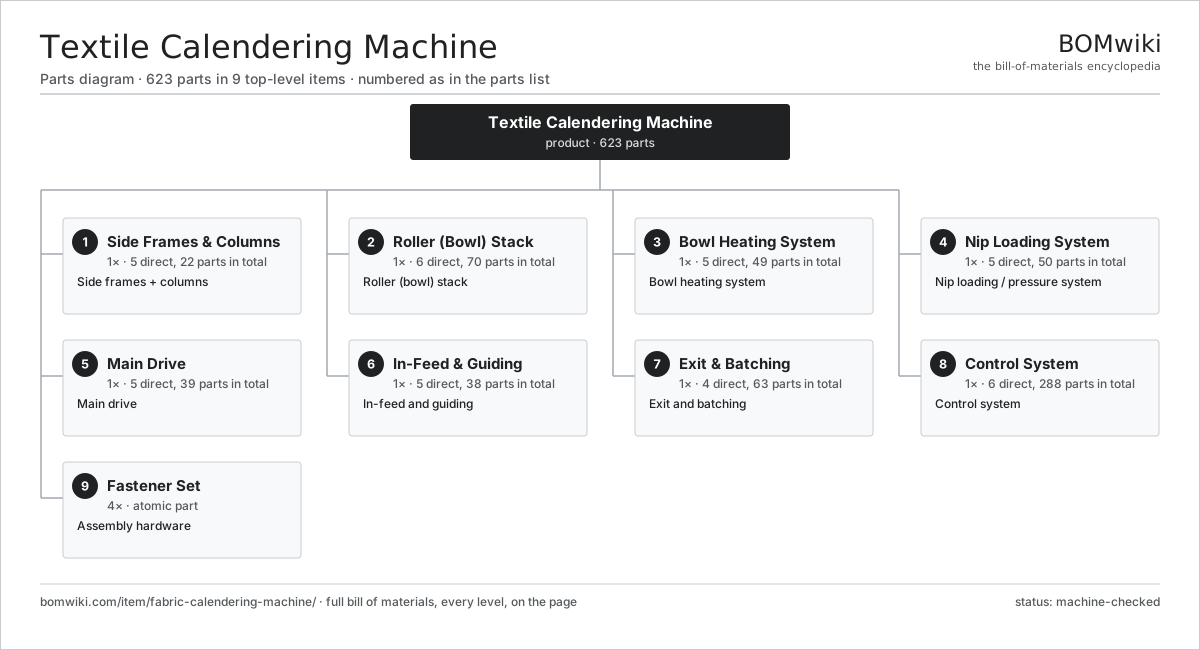
| # | Part | Qty | What it does |
|---|---|---|---|
| 1 | Side Frames & Columns 5 parts | 1× | Side frames + columns |
| 2 | Roller (Bowl) Stack 6 parts | 1× | Roller (bowl) stack |
| 3 | Bowl Heating System 5 parts | 1× | Bowl heating system |
| 4 | Nip Loading System 5 parts | 1× | Nip loading / pressure system |
| 5 | Main Drive 5 parts | 1× | Main drive |
| 6 | In-Feed & Guiding 5 parts | 1× | In-feed and guiding |
| 7 | Exit & Batching 4 parts | 1× | Exit and batching |
| 8 | Control System 6 parts | 1× | Control system |
| 9 | Fastener Set | 4× | Assembly hardware |
3D model
No 3D model yet. Have a CAD file of this? Add a 3D model. STL renders right on this page; STEP, FreeCAD, and OpenSCAD sources are welcome too (openly licensed, like all 3D models on BOMwiki).
Build & assembly graph
expand / collapse · shared sub-assemblies converge · links to related products · est. labourTap an assembly to expand/collapse · tap a part to open it · use “Open page” for any node · drag to pan, scroll to zoom.
Bill of materials for Textile Calendering Machine
9 top-level lines · 102 rows shown · 623 parts total · indented to 3 levels| # | Item / sub-assembly | Part no. | Qty/assy | Ext. qty | Parts | Type |
|---|---|---|---|---|---|---|
| 1 | Side Frames & Columns 5 parts | fabric-calendering-machine-frame | 1× | 1 | 22 | assembly |
| 1.1 | Cast Side Frame | fabric-calendering-machine-side-frame | 2× | 2 | · | part |
| 1.2 | Tie Column | fabric-calendering-machine-tie-column | 4× | 4 | · | part |
| 1.3 | Machine Bed | fabric-calendering-machine-base-bed | 1× | 1 | · | part |
| 1.4 | Journal Bearing Housing 2 parts | fabric-calendering-machine-bearing-housing | 6× | 6 | · | part |
| 1.4.1 | Ball Bearing | ball-bearing | 1× | 6 | · | part |
| 1.4.2 | Oil Seal | oil-seal | 1× | 6 | · | part |
| 1.5 | Fastener Set | fastener-set | 3× | 3 | · | part |
| 2 | Roller (Bowl) Stack 6 parts | fabric-calendering-machine-roller-stack | 1× | 1 | 70 | assembly |
| 2.1 | Chilled Steel Bowl | fabric-calendering-machine-steel-bowl | 2× | 2 | · | part |
| 2.2 | Resilient Soft Bowl | fabric-calendering-machine-soft-bowl | 2× | 2 | · | part |
| 2.3 | Engraved Emboss Bowl | fabric-calendering-machine-emboss-bowl | 1× | 1 | · | part |
| 2.4 | Roller Journal | fabric-calendering-machine-roller-journal | 5× | 5 | · | part |
| 2.5 | Ball Bearing | ball-bearing | 10× | 10 | · | part |
| 2.6 | Crown Adjuster 2 parts | fabric-calendering-machine-crown-adjuster | 2× | 2 | · | part |
| 2.6.1 | Ball Screw | ball-screw | 1× | 2 | · | part |
| 2.6.2 | Servo Motor 4 parts + deeper › | servo-motor | 1× | 2 | 24 | assembly |
| 3 | Bowl Heating System 5 parts | fabric-calendering-machine-heating-system | 1× | 1 | 49 | assembly |
| 3.1 | Rotary Union 2 parts | fabric-calendering-machine-rotary-union | 2× | 2 | · | part |
| 3.1.1 | O-Ring Set | oring-set | 1× | 2 | · | part |
| 3.1.2 | Oil Seal | oil-seal | 1× | 2 | · | part |
| 3.2 | Thermal-Oil Heater 3 parts | fabric-calendering-machine-oil-heater | 1× | 1 | 9 | assembly |
| 3.2.1 | Heating Element | heating-element | 6× | 6 | · | part |
| 3.2.2 | Heater Tank | fabric-calendering-machine-heater-tank | 1× | 1 | · | part |
| 3.2.3 | Temperature Probe | fabric-calendering-machine-temp-probe | 2× | 2 | · | part |
| 3.3 | Oil Circulation Pump 5 parts | fabric-calendering-machine-oil-pump | 1× | 1 | 26 | assembly |
| 3.3.1 | Stator Assembly 3 parts + deeper › | stator-assembly | 1× | 1 | 3 | assembly |
| 3.3.2 | Rotor Assembly 4 parts + deeper › | rotor-assembly | 1× | 1 | 19 | assembly |
| 3.3.3 | Ball Bearing | ball-bearing | 2× | 2 | · | part |
| 3.3.4 | Oil Seal | oil-seal | 1× | 1 | · | part |
| 3.3.5 | Pump Impeller | fabric-calendering-machine-pump-impeller | 1× | 1 | · | part |
| 3.4 | Temperature Probe | fabric-calendering-machine-temp-probe | 4× | 4 | · | part |
| 3.5 | Thermal-Oil Hose | fabric-calendering-machine-oil-hose | 6× | 6 | · | part |
| 4 | Nip Loading System 5 parts | fabric-calendering-machine-nip-loading | 1× | 1 | 50 | assembly |
| 4.1 | Loading Cylinder 2 parts | fabric-calendering-machine-load-cylinder | 2× | 2 | · | part |
| 4.1.1 | O-Ring Set | oring-set | 1× | 2 | · | part |
| 4.1.2 | Oil Seal | oil-seal | 1× | 2 | · | part |
| 4.2 | Hydraulic Power Pack 5 parts | fabric-calendering-machine-hydraulic-pack | 1× | 1 | 38 | assembly |
| 4.2.1 | Hydraulic Pump 4 parts + deeper › | fabric-calendering-machine-hyd-pump | 1× | 1 | 25 | assembly |
| 4.2.2 | Oil Reservoir | fabric-calendering-machine-reservoir | 1× | 1 | · | part |
| 4.2.3 | Valve Block 3 parts + deeper › | fabric-calendering-machine-valve-block | 1× | 1 | 9 | assembly |
| 4.2.4 | Accumulator | fabric-calendering-machine-accumulator | 1× | 1 | · | part |
| 4.2.5 | Pressure Sensor | pressure-sensor | 2× | 2 | · | part |
| 4.3 | Load Cell | fabric-calendering-machine-load-cell | 2× | 2 | · | part |
| 4.4 | Swing Arm | fabric-calendering-machine-swing-arm | 2× | 2 | · | part |
| 4.5 | Ball Bearing | ball-bearing | 4× | 4 | · | part |
| 5 | Main Drive 5 parts | fabric-calendering-machine-drive | 1× | 1 | 39 | assembly |
| 5.1 | Main Motor 4 parts | fabric-calendering-machine-main-motor | 1× | 1 | 25 | assembly |
| 5.1.1 | Stator Assembly 3 parts + deeper › | stator-assembly | 1× | 1 | 3 | assembly |
| 5.1.2 | Rotor Assembly 4 parts + deeper › | rotor-assembly | 1× | 1 | 19 | assembly |
| 5.1.3 | Ball Bearing | ball-bearing | 2× | 2 | · | part |
| 5.1.4 | Oil Seal | oil-seal | 1× | 1 | · | part |
| 5.2 | Reduction Gearbox 4 parts | fabric-calendering-machine-gearbox | 1× | 1 | 9 | assembly |
| 5.2.1 | Helical Gear Pair | gear-pair | 2× | 2 | · | part |
| 5.2.2 | Gearbox Housing | gearbox-housing | 1× | 1 | · | part |
| 5.2.3 | Ball Bearing | ball-bearing | 4× | 4 | · | part |
| 5.2.4 | Oil Seal | oil-seal | 2× | 2 | · | part |
| 5.3 | Bowl Drive Gear | fabric-calendering-machine-drive-gear | 3× | 3 | · | part |
| 5.4 | Line Shaft | fabric-calendering-machine-line-shaft | 1× | 1 | · | part |
| 5.5 | Drive Belt | drive-belt | 1× | 1 | · | part |
| 6 | In-Feed & Guiding 5 parts | fabric-calendering-machine-infeed | 1× | 1 | 38 | assembly |
| 6.1 | Entry Roller | fabric-calendering-machine-entry-roller | 2× | 2 | · | part |
| 6.2 | Spreader (Expander) Roller | fabric-calendering-machine-spreader-roller | 1× | 1 | · | part |
| 6.3 | Tension Roller 1 parts | fabric-calendering-machine-tension-roller | 1× | 1 | · | part |
| 6.3.1 | Load Cell | fabric-calendering-machine-load-cell | 1× | 1 | · | part |
| 6.4 | Edge Guide 3 parts | fabric-calendering-machine-edge-guide | 1× | 1 | 26 | assembly |
| 6.4.1 | Servo Motor 4 parts + deeper › | servo-motor | 1× | 1 | 24 | assembly |
| 6.4.2 | Edge Sensor | fabric-calendering-machine-edge-sensor | 1× | 1 | · | part |
| 6.4.3 | Linear Guide Rail | linear-guide | 1× | 1 | · | part |
| 6.5 | Ball Bearing | ball-bearing | 8× | 8 | · | part |
| 7 | Exit & Batching 4 parts | fabric-calendering-machine-exit | 1× | 1 | 63 | assembly |
| 7.1 | Delivery Roller | fabric-calendering-machine-delivery-roller | 2× | 2 | · | part |
| 7.2 | Batch Winder 4 parts | fabric-calendering-machine-batch-winder | 1× | 1 | 28 | assembly |
| 7.2.1 | Servo Motor 4 parts + deeper › | servo-motor | 1× | 1 | 24 | assembly |
| 7.2.2 | Winding Shaft | fabric-calendering-machine-winder-shaft | 1× | 1 | · | part |
| 7.2.3 | Load Cell | fabric-calendering-machine-load-cell | 1× | 1 | · | part |
| 7.2.4 | Ball Bearing | ball-bearing | 2× | 2 | · | part |
| 7.3 | Plaiter (Cuttler) 3 parts | fabric-calendering-machine-plaiter | 1× | 1 | 27 | assembly |
| 7.3.1 | Servo Motor 4 parts + deeper › | servo-motor | 1× | 1 | 24 | assembly |
| 7.3.2 | Folding Blade | fabric-calendering-machine-fold-blade | 2× | 2 | · | part |
| 7.3.3 | Drive Belt | drive-belt | 1× | 1 | · | part |
| 7.4 | Ball Bearing | ball-bearing | 6× | 6 | · | part |
| 8 | Control System 6 parts | fabric-calendering-machine-control | 1× | 1 | 288 | assembly |
| 8.1 | PLC Controller 4 parts | fabric-calendering-machine-plc | 1× | 1 | 128 | assembly |
| 8.1.1 | Bare PCB | pcb-bare | 1× | 1 | · | part |
| 8.1.2 | Microcontroller | mcu | 1× | 1 | · | part |
| 8.1.3 | Relay | relay | 6× | 6 | · | part |
| 8.1.4 | SMD Passive (R/C/L) | smd-passives | 120× | 120 | · | part |
| 8.2 | Operator Panel 5 parts | fabric-calendering-machine-hmi | 1× | 1 | 64 | assembly |
| 8.2.1 | Bare PCB | pcb-bare | 1× | 1 | · | part |
| 8.2.2 | LCD Panel | lcd-panel | 1× | 1 | · | part |
| 8.2.3 | Touch Digitizer | touch-digitizer | 1× | 1 | · | part |
| 8.2.4 | Compute SoC Module | soc-module | 1× | 1 | · | part |
| 8.2.5 | SMD Passive (R/C/L) | smd-passives | 60× | 60 | · | part |
| 8.3 | Variable-Frequency Drive 3 parts | fabric-calendering-machine-vfd | 1× | 1 | 82 | assembly |
| 8.3.1 | Bare PCB | pcb-bare | 1× | 1 | · | part |
| 8.3.2 | Power Supply | power-supply | 1× | 1 | · | part |
| 8.3.3 | SMD Passive (R/C/L) | smd-passives | 80× | 80 | · | part |
| 8.4 | Power Supply | power-supply | 1× | 1 | · | part |
| 8.5 | Wire Bundle | wire-bundle | 1× | 1 | · | part |
| 8.6 | Connector | connector | 12× | 12 | · | part |
| 9 | Fastener Set | fastener-set | 4× | 4 | · | part |
Related products
same domain, ranked by shared parts Automatic Fabric Cutting Machine
1,695 parts · shares 11 with this page
Automatic Fabric Cutting Machine
1,695 parts · shares 11 with this page
 Rotary Screen Textile Printer
3,441 parts · shares 11 with this page
Rotary Screen Textile Printer
3,441 parts · shares 11 with this page
 Meltblown Nonwoven Line
933 parts · shares 10 with this page
Fabric Coating Machine
316 parts · shares 9 with this page
Mercerizing Range
585 parts · shares 10 with this page
Meltblown Nonwoven Line
933 parts · shares 10 with this page
Fabric Coating Machine
316 parts · shares 9 with this page
Mercerizing Range
585 parts · shares 10 with this page
Sourcing: possible vendors
Browse the supplier directory → Prices, MOQ, and lead times are algorithmic estimates, not quotes, and not claims about these companies. Company mappings are curated by keyword; est. price band $10k–$1M. How estimates work| Vendor | HQ | Specialty | MOQ | Lead time |
|---|---|---|---|---|
|
🇨🇭Rieter
rieter.com ↗
|
Winterthur, CH | Spinning machinery | 10 units | 14–24 wks |
| truetzschler.com ↗ | Mönchengladbach, DE | Textile machinery | 10 units | 14–24 wks |
|
🇧🇪Picanol
picanol.be ↗
|
Ypres, BE | Weaving machines | 10 units | 14–24 wks |
| karlmayer.com ↗ | Obertshausen, DE | Warp knitting machines | 10 units | 14–24 wks |
|
🇨🇭Saurer
saurer.com ↗
|
Arbon, CH | Spinning & embroidery | 10 units | 14–24 wks |
953-word article