Nonwoven Needle Loom
ProductOverview
A needle loom turns a loose pile of fibers into a usable fabric without spinning, weaving or glue. It takes a thick, fragile web of carded and cross-lapped fibers, the kind that falls apart if you lift it, and bonds it by stabbing thousands of barbed needles down through it over and over. Each needle drags a few surface fibers down into the body of the web, and after enough punctures those dragged fibers knot the layers together into a felt with real strength. The product is nonwoven felt: geotextiles under roads, automotive trim and insulation, filter media, carpet underlay, synthetic leather backing and blankets. Because the bond is purely mechanical, the same machine handles polyester, polypropylene, wool, recycled shoddy and glass with only a change of needle and settings.
The web arrives from an upstream card and cross-lapper and is drawn in by the Web Infeed & Draft, driven through the needling zone by the Needle Beam, and pulled out the far side as bonded fabric by the Take-up & Winder. The Main Drive reciprocates the beam, and the Control & HMI keeps stroke rate and line speed in step so the fabric gets the stitch density the recipe asks for.
How it works
The bond is made by barbs. A Barbed Felting Needle is a triangular blade with small notches cut into its three edges. On the downstroke the barbs face the way the needle is moving, so each one catches a tuft of fiber and pulls it down through the thickness of the web. On the upstroke the barbs release and the needle pulls out clean, leaving those fibers reoriented vertically through the batt. One needle does almost nothing. Six thousand needles, each firing 800 to 2,000 times a minute while the web creeps past, lay down a dense field of vertical fiber columns that lock the horizontal layers together. The finished felt is rated by penetration density, the number of needle punctures per square centimetre, which depends on stroke rate, needle count and line speed together.
The web passes between two slotted plates in the Bed & Stripper Plates. The Bed Plate supports the batt from below and lets the needle points pass through its slots, while the Stripper Plate above holds the fabric down so that when the needles withdraw the felt stays put and advances rather than riding up with them. The gap between the two plates, set by the Penetration Adjuster, fixes how deep the needles drive.
The needling head
The Needle Beam is the heart of the machine. Needles are held in drilled aluminium Board Plate boards, several of them staggered across the width so their hole patterns interleave and the puncture field covers the whole fabric with no untouched stripes. The Clamp Bar locks the needle crowns so they cannot lift out under load, and the whole beam runs on hardened Beam Guide Column columns that keep it square. Squareness matters: the needles must drop back into the same slots in the bed and stripper plates every stroke, and a beam that racks even slightly snaps needles by the hundred.
Drive and balance
The Main Drive reciprocates a heavy beam at high speed, so balance is the central design problem. A motor turns an Eccentric Crankshaft whose eccentric throw sets the stroke length, and Connecting Rod rods convert that rotation into the vertical needling motion. Left alone, a beam reversing direction two thousand times a minute would shake the whole loom apart, so Counterweight masses move opposite the beam to cancel its inertia, and Balance Flywheel wheels smooth the speed through the moment the needles bite. An Encoder on the crank reports beam position so the control can hold the stroke rate steady.
Lubrication and frame
At these speeds the crank and bearings shed real heat, so the Lubrication System system circulates oil through a pump, a Oil Filter and a Oil Cooler to the crank, rods and guides, with a Pressure Sensor watching for loss of feed. All of it sits on the Machine Frame, a heavy fabricated base on Anti-vibration Mount mounts that has the mass to absorb the reciprocating forces without walking across the floor.
Process control
The fabric the loom makes depends on the ratio between how fast it needles and how fast the web moves. The Control & HMI locks the stroke frequency of the Main Drive to the line speed of the Web Infeed & Draft and Take-up & Winder through three Variable Frequency Drive drives, so a recipe of, say, 180 punctures per square centimetre comes out the same down the whole roll. The Operator HMI shows stroke rate, line speed and stitch density and holds the recipe library, and an interlock blocks the beam while a guard is open.
Use and variants
A typical line runs several looms back to back. A first pre-needler at low density gives the web just enough strength to be handled, then one or more main looms at high density build the final bond, and a finisher may add a surface pass. Single- board machines suit light webs; multi-board looms like this one handle heavy geotextiles at high output. Down-stroke looms needle from the top, up-stroke looms from below, and double looms needle both faces at once for symmetric felt. Structuring looms use forked needles and a brush bed to pull loops to the surface for velour and patterned floor coverings. Across the family the principle does not change: barbed needles, driven through a fiber web, entangle it into felt.
Nonwoven Needle Loom parts and their functions
9 top-level parts · 6,777 parts in total · full bill of materials below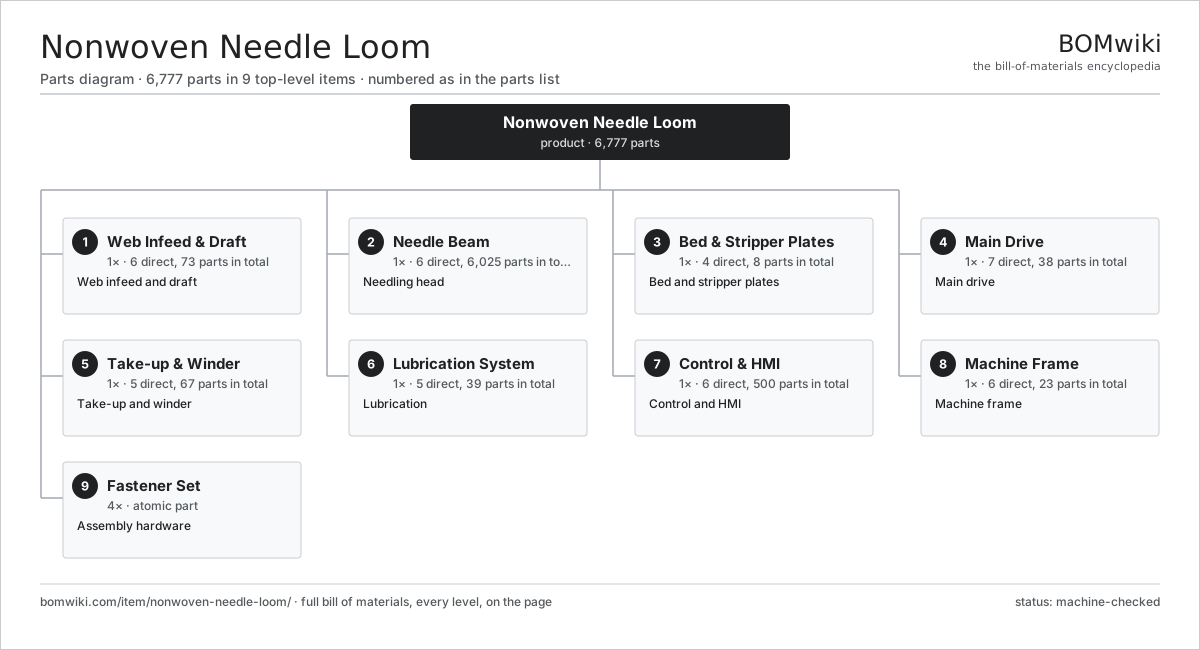
| # | Part | Qty | What it does |
|---|---|---|---|
| 1 | Web Infeed & Draft 6 parts | 1× | Web infeed and draft |
| 2 | Needle Beam 6 parts | 1× | Needling head |
| 3 | Bed & Stripper Plates 4 parts | 1× | Bed and stripper plates |
| 4 | Main Drive 7 parts | 1× | Main drive |
| 5 | Take-up & Winder 5 parts | 1× | Take-up and winder |
| 6 | Lubrication System 5 parts | 1× | Lubrication |
| 7 | Control & HMI 6 parts | 1× | Control and HMI |
| 8 | Machine Frame 6 parts | 1× | Machine frame |
| 9 | Fastener Set | 4× | Assembly hardware |
3D model
No 3D model yet. Have a CAD file of this? Add a 3D model. STL renders right on this page; STEP, FreeCAD, and OpenSCAD sources are welcome too (openly licensed, like all 3D models on BOMwiki).
Build & assembly graph
expand / collapse · shared sub-assemblies converge · links to related products · est. labourTap an assembly to expand/collapse · tap a part to open it · use “Open page” for any node · drag to pan, scroll to zoom.
Bill of materials for Nonwoven Needle Loom
9 top-level lines · 94 rows shown · 6,777 parts total · indented to 3 levels| # | Item / sub-assembly | Part no. | Qty/assy | Ext. qty | Parts | Type |
|---|---|---|---|---|---|---|
| 1 | Web Infeed & Draft 6 parts | nonwoven-needle-loom-infeed | 1× | 1 | 73 | assembly |
| 1.1 | Draft Roller | nonwoven-needle-loom-draft-roller | 4× | 4 | · | part |
| 1.2 | Feed Apron | nonwoven-needle-loom-apron-belt | 2× | 2 | · | part |
| 1.3 | Infeed Gearbox 4 parts | nonwoven-needle-loom-infeed-gearbox | 1× | 1 | 9 | assembly |
| 1.3.1 | Helical Gear Pair | gear-pair | 2× | 2 | · | part |
| 1.3.2 | Gearbox Housing | gearbox-housing | 1× | 1 | · | part |
| 1.3.3 | Ball Bearing | ball-bearing | 4× | 4 | · | part |
| 1.3.4 | Oil Seal | oil-seal | 2× | 2 | · | part |
| 1.4 | Servo Motor 4 parts | servo-motor | 2× | 2 | 24 | assembly |
| 1.4.1 | Stator Assembly 3 parts + deeper › | stator-assembly | 1× | 2 | 3 | assembly |
| 1.4.2 | Rotor Assembly 4 parts + deeper › | rotor-assembly | 1× | 2 | 19 | assembly |
| 1.4.3 | Encoder | encoder | 1× | 2 | · | part |
| 1.4.4 | Motor Housing | motor-housing | 1× | 2 | · | part |
| 1.5 | Ball Bearing | ball-bearing | 8× | 8 | · | part |
| 1.6 | Edge Guide | nonwoven-needle-loom-web-guide | 2× | 2 | · | part |
| 2 | Needle Beam 6 parts | nonwoven-needle-loom-needle-beam | 1× | 1 | 6,025 | assembly |
| 2.1 | Beam Body | nonwoven-needle-loom-beam-body | 1× | 1 | · | part |
| 2.2 | Needle Board 3 parts | nonwoven-needle-loom-needle-board | 3× | 3 | 4 | assembly |
| 2.2.1 | Board Plate | nonwoven-needle-loom-board-plate | 1× | 3 | · | part |
| 2.2.2 | Clamp Bar | nonwoven-needle-loom-clamp-bar | 2× | 6 | · | part |
| 2.2.3 | Fastener Set | fastener-set | 1× | 3 | · | part |
| 2.3 | Barbed Felting Needle | nonwoven-needle-loom-barbed-needle | 6000× | 6,000 | · | part |
| 2.4 | Beam Guide Column | nonwoven-needle-loom-beam-guide | 4× | 4 | · | part |
| 2.5 | Connecting Rod 1 parts | nonwoven-needle-loom-connecting-rod | 2× | 2 | · | part |
| 2.5.1 | Ball Bearing | ball-bearing | 2× | 4 | · | part |
| 2.6 | Ball Bearing | ball-bearing | 4× | 4 | · | part |
| 3 | Bed & Stripper Plates 4 parts | nonwoven-needle-loom-bed-stripper | 1× | 1 | 8 | assembly |
| 3.1 | Bed Plate | nonwoven-needle-loom-bed-plate | 1× | 1 | · | part |
| 3.2 | Stripper Plate | nonwoven-needle-loom-stripper-plate | 1× | 1 | · | part |
| 3.3 | Penetration Adjuster | nonwoven-needle-loom-plate-adjuster | 2× | 2 | · | part |
| 3.4 | Throat Spacer | nonwoven-needle-loom-throat-spacer | 4× | 4 | · | part |
| 4 | Main Drive 7 parts | nonwoven-needle-loom-main-drive | 1× | 1 | 38 | assembly |
| 4.1 | Servo Motor 4 parts | servo-motor | 1× | 1 | 24 | assembly |
| 4.1.1 | Stator Assembly 3 parts + deeper › | stator-assembly | 1× | 1 | 3 | assembly |
| 4.1.2 | Rotor Assembly 4 parts + deeper › | rotor-assembly | 1× | 1 | 19 | assembly |
| 4.1.3 | Encoder | encoder | 1× | 1 | · | part |
| 4.1.4 | Motor Housing | motor-housing | 1× | 1 | · | part |
| 4.2 | Eccentric Crankshaft | nonwoven-needle-loom-crankshaft | 1× | 1 | · | part |
| 4.3 | Balance Flywheel | nonwoven-needle-loom-flywheel | 2× | 2 | · | part |
| 4.4 | Drive Belt | drive-belt | 2× | 2 | · | part |
| 4.5 | Counterweight | nonwoven-needle-loom-counterweight | 2× | 2 | · | part |
| 4.6 | Ball Bearing | ball-bearing | 6× | 6 | · | part |
| 4.7 | Encoder | encoder | 1× | 1 | · | part |
| 5 | Take-up & Winder 5 parts | nonwoven-needle-loom-takeup | 1× | 1 | 67 | assembly |
| 5.1 | Take-up Roller | nonwoven-needle-loom-takeup-roller | 2× | 2 | · | part |
| 5.2 | Surface Winder 3 parts | nonwoven-needle-loom-winder | 1× | 1 | 7 | assembly |
| 5.2.1 | Winder Drum | nonwoven-needle-loom-winder-drum | 1× | 1 | · | part |
| 5.2.2 | Core Chuck | nonwoven-needle-loom-core-chuck | 2× | 2 | · | part |
| 5.2.3 | Ball Bearing | ball-bearing | 4× | 4 | · | part |
| 5.3 | Dancer Tension Roller 2 parts | nonwoven-needle-loom-tension-roller | 1× | 1 | · | part |
| 5.3.1 | Coil Spring | coil-spring | 2× | 2 | · | part |
| 5.3.2 | Ball Bearing | ball-bearing | 2× | 2 | · | part |
| 5.4 | Servo Motor 4 parts | servo-motor | 2× | 2 | 24 | assembly |
| 5.4.1 | Stator Assembly 3 parts + deeper › | stator-assembly | 1× | 2 | 3 | assembly |
| 5.4.2 | Rotor Assembly 4 parts + deeper › | rotor-assembly | 1× | 2 | 19 | assembly |
| 5.4.3 | Encoder | encoder | 1× | 2 | · | part |
| 5.4.4 | Motor Housing | motor-housing | 1× | 2 | · | part |
| 5.5 | Ball Bearing | ball-bearing | 6× | 6 | · | part |
| 6 | Lubrication System 5 parts | nonwoven-needle-loom-lubrication | 1× | 1 | 39 | assembly |
| 6.1 | Oil Pump 4 parts | nonwoven-needle-loom-oil-pump | 1× | 1 | 28 | assembly |
| 6.1.1 | Servo Motor 4 parts + deeper › | servo-motor | 1× | 1 | 24 | assembly |
| 6.1.2 | Helical Gear Pair | gear-pair | 1× | 1 | · | part |
| 6.1.3 | Oil Seal | oil-seal | 1× | 1 | · | part |
| 6.1.4 | Ball Bearing | ball-bearing | 2× | 2 | · | part |
| 6.2 | Oil Filter | nonwoven-needle-loom-oil-filter | 1× | 1 | · | part |
| 6.3 | Oil Cooler | nonwoven-needle-loom-oil-cooler | 1× | 1 | · | part |
| 6.4 | Oil Line | nonwoven-needle-loom-oil-line | 8× | 8 | · | part |
| 6.5 | Pressure Sensor | pressure-sensor | 1× | 1 | · | part |
| 7 | Control & HMI 6 parts | nonwoven-needle-loom-control | 1× | 1 | 500 | assembly |
| 7.1 | PLC Controller 4 parts | nonwoven-needle-loom-plc | 1× | 1 | 150 | assembly |
| 7.1.1 | Bare PCB | pcb-bare | 1× | 1 | · | part |
| 7.1.2 | Microcontroller | mcu | 1× | 1 | · | part |
| 7.1.3 | Relay | relay | 8× | 8 | · | part |
| 7.1.4 | SMD Passive (R/C/L) | smd-passives | 140× | 140 | · | part |
| 7.2 | Operator HMI 4 parts | nonwoven-needle-loom-hmi | 1× | 1 | 53 | assembly |
| 7.2.1 | Bare PCB | pcb-bare | 1× | 1 | · | part |
| 7.2.2 | LCD Panel | lcd-panel | 1× | 1 | · | part |
| 7.2.3 | Touch Digitizer | touch-digitizer | 1× | 1 | · | part |
| 7.2.4 | SMD Passive (R/C/L) | smd-passives | 50× | 50 | · | part |
| 7.3 | Variable Frequency Drive 3 parts | nonwoven-needle-loom-vfd | 3× | 3 | 93 | assembly |
| 7.3.1 | Bare PCB | pcb-bare | 1× | 3 | · | part |
| 7.3.2 | SMD Passive (R/C/L) | smd-passives | 90× | 270 | · | part |
| 7.3.3 | Relay | relay | 2× | 6 | · | part |
| 7.4 | Wire Bundle | wire-bundle | 1× | 1 | · | part |
| 7.5 | Connector | connector | 16× | 16 | · | part |
| 7.6 | Power Supply | power-supply | 1× | 1 | · | part |
| 8 | Machine Frame 6 parts | nonwoven-needle-loom-frame | 1× | 1 | 23 | assembly |
| 8.1 | Frame Weldment | nonwoven-needle-loom-frame-weldment | 1× | 1 | · | part |
| 8.2 | Side Stand | nonwoven-needle-loom-side-stand | 2× | 2 | · | part |
| 8.3 | Anti-vibration Mount | nonwoven-needle-loom-vibration-mount | 6× | 6 | · | part |
| 8.4 | Sheet Metal Panel | sheet-panel | 8× | 8 | · | part |
| 8.5 | Interlock Switch | nonwoven-needle-loom-interlock-switch | 4× | 4 | · | part |
| 8.6 | Emergency Stop | nonwoven-needle-loom-estop | 2× | 2 | · | part |
| 9 | Fastener Set | fastener-set | 4× | 4 | · | part |
Related products
same domain, ranked by shared parts Automatic Fabric Cutting Machine
1,695 parts · shares 9 with this page
Jigger Dyeing Machine
276 parts · shares 9 with this page
Automatic Fabric Cutting Machine
1,695 parts · shares 9 with this page
Jigger Dyeing Machine
276 parts · shares 9 with this page
 Meltblown Nonwoven Line
933 parts · shares 9 with this page
Mercerizing Range
585 parts · shares 9 with this page
Laser Fabric Cutting Machine
297 parts · shares 8 with this page
Jet Dyeing Machine
263 parts · shares 8 with this page
Meltblown Nonwoven Line
933 parts · shares 9 with this page
Mercerizing Range
585 parts · shares 9 with this page
Laser Fabric Cutting Machine
297 parts · shares 8 with this page
Jet Dyeing Machine
263 parts · shares 8 with this page
Sourcing: possible vendors
Browse the supplier directory → Prices, MOQ, and lead times are algorithmic estimates, not quotes, and not claims about these companies. Company mappings are curated by keyword; est. price band $10k–$1M. How estimates work| Vendor | HQ | Specialty | MOQ | Lead time |
|---|---|---|---|---|
|
🇨🇭Rieter
rieter.com ↗
|
Winterthur, CH | Spinning machinery | 10 units | 14–24 wks |
| truetzschler.com ↗ | Mönchengladbach, DE | Textile machinery | 10 units | 14–24 wks |
|
🇧🇪Picanol
picanol.be ↗
|
Ypres, BE | Weaving machines | 10 units | 14–24 wks |
| karlmayer.com ↗ | Obertshausen, DE | Warp knitting machines | 10 units | 14–24 wks |
|
🇨🇭Saurer
saurer.com ↗
|
Arbon, CH | Spinning & embroidery | 10 units | 14–24 wks |
995-word article