Cotton Blowroom Line
ProductOverview
The blowroom is the first line a cotton mill runs, and it sets up everything that follows. Cotton arrives as hard pressed bales, each a tangle of fibers packed with seed fragments, leaf, stalk, sand and dust. The blowroom takes those bales apart, tears the big lumps down into ever smaller tufts, beats and screens out most of the trash and dust, blends fiber from many bales so the natural variation between them averages out, and hands a clean even tuft mat to the carding machines. It is not one machine but a chain of them, linked by air ducting so the fiber flows from one to the next on a stream of air, which is where the name blowroom comes from.
The guiding rule of the line is to open gently and clean progressively. Cotton fiber is easily broken, and a broken fiber is a short fiber that hurts yarn quality, so the line opens the stock in stages from coarse to fine rather than all at once, taking the easy heavy trash out early and the fine dust out last.
Opening the bales
The line starts at the Automatic Bale Opener, a travelling machine that runs along two rows of opened bales. A Take-Off Roller in its descending head shaves a thin layer off the tops of the bales, plucking small tufts. Because the head travels the whole row and shaves a little from every bale on each pass, the very first step already begins the blend, drawing fiber from forty to a hundred bales at once. As the bales shrink the Travelling Tower Column lowers the head to keep contact.
Coarse cleaning
The plucked tufts go to the Coarse Pre-Cleaner, the first cleaning stage. Tufts fall onto fast Spiked Cleaning Roller rollers turning over a Cleaning Grid. The rollers open the tufts further, and the impact flings the heavy trash, seed and stalk down through the grid bars while the lighter fiber is carried on. Most of the heavy trash leaves the line here, where it is easiest to remove, before it can be broken up and worked into the fiber.
Blending
Cleaning alone is not enough; the line also has to blend, because bales differ in micronaire, colour and trash even within one lot, and unblended variation would show as streaks in the finished cloth. The Multi-Bale Mixer does the main blending. It fills several Mixing Chamber chambers in turn, then draws fiber from all of them at once up an Inclined Spiked Lattice spiked lattice, so stock laid down at different moments is mixed together. This time-blending, on top of the multi-bale plucking at the opener, gives an output far more uniform than any single bale.
Fine cleaning and condensing
The blended stock passes through the Fine Cleaner, the last cleaning stage before the cards. A finer Fine Cleaning Roller over a closely set grid takes out the small trash and dust the coarse stage left, run gently so it does not cut fiber. Then the fiber, still riding on air, reaches the Dust Cage & Condenser. Here perforated rotating cages separate fiber from the conveying air: the Condenser Suction Fan pulls the air through the cage wall while the fiber stays on the surface and builds into a mat, and the dust drawn off goes to a filter. The mat is stripped off and fed on to the card chutes.
Pneumatic transport and safety
What ties the separate machines into one line is the Pneumatic Transport system: fans, ducting and diverters that move the fiber on air between every stage and on to the cards. The ducting also carries the line's safety devices. A Spark Detector watches for a spark thrown when a stone or piece of metal strikes a roller, and if it sees one it fires a diverter to dump that slug of fiber before it can reach the cotton mass and start a fire, since a blowroom full of dry cotton and dust is a serious fire risk. A Metal & Fire Detector stops the line if metal or heat is found.
Control, frame and use
A central Line Control runs every machine in step, holds the fiber level in each chute so the cards never starve or choke, sets the cleaning intensity at each stage, and links the safety detectors so the whole line starts, stops and clears as one. The machines sit on welded steel Frames & Ducting sub-frames joined by the ducting, with access platforms and guards over the spiked rollers.
Materials and use
The cleaning rollers carry hardened saw-tooth or pinned wire, the main wear part, replaced as it dulls. The grids and ducting are sheet steel, the sub-frames welded structural steel. The line is sized to feed a whole row of cards, one blowroom commonly supplying eight to twenty cards, so its throughput and the evenness of its output set the pace and the quality floor for the entire spinning mill. Mills judge a blowroom on two numbers above all: how much of the incoming trash it removes, and how little good fiber it breaks doing it.
Cotton Blowroom Line parts and their functions
10 top-level parts · 258 parts in total · full bill of materials below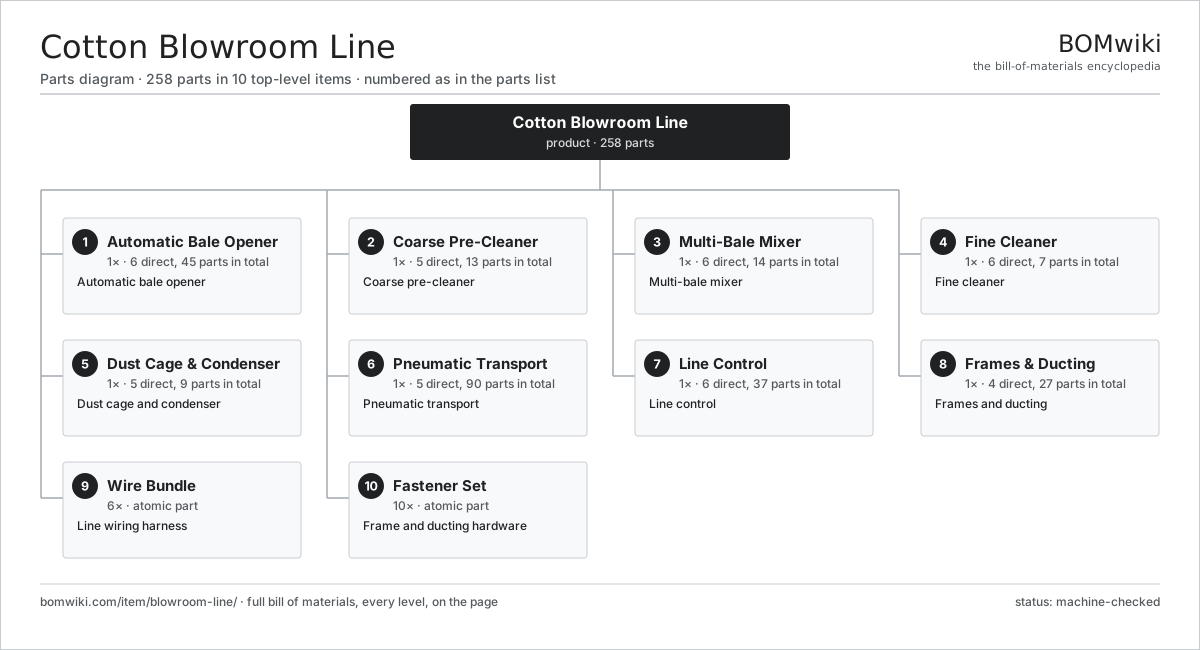
| # | Part | Qty | What it does |
|---|---|---|---|
| 1 | Automatic Bale Opener 6 parts | 1× | Automatic bale opener |
| 2 | Coarse Pre-Cleaner 5 parts | 1× | Coarse pre-cleaner |
| 3 | Multi-Bale Mixer 6 parts | 1× | Multi-bale mixer |
| 4 | Fine Cleaner 6 parts | 1× | Fine cleaner |
| 5 | Dust Cage & Condenser 5 parts | 1× | Dust cage and condenser |
| 6 | Pneumatic Transport 5 parts | 1× | Pneumatic transport |
| 7 | Line Control 6 parts | 1× | Line control |
| 8 | Frames & Ducting 4 parts | 1× | Frames and ducting |
| 9 | Wire Bundle | 6× | Line wiring harness |
| 10 | Fastener Set | 10× | Frame and ducting hardware |
3D model
No 3D model yet. Have a CAD file of this? Add a 3D model. STL renders right on this page; STEP, FreeCAD, and OpenSCAD sources are welcome too (openly licensed, like all 3D models on BOMwiki).
Build & assembly graph
expand / collapse · shared sub-assemblies converge · links to related products · est. labourTap an assembly to expand/collapse · tap a part to open it · use “Open page” for any node · drag to pan, scroll to zoom.
Bill of materials for Cotton Blowroom Line
10 top-level lines · 63 rows shown · 258 parts total · indented to 3 levels| # | Item / sub-assembly | Part no. | Qty/assy | Ext. qty | Parts | Type |
|---|---|---|---|---|---|---|
| 1 | Automatic Bale Opener 6 parts | blowroom-line-bale-opener | 1× | 1 | 45 | assembly |
| 1.1 | Take-Off Roller | blowroom-line-takeoff-roller | 2× | 2 | · | part |
| 1.2 | Take-Off Saw-Tooth Wire | blowroom-line-takeoff-wire | 2× | 2 | · | part |
| 1.3 | Grid Bar | blowroom-line-grid-bar | 8× | 8 | · | part |
| 1.4 | Travelling Tower Column | blowroom-line-tower-column | 1× | 1 | · | part |
| 1.5 | Tower Traverse Drive 3 parts | blowroom-line-traverse-drive | 1× | 1 | 28 | assembly |
| 1.5.1 | Servo Motor 4 parts + deeper › | servo-motor | 1× | 1 | 24 | assembly |
| 1.5.2 | Helical Gear Pair | gear-pair | 2× | 2 | · | part |
| 1.5.3 | Ball Bearing | ball-bearing | 2× | 2 | · | part |
| 1.6 | Ball Bearing | ball-bearing | 4× | 4 | · | part |
| 2 | Coarse Pre-Cleaner 5 parts | blowroom-line-coarse-cleaner | 1× | 1 | 13 | assembly |
| 2.1 | Spiked Cleaning Roller | blowroom-line-spiked-roller | 3× | 3 | · | part |
| 2.2 | Cleaning Grid | blowroom-line-cleaning-grid | 1× | 1 | · | part |
| 2.3 | Air Deflector | blowroom-line-deflector | 2× | 2 | · | part |
| 2.4 | Trash Chute | blowroom-line-trash-chute | 1× | 1 | · | part |
| 2.5 | Ball Bearing | ball-bearing | 6× | 6 | · | part |
| 3 | Multi-Bale Mixer 6 parts | blowroom-line-mixer | 1× | 1 | 14 | assembly |
| 3.1 | Mixing Chamber | blowroom-line-mix-chamber | 6× | 6 | · | part |
| 3.2 | Inclined Spiked Lattice | blowroom-line-incline-lattice | 1× | 1 | · | part |
| 3.3 | Evener Roller | blowroom-line-evener-roller | 1× | 1 | · | part |
| 3.4 | Stripping Roller | blowroom-line-stripping-roller | 1× | 1 | · | part |
| 3.5 | Chamber Filling Fan | blowroom-line-mix-fan | 1× | 1 | · | part |
| 3.6 | Ball Bearing | ball-bearing | 4× | 4 | · | part |
| 4 | Fine Cleaner 6 parts | blowroom-line-fine-cleaner | 1× | 1 | 7 | assembly |
| 4.1 | Fine Cleaning Roller | blowroom-line-fine-roller | 1× | 1 | · | part |
| 4.2 | Fine Cleaning Wire | blowroom-line-fine-wire | 1× | 1 | · | part |
| 4.3 | Fine Grid | blowroom-line-fine-grid | 1× | 1 | · | part |
| 4.4 | Feed Trough | blowroom-line-feed-trough | 1× | 1 | · | part |
| 4.5 | Pressure Sensor | pressure-sensor | 1× | 1 | · | part |
| 4.6 | Ball Bearing | ball-bearing | 2× | 2 | · | part |
| 5 | Dust Cage & Condenser 5 parts | blowroom-line-dust-cage | 1× | 1 | 9 | assembly |
| 5.1 | Perforated Cage | blowroom-line-perforated-cage | 2× | 2 | · | part |
| 5.2 | Condenser Suction Fan | blowroom-line-condenser-fan | 1× | 1 | · | part |
| 5.3 | Dust Filter | blowroom-line-dust-filter | 1× | 1 | · | part |
| 5.4 | Mat Doffing Roller | blowroom-line-mat-doffer | 1× | 1 | · | part |
| 5.5 | Ball Bearing | ball-bearing | 4× | 4 | · | part |
| 6 | Pneumatic Transport 5 parts | blowroom-line-transport | 1× | 1 | 90 | assembly |
| 6.1 | Transport Fan 3 parts | blowroom-line-transport-fan | 3× | 3 | 24 | assembly |
| 6.1.1 | Stator Assembly 3 parts + deeper › | stator-assembly | 1× | 3 | 3 | assembly |
| 6.1.2 | Rotor Assembly 4 parts + deeper › | rotor-assembly | 1× | 3 | 19 | assembly |
| 6.1.3 | Ball Bearing | ball-bearing | 2× | 6 | · | part |
| 6.2 | Duct Section | blowroom-line-duct-section | 12× | 12 | · | part |
| 6.3 | Diverter Flap | blowroom-line-diverter-flap | 4× | 4 | · | part |
| 6.4 | Spark Detector | blowroom-line-spark-detector | 1× | 1 | · | part |
| 6.5 | Metal & Fire Detector | blowroom-line-metal-detector | 1× | 1 | · | part |
| 7 | Line Control 6 parts | blowroom-line-control | 1× | 1 | 37 | assembly |
| 7.1 | Line Controller 4 parts | blowroom-line-controller | 1× | 1 | 7 | assembly |
| 7.1.1 | Bare PCB | pcb-bare | 1× | 1 | · | part |
| 7.1.2 | Microcontroller | mcu | 1× | 1 | · | part |
| 7.1.3 | SMD Passive (R/C/L) | smd-passives | 1× | 1 | · | part |
| 7.1.4 | Connector | connector | 4× | 4 | · | part |
| 7.2 | LCD Panel | lcd-panel | 1× | 1 | · | part |
| 7.3 | Power Supply | power-supply | 1× | 1 | · | part |
| 7.4 | Microcontroller | mcu | 4× | 4 | · | part |
| 7.5 | Relay | relay | 8× | 8 | · | part |
| 7.6 | Connector | connector | 16× | 16 | · | part |
| 8 | Frames & Ducting 4 parts | blowroom-line-frame | 1× | 1 | 27 | assembly |
| 8.1 | Machine Sub-Frame | blowroom-line-machine-frame | 5× | 5 | · | part |
| 8.2 | Access Platform | blowroom-line-platform | 2× | 2 | · | part |
| 8.3 | Roller Guard | blowroom-line-guard | 8× | 8 | · | part |
| 8.4 | Sheet Metal Panel | sheet-panel | 12× | 12 | · | part |
| 9 | Wire Bundle | wire-bundle | 6× | 6 | · | part |
| 10 | Fastener Set | fastener-set | 10× | 10 | · | part |
Related products
same domain, ranked by shared parts Automatic Fabric Cutting Machine
1,695 parts · shares 5 with this page
Fabric Coating Machine
316 parts · shares 5 with this page
FDY Filament Spinning Line
679 parts · shares 5 with this page
Automatic Fabric Cutting Machine
1,695 parts · shares 5 with this page
Fabric Coating Machine
316 parts · shares 5 with this page
FDY Filament Spinning Line
679 parts · shares 5 with this page
 Industrial Quilting Machine
1,090 parts · shares 5 with this page
Jet Dyeing Machine
263 parts · shares 5 with this page
Industrial Quilting Machine
1,090 parts · shares 5 with this page
Jet Dyeing Machine
263 parts · shares 5 with this page
Sourcing: possible vendors
Browse the supplier directory → Prices, MOQ, and lead times are algorithmic estimates, not quotes, and not claims about these companies. Company mappings are curated by keyword; est. price band $10k–$1M. How estimates work| Vendor | HQ | Specialty | MOQ | Lead time |
|---|---|---|---|---|
|
🇨🇭Rieter
rieter.com ↗
|
Winterthur, CH | Spinning machinery | 10 units | 14–24 wks |
| truetzschler.com ↗ | Mönchengladbach, DE | Textile machinery | 10 units | 14–24 wks |
|
🇧🇪Picanol
picanol.be ↗
|
Ypres, BE | Weaving machines | 10 units | 14–24 wks |
| karlmayer.com ↗ | Obertshausen, DE | Warp knitting machines | 10 units | 14–24 wks |
|
🇨🇭Saurer
saurer.com ↗
|
Arbon, CH | Spinning & embroidery | 10 units | 14–24 wks |
879-word article