Hopper Barge
ProductOverview
A hopper barge is an unpowered steel vessel built to carry loose material, almost always wet dredged spoil, and to release that load straight down through doors in the hull bottom. It is filled at a dredging site by a dredger, a conveyor or a grab crane, towed or pushed to a disposal ground, and then dumped over deep water in seconds rather than being unloaded piece by piece. The whole vessel is shaped around that one motion: a large open Hopper Box sitting inside a buoyant Hull Structure, with a Bottom Door Row in the floor that the Door Actuation System swings open to discharge.
Because the barge carries no engine of its own, it relies on a separate towboat or pusher tug for movement, and its Mooring & Towing Set includes the coupling fittings that let a pusher lock onto its stern. A small Electrical System system runs the navigation lights and the door control panel, while the Deck Outfit gives crews safe access along the side decks during loading and inspection.
Hull and buoyancy
The Hull Structure is a welded steel box with a double bottom, longitudinal girders and a row of transverse Watertight Bulkhead divisions. The double bottom matters for two reasons: it forms the buoyant wing tanks that keep the barge afloat even when the central hopper is open to the sea, and it gives the Bottom Shell Plating a sacrificial wear surface for the abrasion of sand and gravel. The raked ends, the Raked End Section sections at bow and stern, are sloped so the barge can be towed or pushed without dragging a blunt face through the water.
Watertight subdivision is the safety backbone. The bulkheads split the wing volume into separate compartments, so a single dented or holed wing tank floods on its own and the barge stays up. The Transverse Web Frame web frames and the Center Keelson tie the bottom, sides and deck into one stiff structure that resists the bending loads of a heavy, concentrated cargo over a long, slender hull.
The hopper and bottom doors
The Hopper Box is the open cargo well. Its Hopper Coaming walls contain the spoil and stiffen the deck edge, while sloped Sloped Wing Plate plates funnel the load inward toward the door line as the hopper drains. An Overflow Weir along the top lets surplus water spill back out during loading, so the barge keeps gaining solids rather than just filling with slurry. Where abrasion is worst, a hard Abrasion-Resistant Liner protects the base plate.
Discharge happens through the Bottom Door Row. Each row carries several hinged Bottom Door Leaf leaves that, when closed, form a continuous part of the hull bottom and seat against the machined Door Sill Beam beams through resilient Door Seal Strip strips. The doors hang on heavy Door Hinge Casting castings and Hinge Pin pins, and opposing leaves are tied together by a Door Tie Linkage so they move as a set. When the doors swing down, the entire hopper empties by gravity in moments, leaving the barge floating high and ready to return for another load.
Door actuation
Opening the doors against the weight of a full hopper takes real force, supplied by the Door Actuation System system. A Hydraulic Power Unit with a Hydraulic Pump driven by an electric Pump Drive Motor pressurizes oil from a reservoir, passing it through filtration before it reaches the doors. Long-stroke Door Hydraulic Cylinder rams, each built from a Cylinder Barrel, Cylinder Rod and Cylinder Piston with O-ring and Oil Seal sealing, push the leaves open and pull them shut.
A Valve Block (Manifold) manifold directs flow to open or close, and Hydraulic Hose runs carry oil out to each cylinder. Feedback comes from a Door Position Sensor on each door and a Pressure Sensor in the circuit, so the operator on the tug knows the doors have fully opened and fully reseated before the barge is moved again.
Mooring, towing and outfit
Since a hopper barge moves only when something moves it, the Mooring & Towing Set is as much about coupling to a tug as it is about tying up. Heavy Mooring Bitt bollards and Fairlead guides handle the mooring lines, while Push Coupling Fitting notches let a pusher tug lock rigidly to the stern and steer the barge as one rigid unit. A Towing Bracket and a stockless Stockless Anchor cover the alternative of being towed astern.
The Deck Outfit gives the crew safe footing during these operations: side decks, Guard Rail railings, bolted Access Hatch manholes into the wing tanks, ladders and rubber Rubber Fender bumpers along the sides for when barges are rafted together. The Electrical System system is deliberately minimal, a pair of service batteries kept topped up by Solar Charging Panel panels feeding navigation lights and the Door Control Panel that commands the door hydraulics.
Use and operation
In service a hopper barge spends most of its life in a simple cycle. It is loaded alongside a dredger until the overflow weir shows the optimum mix of solids and water, then a tug couples on and moves it to a designated dump ground, often several kilometers out over deep water where the spoil can be released without harming navigation channels. There the doors open, the hopper empties, and the barge returns light. Larger fleets run several barges against one dredger so loading never stops. The design trades flexibility for throughput: a hopper barge cannot unload onto a quay the way a tank or general-cargo barge can, but for moving and dumping dredged material in bulk, gravity discharge through the hull bottom is far faster than any mechanical unloader.
Hopper Barge parts and their functions
8 top-level parts · 404 parts in total · full bill of materials below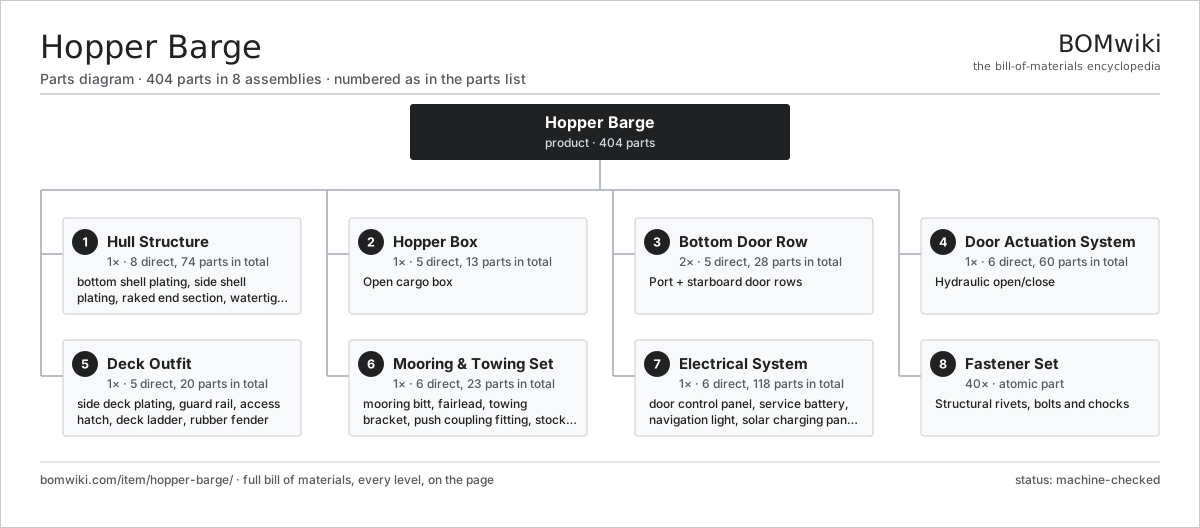
| # | Part | Qty | What it does |
|---|---|---|---|
| 1 | Hull Structure 8 parts | 1× | Welded steel box hull with double bottom, longitudinal girders and transverse frames carrying the hopper load into the water. |
| 2 | Hopper Box 5 parts | 1× | Open cargo box |
| 3 | Bottom Door Row 5 parts | 2× | Port + starboard door rows |
| 4 | Door Actuation System 6 parts | 1× | Hydraulic open/close |
| 5 | Deck Outfit 5 parts | 1× | Walkways, railings, hatches and access fittings on the side decks around the hopper. |
| 6 | Mooring & Towing Set 6 parts | 1× | Bitts, fairleads and connection fittings for towing the barge or coupling it into a pushed tow. |
| 7 | Electrical System 6 parts | 1× | Battery, navigation lights and the control panel that commands the door hydraulics. |
| 8 | Fastener Set | 40× | Structural rivets, bolts and chocks |
3D model
No 3D model yet. Have a CAD file of this? Add a 3D model — STL renders right on this page; STEP, FreeCAD, and OpenSCAD sources are welcome too (openly licensed, like all 3D models on BOMwiki).
Build & assembly graph
expand / collapse · shared sub-assemblies converge · links to related products · est. labourTap an assembly to expand/collapse · tap a part to open it · use “Open page” for any node · drag to pan, scroll to zoom.
Bill of materials for Hopper Barge
8 top-level lines · 64 rows shown · 404 parts total · indented to 3 levels| # | Item / sub-assembly | Part no. | Qty/assy | Ext. qty | Parts | Type |
|---|---|---|---|---|---|---|
| 1 | Hull Structure 8 parts | hopper-barge-hull | 1× | 1 | 74 | assembly |
| 1.1 | Bottom Shell Plating | hopper-barge-bottom-shell | 1× | 1 | · | part |
| 1.2 | Side Shell Plating | hopper-barge-side-shell | 2× | 2 | · | part |
| 1.3 | Raked End Section | hopper-barge-rake-end | 2× | 2 | · | part |
| 1.4 | Watertight Bulkhead | hopper-barge-bulkhead | 6× | 6 | · | part |
| 1.5 | Longitudinal Girder | hopper-barge-longitudinal-girder | 4× | 4 | · | part |
| 1.6 | Transverse Web Frame | hopper-barge-frame | 28× | 28 | · | part |
| 1.7 | Center Keelson | hopper-barge-keelson | 1× | 1 | · | part |
| 1.8 | Sheet Metal Panel | sheet-panel | 30× | 30 | · | part |
| 2 | Hopper Box 5 parts | hopper-barge-hopper | 1× | 1 | 13 | assembly |
| 2.1 | Hopper Coaming | hopper-barge-coaming | 4× | 4 | · | part |
| 2.2 | Sloped Wing Plate | hopper-barge-sloped-wing | 2× | 2 | · | part |
| 2.3 | Abrasion-Resistant Liner | hopper-barge-hopper-liner | 1× | 1 | · | part |
| 2.4 | Door Sill Beam | hopper-barge-door-sill | 4× | 4 | · | part |
| 2.5 | Overflow Weir | hopper-barge-overflow-weir | 2× | 2 | · | part |
| 3 | Bottom Door Row 5 parts | hopper-barge-bottom-door-set | 2× | 2 | 28 | assembly |
| 3.1 | Bottom Door Leaf | hopper-barge-bottom-door | 4× | 8 | · | part |
| 3.2 | Door Hinge Casting | hopper-barge-door-hinge | 8× | 16 | · | part |
| 3.3 | Door Seal Strip | hopper-barge-door-seal | 4× | 8 | · | part |
| 3.4 | Door Tie Linkage | hopper-barge-door-linkage | 4× | 8 | · | part |
| 3.5 | Hinge Pin | hopper-barge-door-pin | 8× | 16 | · | part |
| 4 | Door Actuation System 6 parts | hopper-barge-door-actuation | 1× | 1 | 60 | assembly |
| 4.1 | Hydraulic Power Unit 5 parts | hopper-barge-hydraulic-power-unit | 1× | 1 | 9 | assembly |
| 4.1.1 | Hydraulic Pump | hopper-barge-hydraulic-pump | 1× | 1 | · | part |
| 4.1.2 | Pump Drive Motor | hopper-barge-hydraulic-motor | 1× | 1 | · | part |
| 4.1.3 | Oil Reservoir | hopper-barge-oil-reservoir | 1× | 1 | · | part |
| 4.1.4 | Hydraulic Filter | hopper-barge-hydraulic-filter | 2× | 2 | · | part |
| 4.1.5 | O-Ring Set | oring-set | 4× | 4 | · | part |
| 4.2 | Door Hydraulic Cylinder 5 parts | hopper-barge-door-cylinder | 4× | 4 | 8 | assembly |
| 4.2.1 | Cylinder Barrel | hopper-barge-cylinder-barrel | 1× | 4 | · | part |
| 4.2.2 | Cylinder Rod | hopper-barge-cylinder-rod | 1× | 4 | · | part |
| 4.2.3 | Cylinder Piston | hopper-barge-cylinder-piston | 1× | 4 | · | part |
| 4.2.4 | O-Ring Set | oring-set | 3× | 12 | · | part |
| 4.2.5 | Oil Seal | oil-seal | 2× | 8 | · | part |
| 4.3 | Valve Block (Manifold) | hopper-barge-hydraulic-valve-block | 1× | 1 | · | part |
| 4.4 | Hydraulic Hose | hopper-barge-hydraulic-hose | 12× | 12 | · | part |
| 4.5 | Door Position Sensor | hopper-barge-position-sensor | 4× | 4 | · | part |
| 4.6 | Pressure Sensor | pressure-sensor | 2× | 2 | · | part |
| 5 | Deck Outfit 5 parts | hopper-barge-deck-outfit | 1× | 1 | 20 | assembly |
| 5.1 | Side Deck Plating | hopper-barge-side-deck | 2× | 2 | · | part |
| 5.2 | Guard Rail | hopper-barge-guard-rail | 4× | 4 | · | part |
| 5.3 | Access Hatch | hopper-barge-access-hatch | 4× | 4 | · | part |
| 5.4 | Deck Ladder | hopper-barge-ladder | 2× | 2 | · | part |
| 5.5 | Rubber Fender | hopper-barge-fender | 8× | 8 | · | part |
| 6 | Mooring & Towing Set 6 parts | hopper-barge-mooring-set | 1× | 1 | 23 | assembly |
| 6.1 | Mooring Bitt | hopper-barge-bitt | 6× | 6 | · | part |
| 6.2 | Fairlead | hopper-barge-fairlead | 8× | 8 | · | part |
| 6.3 | Towing Bracket | hopper-barge-towing-bracket | 2× | 2 | · | part |
| 6.4 | Push Coupling Fitting | hopper-barge-coupling-fitting | 2× | 2 | · | part |
| 6.5 | Stockless Anchor | hopper-barge-anchor | 1× | 1 | · | part |
| 6.6 | Mooring Line | hopper-barge-mooring-line | 4× | 4 | · | part |
| 7 | Electrical System 6 parts | hopper-barge-electrical | 1× | 1 | 118 | assembly |
| 7.1 | Door Control Panel 5 parts | hopper-barge-control-panel | 1× | 1 | 89 | assembly |
| 7.1.1 | Bare PCB | pcb-bare | 1× | 1 | · | part |
| 7.1.2 | Microcontroller | mcu | 1× | 1 | · | part |
| 7.1.3 | Relay | relay | 6× | 6 | · | part |
| 7.1.4 | LCD Panel | lcd-panel | 1× | 1 | · | part |
| 7.1.5 | SMD Passive (R/C/L) | smd-passives | 80× | 80 | · | part |
| 7.2 | Service Battery | hopper-barge-battery | 2× | 2 | · | part |
| 7.3 | Navigation Light | hopper-barge-nav-light | 4× | 4 | · | part |
| 7.4 | Solar Charging Panel | hopper-barge-solar-panel | 2× | 2 | · | part |
| 7.5 | Wire Bundle | wire-bundle | 1× | 1 | · | part |
| 7.6 | Connector | connector | 20× | 20 | · | part |
| 8 | Fastener Set | fastener-set | 40× | 40 | · | part |
Related products
same domain, ranked by shared parts Container Feeder Ship
2,496 parts · shares 10 with this page
Container Feeder Ship
2,496 parts · shares 10 with this page
 Crab Fishing Boat
8,775 parts · shares 10 with this page
Crab Fishing Boat
8,775 parts · shares 10 with this page
 Crewed Submersible
2,830 parts · shares 10 with this page
Crewed Submersible
2,830 parts · shares 10 with this page
 Floating Crane Barge
1,501 parts · shares 10 with this page
Floating Crane Barge
1,501 parts · shares 10 with this page
 Heavy-Lift Ship
40,014 parts · shares 10 with this page
Heavy-Lift Ship
40,014 parts · shares 10 with this page
 Livestock Carrier
40,809 parts · shares 10 with this page
Livestock Carrier
40,809 parts · shares 10 with this page
Sourcing: possible vendors
Prices, MOQ, and lead times are algorithmic estimates, not quotes, and not claims about these companies. Company mappings are curated by keyword; est. price band $2k–$500M. How estimates work| Vendor | HQ | Specialty | MOQ | Lead time |
|---|---|---|---|---|
| hd.com ↗ | Ulsan, KR | Shipbuilder | made to order | 52–104 wks |
| fincantieri.com ↗ | Trieste, IT | Shipbuilder | made to order | 52–104 wks |
| damen.com ↗ | Gorinchem, NL | Shipbuilder | made to order | 52–104 wks |
| brunswick.com ↗ | Mettawa, US | Marine & boats | made to order | 52–104 wks |
|
🇨🇳CSSC
cssc.net.cn ↗
|
Shanghai, CN | Shipbuilding conglomerate | made to order | 52–104 wks |
1,014-word article