Hydrofoil Boat
ProductOverview
A hydrofoil boat is a fast passenger craft that lifts its hull clear of the water at speed, riding instead on small underwater wings called foils. At rest and at low speed the vessel floats on its Hull like any conventional boat. As the Propulsion System accelerates the craft past roughly 18–22 knots, the Foil System generates enough lift to raise the whole hull out of the water, leaving only the thin foils and struts immersed. With the hull no longer plowing through the surface, drag drops sharply and the boat cruises smoothly at 36–45 knots while using far less power than a planing hull would need at the same speed.
The example described here is a 27 m commuter ferry carrying 60–120 passengers across coastal and inter-island routes. It is built from welded 5083 marine aluminium with stainless steel foils, displaces 60–90 tonnes, and is driven by a single 900–1,200 kW high-speed diesel. The cabin is enclosed and air-conditioned, and the vessel is conned from a forward Navigation Bridge much like a small aircraft cockpit.
How foiling works
A foil is a wing that works in water instead of air. Because water is about 800 times denser than air, a hydrofoil only needs a small area to carry the whole boat. The Forward Foil sits below the bow on the Forward Strut and carries roughly 60% of the load. The Aft Foil sits below the transom on the Aft Strut and carries the rest while also setting the boat's pitch trim. Lift rises with the square of speed, so below take-off speed the foils cannot support the boat and it stays hullborne. Above take-off speed the lift exceeds the weight, the hull rises, and the boat settles at a height where lift and weight balance.
This design uses fully submerged foils, which stay completely underwater during flight. Fully submerged foils give a smooth ride in waves because they are not disturbed by the surface, but they are not naturally stable: left alone they would either climb out of the water or sink back into it. The Foil Control System solves this. It is an active autopilot that continuously adjusts the foils to hold a steady ride height.
Foil control
The ride-control loop runs about 50 times a second. A forward and an aft Height Sensor measure how deep the foils are below the surface, using ultrasonic ranging and submersion pressure read by a pressure-sensor. A Gyro Unit reports the boat's pitch, roll and vertical motion. The Autopilot Controller, a sealed unit built around an mcu on a marine-grade board, takes these readings and computes how much each foil should change its lift. It commands four Flap Actuator units, each driving a trailing-edge Foil Flap through a servo-motor. Deflecting a flap a few degrees changes the foil's lift almost instantly, so the controller can hold the hull at a steady cruising height of about 1.5 m above the water even as waves pass underneath. The same loop damps roll by deflecting the port and starboard flaps differently, keeping the cabin level in a beam sea.
Hull and structure
Although the boat flies at speed, the Hull still has to carry it at rest, during take-off, and on landing. It is a welded aluminium planing hull, 5–8 mm Hull Plating over a grid of transverse Frame Set frames and a central Keel Beam box girder that also anchors the forward strut. The hull is divided by watertight Watertight Bulkhead walls into buoyant compartments so flooding one section will not sink the boat. A Spray Rail runs along each chine to throw spray downward during the planing take-off run, and the reinforced Transom mounts the aft strut and the drive line.
Propulsion and steering
Power comes from a high-speed common-rail Marine Diesel Engine of 900–1,200 kW. Because the propeller has to sit at the bottom of the aft strut, well below the hull, the drive turns through a down-angle Reduction Gearbox built around a gearbox-housing and a gear-pair, then runs down the strut on the Propeller Shaft to a Supercavitating Propeller. At foilborne speed the propeller works in a regime where the water around the blades vaporises, so a supercavitating profile is used that is shaped to run efficiently inside its own vapour cavity. The engine is cooled by a seawater Cooling Circuit and isolated from the hull by rubber Engine Mount blocks.
Steering is hydraulic. The Helm Wheel drives a Steering Pump that pressurises a Steering Cylinder, which swings the Tiller Arm to set the angle of a strut-mounted Rudder. The rudder stays immersed at all speeds, so the boat steers the same way hullborne and foilborne, though turns at 40 knots are gentle to keep the foils from broaching the surface.
Cabin, electrical and fuel
The Passenger Cabin is enclosed and laid out like an aircraft, with rows of reclining Passenger Seat units, large bonded Cabin Window panes, and a 12 kW HVAC Unit for climate control. Passengers wear a lap belt during take-off and landing transitions. The Electrical System runs at 24 V DC: an engine Alternator charges a sealed AGM Battery Bank, and a Distribution Panel feeds the control, navigation and cabin circuits through individual breakers. Diesel is held in two baffled Fuel Tank units feeding the engine through water-separating Fuel Filter elements in the Fuel System.
Variants and use cases
Hydrofoil designs split into two families. Surface-piercing foils form a V or ladder shape that pokes through the surface; they are self-stabilising because lift falls automatically as the foil rises out of the water, so they need no active control, but they ride more roughly in waves. Fully submerged foils, like the ones on this craft, stay underwater and give a far smoother ride at the cost of needing the active Foil Control System. Sizes range from small 5 m sport foilers up to the large passenger hydrofoils that have run on rivers and coastal routes for decades.
The main use case is fast passenger transport on protected and coastal waters: commuter ferries, island hops, and harbour shuttles where a 40-knot crossing beats both a slower displacement ferry and a road detour. The smooth foilborne ride reduces seasickness compared with a planing craft slamming through chop, which matters on routes that run many times a day in moderate seas.
Hydrofoil Boat parts and their functions
9 top-level parts · 499 parts in total · full bill of materials below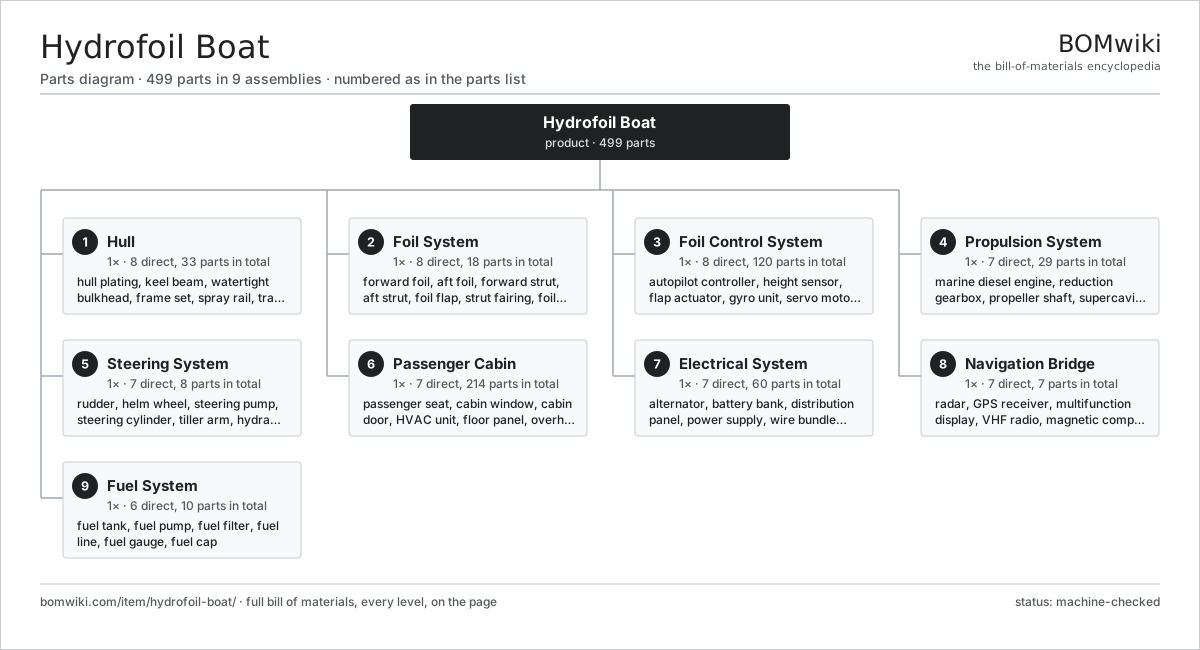
| # | Part | Qty | What it does |
|---|---|---|---|
| 1 | Hull 8 parts | 1× | Welded marine-grade aluminium planing hull that supports the vessel at rest and during take-off before the foils lift it clear. |
| 2 | Foil System 8 parts | 1× | Fully submerged forward and aft hydrofoils on vertical struts that generate lift as speed builds and raise the hull above the surface. |
| 3 | Foil Control System 8 parts | 1× | Closed-loop autopilot that reads ride height and motion, then drives the flap actuators to hold a steady cruising altitude in waves. |
| 4 | Propulsion System 7 parts | 1× | High-speed marine diesel driving a supercavitating propeller through an inclined shaft down the aft strut. |
| 5 | Steering System 7 parts | 1× | Hydraulic helm turning a strut-mounted rudder that steers the boat both hullborne and foilborne. |
| 6 | Passenger Cabin 7 parts | 1× | Enclosed climate-controlled cabin seating 60–120 passengers with large windows and an aircraft-style layout. |
| 7 | Electrical System 7 parts | 1× | Engine-driven alternator, battery bank and distribution board powering control, navigation and cabin loads at 24 V DC. |
| 8 | Navigation Bridge 7 parts | 1× | Forward wheelhouse with radar, GPS chartplotter, VHF radio and a multifunction display for high-speed pilotage. |
| 9 | Fuel System 6 parts | 1× | Aluminium diesel tank, transfer pump and water-separating filters feeding the engine through baffled lines. |
3D model
No 3D model yet. Have a CAD file of this? Add a 3D model — STL renders right on this page; STEP, FreeCAD, and OpenSCAD sources are welcome too (openly licensed, like all 3D models on BOMwiki).
Build & assembly graph
expand / collapse · shared sub-assemblies converge · links to related products · est. labourTap an assembly to expand/collapse · tap a part to open it · use “Open page” for any node · drag to pan, scroll to zoom.
Bill of materials for Hydrofoil Boat
9 top-level lines · 104 rows shown · 499 parts total · indented to 3 levels| # | Item / sub-assembly | Part no. | Qty/assy | Ext. qty | Parts | Type |
|---|---|---|---|---|---|---|
| 1 | Hull 8 parts | hydrofoil-boat-hull | 1× | 1 | 33 | assembly |
| 1.1 | Hull Plating | hydrofoil-boat-hull-plating | 1× | 1 | · | part |
| 1.2 | Keel Beam | hydrofoil-boat-keel-beam | 1× | 1 | · | part |
| 1.3 | Watertight Bulkhead | hydrofoil-boat-bulkhead | 5× | 5 | · | part |
| 1.4 | Frame Set | hydrofoil-boat-frame-set | 18× | 18 | · | part |
| 1.5 | Spray Rail | hydrofoil-boat-spray-rail | 2× | 2 | · | part |
| 1.6 | Transom | hydrofoil-boat-transom | 1× | 1 | · | part |
| 1.7 | Deck Plating | hydrofoil-boat-deck-plating | 1× | 1 | · | part |
| 1.8 | Fastener Set | fastener-set | 4× | 4 | · | part |
| 2 | Foil System 8 parts | hydrofoil-boat-foil-system | 1× | 1 | 18 | assembly |
| 2.1 | Forward Foil | hydrofoil-boat-forward-foil | 1× | 1 | · | part |
| 2.2 | Aft Foil | hydrofoil-boat-aft-foil | 1× | 1 | · | part |
| 2.3 | Forward Strut | hydrofoil-boat-forward-strut | 1× | 1 | · | part |
| 2.4 | Aft Strut | hydrofoil-boat-aft-strut | 2× | 2 | · | part |
| 2.5 | Foil Flap | hydrofoil-boat-foil-flap | 4× | 4 | · | part |
| 2.6 | Strut Fairing | hydrofoil-boat-strut-fairing | 3× | 3 | · | part |
| 2.7 | Foil Mount Bracket | hydrofoil-boat-foil-mount-bracket | 3× | 3 | · | part |
| 2.8 | Fastener Set | fastener-set | 3× | 3 | · | part |
| 3 | Foil Control System 8 parts | hydrofoil-boat-foil-control-system | 1× | 1 | 120 | assembly |
| 3.1 | Autopilot Controller 5 parts | hydrofoil-boat-autopilot-controller | 1× | 1 | 8 | assembly |
| 3.1.1 | Bare PCB | pcb-bare | 1× | 1 | · | part |
| 3.1.2 | Microcontroller | mcu | 1× | 1 | · | part |
| 3.1.3 | SMD Passive (R/C/L) | smd-passives | 1× | 1 | · | part |
| 3.1.4 | Controller Enclosure | hydrofoil-boat-controller-enclosure | 1× | 1 | · | part |
| 3.1.5 | Connector | connector | 4× | 4 | · | part |
| 3.2 | Height Sensor | hydrofoil-boat-height-sensor | 2× | 2 | · | part |
| 3.3 | Flap Actuator | hydrofoil-boat-flap-actuator | 4× | 4 | · | part |
| 3.4 | Gyro Unit | hydrofoil-boat-gyro-unit | 1× | 1 | · | part |
| 3.5 | Servo Motor 4 parts | servo-motor | 4× | 4 | 24 | assembly |
| 3.5.1 | Stator Assembly 3 parts + deeper › | stator-assembly | 1× | 4 | 3 | assembly |
| 3.5.2 | Rotor Assembly 4 parts + deeper › | rotor-assembly | 1× | 4 | 19 | assembly |
| 3.5.3 | Encoder | encoder | 1× | 4 | · | part |
| 3.5.4 | Motor Housing | motor-housing | 1× | 4 | · | part |
| 3.6 | Pressure Sensor | pressure-sensor | 2× | 2 | · | part |
| 3.7 | Control Harness | hydrofoil-boat-control-harness | 1× | 1 | · | part |
| 3.8 | Connector | connector | 6× | 6 | · | part |
| 4 | Propulsion System 7 parts | hydrofoil-boat-propulsion-system | 1× | 1 | 29 | assembly |
| 4.1 | Marine Diesel Engine | hydrofoil-boat-diesel-engine | 1× | 1 | · | part |
| 4.2 | Reduction Gearbox 5 parts | hydrofoil-boat-reduction-gearbox | 1× | 1 | 14 | assembly |
| 4.2.1 | Gearbox Housing | gearbox-housing | 1× | 1 | · | part |
| 4.2.2 | Helical Gear Pair | gear-pair | 2× | 2 | · | part |
| 4.2.3 | Ball Bearing | ball-bearing | 6× | 6 | · | part |
| 4.2.4 | Oil Seal | oil-seal | 4× | 4 | · | part |
| 4.2.5 | O-Ring Set | oring-set | 1× | 1 | · | part |
| 4.3 | Propeller Shaft | hydrofoil-boat-propeller-shaft | 1× | 1 | · | part |
| 4.4 | Supercavitating Propeller | hydrofoil-boat-propeller | 1× | 1 | · | part |
| 4.5 | Engine Mount | hydrofoil-boat-engine-mount | 4× | 4 | · | part |
| 4.6 | Cooling Circuit 4 parts | hydrofoil-boat-cooling-circuit | 1× | 1 | 7 | assembly |
| 4.6.1 | Heat Exchanger | hydrofoil-boat-heat-exchanger | 1× | 1 | · | part |
| 4.6.2 | Coolant Pump | hydrofoil-boat-coolant-pump | 1× | 1 | · | part |
| 4.6.3 | Coolant Hose | hydrofoil-boat-coolant-hose | 4× | 4 | · | part |
| 4.6.4 | O-Ring Set | oring-set | 1× | 1 | · | part |
| 4.7 | Exhaust Line | hydrofoil-boat-exhaust-line | 1× | 1 | · | part |
| 5 | Steering System 7 parts | hydrofoil-boat-steering-system | 1× | 1 | 8 | assembly |
| 5.1 | Rudder | hydrofoil-boat-rudder | 1× | 1 | · | part |
| 5.2 | Helm Wheel | hydrofoil-boat-helm-wheel | 1× | 1 | · | part |
| 5.3 | Steering Pump | hydrofoil-boat-steering-pump | 1× | 1 | · | part |
| 5.4 | Steering Cylinder | hydrofoil-boat-steering-cylinder | 1× | 1 | · | part |
| 5.5 | Tiller Arm | hydrofoil-boat-tiller-arm | 1× | 1 | · | part |
| 5.6 | Hydraulic Line | hydrofoil-boat-hydraulic-line | 2× | 2 | · | part |
| 5.7 | O-Ring Set | oring-set | 1× | 1 | · | part |
| 6 | Passenger Cabin 7 parts | hydrofoil-boat-passenger-cabin | 1× | 1 | 214 | assembly |
| 6.1 | Passenger Seat | hydrofoil-boat-passenger-seat | 80× | 80 | · | part |
| 6.2 | Cabin Window | hydrofoil-boat-cabin-window | 24× | 24 | · | part |
| 6.3 | Cabin Door | hydrofoil-boat-cabin-door | 2× | 2 | · | part |
| 6.4 | HVAC Unit 5 parts | hydrofoil-boat-hvac-unit | 1× | 1 | 26 | assembly |
| 6.4.1 | HVAC Blower | hydrofoil-boat-hvac-blower | 1× | 1 | · | part |
| 6.4.2 | HVAC Coil | hydrofoil-boat-hvac-coil | 1× | 1 | · | part |
| 6.4.3 | Stator Assembly 3 parts + deeper › | stator-assembly | 1× | 1 | 3 | assembly |
| 6.4.4 | Rotor Assembly 4 parts + deeper › | rotor-assembly | 1× | 1 | 19 | assembly |
| 6.4.5 | Relay | relay | 2× | 2 | · | part |
| 6.5 | Floor Panel | hydrofoil-boat-floor-panel | 1× | 1 | · | part |
| 6.6 | Overhead Panel | hydrofoil-boat-overhead-panel | 1× | 1 | · | part |
| 6.7 | Seatbelt Set | hydrofoil-boat-seatbelt-set | 80× | 80 | · | part |
| 7 | Electrical System 7 parts | hydrofoil-boat-electrical-system | 1× | 1 | 60 | assembly |
| 7.1 | Alternator | hydrofoil-boat-alternator | 1× | 1 | · | part |
| 7.2 | Battery Bank 3 parts | hydrofoil-boat-battery-bank | 1× | 1 | 13 | assembly |
| 7.2.1 | Battery Cell | hydrofoil-boat-battery-cell | 8× | 8 | · | part |
| 7.2.2 | Battery Tray | hydrofoil-boat-battery-tray | 1× | 1 | · | part |
| 7.2.3 | Connector | connector | 4× | 4 | · | part |
| 7.3 | Distribution Panel 4 parts | hydrofoil-boat-distribution-panel | 1× | 1 | 27 | assembly |
| 7.3.1 | Circuit Breaker | hydrofoil-boat-breaker | 16× | 16 | · | part |
| 7.3.2 | Busbar | hydrofoil-boat-busbar | 2× | 2 | · | part |
| 7.3.3 | Bare PCB | pcb-bare | 1× | 1 | · | part |
| 7.3.4 | Connector | connector | 8× | 8 | · | part |
| 7.4 | Power Supply | power-supply | 2× | 2 | · | part |
| 7.5 | Wire Bundle | wire-bundle | 1× | 1 | · | part |
| 7.6 | Relay | relay | 6× | 6 | · | part |
| 7.7 | Connector | connector | 10× | 10 | · | part |
| 8 | Navigation Bridge 7 parts | hydrofoil-boat-navigation-bridge | 1× | 1 | 7 | assembly |
| 8.1 | Radar | hydrofoil-boat-radar | 1× | 1 | · | part |
| 8.2 | GPS Receiver | hydrofoil-boat-gps-receiver | 1× | 1 | · | part |
| 8.3 | Multifunction Display | hydrofoil-boat-mfd-display | 1× | 1 | · | part |
| 8.4 | VHF Radio | hydrofoil-boat-vhf-radio | 1× | 1 | · | part |
| 8.5 | Magnetic Compass | hydrofoil-boat-compass | 1× | 1 | · | part |
| 8.6 | Throttle Console | hydrofoil-boat-throttle-console | 1× | 1 | · | part |
| 8.7 | LCD Panel | lcd-panel | 1× | 1 | · | part |
| 9 | Fuel System 6 parts | hydrofoil-boat-fuel-system | 1× | 1 | 10 | assembly |
| 9.1 | Fuel Tank | hydrofoil-boat-fuel-tank | 2× | 2 | · | part |
| 9.2 | Fuel Pump | hydrofoil-boat-fuel-pump | 1× | 1 | · | part |
| 9.3 | Fuel Filter | hydrofoil-boat-fuel-filter | 2× | 2 | · | part |
| 9.4 | Fuel Line | hydrofoil-boat-fuel-line | 1× | 1 | · | part |
| 9.5 | Fuel Gauge | hydrofoil-boat-fuel-gauge | 2× | 2 | · | part |
| 9.6 | Fuel Cap | hydrofoil-boat-fuel-cap | 2× | 2 | · | part |
Related products
same domain, ranked by shared parts Anchor Handling Tug
1,196 parts · shares 23 with this page
Car Ferry
731 parts · shares 23 with this page
Anchor Handling Tug
1,196 parts · shares 23 with this page
Car Ferry
731 parts · shares 23 with this page
 Container Feeder Ship
2,496 parts · shares 23 with this page
Container Feeder Ship
2,496 parts · shares 23 with this page
 Crewed Submersible
2,830 parts · shares 23 with this page
Crewed Submersible
2,830 parts · shares 23 with this page
 Factory Ship
2,311 parts · shares 23 with this page
Factory Ship
2,311 parts · shares 23 with this page
 Floating Crane Barge
1,501 parts · shares 23 with this page
Floating Crane Barge
1,501 parts · shares 23 with this page
Sourcing: possible vendors
Prices, MOQ, and lead times are algorithmic estimates, not quotes, and not claims about these companies. Company mappings are curated by keyword; est. price band $2k–$500M. How estimates work| Vendor | HQ | Specialty | MOQ | Lead time |
|---|---|---|---|---|
| hd.com ↗ | Ulsan, KR | Shipbuilder | made to order | 52–104 wks |
| fincantieri.com ↗ | Trieste, IT | Shipbuilder | made to order | 52–104 wks |
| damen.com ↗ | Gorinchem, NL | Shipbuilder | made to order | 52–104 wks |
| brunswick.com ↗ | Mettawa, US | Marine & boats | made to order | 52–104 wks |
|
🇨🇳CSSC
cssc.net.cn ↗
|
Shanghai, CN | Shipbuilding conglomerate | made to order | 52–104 wks |
1,174-word article