Rowing Shell
ProductOverview
A rowing shell is a racing boat stripped to the minimum needed to carry a rower and convert their stroke into speed. It is extremely long and narrow, has almost no freeboard, and weighs as little as the rules allow. A single scull is 8.2 m long but under 30 cm wide, so narrow that it would tip instantly without the stabilising effect of the rower's oars resting in the water. Everything about the boat serves one goal: minimal drag for maximum boat speed over a 2,000 m course.
The shell is best understood as a hull plus a power-transmission machine bolted to it. The Composite Hull carries the rower; the Rigging sets the leverage geometry of the oars; the Sliding Seat System and Foot Stretcher let the rower use their legs, the largest muscles in the stroke; the Steering keeps it on course; and the Sculling Oar Set does the actual work against the water. A few Fittings & Safety and a light Finish complete the boat.
Hull
The Composite Hull is a Hull Shell built as a carbon-fiber and Nomex honeycomb sandwich monocoque, the same construction philosophy as a Formula car tub: a thin, stiff, very light skin that carries load through its shape rather than internal structure. A single-scull hull weighs as little as 14 kg, the FISA minimum. Even so, the long thin shape needs help resisting bending, so an internal Keel Spine spine and transverse Rib frames stiffen it, and the cockpit edges are reinforced with a Gunwale. The ends are closed with a sealed Deck Skin over flotation. A soft rubber Bow Ball on the bow is mandatory under the rules: it blunts the needle-sharp bow so a collision is far less dangerous to other rowers.
Rigging
The Rigging is what turns the oar into a lever and is the most tuned part of the boat. Because the hull is too narrow to mount the oarlocks directly, each oar pivots on a Rigger (Outrigger) outrigger arm extending out from the hull, braced by a Rigger Backstay. At the end of each rigger sits an Oarlock Gate gate on a Rigger Pin vertical pivot. The height of the oarlock above the water, set by stacking Height Spacer washers, and the pin's angle and spread are all adjustable. These rigging numbers change the gearing of the stroke, how heavy or light the oar feels, and crews spend real effort dialling them in to match the rower's strength and the race conditions.
Sliding Seat
A rowing stroke is mostly legs, not arms, and the Sliding Seat System is what makes that possible. The Seat rolls on four Seat Wheel wheels along two Slide Track rails, with Track Stop limits at each end. As the rower drives, the seat slides sternward, letting the legs extend and push the whole body weight into the stroke. A fixed seat would limit the rower to a weak arms-and-back pull, so the sliding seat roughly doubles the usable power per stroke and is one of the defining inventions of modern rowing.
Foot Stretcher
The legs need something to push against, which is the Foot Stretcher. The rower's feet sit in fixed Rowing Shoe units bolted to an angled Stretcher Plate, which slides on a Stretcher Rail to set fore-aft position and angle via the Clog Adjuster. A Heel Restraint restraint holds the heel but releases instantly if the boat capsizes, so the rower can never be trapped underwater. The foot stretcher is the anchor point for all the leg drive, so its rigidity and adjustment directly affect both power and comfort.
Steering
A single scull has no rudder and tracks on a fixed Skeg (Fin) fin, steered by the rower pulling harder on one oar. Larger boats add a Steering system: a small Rudder connected by Steering Wire cables to a Toe Steering Pivot under one rower's shoe, so the rower can steer with a small foot movement without breaking stroke. In coxed boats the cox steers instead; in coxless boats the toe steering keeps the crew on line over the 2,000 m course.
Oars
The Sculling Oar Set does the propulsion. Each Sculling Oar is a carbon Oar Shaft ending in an asymmetric Hatchet Blade, the hatchet or cleaver shape that grips the water better than the old symmetric blades. A plastic Sleeve bears against the oarlock, an adjustable Collar (Button) button sets how much of the oar is inboard of the pivot, fixing the leverage, and a Handle Grip grip is where the rower applies force. The collar position works together with the rigging to set the overall gearing of the boat.
Fittings and Finish
The Fittings & Safety keep the boat safe and measured. Sealed Flotation Compartment compartments keep a swamped shell afloat, a Self-Bailer drains water at speed, Inspection Hatch covers give access to the buoyancy spaces, and a SpeedCoach with an LCD Panel shows GPS speed and stroke rate so the crew can pace the race. A Bow Number Holder holder carries the race number. The Finish is minimal: often just a Clear Coat over bare carbon to save weight, with Topside Paint only for club livery.
A racing single costs roughly $8,000 to $15,000, and an eight far more. The boat is a precision instrument: small changes in rigging, oar gearing, and weight measurably change boat speed, which is why rowing equipment is adjusted as carefully as the training behind it.
Rowing Shell parts and their functions
8 top-level parts · 80 parts in total · full bill of materials below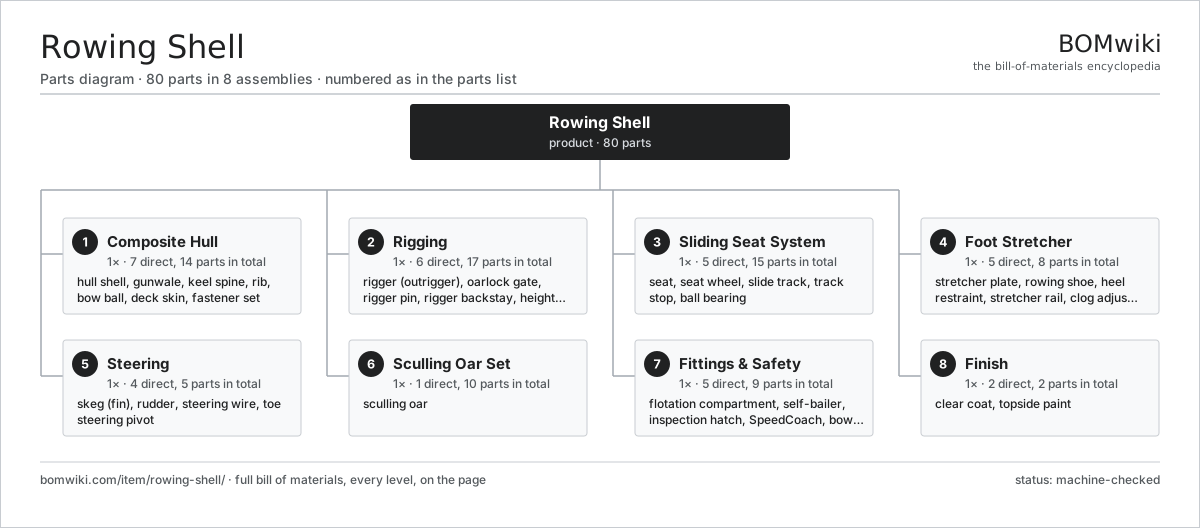
| # | Part | Qty | What it does |
|---|---|---|---|
| 1 | Composite Hull 7 parts | 1× | Long needle-thin carbon-honeycomb monocoque hull. |
| 2 | Rigging 6 parts | 1× | Outrigger arms and oarlocks setting the leverage geometry. |
| 3 | Sliding Seat System 5 parts | 1× | Wheeled seat running on tracks to use the legs in the stroke. |
| 4 | Foot Stretcher 5 parts | 1× | Adjustable foot plate the rower drives against. |
| 5 | Steering 4 parts | 1× | Bow rudder steered by a foot-mounted toe linkage. |
| 6 | Sculling Oar Set 1 parts | 1× | Pair of sculling oars. |
| 7 | Fittings & Safety 5 parts | 1× | Buoyancy, hatches and onboard electronics. |
| 8 | Finish 2 parts | 1× | Hull coatings. |
3D model
No 3D model yet. Have a CAD file of this? Add a 3D model — STL renders right on this page; STEP, FreeCAD, and OpenSCAD sources are welcome too (openly licensed, like all 3D models on BOMwiki).
Build & assembly graph
expand / collapse · shared sub-assemblies converge · links to related products · est. labourTap an assembly to expand/collapse · tap a part to open it · use “Open page” for any node · drag to pan, scroll to zoom.
Bill of materials for Rowing Shell
8 top-level lines · 51 rows shown · 80 parts total · indented to 3 levels| # | Item / sub-assembly | Part no. | Qty/assy | Ext. qty | Parts | Type |
|---|---|---|---|---|---|---|
| 1 | Composite Hull 7 parts | rowing-shell-hull | 1× | 1 | 14 | assembly |
| 1.1 | Hull Shell | rowing-shell-hull-shell | 1× | 1 | · | part |
| 1.2 | Gunwale | rowing-shell-gunwale | 2× | 2 | · | part |
| 1.3 | Keel Spine | rowing-shell-keel | 1× | 1 | · | part |
| 1.4 | Rib | rowing-shell-rib | 6× | 6 | · | part |
| 1.5 | Bow Ball | rowing-shell-bow-ball | 1× | 1 | · | part |
| 1.6 | Deck Skin | rowing-shell-deck-skin | 1× | 1 | · | part |
| 1.7 | Fastener Set | fastener-set | 2× | 2 | · | part |
| 2 | Rigging 6 parts | rowing-shell-rigging | 1× | 1 | 17 | assembly |
| 2.1 | Rigger (Outrigger) | rowing-shell-rigger | 2× | 2 | · | part |
| 2.2 | Oarlock Gate | rowing-shell-oarlock | 2× | 2 | · | part |
| 2.3 | Rigger Pin | rowing-shell-pin | 2× | 2 | · | part |
| 2.4 | Rigger Backstay | rowing-shell-backstay | 2× | 2 | · | part |
| 2.5 | Height Spacer | rowing-shell-spacer | 8× | 8 | · | part |
| 2.6 | Fastener Set | fastener-set | 1× | 1 | · | part |
| 3 | Sliding Seat System 5 parts | rowing-shell-seat-system | 1× | 1 | 15 | assembly |
| 3.1 | Seat | rowing-shell-seat | 1× | 1 | · | part |
| 3.2 | Seat Wheel | rowing-shell-seat-wheel | 4× | 4 | · | part |
| 3.3 | Slide Track | rowing-shell-slide-track | 2× | 2 | · | part |
| 3.4 | Track Stop | rowing-shell-track-stop | 4× | 4 | · | part |
| 3.5 | Ball Bearing | ball-bearing | 4× | 4 | · | part |
| 4 | Foot Stretcher 5 parts | rowing-shell-foot-system | 1× | 1 | 8 | assembly |
| 4.1 | Stretcher Plate | rowing-shell-stretcher-plate | 1× | 1 | · | part |
| 4.2 | Rowing Shoe | rowing-shell-shoe | 2× | 2 | · | part |
| 4.3 | Heel Restraint | rowing-shell-heel-tie | 2× | 2 | · | part |
| 4.4 | Stretcher Rail | rowing-shell-stretcher-rail | 2× | 2 | · | part |
| 4.5 | Clog Adjuster | rowing-shell-clog-adjuster | 1× | 1 | · | part |
| 5 | Steering 4 parts | rowing-shell-steering | 1× | 1 | 5 | assembly |
| 5.1 | Skeg (Fin) | rowing-shell-skeg | 1× | 1 | · | part |
| 5.2 | Rudder | rowing-shell-rudder | 1× | 1 | · | part |
| 5.3 | Steering Wire | rowing-shell-steering-wire | 2× | 2 | · | part |
| 5.4 | Toe Steering Pivot | rowing-shell-toe-pivot | 1× | 1 | · | part |
| 6 | Sculling Oar Set 1 parts | rowing-shell-oar-set | 1× | 1 | 10 | assembly |
| 6.1 | Sculling Oar 5 parts | rowing-shell-oar | 2× | 2 | 5 | assembly |
| 6.1.1 | Oar Shaft | rowing-shell-oar-shaft | 1× | 2 | · | part |
| 6.1.2 | Hatchet Blade | rowing-shell-oar-blade | 1× | 2 | · | part |
| 6.1.3 | Sleeve | rowing-shell-oar-sleeve | 1× | 2 | · | part |
| 6.1.4 | Collar (Button) | rowing-shell-oar-collar | 1× | 2 | · | part |
| 6.1.5 | Handle Grip | rowing-shell-oar-handle | 1× | 2 | · | part |
| 7 | Fittings & Safety 5 parts | rowing-shell-fittings | 1× | 1 | 9 | assembly |
| 7.1 | Flotation Compartment | rowing-shell-flotation | 2× | 2 | · | part |
| 7.2 | Self-Bailer | rowing-shell-bailer | 1× | 1 | · | part |
| 7.3 | Inspection Hatch | rowing-shell-hatch | 2× | 2 | · | part |
| 7.4 | SpeedCoach 3 parts | rowing-shell-speed-coach | 1× | 1 | 3 | assembly |
| 7.4.1 | LCD Panel | lcd-panel | 1× | 1 | · | part |
| 7.4.2 | Bare PCB | pcb-bare | 1× | 1 | · | part |
| 7.4.3 | Microcontroller | mcu | 1× | 1 | · | part |
| 7.5 | Bow Number Holder | rowing-shell-bow-number | 1× | 1 | · | part |
| 8 | Finish 2 parts | rowing-shell-finish | 1× | 1 | 2 | assembly |
| 8.1 | Clear Coat | rowing-shell-clear-coat | 1× | 1 | · | part |
| 8.2 | Topside Paint | rowing-shell-paint | 1× | 1 | · | part |
Related products
same domain, ranked by shared parts Anchor Handling Tug
1,196 parts · shares 3 with this page
Anchor Handling Tug
1,196 parts · shares 3 with this page
 Anchor Windlass
79 parts · shares 3 with this page
Bass Fishing Boat
306 parts · shares 3 with this page
Anchor Windlass
79 parts · shares 3 with this page
Bass Fishing Boat
306 parts · shares 3 with this page
 Cabin Cruiser
158 parts · shares 3 with this page
Cabin Cruiser
158 parts · shares 3 with this page
 Canal Narrowboat
144 parts · shares 3 with this page
Car Ferry
731 parts · shares 3 with this page
Canal Narrowboat
144 parts · shares 3 with this page
Car Ferry
731 parts · shares 3 with this page
Sourcing: possible vendors
Prices, MOQ, and lead times are algorithmic estimates, not quotes, and not claims about these companies. Company mappings are curated by keyword; est. price band $2k–$500M. How estimates work| Vendor | HQ | Specialty | MOQ | Lead time |
|---|---|---|---|---|
| hd.com ↗ | Ulsan, KR | Shipbuilder | made to order | 52–104 wks |
| fincantieri.com ↗ | Trieste, IT | Shipbuilder | made to order | 52–104 wks |
| damen.com ↗ | Gorinchem, NL | Shipbuilder | made to order | 52–104 wks |
| brunswick.com ↗ | Mettawa, US | Marine & boats | made to order | 52–104 wks |
|
🇨🇳CSSC
cssc.net.cn ↗
|
Shanghai, CN | Shipbuilding conglomerate | made to order | 52–104 wks |
1,007-word article