River Pusher Tug
ProductOverview
A river pusher tug, called a towboat on many waterways despite the name, is a powerful, shallow-draft vessel built to push a tow of barges rather than pull it. Its bow is flat and square so it can press against the square stern of a barge string and drive the whole assembly forward as one rigid unit. The vessel concentrates a large amount of engine power in a small, maneuverable hull, with a tall wheelhouse that lets the pilot see over a tow that may stretch hundreds of meters ahead. The main building blocks are the Hull Structure, the twin Propulsion Train trains, the Steering System system, the Deckhouse & Wheelhouse, and the Barge Coupling Gear that locks tug and barges together.
Supporting these are the Electrical System system, the Auxiliary Systems that handle fuel, cooling and bilge water, and the Deck Outfit of capstans, bitts and fenders. Everything is sized around one job: producing high thrust at low speed and steering a long, heavy tow through the bends and locks of a river.
Hull and push bow
The Hull Structure is a flat-bottomed steel box with a shallow draft so it can work rivers that would ground a deeper vessel. Its defining feature is the Push Bow (Tow Knees), a flat vertical structure with tow knees that bears directly on the barge stern and transmits pushing thrust without a towline. Aft, Skeg fins ahead of the propellers improve straight-line tracking and shield the screws from debris and grounding.
Internally the hull is divided by Watertight Bulkhead walls into watertight compartments and stiffened by Transverse Frame members. The shape is a compromise: blunt and beamy enough to push squarely against a barge, yet still able to slip astern and turn quickly, which is why these boats look stubby compared with seagoing tugs.
Propulsion
Each Propulsion Train train starts with a Main Diesel Engine, a medium-speed marine diesel built around an Engine Block, a Crankshaft and several Piston & Conrod units, breathing through a Turbocharger and fed by a Fuel Injection System system. The engine drives a Marine Reduction Gearbox with a Reversing Clutch that selects ahead or astern without stopping the engine, then power passes down a Propeller Shaft through a sealed Stern Tube & Seal to the Propeller.
The propeller runs inside a Kort Nozzle, a shrouding duct that markedly increases thrust at the low speeds at which a tug pushes a heavy tow. That bollard pull, the static pushing force, matters far more here than top speed, so the whole train is geared and ducted for it. Two such trains side by side give the redundancy and turning authority a single screw could not.
Steering and wheelhouse
Maneuvering a long tow demands more rudder authority than an ordinary vessel needs. The Steering System system uses several rudders: a main Rudder behind each propeller for ahead steering, plus flanking rudders forward of them that steer while backing down, all driven through Rudder Stock stocks by a hydraulic Hydraulic Steering Gear. This lets a pilot pivot the tow, hold it against a current, and ease it into a lock.
The Deckhouse & Wheelhouse carries the crew accommodation below and an elevated Elevated Wheelhouse, sometimes telescoping, so the pilot can see over the barges. The Helm Console gathers the throttle controls, steering lever and instrument displays, and a Navigation Suite of radar, GPS compass, electronic charts, VHF radios and searchlights supports night and low-visibility running on busy rivers.
Coupling gear
What turns a tug and a string of barges into a single controllable vessel is the Barge Coupling Gear. Padded Push Knee surfaces on the bow press against the barge, and heavy Face Wire wires are run from the tug to the barge and hauled bar-tight by Coupling Winch winches and hand Wire Ratchet ratchets against Timberhead Bitt bitts. Tensioned correctly, the coupling is rigid enough that the tow steers as one hull, with no slack to let the barges wander.
Power, auxiliaries and outfit
The Electrical System system runs on two diesel Diesel Generator Set units feeding a main Main Switchboard, with batteries and a Shore Power Connection for power in port. The Auxiliary Systems keep the propulsion plant alive: a Fuel Storage & Transfer storing and transferring diesel, a Bilge System with an Oily Water Separator to discharge bilge water cleanly, Sea Chest & Strainer intakes drawing river water for cooling, a starting-air compressor and a fire pump. On deck the Deck Outfit adds capstans for handling wires, mooring bitts, a row of fenders and life rafts.
Use and operation
In service a pusher tug rarely stops. It makes up a tow at a fleeting area, couples on, and pushes it for days at a stretch, the crew standing watches around the clock. River work means constant adjustment: setting up for bends, holding station in current while waiting for a lock, and breaking the tow into sections to lock through where the chamber is too short for the whole assembly. The design is specialized for exactly this, high thrust at low speed and tight maneuvering, rather than the open-water seakeeping a harbor or ocean tug needs. That specialization is why a single pusher tug can move a tonnage that would take a long train of trucks, at a fraction of the fuel per ton-mile.
River Pusher Tug parts and their functions
8 top-level parts · 764 parts in total · full bill of materials below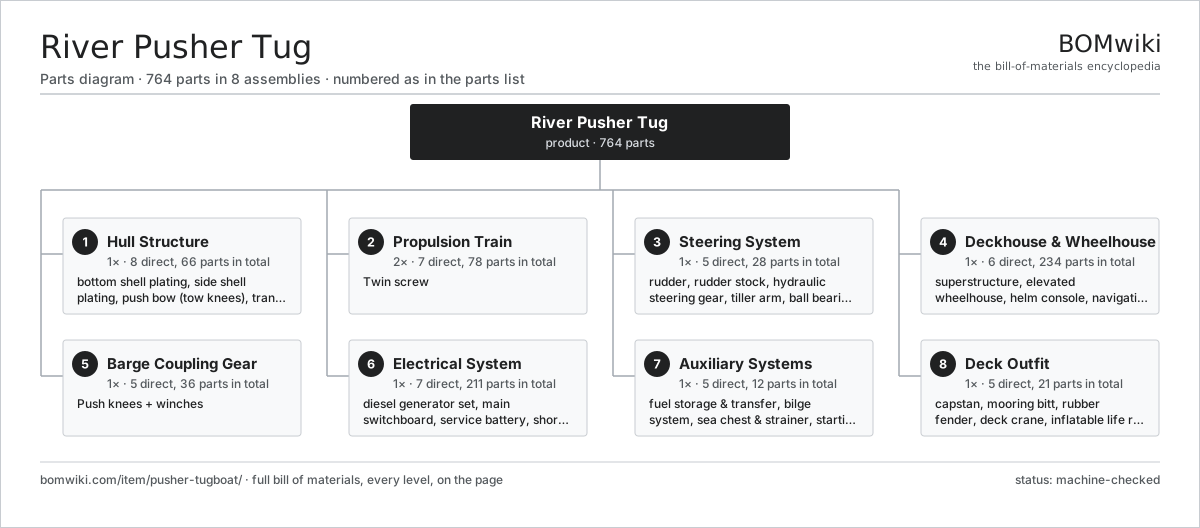
| # | Part | Qty | What it does |
|---|---|---|---|
| 1 | Hull Structure 8 parts | 1× | Shallow-draft steel hull with a flat, vertical push bow (towknees) and a flat bottom suited to rivers. |
| 2 | Propulsion Train 7 parts | 2× | Twin screw |
| 3 | Steering System 5 parts | 1× | Multiple main and flanking rudders driven by hydraulic gear, giving the maneuverability needed to handle a long tow. |
| 4 | Deckhouse & Wheelhouse 6 parts | 1× | Crew accommodation topped by an elevated wheelhouse with the helm console and the all-around visibility needed to see over the tow. |
| 5 | Barge Coupling Gear 5 parts | 1× | Push knees + winches |
| 6 | Electrical System 7 parts | 1× | |
| 7 | Auxiliary Systems 5 parts | 1× | |
| 8 | Deck Outfit 5 parts | 1× |
3D model
No 3D model yet. Have a CAD file of this? Add a 3D model — STL renders right on this page; STEP, FreeCAD, and OpenSCAD sources are welcome too (openly licensed, like all 3D models on BOMwiki).
Build & assembly graph
expand / collapse · shared sub-assemblies converge · links to related products · est. labourTap an assembly to expand/collapse · tap a part to open it · use “Open page” for any node · drag to pan, scroll to zoom.
Bill of materials for River Pusher Tug
8 top-level lines · 103 rows shown · 764 parts total · indented to 3 levels| # | Item / sub-assembly | Part no. | Qty/assy | Ext. qty | Parts | Type |
|---|---|---|---|---|---|---|
| 1 | Hull Structure 8 parts | pusher-tugboat-hull | 1× | 1 | 66 | assembly |
| 1.1 | Bottom Shell Plating | pusher-tugboat-bottom-shell | 1× | 1 | · | part |
| 1.2 | Side Shell Plating | pusher-tugboat-side-shell | 2× | 2 | · | part |
| 1.3 | Push Bow (Tow Knees) | pusher-tugboat-push-bow | 1× | 1 | · | part |
| 1.4 | Transom Stern | pusher-tugboat-transom | 1× | 1 | · | part |
| 1.5 | Watertight Bulkhead | pusher-tugboat-bulkhead | 5× | 5 | · | part |
| 1.6 | Transverse Frame | pusher-tugboat-frame | 24× | 24 | · | part |
| 1.7 | Skeg | pusher-tugboat-skeg | 2× | 2 | · | part |
| 1.8 | Sheet Metal Panel | sheet-panel | 30× | 30 | · | part |
| 2 | Propulsion Train 7 parts | pusher-tugboat-propulsion | 2× | 2 | 78 | assembly |
| 2.1 | Main Diesel Engine 7 parts | pusher-tugboat-main-engine | 1× | 2 | 55 | assembly |
| 2.1.1 | Engine Block | pusher-tugboat-engine-block | 1× | 2 | · | part |
| 2.1.2 | Crankshaft | pusher-tugboat-crankshaft | 1× | 2 | · | part |
| 2.1.3 | Piston & Conrod 4 parts + deeper › | pusher-tugboat-piston-assembly | 6× | 12 | 6 | assembly |
| 2.1.4 | Cylinder Head | pusher-tugboat-cylinder-head | 6× | 12 | · | part |
| 2.1.5 | Turbocharger | pusher-tugboat-turbocharger | 1× | 2 | · | part |
| 2.1.6 | Fuel Injection System 3 parts + deeper › | pusher-tugboat-fuel-injection | 1× | 2 | 9 | assembly |
| 2.1.7 | Engine Heat Exchanger | pusher-tugboat-engine-cooler | 1× | 2 | · | part |
| 2.2 | Marine Reduction Gearbox 5 parts | pusher-tugboat-marine-gearbox | 1× | 2 | 10 | assembly |
| 2.2.1 | Helical Gear Pair | gear-pair | 2× | 4 | · | part |
| 2.2.2 | Gearbox Housing | gearbox-housing | 1× | 2 | · | part |
| 2.2.3 | Ball Bearing | ball-bearing | 4× | 8 | · | part |
| 2.2.4 | Oil Seal | oil-seal | 2× | 4 | · | part |
| 2.2.5 | Reversing Clutch | pusher-tugboat-clutch | 1× | 2 | · | part |
| 2.3 | Propeller Shaft | pusher-tugboat-propeller-shaft | 1× | 2 | · | part |
| 2.4 | Propeller | pusher-tugboat-propeller | 1× | 2 | · | part |
| 2.5 | Kort Nozzle | pusher-tugboat-kort-nozzle | 1× | 2 | · | part |
| 2.6 | Stern Tube & Seal 3 parts | pusher-tugboat-stern-tube | 1× | 2 | 6 | assembly |
| 2.6.1 | Oil Seal | oil-seal | 2× | 4 | · | part |
| 2.6.2 | Ball Bearing | ball-bearing | 2× | 4 | · | part |
| 2.6.3 | O-Ring Set | oring-set | 2× | 4 | · | part |
| 2.7 | Ball Bearing | ball-bearing | 4× | 8 | · | part |
| 3 | Steering System 5 parts | pusher-tugboat-steering | 1× | 1 | 28 | assembly |
| 3.1 | Rudder | pusher-tugboat-rudder | 4× | 4 | · | part |
| 3.2 | Rudder Stock | pusher-tugboat-rudder-stock | 4× | 4 | · | part |
| 3.3 | Hydraulic Steering Gear 4 parts | pusher-tugboat-steering-gear | 1× | 1 | 8 | assembly |
| 3.3.1 | Steering Hydraulic Pump | pusher-tugboat-steering-pump | 1× | 1 | · | part |
| 3.3.2 | Steering Cylinder | pusher-tugboat-steering-cylinder | 2× | 2 | · | part |
| 3.3.3 | O-Ring Set | oring-set | 4× | 4 | · | part |
| 3.3.4 | Pressure Sensor | pressure-sensor | 1× | 1 | · | part |
| 3.4 | Tiller Arm | pusher-tugboat-tiller | 4× | 4 | · | part |
| 3.5 | Ball Bearing | ball-bearing | 8× | 8 | · | part |
| 4 | Deckhouse & Wheelhouse 6 parts | pusher-tugboat-deckhouse | 1× | 1 | 234 | assembly |
| 4.1 | Superstructure | pusher-tugboat-superstructure | 1× | 1 | · | part |
| 4.2 | Elevated Wheelhouse | pusher-tugboat-wheelhouse | 1× | 1 | · | part |
| 4.3 | Helm Console 6 parts | pusher-tugboat-helm-console | 1× | 1 | 209 | assembly |
| 4.3.1 | Bare PCB | pcb-bare | 2× | 2 | · | part |
| 4.3.2 | Microcontroller | mcu | 2× | 2 | · | part |
| 4.3.3 | LCD Panel | lcd-panel | 2× | 2 | · | part |
| 4.3.4 | Engine Throttle Control | pusher-tugboat-throttle-control | 2× | 2 | · | part |
| 4.3.5 | Steering Lever | pusher-tugboat-steering-lever | 1× | 1 | · | part |
| 4.3.6 | SMD Passive (R/C/L) | smd-passives | 200× | 200 | · | part |
| 4.4 | Navigation Suite 5 parts | pusher-tugboat-navigation-suite | 1× | 1 | 7 | assembly |
| 4.4.1 | Radar Scanner | pusher-tugboat-radar | 1× | 1 | · | part |
| 4.4.2 | GPS Compass | pusher-tugboat-gps-compass | 1× | 1 | · | part |
| 4.4.3 | VHF Radio | pusher-tugboat-vhf-radio | 2× | 2 | · | part |
| 4.4.4 | Electronic Chart Display | pusher-tugboat-ecdis | 1× | 1 | · | part |
| 4.4.5 | Searchlight | pusher-tugboat-searchlight | 2× | 2 | · | part |
| 4.5 | Crew Cabin Module | pusher-tugboat-crew-cabin | 4× | 4 | · | part |
| 4.6 | Wheelhouse Window | pusher-tugboat-window | 12× | 12 | · | part |
| 5 | Barge Coupling Gear 5 parts | pusher-tugboat-coupling-gear | 1× | 1 | 36 | assembly |
| 5.1 | Push Knee | pusher-tugboat-push-knee | 2× | 2 | · | part |
| 5.2 | Coupling Winch 4 parts | pusher-tugboat-coupling-winch | 4× | 4 | 5 | assembly |
| 5.2.1 | Winch Drum | pusher-tugboat-winch-drum | 1× | 4 | · | part |
| 5.2.2 | Helical Gear Pair | gear-pair | 1× | 4 | · | part |
| 5.2.3 | Gearbox Housing | gearbox-housing | 1× | 4 | · | part |
| 5.2.4 | Ball Bearing | ball-bearing | 2× | 8 | · | part |
| 5.3 | Face Wire | pusher-tugboat-face-wire | 4× | 4 | · | part |
| 5.4 | Wire Ratchet | pusher-tugboat-ratchet | 4× | 4 | · | part |
| 5.5 | Timberhead Bitt | pusher-tugboat-timberhead | 6× | 6 | · | part |
| 6 | Electrical System 7 parts | pusher-tugboat-electrical | 1× | 1 | 211 | assembly |
| 6.1 | Diesel Generator Set 4 parts | pusher-tugboat-generator-set | 2× | 2 | 24 | assembly |
| 6.1.1 | Generator Diesel Engine | pusher-tugboat-genset-engine | 1× | 2 | · | part |
| 6.1.2 | Stator Assembly 3 parts + deeper › | stator-assembly | 1× | 2 | 3 | assembly |
| 6.1.3 | Rotor Assembly 4 parts + deeper › | rotor-assembly | 1× | 2 | 19 | assembly |
| 6.1.4 | Genset Controller | pusher-tugboat-genset-controller | 1× | 2 | · | part |
| 6.2 | Main Switchboard 4 parts | pusher-tugboat-switchboard | 1× | 1 | 109 | assembly |
| 6.2.1 | Bare PCB | pcb-bare | 1× | 1 | · | part |
| 6.2.2 | Relay | relay | 16× | 16 | · | part |
| 6.2.3 | Circuit Breaker | pusher-tugboat-breaker | 12× | 12 | · | part |
| 6.2.4 | SMD Passive (R/C/L) | smd-passives | 80× | 80 | · | part |
| 6.3 | Service Battery | pusher-tugboat-battery | 4× | 4 | · | part |
| 6.4 | Shore Power Connection | pusher-tugboat-shore-connection | 1× | 1 | · | part |
| 6.5 | Navigation Light | pusher-tugboat-nav-light | 8× | 8 | · | part |
| 6.6 | Wire Bundle | wire-bundle | 1× | 1 | · | part |
| 6.7 | Connector | connector | 40× | 40 | · | part |
| 7 | Auxiliary Systems 5 parts | pusher-tugboat-auxiliary-systems | 1× | 1 | 12 | assembly |
| 7.1 | Fuel Storage & Transfer 3 parts | pusher-tugboat-fuel-system | 1× | 1 | 5 | assembly |
| 7.1.1 | Fuel Tank | pusher-tugboat-fuel-tank | 2× | 2 | · | part |
| 7.1.2 | Fuel Transfer Pump | pusher-tugboat-fuel-transfer-pump | 1× | 1 | · | part |
| 7.1.3 | Fuel Filter | pusher-tugboat-fuel-filter | 2× | 2 | · | part |
| 7.2 | Bilge System 2 parts | pusher-tugboat-bilge-system | 1× | 1 | 3 | assembly |
| 7.2.1 | Bilge Pump | pusher-tugboat-bilge-pump | 2× | 2 | · | part |
| 7.2.2 | Oily Water Separator | pusher-tugboat-oily-water-separator | 1× | 1 | · | part |
| 7.3 | Sea Chest & Strainer | pusher-tugboat-cooling-seachest | 2× | 2 | · | part |
| 7.4 | Starting Air Compressor | pusher-tugboat-air-compressor | 1× | 1 | · | part |
| 7.5 | Fire Pump | pusher-tugboat-fire-pump | 1× | 1 | · | part |
| 8 | Deck Outfit 5 parts | pusher-tugboat-deck-outfit | 1× | 1 | 21 | assembly |
| 8.1 | Capstan | pusher-tugboat-capstan | 2× | 2 | · | part |
| 8.2 | Mooring Bitt | pusher-tugboat-bitt | 6× | 6 | · | part |
| 8.3 | Rubber Fender | pusher-tugboat-fender | 10× | 10 | · | part |
| 8.4 | Deck Crane | pusher-tugboat-deck-crane | 1× | 1 | · | part |
| 8.5 | Inflatable Life Raft | pusher-tugboat-life-raft | 2× | 2 | · | part |
Related products
same domain, ranked by shared parts Container Feeder Ship
2,496 parts · shares 20 with this page
Container Feeder Ship
2,496 parts · shares 20 with this page
 Crab Fishing Boat
8,775 parts · shares 20 with this page
Crab Fishing Boat
8,775 parts · shares 20 with this page
 Crewed Submersible
2,830 parts · shares 20 with this page
Crewed Submersible
2,830 parts · shares 20 with this page
 Floating Crane Barge
1,501 parts · shares 20 with this page
Floating Crane Barge
1,501 parts · shares 20 with this page
 Heavy-Lift Ship
40,014 parts · shares 20 with this page
Heavy-Lift Ship
40,014 parts · shares 20 with this page
 Passenger Hovercraft
354 parts · shares 20 with this page
Passenger Hovercraft
354 parts · shares 20 with this page
Sourcing: possible vendors
Prices, MOQ, and lead times are algorithmic estimates, not quotes, and not claims about these companies. Company mappings are curated by keyword; est. price band $2k–$500M. How estimates work| Vendor | HQ | Specialty | MOQ | Lead time |
|---|---|---|---|---|
| hd.com ↗ | Ulsan, KR | Shipbuilder | made to order | 52–104 wks |
| fincantieri.com ↗ | Trieste, IT | Shipbuilder | made to order | 52–104 wks |
| damen.com ↗ | Gorinchem, NL | Shipbuilder | made to order | 52–104 wks |
| brunswick.com ↗ | Mettawa, US | Marine & boats | made to order | 52–104 wks |
|
🇨🇳CSSC
cssc.net.cn ↗
|
Shanghai, CN | Shipbuilding conglomerate | made to order | 52–104 wks |
959-word article