Amphibious Duck Boat
ProductOverview
An amphibious duck boat is a passenger vehicle that drives on roads like a bus and then drives straight down a ramp into a lake or river and floats away under its own propeller. The name and the shape come from the DUKW, a wartime amphibious truck whose factory code gave it the nickname duck, and modern tour ducks keep the same idea: a watertight boat hull that also serves as the vehicle chassis, with road wheels and a marine propeller both driven by one engine. They run sightseeing tours in cities with both a downtown core and a waterfront, giving passengers a land tour that ends with a splash into the water.
The vehicle has to be two machines in one body. The Hull Body is a boat hull that doubles as the chassis. One Engine powers everything through a Transmission that splits drive between the Road Running Gear on land and the Marine Drive afloat. The Brake System stops it on the road, the Bilge System keeps it from sinking on the water, and the Passenger Fitout and Electrical System systems carry and serve the tour load.
Hull and body
The Hull Body is the heart of the dual nature. The Hull Shell is a welded watertight steel or aluminum boat hull, and built into it is a Chassis Frame that carries the axles, engine and running gear, so the same structure that floats also takes the road loads. The hull is divided by Bulkhead watertight bulkheads into separate compartments so that flooding in one section does not sink the whole vehicle, an important safety feature given the history of duck-boat accidents.
Keeping water out is constant work. A full Hull Seal Set set seals every hatch, shaft penetration and opening, the Deck Plate floor plating sits above the bilge to keep the cabin dry, and Fender rubber fenders protect the hull when coming alongside docks. The hull must be heavy and strong enough for road use yet still float with thirty passengers aboard, which makes these vehicles large and heavy for their length compared with an ordinary boat.
Engine and transmission
A single Engine does all the work. It is a marine-rated turbo-diesel: a cast Engine Block with Piston pistons on a Crankshaft, a Cylinder Head, a Turbocharger and Fuel Injection, cooled by a Radiator and breathing through a raised Air Filter intake placed high to keep water out. Marine rating matters because the engine must run hard at low road speed and then push a heavy hull through water, both of which load it more than ordinary truck duty.
The clever part is the Transmission. A road Gearbox drives the wheels on land, and a Transfer Case splits the engine's output between the axles and a Power Take-Off power take-off. When the driver enters the water, the transfer case sends drive through the PTO to the marine propeller instead of, or as well as, the wheels, while Driveshaft shafts and a Clutch manage the changeover. The transition from land to water is the most demanding moment in the whole machine, because drive has to move smoothly from wheels to propeller as the hull starts to float.
Marine drive and road running gear
Afloat, the Marine Drive takes over. The PTO turns a Propeller Shaft running through a sealed Stern Tube to a Propeller at the stern, supported on Ball Bearing bearings and kept watertight by an Oil Seal. Steering on the water is by a Water Rudder behind the propeller, worked through a Rudder Linkage from the same wheel that steers on the road. The boat is slow on the water, around five or six knots, because the blunt amphibious hull is a poor boat shape, but it is steady and easy to handle for a sightseeing run.
On land the Road Running Gear carries the load. Multiple driven Axle axles spread the heavy hull across six Wheel Assembly wheels on Leaf Spring springs, steered through a Steering Box and Tie Rod tie rods. A Central Tire Inflation central tire inflation system can drop tire pressure for grip on the soft, slippery launch ramp and raise it again for the road. Because the vehicle is heavy and tall, the Brake System uses Brake Drum drums on every wheel actuated by Brake Chamber air chambers fed by an Air Compressor, the same heavy-duty braking used on trucks and buses.
Safety, passengers and electrics
On the water the Bilge System is the last line of defence. Two Bilge Pump pumps clear any water that gets into the hull, discharging it overboard through Thru-Hull Fitting fittings, and a Bilge Alarm high-water alarm warns the driver of flooding before it becomes dangerous. After several fatal sinkings, regulators have pushed hard on bilge alarms, reserve buoyancy and crew procedures for these vehicles.
The Passenger Fitout carries up to thirty people on cross Bench Seat benches under a Canopy roof, with Grab Rail rails, Boarding Step steps for climbing into the high hull, and a Life Jacket for every passenger. A PA System carries the guide's commentary over the engine noise. The Electrical System system, run from twin Battery batteries charged by an Alternator, powers both road-legal Road Lights and marine Navigation Lights, read out on a combined Instrument Panel. Duck boats serve almost entirely as tourist attractions in waterfront cities, where the novelty of one vehicle that drives and then floats is the whole appeal.
Amphibious Duck Boat parts and their functions
9 top-level parts · 168 parts in total · full bill of materials below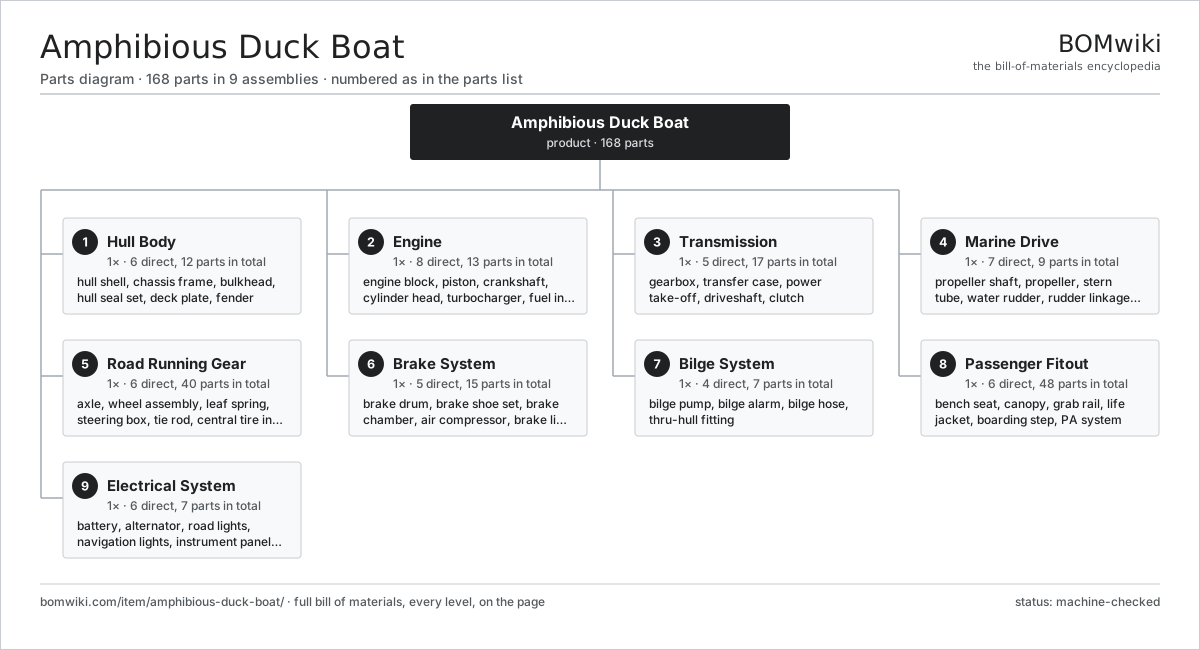
| # | Part | Qty | What it does |
|---|---|---|---|
| 1 | Hull Body 6 parts | 1× | Watertight boat hull doubling as the vehicle chassis. |
| 2 | Engine 8 parts | 1× | Marine-rated diesel powering road and water modes. |
| 3 | Transmission 5 parts | 1× | Gearbox and transfer case splitting drive to road and water. |
| 4 | Marine Drive 7 parts | 1× | Propeller, shaft and water rudder for floating mode. |
| 5 | Road Running Gear 6 parts | 1× | Axles, wheels and steering for the street. |
| 6 | Brake System 5 parts | 1× | Air or hydraulic brakes for road use. |
| 7 | Bilge System 4 parts | 1× | Pumps and alarms keeping the hull dry. |
| 8 | Passenger Fitout 6 parts | 1× | Seating, canopy and safety gear for the tour load. |
| 9 | Electrical System 6 parts | 1× | Battery, lighting and instruments for road and marine modes. |
3D model
No 3D model yet. Have a CAD file of this? Add a 3D model — STL renders right on this page; STEP, FreeCAD, and OpenSCAD sources are welcome too (openly licensed, like all 3D models on BOMwiki).
Build & assembly graph
expand / collapse · shared sub-assemblies converge · links to related products · est. labourTap an assembly to expand/collapse · tap a part to open it · use “Open page” for any node · drag to pan, scroll to zoom.
Bill of materials for Amphibious Duck Boat
9 top-level lines · 70 rows shown · 168 parts total · indented to 3 levels| # | Item / sub-assembly | Part no. | Qty/assy | Ext. qty | Parts | Type |
|---|---|---|---|---|---|---|
| 1 | Hull Body 6 parts | duck-hull-body | 1× | 1 | 12 | assembly |
| 1.1 | Hull Shell | duck-hull-shell | 1× | 1 | · | part |
| 1.2 | Chassis Frame | duck-chassis-frame | 1× | 1 | · | part |
| 1.3 | Bulkhead | duck-bulkhead | 4× | 4 | · | part |
| 1.4 | Hull Seal Set | duck-hull-seal | 1× | 1 | · | part |
| 1.5 | Deck Plate | duck-deck-plate | 1× | 1 | · | part |
| 1.6 | Fender | duck-fender | 4× | 4 | · | part |
| 2 | Engine 8 parts | duck-engine | 1× | 1 | 13 | assembly |
| 2.1 | Engine Block | duck-engine-block | 1× | 1 | · | part |
| 2.2 | Piston | duck-piston | 6× | 6 | · | part |
| 2.3 | Crankshaft | duck-crankshaft | 1× | 1 | · | part |
| 2.4 | Cylinder Head | duck-cylinder-head | 1× | 1 | · | part |
| 2.5 | Turbocharger | duck-turbocharger | 1× | 1 | · | part |
| 2.6 | Fuel Injection | duck-fuel-injection | 1× | 1 | · | part |
| 2.7 | Radiator | duck-radiator | 1× | 1 | · | part |
| 2.8 | Air Filter | duck-air-filter | 1× | 1 | · | part |
| 3 | Transmission 5 parts | duck-transmission | 1× | 1 | 17 | assembly |
| 3.1 | Gearbox 4 parts | duck-gearbox | 1× | 1 | 12 | assembly |
| 3.1.1 | Helical Gear Pair | gear-pair | 3× | 3 | · | part |
| 3.1.2 | Gearbox Housing | gearbox-housing | 1× | 1 | · | part |
| 3.1.3 | Ball Bearing | ball-bearing | 6× | 6 | · | part |
| 3.1.4 | Oil Seal | oil-seal | 2× | 2 | · | part |
| 3.2 | Transfer Case | duck-transfer-case | 1× | 1 | · | part |
| 3.3 | Power Take-Off | duck-pto | 1× | 1 | · | part |
| 3.4 | Driveshaft | duck-driveshaft | 2× | 2 | · | part |
| 3.5 | Clutch | duck-clutch | 1× | 1 | · | part |
| 4 | Marine Drive 7 parts | duck-marine-drive | 1× | 1 | 9 | assembly |
| 4.1 | Propeller Shaft | duck-prop-shaft | 1× | 1 | · | part |
| 4.2 | Propeller | duck-propeller | 1× | 1 | · | part |
| 4.3 | Stern Tube | duck-stern-tube | 1× | 1 | · | part |
| 4.4 | Water Rudder | duck-water-rudder | 1× | 1 | · | part |
| 4.5 | Rudder Linkage | duck-rudder-linkage | 1× | 1 | · | part |
| 4.6 | Oil Seal | oil-seal | 2× | 2 | · | part |
| 4.7 | Ball Bearing | ball-bearing | 2× | 2 | · | part |
| 5 | Road Running Gear 6 parts | duck-road-running-gear | 1× | 1 | 40 | assembly |
| 5.1 | Axle | duck-axle | 2× | 2 | · | part |
| 5.2 | Wheel Assembly 4 parts | duck-wheel-assy | 6× | 6 | 5 | assembly |
| 5.2.1 | Tire | duck-tire | 1× | 6 | · | part |
| 5.2.2 | Wheel Rim | duck-rim | 1× | 6 | · | part |
| 5.2.3 | Wheel Hub | duck-hub | 1× | 6 | · | part |
| 5.2.4 | Ball Bearing | ball-bearing | 2× | 12 | · | part |
| 5.3 | Leaf Spring | duck-leaf-spring | 4× | 4 | · | part |
| 5.4 | Steering Box | duck-steering-box | 1× | 1 | · | part |
| 5.5 | Tie Rod | duck-tie-rod | 2× | 2 | · | part |
| 5.6 | Central Tire Inflation | duck-ctd-system | 1× | 1 | · | part |
| 6 | Brake System 5 parts | duck-brake-system | 1× | 1 | 15 | assembly |
| 6.1 | Brake Drum | duck-brake-drum | 6× | 6 | · | part |
| 6.2 | Brake Shoe Set | duck-brake-shoe | 1× | 1 | · | part |
| 6.3 | Brake Chamber | duck-brake-chamber | 6× | 6 | · | part |
| 6.4 | Air Compressor | duck-air-compressor | 1× | 1 | · | part |
| 6.5 | Brake Line Set | duck-brake-line | 1× | 1 | · | part |
| 7 | Bilge System 4 parts | duck-bilge-system | 1× | 1 | 7 | assembly |
| 7.1 | Bilge Pump | duck-bilge-pump | 2× | 2 | · | part |
| 7.2 | Bilge Alarm | duck-bilge-alarm | 1× | 1 | · | part |
| 7.3 | Bilge Hose | duck-bilge-hose | 2× | 2 | · | part |
| 7.4 | Thru-Hull Fitting | duck-thru-hull | 2× | 2 | · | part |
| 8 | Passenger Fitout 6 parts | duck-passenger-fitout | 1× | 1 | 48 | assembly |
| 8.1 | Bench Seat | duck-bench-seat | 8× | 8 | · | part |
| 8.2 | Canopy | duck-canopy | 1× | 1 | · | part |
| 8.3 | Grab Rail | duck-grab-rail | 6× | 6 | · | part |
| 8.4 | Life Jacket | duck-life-jacket | 30× | 30 | · | part |
| 8.5 | Boarding Step | duck-boarding-step | 2× | 2 | · | part |
| 8.6 | PA System | duck-pa-system | 1× | 1 | · | part |
| 9 | Electrical System 6 parts | duck-electrical | 1× | 1 | 7 | assembly |
| 9.1 | Battery | duck-battery | 2× | 2 | · | part |
| 9.2 | Alternator | duck-alternator | 1× | 1 | · | part |
| 9.3 | Road Lights | duck-road-lights | 1× | 1 | · | part |
| 9.4 | Navigation Lights | duck-nav-lights | 1× | 1 | · | part |
| 9.5 | Instrument Panel | duck-instrument-panel | 1× | 1 | · | part |
| 9.6 | Wire Bundle | wire-bundle | 1× | 1 | · | part |
Related products
same domain, ranked by shared parts Airboat
78 parts · shares 4 with this page
Airboat
78 parts · shares 4 with this page
 Anchor Handling Tug
1,196 parts · shares 4 with this page
Anchor Handling Tug
1,196 parts · shares 4 with this page
 Anchor Windlass
79 parts · shares 4 with this page
Anchor Windlass
79 parts · shares 4 with this page
 Canal Narrowboat
144 parts · shares 4 with this page
Car Carrier Ship
266,341 parts · shares 4 with this page
Car Ferry
731 parts · shares 4 with this page
Canal Narrowboat
144 parts · shares 4 with this page
Car Carrier Ship
266,341 parts · shares 4 with this page
Car Ferry
731 parts · shares 4 with this page
Sourcing: possible vendors
Prices, MOQ, and lead times are algorithmic estimates, not quotes, and not claims about these companies. Company mappings are curated by keyword; est. price band $2k–$500M. How estimates work| Vendor | HQ | Specialty | MOQ | Lead time |
|---|---|---|---|---|
| hd.com ↗ | Ulsan, KR | Shipbuilder | made to order | 52–104 wks |
| fincantieri.com ↗ | Trieste, IT | Shipbuilder | made to order | 52–104 wks |
| damen.com ↗ | Gorinchem, NL | Shipbuilder | made to order | 52–104 wks |
| brunswick.com ↗ | Mettawa, US | Marine & boats | made to order | 52–104 wks |
|
🇨🇳CSSC
cssc.net.cn ↗
|
Shanghai, CN | Shipbuilding conglomerate | made to order | 52–104 wks |
974-word article