Tank Barge
ProductOverview
A tank barge carries liquid bulk, petroleum products, chemicals, or edible oils, along rivers and inland waterways inside a set of tanks built into a flat-bottomed steel hull. It has no engine, so a pusher tug or towboat moves it, and the barge itself is essentially a floating set of tanks wrapped in a protective double hull with the piping, pumps and safety systems needed to load and discharge liquid cargo. The core of the vessel is the Double-Hull Structure enclosing several Cargo Tank compartments, served by the Cargo Piping System and the Pump Room.
Because the cargo is often flammable or hazardous, much of the design exists to keep it contained and to manage the vapor it gives off. A Vapor & Inert Gas System handles tank breathing and inerting, a Firefighting System foam system protects the deck, and a Deck Outfit with spill coamings keeps minor leaks aboard. Power for pumps and controls comes from the Electrical & Control System system, and the Mooring & Coupling Set both ties the barge up and couples it to the pushing tug.
Double-hull structure
The Double-Hull Structure is a double-skin steel box. An outer Side Shell Plating and Bottom Shell Plating form the part that contacts water, river bed and quay, while an Inner Skin Plating inboard of them actually holds the cargo. The void space between the two skins is the spill barrier: if the barge grounds or is struck and the outer hull is breached, the cargo behind the intact inner skin stays put. This double-hull arrangement is now standard for liquid cargoes precisely for that reason.
Inside, Transverse Bulkhead walls divide the length into separate tanks, and a centerline Longitudinal Bulkhead often splits each into port and starboard halves. Beyond their role as tank boundaries, these bulkheads are major strength members and they cut the free-surface effect, the destabilizing slosh of a half-full tank, by limiting how wide any single liquid surface can be. The Raked End Section sections taper the bow and stern so the barge can be pushed cleanly through the water.
Cargo tanks
Each Cargo Tank is a liquid-tight compartment of welded plate, internally braced by Tank Stiffener Web webs and protected inside by a Tank Coating / Lining chosen for the cargo, an epoxy or specialty lining that resists chemical attack and keeps the product uncontaminated. A raised Tank Dome & Trunk over each tank carries the loading hatch, the gauging point and the vent connections in one accessible trunk.
Every tank is instrumented. A Tank Level Gauge with a non-contact Radar Level Gauge reads the liquid surface through a closed hatch, an independent High-Level Alarm Switch guards against overfill, and a Pressure/Vacuum Valve lets the tank breathe safely as it fills and empties without venting freely to atmosphere. For heavy, viscous cargoes a Cargo Heating Coil keeps the product warm enough to pump.
Piping, pumps and vapor control
Loading and discharge run through the Cargo Piping System. A main Cargo Pipe Run line links every tank, Cargo Valve valves isolate them individually, and port and starboard Loading Manifold connections are where shore hoses or loading arms couple on, each over a Drip Tray (Save-All) save-all to catch connection spills. A Stripping Line drains the last residue that the main pumps cannot lift.
The Pump Room holds the Cargo Pump units, centrifugal pumps with a Mechanical Seal on the shaft to keep cargo from leaking, turned by a diesel or hydraulic Pump Driver. Because the compartment can collect flammable vapor, it is force-ventilated by a Pump Room Ventilation Fan fan and watched by fixed Gas Detector sensors. Above deck, the Vapor & Inert Gas System routes displaced vapor through Flame Arrester elements to a high High-Velocity Vent Mast or back to shore via a Vapor Return Line, and an Inert Gas Connection lets the tanks be blanketed so their atmosphere never sits in the flammable range.
Outfit, power and safety
The Deck Outfit is built around safe access and containment: a raised Raised Catwalk catwalk over the tank deck, guard rails, tank access hatches and a perimeter Spill Coaming that holds spills on board. The Mooring & Coupling Set combines bitts, fairleads and a powered Mooring Winch for handling lines with Push Coupling Fitting notches that let a pusher tug lock to the stern.
Onboard power comes from the Electrical & Control System system, where an auxiliary Diesel Generator Set feeds the cargo pumps, the Cargo Control Console and the navigation lights. Fire protection is treated as a primary system rather than an afterthought: the Firefighting System arrangement keeps foam concentrate, a fire pump and deck-mounted Foam Monitor nozzles ready to blanket a hydrocarbon fire on the cargo deck.
Use and operation
A tankerman oversees each transfer, lining up valves so the right tanks fill or empty, watching the radar gauges and the high-level alarms, and managing tank pressure through the vent system. Once loaded and inspected, the barge is coupled to a tug and pushed to its destination terminal, where the cycle reverses. Tank barges are valued for the same reason as other liquid carriers: a single pushed tow of several barges moves an enormous volume of product with very little fuel per ton-mile, which is why inland waterways carry so much of the bulk-liquid trade. The trade-offs are the strict procedures around flammable cargo and the cleaning needed between incompatible products, both of which the vapor, pumping and safety systems are designed to handle.
Tank Barge parts and their functions
9 top-level parts · 519 parts in total · full bill of materials below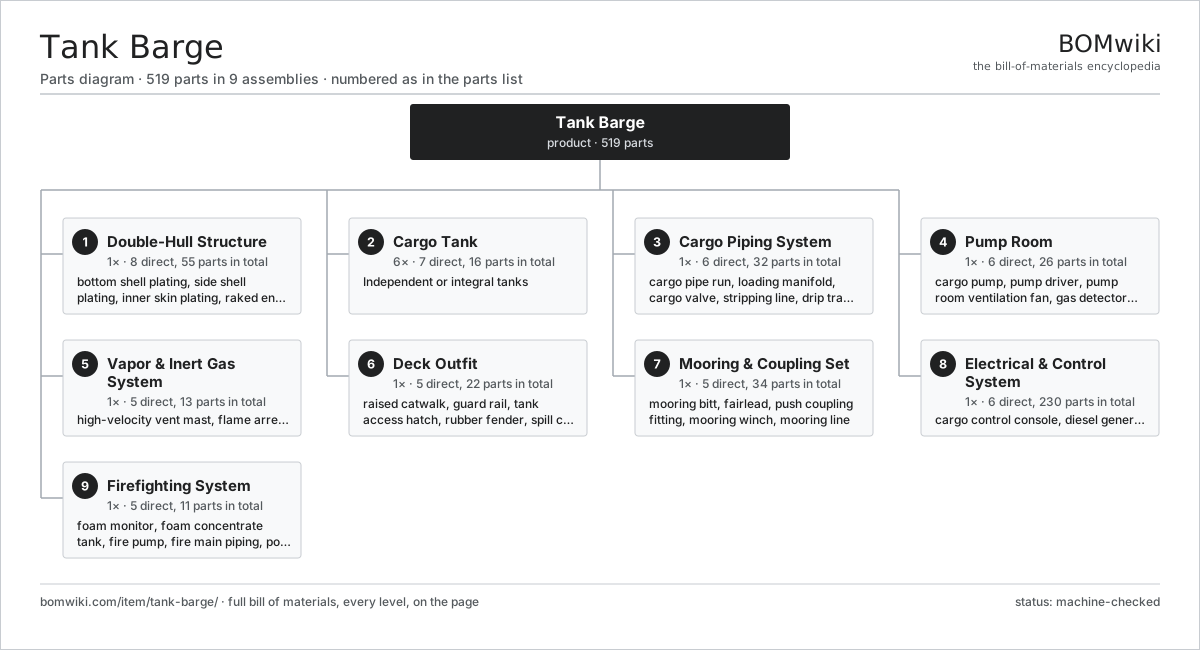
| # | Part | Qty | What it does |
|---|---|---|---|
| 1 | Double-Hull Structure 8 parts | 1× | Welded steel double-skin hull with wing and bottom void tanks surrounding the cargo tanks for spill protection. |
| 2 | Cargo Tank 7 parts | 6× | Independent or integral tanks |
| 3 | Cargo Piping System 6 parts | 1× | Deck and below-deck pipework, manifolds and valves connecting every tank to the pump room and the shore loading arms. |
| 4 | Pump Room 6 parts | 1× | Ventilated compartment housing the cargo pumps and their drives, with gas detection because of the flammable atmosphere. |
| 5 | Vapor & Inert Gas System 5 parts | 1× | Vent piping, flame arresters and inert-gas connection that manage tank atmospheres safely during loading and discharge. |
| 6 | Deck Outfit 5 parts | 1× | |
| 7 | Mooring & Coupling Set 5 parts | 1× | |
| 8 | Electrical & Control System 6 parts | 1× | |
| 9 | Firefighting System 5 parts | 1× | Foam monitors and fire main protecting the cargo deck against a hydrocarbon fire. |
3D model
No 3D model yet. Have a CAD file of this? Add a 3D model — STL renders right on this page; STEP, FreeCAD, and OpenSCAD sources are welcome too (openly licensed, like all 3D models on BOMwiki).
Build & assembly graph
expand / collapse · shared sub-assemblies converge · links to related products · est. labourTap an assembly to expand/collapse · tap a part to open it · use “Open page” for any node · drag to pan, scroll to zoom.
Bill of materials for Tank Barge
9 top-level lines · 84 rows shown · 519 parts total · indented to 3 levels| # | Item / sub-assembly | Part no. | Qty/assy | Ext. qty | Parts | Type |
|---|---|---|---|---|---|---|
| 1 | Double-Hull Structure 8 parts | tank-barge-hull | 1× | 1 | 55 | assembly |
| 1.1 | Bottom Shell Plating | tank-barge-bottom-shell | 1× | 1 | · | part |
| 1.2 | Side Shell Plating | tank-barge-side-shell | 2× | 2 | · | part |
| 1.3 | Inner Skin Plating | tank-barge-inner-skin | 1× | 1 | · | part |
| 1.4 | Raked End Section | tank-barge-rake-end | 2× | 2 | · | part |
| 1.5 | Transverse Bulkhead | tank-barge-transverse-bulkhead | 7× | 7 | · | part |
| 1.6 | Longitudinal Bulkhead | tank-barge-longitudinal-bulkhead | 1× | 1 | · | part |
| 1.7 | Main Deck Plating | tank-barge-deck-plating | 1× | 1 | · | part |
| 1.8 | Sheet Metal Panel | sheet-panel | 40× | 40 | · | part |
| 2 | Cargo Tank 7 parts | tank-barge-cargo-tank | 6× | 6 | 16 | assembly |
| 2.1 | Tank Shell Plating | tank-barge-tank-shell | 1× | 6 | · | part |
| 2.2 | Tank Stiffener Web | tank-barge-tank-stiffener | 8× | 48 | · | part |
| 2.3 | Tank Coating / Lining | tank-barge-tank-coating | 1× | 6 | · | part |
| 2.4 | Tank Dome & Trunk | tank-barge-tank-dome | 1× | 6 | · | part |
| 2.5 | Tank Level Gauge 3 parts | tank-barge-level-gauge | 1× | 6 | 3 | assembly |
| 2.5.1 | Radar Level Gauge | tank-barge-radar-gauge | 1× | 6 | · | part |
| 2.5.2 | High-Level Alarm Switch | tank-barge-high-level-alarm | 1× | 6 | · | part |
| 2.5.3 | Pressure Sensor | pressure-sensor | 1× | 6 | · | part |
| 2.6 | Pressure/Vacuum Valve | tank-barge-pressure-vacuum-valve | 1× | 6 | · | part |
| 2.7 | Cargo Heating Coil | tank-barge-heating-coil | 1× | 6 | · | part |
| 3 | Cargo Piping System 6 parts | tank-barge-cargo-piping | 1× | 1 | 32 | assembly |
| 3.1 | Cargo Pipe Run | tank-barge-cargo-pipe | 1× | 1 | · | part |
| 3.2 | Loading Manifold | tank-barge-manifold | 2× | 2 | · | part |
| 3.3 | Cargo Valve | tank-barge-cargo-valve | 12× | 12 | · | part |
| 3.4 | Stripping Line | tank-barge-stripping-line | 1× | 1 | · | part |
| 3.5 | Drip Tray (Save-All) | tank-barge-drip-tray | 4× | 4 | · | part |
| 3.6 | O-Ring Set | oring-set | 12× | 12 | · | part |
| 4 | Pump Room 6 parts | tank-barge-pump-room | 1× | 1 | 26 | assembly |
| 4.1 | Cargo Pump 6 parts | tank-barge-cargo-pump | 2× | 2 | 8 | assembly |
| 4.1.1 | Pump Casing | tank-barge-pump-casing | 1× | 2 | · | part |
| 4.1.2 | Pump Impeller | tank-barge-impeller | 1× | 2 | · | part |
| 4.1.3 | Pump Shaft | tank-barge-pump-shaft | 1× | 2 | · | part |
| 4.1.4 | Ball Bearing | ball-bearing | 2× | 4 | · | part |
| 4.1.5 | Oil Seal | oil-seal | 2× | 4 | · | part |
| 4.1.6 | Mechanical Seal | tank-barge-mechanical-seal | 1× | 2 | · | part |
| 4.2 | Pump Driver | tank-barge-pump-driver | 2× | 2 | · | part |
| 4.3 | Pump Room Ventilation Fan | tank-barge-pump-room-vent | 1× | 1 | · | part |
| 4.4 | Gas Detector | tank-barge-gas-detector | 4× | 4 | · | part |
| 4.5 | Bilge Pump | tank-barge-bilge-pump | 1× | 1 | · | part |
| 4.6 | Pressure Sensor | pressure-sensor | 2× | 2 | · | part |
| 5 | Vapor & Inert Gas System 5 parts | tank-barge-vapor-system | 1× | 1 | 13 | assembly |
| 5.1 | High-Velocity Vent Mast | tank-barge-vent-mast | 1× | 1 | · | part |
| 5.2 | Flame Arrester | tank-barge-flame-arrester | 6× | 6 | · | part |
| 5.3 | Vapor Return Line | tank-barge-vapor-return-line | 1× | 1 | · | part |
| 5.4 | Inert Gas Connection | tank-barge-inert-gas-connection | 1× | 1 | · | part |
| 5.5 | Cargo Valve | tank-barge-cargo-valve | 4× | 4 | · | part |
| 6 | Deck Outfit 5 parts | tank-barge-deck-outfit | 1× | 1 | 22 | assembly |
| 6.1 | Raised Catwalk | tank-barge-walkway | 1× | 1 | · | part |
| 6.2 | Guard Rail | tank-barge-guard-rail | 6× | 6 | · | part |
| 6.3 | Tank Access Hatch | tank-barge-access-hatch | 6× | 6 | · | part |
| 6.4 | Rubber Fender | tank-barge-fender | 8× | 8 | · | part |
| 6.5 | Spill Coaming | tank-barge-spill-coaming | 1× | 1 | · | part |
| 7 | Mooring & Coupling Set 5 parts | tank-barge-mooring-set | 1× | 1 | 34 | assembly |
| 7.1 | Mooring Bitt | tank-barge-bitt | 8× | 8 | · | part |
| 7.2 | Fairlead | tank-barge-fairlead | 8× | 8 | · | part |
| 7.3 | Push Coupling Fitting | tank-barge-coupling-fitting | 2× | 2 | · | part |
| 7.4 | Mooring Winch 4 parts | tank-barge-winch | 2× | 2 | 5 | assembly |
| 7.4.1 | Winch Drum | tank-barge-winch-drum | 1× | 2 | · | part |
| 7.4.2 | Gearbox Housing | gearbox-housing | 1× | 2 | · | part |
| 7.4.3 | Helical Gear Pair | gear-pair | 1× | 2 | · | part |
| 7.4.4 | Ball Bearing | ball-bearing | 2× | 4 | · | part |
| 7.5 | Mooring Line | tank-barge-mooring-line | 6× | 6 | · | part |
| 8 | Electrical & Control System 6 parts | tank-barge-electrical | 1× | 1 | 230 | assembly |
| 8.1 | Cargo Control Console 5 parts | tank-barge-control-console | 1× | 1 | 167 | assembly |
| 8.1.1 | Bare PCB | pcb-bare | 2× | 2 | · | part |
| 8.1.2 | Microcontroller | mcu | 2× | 2 | · | part |
| 8.1.3 | LCD Panel | lcd-panel | 1× | 1 | · | part |
| 8.1.4 | Relay | relay | 12× | 12 | · | part |
| 8.1.5 | SMD Passive (R/C/L) | smd-passives | 150× | 150 | · | part |
| 8.2 | Diesel Generator Set 4 parts | tank-barge-generator-set | 1× | 1 | 24 | assembly |
| 8.2.1 | Auxiliary Diesel Engine | tank-barge-diesel-engine | 1× | 1 | · | part |
| 8.2.2 | Stator Assembly 3 parts + deeper › | stator-assembly | 1× | 1 | 3 | assembly |
| 8.2.3 | Rotor Assembly 4 parts + deeper › | rotor-assembly | 1× | 1 | 19 | assembly |
| 8.2.4 | Day Fuel Tank | tank-barge-fuel-tank | 1× | 1 | · | part |
| 8.3 | Service Battery | tank-barge-battery | 2× | 2 | · | part |
| 8.4 | Navigation Light | tank-barge-nav-light | 6× | 6 | · | part |
| 8.5 | Wire Bundle | wire-bundle | 1× | 1 | · | part |
| 8.6 | Connector | connector | 30× | 30 | · | part |
| 9 | Firefighting System 5 parts | tank-barge-firefighting | 1× | 1 | 11 | assembly |
| 9.1 | Foam Monitor | tank-barge-foam-monitor | 2× | 2 | · | part |
| 9.2 | Foam Concentrate Tank | tank-barge-foam-tank | 1× | 1 | · | part |
| 9.3 | Fire Pump | tank-barge-fire-pump | 1× | 1 | · | part |
| 9.4 | Fire Main Piping | tank-barge-fire-main | 1× | 1 | · | part |
| 9.5 | Portable Extinguisher | tank-barge-portable-extinguisher | 6× | 6 | · | part |
Related products
same domain, ranked by shared parts Container Feeder Ship
2,496 parts · shares 20 with this page
Container Feeder Ship
2,496 parts · shares 20 with this page
 Crab Fishing Boat
8,775 parts · shares 20 with this page
Crab Fishing Boat
8,775 parts · shares 20 with this page
 Crewed Submersible
2,830 parts · shares 20 with this page
Crewed Submersible
2,830 parts · shares 20 with this page
 Floating Crane Barge
1,501 parts · shares 20 with this page
Floating Crane Barge
1,501 parts · shares 20 with this page
 Heavy-Lift Ship
40,014 parts · shares 20 with this page
Heavy-Lift Ship
40,014 parts · shares 20 with this page
 Passenger Hovercraft
354 parts · shares 20 with this page
Passenger Hovercraft
354 parts · shares 20 with this page
Sourcing: possible vendors
Prices, MOQ, and lead times are algorithmic estimates, not quotes, and not claims about these companies. Company mappings are curated by keyword; est. price band $2k–$500M. How estimates work| Vendor | HQ | Specialty | MOQ | Lead time |
|---|---|---|---|---|
| hd.com ↗ | Ulsan, KR | Shipbuilder | made to order | 52–104 wks |
| fincantieri.com ↗ | Trieste, IT | Shipbuilder | made to order | 52–104 wks |
| damen.com ↗ | Gorinchem, NL | Shipbuilder | made to order | 52–104 wks |
| brunswick.com ↗ | Mettawa, US | Marine & boats | made to order | 52–104 wks |
|
🇨🇳CSSC
cssc.net.cn ↗
|
Shanghai, CN | Shipbuilding conglomerate | made to order | 52–104 wks |
991-word article