Mobile Pet Grooming Van
ProductOverview
A mobile pet grooming van is a fully equipped grooming salon on wheels, enabling professional groomers to service clients at home or in designated grooming sites without fixed overhead of a brick-and-mortar facility. The van integrates a pressurized hot water system, bathing tub with hydraulic lift, high-velocity drying equipment, generator power, cabinetry, and ventilation into a commercial van chassis (14,000–16,000 lbs GVW).
Target market: independent mobile groomers (sole proprietors and small chains), competitive advantage over stationary salons is on-site convenience and reduced commute stress for pet owners and anxious animals. Typical revenue per grooming is $60–150 (dogs) or $50–100 (cats), with 4–6 appointments per day generating $250–900 daily in high-demand urban/suburban markets. Fixed costs include vehicle fuel ($800–1,200/month), generator fuel ($300–500/month), insurance, maintenance, and supply inventory.
Chassis and Powertrain
The Chassis and Engine is a commercial van platform (Ford E-Series 450, Mercedes Sprinter 3500, Freightliner MT-55) with a 6.0–7.3L diesel or gas engine rated 250–350 horsepower. The chassis must support 6,000–8,000 lbs of added weight (water tanks, tub, cabinetry, generator, equipment) while maintaining payload-rating compliance for licensing and insurance.
Load distribution: Fresh water (150 gal = 1,200 lbs) + gray water (empty) + tub assembly (400–500 lbs) + cabinetry (600–800 lbs) + generator (800–1,200 lbs) + tools/supplies (300–500 lbs) = 4,300–5,700 lbs total. This sits within the 6,000–8,000 lbs payload margin, leaving margin for two groomers and extra water if desired.
The Suspension System must be heavy-duty (air bags, multi-stage springs) to handle uneven load shifts as water tanks fill/drain and the tub hydraulic lift cycles. Poor suspension design causes:
- Rear sag when tub is raised (affecting steering and braking).
- Harsh ride quality damaging water lines and electrical connections.
- Uneven water distribution in tanks (sloshing during turns, tank stress).
Water and Heating System
The Water System provides on-demand hot water independent of vehicle engine, critical for grooming operations. The system comprises:
Fresh water: A 150–200 gallon food-grade polyethylene tank with fill cap (vehicle-top mounted or side panel) and low-level sensor. In urban areas, water is loaded at grooming facilities or public service areas (many marinas and RV parks offer fill-up services for $3–5).
Gray water: A separate 150–200 gallon sealed tank collecting wash runoff. When full, the groomer drives to a disposal station (RV dump sites, wastewater treatment facilities) for emptying ($5–15 per visit). Some vans install gravity drains at fixed service locations (home garages, commercial lots with dedicated drain connections).
Water heater: A tankless electric (40 kW, 240 V from generator) or propane (50,000 BTU) heater raises inlet water from 40–60 °F (winter, groundwater temperature) to 100–110 °F. On-demand heating reduces energy waste and provides consistent temperature during long grooming sessions.
Pressure system: A 12 VDC membrane pump (3–5 GPM at 60 psi) draws from the fresh water tank through a Filter Assembly (sediment + carbon cartridge) to remove sediment and chlorine taste. A Pressure Regulator limits tank pressure to 60 psi, protecting hoses and fittings from over-pressure. A Mixing Valve blends hot and cold water to the setpoint (typically 105 °F), preventing scalding.
Hose routing: Quick-disconnect couplers (stainless steel, rated for food-service use) allow the groomer to connect/disconnect tub spray, rinse sink, and pre-rinse sprayer without shutting down the pump. This modular approach enables rapid setup and breakdown.
Bathing and Lift System
The Grooming Station centers on a 30×36×18 inch fiberglass tub bolted to the floor via a Hydraulic Lift. The tub interior is non-slip (textured surface) to prevent slipping. The tub slopes 3–5 degrees toward a 2-inch drain opening with a removable hair trap to prevent clogging.
Hydraulic lift: A 12 VDC electric pump (2–3 HP) powers a hydraulic cylinder raising/lowering the tub 12–18 inches. Ergonomic benefit is significant: small dogs (10–20 lbs) are raised to waist height, reducing groomer back strain during 2–3 hour shifts. The lift cycles 2–4 times per appointment.
Restraint system: Two Restraint Loop nooses (adjustable rope with slide knots) attach to the tub rim, securing the pet's head during bathing. Professional groomers use gentle tension, never strangling; the noose prevents sudden escapes or jumping out.
Spray wands: Two handheld Spray Wand (8-foot reinforced hose, stainless steel nozzle, shut-off lever) are routed through the wall. One is used for initial rinse and shampoo application; the second is a hot-water rinse. Hose-routing failures (pinching, leaks at connections) are common wear items, requiring quarterly inspection and annual replacement.
Drainage: The tub drain connects via flexible hose to the Gray Water Tank. A gravity-fed siphon or electric pump conveys water and hair (filtered via a removable screen) to gray tank. If the siphon fails, gray water backs up into the tub, requiring on-site cleanup.
Drying System
After bathing, pets are dried using two types of equipment:
High-velocity dryer: A High-Velocity Dryer (3.2 HP motor, 100+ mph airstream, noise ~95 dB) blasts water off the coat in 5–10 minutes. The dryer uses pure air compression (no heat) to avoid skin irritation. It cycles through wet and damp phases, with the groomer directing the nozzle along the pet's body. The exhaust air vents outdoors via ductwork.
Cage dryer: A Cage Dryer (1.5 HP gentle circulation fan, 70–80 dB) finishes the coat with soft air flow. Some groomers use the cage dryer while handling another appointment or during breaktime, enabling multi-tasking. Operating time: 15–30 minutes per pet.
Heat control: Optional Heat Exchanger modules warm air for winter grooming (cold air can stress small/young animals). Most vans operate ambient-temperature air in warm months and heated air (80–90 °F) October–March.
Energy load: The two dryers operate sequentially (not simultaneously) due to generator capacity limits. Running both dryers simultaneously would exceed the 20–30 kW generator output if other loads (water heater, lights, controls) are active.
Storage and Workflow
The Cabinetry and Storage is custom-built to maximize storage while maintaining a clear grooming workflow. Layout typically follows:
- Upper cabinets: Shampoo bottles (15–20 varieties, typically Earthbath, Chris Christensen, or hypoallergenic formulations), conditioners, flea/tick treatments, and specialty products.
- Countertop: Prep surface for mixing shampoo solutions, laying out clippers, scissors, and nail tools (stainless steel, autoclave-sterilizable).
- Under-sink: Access to water lines, drainage valves, and cleaning supplies (degreaser, bleach solution for sanitizing between pets with potential allergies or contagious conditions).
- Open shelving: Towels (25–50 per day, typically cotton or microfiber, wash them nightly or use disposable), dryer cords, and restraints.
- Rolling cart: Mobile storage for electric clippers, cordless drills (for toe-pad shaving), scissors sets, and nail grinders, rolled to each grooming station.
Professional groomers invest $3,000–8,000 in hand tools (scissors $50–300 each, clippers $80–200 each) and replace worn blades quarterly at $20–50 per set.
Generator and Electrical System
The Generator and Fuel System (20–30 kW diesel or gas) operates independently of the vehicle engine, enabling idle parking while grooming without main engine running. A diesel generator runs 8–12 hours on a single 75-gallon tank, generating $0.50–0.75 per hour in fuel cost.
Load profile:
- Grooming water heater: 40 kW peak (tankless electric), 15 kW sustained.
- High-velocity dryer: 3.2 kW continuous.
- Cage dryer: 1.5 kW continuous.
- Lights: 2 kW (LED strips).
- Pump and controls: 0.5 kW.
- Total simultaneous: ~6–8 kW during dryer operation; ~18–20 kW if water heater is heating.
A 20 kW generator is undersized for simultaneous water heating + drying; most groomers cycle operations (heat water first, then begin drying while heater is idle). A 30 kW generator provides comfortable margin and costs $8,000–12,000 installed (vs. $6,000–8,000 for 20 kW).
The Electrical System system includes a main 200 A service disconnect, 16-circuit breaker panel, GFCI protection for all water-area outlets, standard 120 V receptacles for tool power, and LED lighting. A 12 VDC isolated converter powers the water pump, lift solenoid, and thermostat controls.
Safety: All electrical work should meet NFPA 70 (National Electrical Code) standards. Common failures include water intrusion in outlets (poor GFCI protection), loose connections causing voltage drop to 100 V (insufficient dryer performance), and battery isolation failures (12 VDC pump remains powered when generator is off, slowly draining the starter battery).
Ventilation and Climate Control
The Ventilation System system maintains air quality during high-humidity grooming operations. Two Exhaust Fan (500 CFM each, roof-mounted) exhaust humid, odor-laden air. Two Intake Vent (louvered with replaceable filters) bring fresh air, creating positive air circulation.
Humidity control: After a 2–3 hour grooming session bathing 4–6 pets, interior humidity can reach 80–90% (saturated air). Without ventilation, interior surfaces sweat, mold risks increase, and pet dander accumulates. The exhaust fans cycle continuously or on demand (triggered by humidity sensor at 70% threshold), maintaining interior at 40–60% relative humidity.
Odor control: Pet urine, anal gland secretions, and bacterial growth in gray water create odors. Continuous air exchange and regular (daily/weekly) tank cleaning mitigate this. Some groomers install carbon or HEPA filters on intake vents.
Regulatory and Operational Considerations
Mobile grooming vans operate under varying local regulations:
- Licensing: Most jurisdictions require a mobile food-service-style permit (even though grooming is not food-service, water discharge regulations apply). Costs: $100–500 annually.
- Insurance: Commercial auto + general liability + business property insurance typically costs $2,000–4,000 per year for a sole proprietor.
- Zoning: Some areas restrict operating hours (no early morning or evening noise from generator/dryers) and prohibit parking in residential neighborhoods. Commercial zones and by-appointment-only models avoid these issues.
- Water discharge: Some municipalities prohibit dumping gray water on-site (pet shampoo residue must go to treatment facility). Others allow on-property drainage if infiltration is managed.
Business economics: A groomer earning $70 per appointment, performing 5 appointments per day, generates $350/day revenue. Subtract fuel ($30), generator fuel ($15), supplies ($40), and a 50% profit margin on business costs leaves $150–180 profit per day or $36,000–43,000 annually (240 working days). This is competitive with stationary salon employment ($35,000–50,000 salary) while avoiding rent ($1,500–3,000/month).
Mobile Pet Grooming Van parts and their functions
8 top-level parts · 71 parts in total · full bill of materials below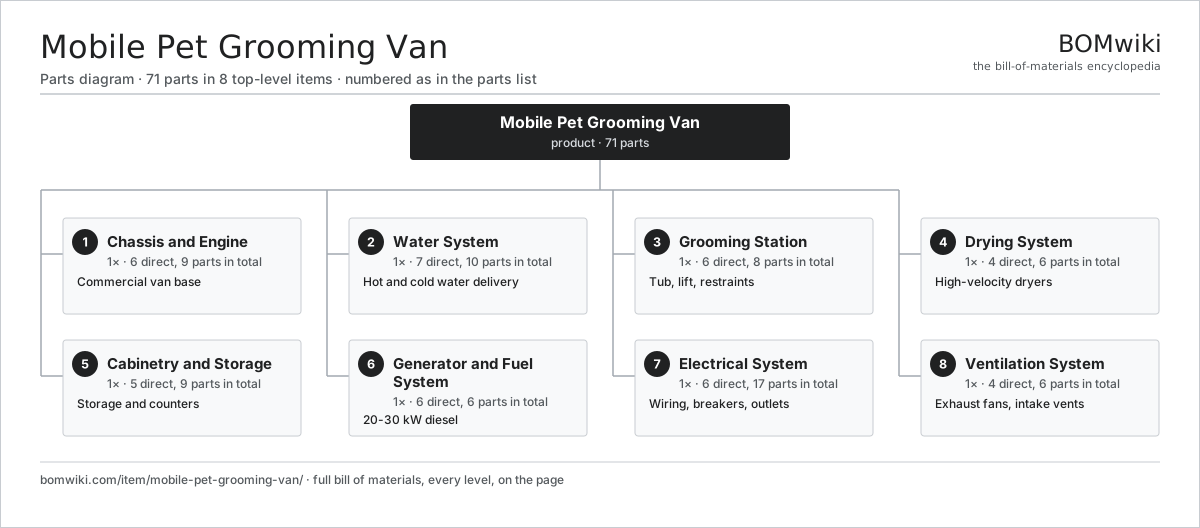
| # | Part | Qty | What it does |
|---|---|---|---|
| 1 | Chassis and Engine 6 parts | 1× | Commercial van base |
| 2 | Water System 7 parts | 1× | Hot and cold water delivery |
| 3 | Grooming Station 6 parts | 1× | Tub, lift, restraints |
| 4 | Drying System 4 parts | 1× | High-velocity dryers |
| 5 | Cabinetry and Storage 5 parts | 1× | Storage and counters |
| 6 | Generator and Fuel System 6 parts | 1× | 20-30 kW diesel |
| 7 | Electrical System 6 parts | 1× | Wiring, breakers, outlets |
| 8 | Ventilation System 4 parts | 1× | Exhaust fans, intake vents |
3D model
No 3D model yet. Have a CAD file of this? Add a 3D model. STL renders right on this page; STEP, FreeCAD, and OpenSCAD sources are welcome too (openly licensed, like all 3D models on BOMwiki).
Build & assembly graph
expand / collapse · shared sub-assemblies converge · links to related products · est. labourTap an assembly to expand/collapse · tap a part to open it · use “Open page” for any node · drag to pan, scroll to zoom.
Bill of materials for Mobile Pet Grooming Van
8 top-level lines · 52 rows shown · 71 parts total · indented to 3 levels| # | Item / sub-assembly | Part no. | Qty/assy | Ext. qty | Parts | Type |
|---|---|---|---|---|---|---|
| 1 | Chassis and Engine 6 parts | mobile-pet-grooming-van-chassis-engine | 1× | 1 | 9 | assembly |
| 1.1 | Frame | mobile-pet-grooming-van-frame | 1× | 1 | · | part |
| 1.2 | Engine | mobile-pet-grooming-van-engine | 1× | 1 | · | part |
| 1.3 | Transmission | mobile-pet-grooming-van-transmission | 1× | 1 | · | part |
| 1.4 | Suspension System | mobile-pet-grooming-van-suspension | 1× | 1 | · | part |
| 1.5 | Wheels and Tires | mobile-pet-grooming-van-wheels-tires | 4× | 4 | · | part |
| 1.6 | Brake System | mobile-pet-grooming-van-brake-system | 1× | 1 | · | part |
| 2 | Water System 7 parts | mobile-pet-grooming-van-water-system | 1× | 1 | 10 | assembly |
| 2.1 | Fresh Water Tank | mobile-pet-grooming-van-fresh-water-tank | 1× | 1 | · | part |
| 2.2 | Gray Water Tank | mobile-pet-grooming-van-gray-water-tank | 1× | 1 | · | part |
| 2.3 | Water Heater | mobile-pet-grooming-van-water-heater | 1× | 1 | · | part |
| 2.4 | Water Pump | mobile-pet-grooming-van-pump | 1× | 1 | · | part |
| 2.5 | Filter Assembly | mobile-pet-grooming-van-filter-assembly | 1× | 1 | · | part |
| 2.6 | Pressure Regulator | mobile-pet-grooming-van-pressure-regulator | 1× | 1 | · | part |
| 2.7 | Hose Quick Disconnect | mobile-pet-grooming-van-hose-quick-disconnect | 4× | 4 | · | part |
| 3 | Grooming Station 6 parts | mobile-pet-grooming-van-grooming-station | 1× | 1 | 8 | assembly |
| 3.1 | Tub Basin | mobile-pet-grooming-van-tub-basin | 1× | 1 | · | part |
| 3.2 | Hydraulic Lift | mobile-pet-grooming-van-hydraulic-lift | 1× | 1 | · | part |
| 3.3 | Restraint Loop | mobile-pet-grooming-van-restraint-loop | 2× | 2 | · | part |
| 3.4 | Spray Wand | mobile-pet-grooming-van-spray-wand | 2× | 2 | · | part |
| 3.5 | Mixing Valve | mobile-pet-grooming-van-mixing-valve | 1× | 1 | · | part |
| 3.6 | Drain Hose | mobile-pet-grooming-van-drain-hose | 1× | 1 | · | part |
| 4 | Drying System 4 parts | mobile-pet-grooming-van-drying-system | 1× | 1 | 6 | assembly |
| 4.1 | High-Velocity Dryer | mobile-pet-grooming-van-high-velocity-dryer | 2× | 2 | · | part |
| 4.2 | Cage Dryer | mobile-pet-grooming-van-cage-dryer | 1× | 1 | · | part |
| 4.3 | Flexible Hose | mobile-pet-grooming-van-flexible-hose | 2× | 2 | · | part |
| 4.4 | Heat Exchanger | mobile-pet-grooming-van-heat-exchanger | 1× | 1 | · | part |
| 5 | Cabinetry and Storage 5 parts | mobile-pet-grooming-van-cabinetry | 1× | 1 | 9 | assembly |
| 5.1 | Wall Cabinet | mobile-pet-grooming-van-wall-cabinet | 4× | 4 | · | part |
| 5.2 | Countertop | mobile-pet-grooming-van-stainless-countertop | 1× | 1 | · | part |
| 5.3 | Under-Sink Cabinet | mobile-pet-grooming-van-under-sink-cabinet | 1× | 1 | · | part |
| 5.4 | Shelving | mobile-pet-grooming-van-shelving | 2× | 2 | · | part |
| 5.5 | Rolling Cart | mobile-pet-grooming-van-stool-cart | 1× | 1 | · | part |
| 6 | Generator and Fuel System 6 parts | mobile-pet-grooming-van-generator | 1× | 1 | 6 | assembly |
| 6.1 | Generator Engine | mobile-pet-grooming-van-gen-engine | 1× | 1 | · | part |
| 6.2 | Alternator | mobile-pet-grooming-van-gen-alternator | 1× | 1 | · | part |
| 6.3 | Fuel Tank | mobile-pet-grooming-van-fuel-tank | 1× | 1 | · | part |
| 6.4 | Fuel Pump | mobile-pet-grooming-van-fuel-pump | 1× | 1 | · | part |
| 6.5 | Muffler | mobile-pet-grooming-van-muffler | 1× | 1 | · | part |
| 6.6 | Battery | mobile-pet-grooming-van-battery | 1× | 1 | · | part |
| 7 | Electrical System 6 parts | mobile-pet-grooming-van-electrical | 1× | 1 | 17 | assembly |
| 7.1 | Main Breaker | mobile-pet-grooming-van-main-breaker | 1× | 1 | · | part |
| 7.2 | Breaker Panel | mobile-pet-grooming-van-breaker-panel | 1× | 1 | · | part |
| 7.3 | GFCI Outlet | mobile-pet-grooming-van-gfci-outlet | 4× | 4 | · | part |
| 7.4 | Standard Outlet | mobile-pet-grooming-van-standard-outlet | 6× | 6 | · | part |
| 7.5 | Light Fixture | mobile-pet-grooming-van-light-fixture | 4× | 4 | · | part |
| 7.6 | 12V Converter | mobile-pet-grooming-van-12v-converter | 1× | 1 | · | part |
| 8 | Ventilation System 4 parts | mobile-pet-grooming-van-ventilation | 1× | 1 | 6 | assembly |
| 8.1 | Exhaust Fan | mobile-pet-grooming-van-exhaust-fan | 2× | 2 | · | part |
| 8.2 | Intake Vent | mobile-pet-grooming-van-intake-vent | 2× | 2 | · | part |
| 8.3 | Ductwork | mobile-pet-grooming-van-ductwork | 1× | 1 | · | part |
| 8.4 | Thermostat Control | mobile-pet-grooming-van-thermostat-control | 1× | 1 | · | part |
Something wrong in this list? Report a problem with this BOM.
Sourcing: possible vendors
Browse the supplier directory → Prices, MOQ, and lead times are algorithmic estimates, not quotes, and not claims about these companies. Company mappings are curated by keyword; est. price band $8k–$90k. How estimates work| Vendor | HQ | Specialty | MOQ | Lead time |
|---|---|---|---|---|
|
🇯🇵Toyota
global.toyota ↗
|
Toyota City, JP | Automaker | made to order | 16–28 wks |
| volkswagen-group.com ↗ | Wolfsburg, DE | Automaker | made to order | 16–28 wks |
| gm.com ↗ | Detroit, US | Automaker | made to order | 16–28 wks |
| hyundai.com ↗ | Seoul, KR | Automaker | made to order | 16–28 wks |
|
🇨🇳BYD
byd.com ↗
|
Shenzhen, CN | EV & battery manufacturer | made to order | 16–28 wks |
1,826-word article