Amphibious Car
ProductOverview
An amphibious car is a vehicle engineered to drive on roads and also travel across water under its own power, switching between the two without the driver leaving the seat. It is a hard engineering problem because the requirements pull in opposite directions: a car needs wheels, weight, and ground clearance, while a boat needs a watertight buoyant hull, propulsion that works in water, and as little weight as possible. The vehicle solves this by sealing the body into a hull, adding a separate water propulsion path, and retracting the wheels once afloat.
The Hull Body is both car shell and boat hull. The Powertrain drives either the road wheels or the water, the Land Drivetrain handles driving on land, and the Marine Drive provides thrust on water. The Retractable Suspension lifts the wheels clear once afloat, the Steering works in both modes, and the Sealing & Bilge system keeps the vehicle dry inside. The Cabin holds the dual-mode controls and the Electrical System system manages the transition between land and water.
Hull and buoyancy
Everything depends on the Hull Body being watertight and buoyant. The Hull Shell is shaped as a planing hull, with Planing Strake ridges that lift the vehicle up onto the surface at speed rather than plowing through the water. The Deck closes the top, and sealed voids are filled with Buoyancy Foam so the vehicle stays afloat even if the cabin floods. A sloped Windshield throws spray over the occupants, and sealed Deck Hatch panels give access to the machinery while keeping water out.
Powertrain and propulsion
The Marinized Engine is marinized, meaning it is prepared for the wet, salty, corrosive environment. It uses sealed ignition parts, corrosion-resistant materials, and a Heat Exchanger that cools the engine against outside water instead of an open radiator that water would foul. A Marine Exhaust water-lock prevents water from flowing back into the engine through the exhaust.
The clever part is splitting the power. A Transfer Case routes engine torque either to the Land Drivetrain for road driving or to the Marine Drive for water. On land, the engine turns the Front Differential and Rear Differential through driveshafts and CV Axle joints, exactly like a normal car. On water, the engine drives the Jet Pump, whose Jet Impeller draws water through the Jet Intake and forces it out a Steering Nozzle for thrust. A water jet is chosen over a propeller because it has no exposed blades to damage in shallow water and it provides steering through nozzle angle.
Land-to-water transition
The transition is the defining capability. As the vehicle drives into the water and starts to float, the Retractable Suspension system lifts the wheels. Each Retracting Arm swings up under a Hydraulic Ram driven by the Hydraulic Pump, pulling the wheels clear of the water so they do not drag and slow the vehicle. At the same time the Transfer Case disengages the wheels and engages the jet. The whole sequence is coordinated so the driver simply selects water mode and continues.
Steering changes mode as well. The Steering system uses a Steering Rack and Tie Rod links to turn the road wheels on land, but afloat the Mode Actuator redirects the Steering Wheel input through the Nozzle Linkage to swing the jet nozzle, so the same wheel steers the boat.
Keeping water out
Floating only works if the inside stays dry. The Sealing & Bilge system handles this with Door Seal compression seals on every opening and Shaft Seal units where driveshafts pass through the hull, which are the hardest points to keep watertight because they rotate. Any water that does get in collects in the bilge, where Water Sensor units trigger the Bilge Pump units to pump it back out. On land, Drain Plug fittings let the hull drain completely.
Cabin, electrical, and use
The Cabin is fitted out for both environments, with drainable Seat units, a dual-mode Dashboard, and an Instrument Cluster that shows water-relevant data alongside road speed. A Mode Switch selects land or water, and a Bilge Blower clears any fuel vapor from the engine bay before starting, a standard marine safety step. The Electrical System system uses sealed, corrosion-resistant wiring and a Mode Controller that sequences the transition steps, along with Navigation Light units required when operating on water.
Amphibious cars have always been niche. Most production examples have been low-volume sports vehicles or specialty machines, since the added weight and complexity compromise both road and water performance compared to a dedicated car or boat. They appeal to buyers who value the novelty and the genuine freedom of crossing water without a launch ramp, and they require both a road registration and compliance with the boating rules of wherever they are used afloat.
Amphibious Car parts and their functions
9 top-level parts · 134 parts in total · full bill of materials below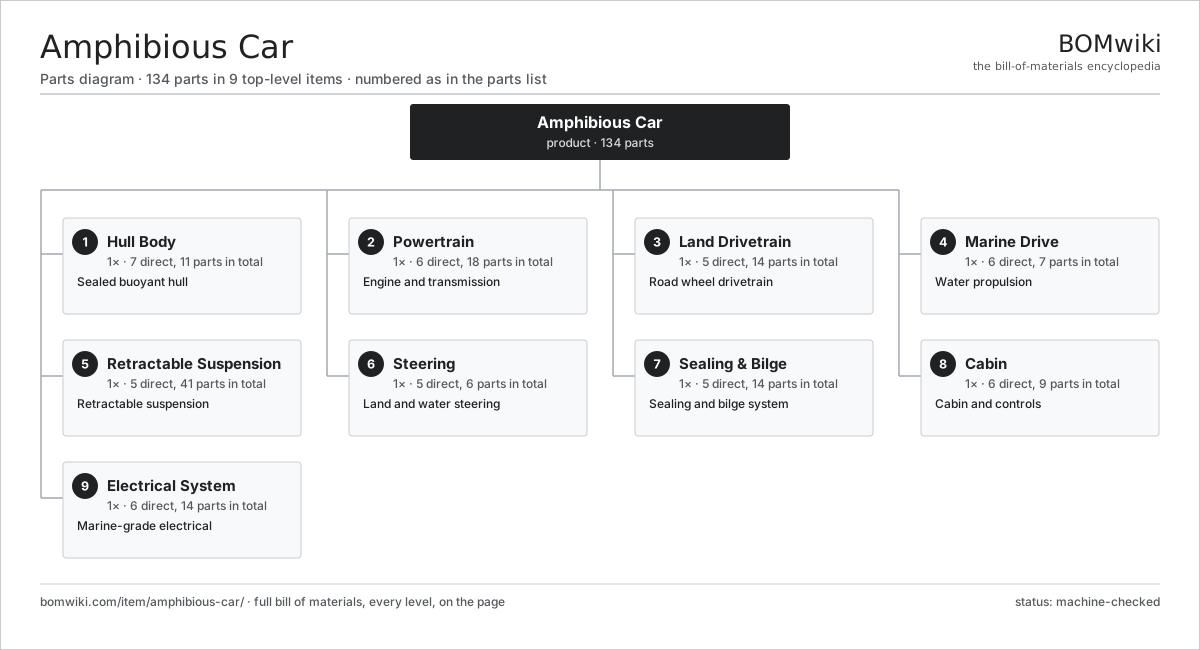
| # | Part | Qty | What it does |
|---|---|---|---|
| 1 | Hull Body 7 parts | 1× | Sealed buoyant hull |
| 2 | Powertrain 6 parts | 1× | Engine and transmission |
| 3 | Land Drivetrain 5 parts | 1× | Road wheel drivetrain |
| 4 | Marine Drive 6 parts | 1× | Water propulsion |
| 5 | Retractable Suspension 5 parts | 1× | Retractable suspension |
| 6 | Steering 5 parts | 1× | Land and water steering |
| 7 | Sealing & Bilge 5 parts | 1× | Sealing and bilge system |
| 8 | Cabin 6 parts | 1× | Cabin and controls |
| 9 | Electrical System 6 parts | 1× | Marine-grade electrical |
3D model
No 3D model yet. Have a CAD file of this? Add a 3D model. STL renders right on this page; STEP, FreeCAD, and OpenSCAD sources are welcome too (openly licensed, like all 3D models on BOMwiki).
Build & assembly graph
expand / collapse · shared sub-assemblies converge · links to related products · est. labourTap an assembly to expand/collapse · tap a part to open it · use “Open page” for any node · drag to pan, scroll to zoom.
Bill of materials for Amphibious Car
9 top-level lines · 70 rows shown · 134 parts total · indented to 3 levels| # | Item / sub-assembly | Part no. | Qty/assy | Ext. qty | Parts | Type |
|---|---|---|---|---|---|---|
| 1 | Hull Body 7 parts | amp-hull-body | 1× | 1 | 11 | assembly |
| 1.1 | Hull Shell | amp-hull-shell | 1× | 1 | · | part |
| 1.2 | Deck | amp-deck | 1× | 1 | · | part |
| 1.3 | Buoyancy Foam | amp-buoyancy-foam | 1× | 1 | · | part |
| 1.4 | Planing Strake | amp-planing-strake | 4× | 4 | · | part |
| 1.5 | Windshield | amp-windshield | 1× | 1 | · | part |
| 1.6 | Deck Hatch | amp-deck-hatch | 2× | 2 | · | part |
| 1.7 | Fastener Set | fastener-set | 1× | 1 | · | part |
| 2 | Powertrain 6 parts | amp-powertrain | 1× | 1 | 18 | assembly |
| 2.1 | Marinized Engine 7 parts | amp-engine | 1× | 1 | 13 | assembly |
| 2.1.1 | Engine Block | amp-engine-block | 1× | 1 | · | part |
| 2.1.2 | Cylinder Head | amp-cylinder-head | 1× | 1 | · | part |
| 2.1.3 | Piston | amp-piston | 4× | 4 | · | part |
| 2.1.4 | Crankshaft | amp-crankshaft | 1× | 1 | · | part |
| 2.1.5 | Fuel Injector | amp-fuel-injector | 4× | 4 | · | part |
| 2.1.6 | Heat Exchanger | amp-heat-exchanger | 1× | 1 | · | part |
| 2.1.7 | O-Ring Set | oring-set | 1× | 1 | · | part |
| 2.2 | Transmission | amp-transmission | 1× | 1 | · | part |
| 2.3 | Transfer Case | amp-transfer-case | 1× | 1 | · | part |
| 2.4 | Cooling System | amp-engine-cooling | 1× | 1 | · | part |
| 2.5 | Marine Exhaust | amp-exhaust-marine | 1× | 1 | · | part |
| 2.6 | Fuel Tank | amp-fuel-tank | 1× | 1 | · | part |
| 3 | Land Drivetrain 5 parts | amp-land-drivetrain | 1× | 1 | 14 | assembly |
| 3.1 | Front Differential | amp-front-diff | 1× | 1 | · | part |
| 3.2 | Rear Differential | amp-rear-diff | 1× | 1 | · | part |
| 3.3 | Drive Shaft | amp-drive-shaft | 2× | 2 | · | part |
| 3.4 | CV Axle | amp-cv-axle | 4× | 4 | · | part |
| 3.5 | Oil Seal | oil-seal | 6× | 6 | · | part |
| 4 | Marine Drive 6 parts | amp-marine-drive | 1× | 1 | 7 | assembly |
| 4.1 | Jet Pump | amp-jet-pump | 1× | 1 | · | part |
| 4.2 | Jet Impeller | amp-jet-impeller | 1× | 1 | · | part |
| 4.3 | Jet Intake | amp-jet-intake | 1× | 1 | · | part |
| 4.4 | Steering Nozzle | amp-steering-nozzle | 1× | 1 | · | part |
| 4.5 | Reverse Bucket | amp-reverse-bucket | 1× | 1 | · | part |
| 4.6 | Ball Bearing | ball-bearing | 2× | 2 | · | part |
| 5 | Retractable Suspension 5 parts | amp-suspension-retract | 1× | 1 | 41 | assembly |
| 5.1 | Retracting Arm | amp-retract-arm | 4× | 4 | · | part |
| 5.2 | Hydraulic Ram | amp-hydraulic-ram | 4× | 4 | · | part |
| 5.3 | Hydraulic Pump | amp-hydraulic-pump | 1× | 1 | · | part |
| 5.4 | Coil Spring | coil-spring | 4× | 4 | · | part |
| 5.5 | Wheel Hub 3 parts | wheel-hub | 4× | 4 | 7 | assembly |
| 5.5.1 | Wheel Hub Bearing | hub-bearing | 1× | 4 | · | part |
| 5.5.2 | Hub Flange | hub-flange | 1× | 4 | · | part |
| 5.5.3 | Wheel Stud | wheel-stud | 5× | 20 | · | part |
| 6 | Steering 5 parts | amp-steering | 1× | 1 | 6 | assembly |
| 6.1 | Steering Rack | amp-steering-rack | 1× | 1 | · | part |
| 6.2 | Tie Rod | amp-tie-rod | 2× | 2 | · | part |
| 6.3 | Steering Wheel | amp-steering-wheel | 1× | 1 | · | part |
| 6.4 | Mode Actuator | amp-mode-actuator | 1× | 1 | · | part |
| 6.5 | Nozzle Linkage | amp-nozzle-linkage | 1× | 1 | · | part |
| 7 | Sealing & Bilge 5 parts | amp-bilge-sealing | 1× | 1 | 14 | assembly |
| 7.1 | Door Seal | amp-door-seal | 4× | 4 | · | part |
| 7.2 | Shaft Seal | amp-shaft-seal | 4× | 4 | · | part |
| 7.3 | Bilge Pump | amp-bilge-pump | 2× | 2 | · | part |
| 7.4 | Water Sensor | amp-water-sensor | 2× | 2 | · | part |
| 7.5 | Drain Plug | amp-drain-plug | 2× | 2 | · | part |
| 8 | Cabin 6 parts | amp-cabin | 1× | 1 | 9 | assembly |
| 8.1 | Seat | amp-seat | 4× | 4 | · | part |
| 8.2 | Dashboard | amp-dashboard | 1× | 1 | · | part |
| 8.3 | Instrument Cluster | amp-instrument-cluster | 1× | 1 | · | part |
| 8.4 | Pedal Set | amp-pedal-set | 1× | 1 | · | part |
| 8.5 | Mode Switch | amp-mode-switch | 1× | 1 | · | part |
| 8.6 | Bilge Blower | amp-bilge-blower | 1× | 1 | · | part |
| 9 | Electrical System 6 parts | amp-electrical | 1× | 1 | 14 | assembly |
| 9.1 | Battery | amp-battery | 1× | 1 | · | part |
| 9.2 | Mode Controller | amp-mode-controller | 1× | 1 | · | part |
| 9.3 | Wiring Harness | amp-wiring-harness | 1× | 1 | · | part |
| 9.4 | Navigation Light | amp-nav-light | 3× | 3 | · | part |
| 9.5 | Headlight | amp-headlight | 2× | 2 | · | part |
| 9.6 | Relay | relay | 6× | 6 | · | part |
Related products
same domain, ranked by shared parts Ambulance
793 parts · shares 6 with this page
Ambulance
793 parts · shares 6 with this page
 Convertible Car
1,727 parts · shares 6 with this page
Convertible Car
1,727 parts · shares 6 with this page
 Coupe Car
1,617 parts · shares 6 with this page
Coupe Car
1,617 parts · shares 6 with this page
 Crossover SUV
1,653 parts · shares 6 with this page
Crossover SUV
1,653 parts · shares 6 with this page
 Funeral Coach
539 parts · shares 6 with this page
Funeral Coach
539 parts · shares 6 with this page
 Gasoline Car
1,190 parts · shares 6 with this page
Gasoline Car
1,190 parts · shares 6 with this page
Sourcing: possible vendors
Browse the supplier directory → Prices, MOQ, and lead times are algorithmic estimates, not quotes, and not claims about these companies. Company mappings are curated by keyword; est. price band $8k–$90k. How estimates work| Vendor | HQ | Specialty | MOQ | Lead time |
|---|---|---|---|---|
|
🇯🇵Toyota
global.toyota ↗
|
Toyota City, JP | Automaker | made to order | 16–28 wks |
| volkswagen-group.com ↗ | Wolfsburg, DE | Automaker | made to order | 16–28 wks |
| gm.com ↗ | Detroit, US | Automaker | made to order | 16–28 wks |
| hyundai.com ↗ | Seoul, KR | Automaker | made to order | 16–28 wks |
|
🇨🇳BYD
byd.com ↗
|
Shenzhen, CN | EV & battery manufacturer | made to order | 16–28 wks |
852-word article