Taxi Cab
ProductOverview
A taxi cab is an ordinary passenger car turned into a regulated public-hire vehicle by a set of added equipment and a licence. The Base Vehicle is chosen for low running cost and durability rather than style, then fitted with a Taximeter System to calculate fares, a Roof Sign to advertise availability, a Safety Partition for driver safety, a Payment System to take cards, a Dispatch System to receive jobs, mandated Livery & Identification, and often a Accessibility Kit kit. What separates a cab from a private car is less the hardware than the regulation around it: the meter is sealed and periodically verified, the colours and door markings are prescribed, and the vehicle carries a licence plate or medallion issued by a local authority.
The base vehicle
Taxi operators pick the Base Vehicle on economics. A typical cab covers 50,000 to 80,000 km a year, so the Engine is a modest four-cylinder unit, frequently a hybrid for stop-start economy or fitted with a LPG Conversion Kit to run on cheaper autogas. The Transmission is almost always an automatic or CVT, since a city cab makes thousands of gear changes a day. The Body-in-White and Skateboard Chassis are stock, but the cabin is specified for abuse: a wipe-clean Rear Bench Seat in vinyl or heavy fabric, rubber floor mats, and trim that survives constant passenger turnover. Purpose-built cabs such as the London hackney go further, designing a tall, square rear cabin around accessibility from the start, but most of the world's taxis are converted production cars.
The taximeter
The Taximeter System is the legally significant part of the cab. The Taximeter Head takes distance pulses from a Speed Sensor and a clock, and computes the fare against a stored tariff that mixes a flagfall, a per-distance rate, and a per-time waiting rate. Because the fare is money, the meter is calibrated by an approved authority and then sealed: a Tamper Seal over the housing makes tampering evident, and a broken seal invalidates the certification. The running fare shows on the Fare Display where the passenger can watch it, and a Receipt Printer issues a receipt. The meter is wired through the Meter Wiring to the Roof Sign so that engaging the meter darkens the rooftop light, signalling that the cab is hired.
Roof sign and identification
The Roof Sign makes the cab recognisable and hailable. Its Sign Lens carries the operator name or a "TAXI" legend, lit from behind by an LED Light Panel panel, and a Roof Mount or bolted bracket fixes it to the roof. The convention that a lit sign means the cab is free and a dark sign means it is engaged is enforced by the meter interlock. Beyond the sign, the Livery & Identification tells the public and inspectors that the car is licensed: a prescribed Livery Wrap colour scheme, Door Decal markings with the operator and phone number, a Licence Plaque or medallion from the authority, and a posted Fare Card so passengers can see the rates.
Safety, payment, and dispatch
Driver safety drives the Safety Partition: a Partition Screen of impact-resistant polycarbonate divides front from rear, with a Cash Tray passing money through without an opening. Fare settlement has moved from cash to the Payment System, whose Card Terminal takes chip and contactless payment fed the amount directly by the meter, settling over a Data Modem. The Dispatch System is how a cab gets work: a GPS Receiver reports the cab's position and a Mobile Data Terminal touchscreen receives dispatched jobs and navigation, with a Two-Way Radio kept as backup. These systems let a control room match the nearest cab to a waiting passenger, the function that ride-hailing apps later automated on phones.
Accessibility and regulation
Many licensing regimes require cabs to carry passengers who use wheelchairs, so the Accessibility Kit kit adds a folding Access Ramp, floor Wheelchair Anchor points, a Restraint Belt for the wheelchair and occupant, and Grab Handle assists at the doors. The whole vehicle sits inside a licensing framework that distinguishes a taxi from other cars: only a licensed cab may pick up a street hail, the fare is fixed by the metered tariff rather than negotiated, and the meter, livery, and plate are inspected on a schedule. That regulatory wrapper, more than any single component, is what makes a taxi a taxi. A taxi also leads a hard life: covering far more distance than a private car, idling at ranks, and carrying a constant stream of passengers, so operators choose vehicles that reach three hundred thousand to half a million kilometres with routine maintenance, and they fit consumables like the Rear Bench Seat and floor coverings for easy replacement. The economics of the trade run through every choice, from the hybrid or autogas Engine that lowers fuel cost per kilometre, to the durable automatic Transmission, to the wipe-clean interior that turns around quickly between fares. Ride-hailing platforms later replicated the dispatch and payment functions of these systems on a smartphone, but a street-hail taxi still carries the metered, liveried, licensed hardware that the law requires of a vehicle for public hire.
Taxi Cab parts and their functions
8 top-level parts · 768 parts in total · full bill of materials below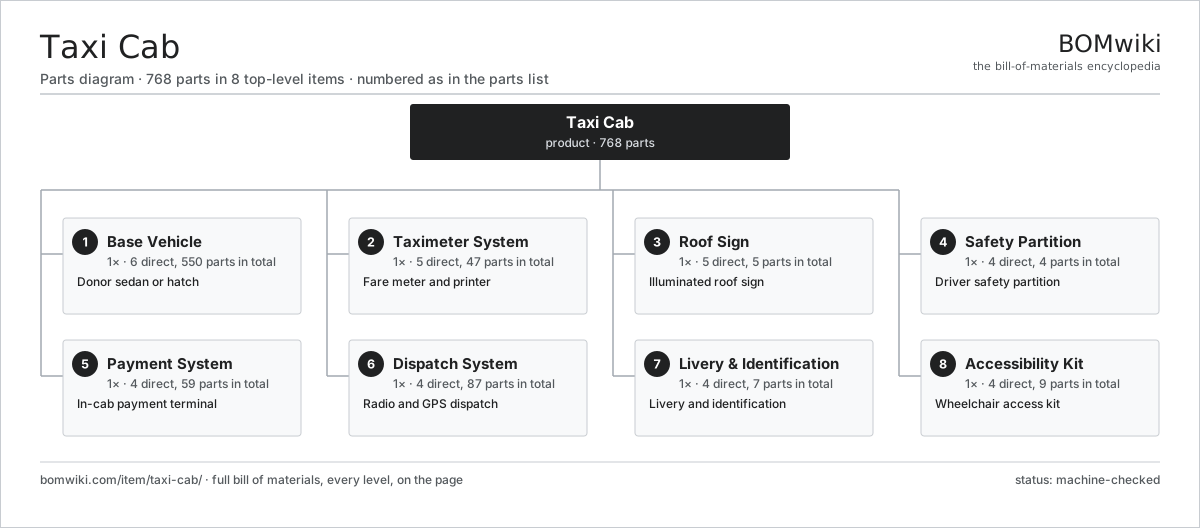
| # | Part | Qty | What it does |
|---|---|---|---|
| 1 | Base Vehicle 6 parts | 1× | Donor sedan or hatch |
| 2 | Taximeter System 5 parts | 1× | Fare meter and printer |
| 3 | Roof Sign 5 parts | 1× | Illuminated roof sign |
| 4 | Safety Partition 4 parts | 1× | Driver safety partition |
| 5 | Payment System 4 parts | 1× | In-cab payment terminal |
| 6 | Dispatch System 4 parts | 1× | Radio and GPS dispatch |
| 7 | Livery & Identification 4 parts | 1× | Livery and identification |
| 8 | Accessibility Kit 4 parts | 1× | Wheelchair access kit |
3D model
No 3D model yet. Have a CAD file of this? Add a 3D model. STL renders right on this page; STEP, FreeCAD, and OpenSCAD sources are welcome too (openly licensed, like all 3D models on BOMwiki).
Build & assembly graph
expand / collapse · shared sub-assemblies converge · links to related products · est. labourTap an assembly to expand/collapse · tap a part to open it · use “Open page” for any node · drag to pan, scroll to zoom.
Bill of materials for Taxi Cab
8 top-level lines · 80 rows shown · 768 parts total · indented to 3 levels| # | Item / sub-assembly | Part no. | Qty/assy | Ext. qty | Parts | Type |
|---|---|---|---|---|---|---|
| 1 | Base Vehicle 6 parts | taxi-cab-base-vehicle | 1× | 1 | 550 | assembly |
| 1.1 | Engine 6 parts | taxi-cab-engine | 1× | 1 | 14 | assembly |
| 1.1.1 | Engine Block | taxi-cab-engine-block | 1× | 1 | · | part |
| 1.1.2 | Cylinder Head | taxi-cab-cylinder-head | 1× | 1 | · | part |
| 1.1.3 | Piston | taxi-cab-piston | 4× | 4 | · | part |
| 1.1.4 | Spark Plug | spark-plug | 4× | 4 | · | part |
| 1.1.5 | LPG Conversion Kit | taxi-cab-lpg-kit | 1× | 1 | · | part |
| 1.1.6 | Oil Seal | oil-seal | 3× | 3 | · | part |
| 1.2 | Transmission 3 parts | taxi-cab-transmission | 1× | 1 | 6 | assembly |
| 1.2.1 | Helical Gear Pair | gear-pair | 3× | 3 | · | part |
| 1.2.2 | Gearbox Housing | gearbox-housing | 1× | 1 | · | part |
| 1.2.3 | Oil Seal | oil-seal | 2× | 2 | · | part |
| 1.3 | Body-in-White 5 parts | body-in-white | 1× | 1 | 32 | assembly |
| 1.3.1 | Door Assembly 6 parts + deeper › | door-assembly | 4× | 4 | 7 | assembly |
| 1.3.2 | Hood | hood | 1× | 1 | · | part |
| 1.3.3 | Roof Panel | roof-panel | 1× | 1 | · | part |
| 1.3.4 | Windshield | windshield | 1× | 1 | · | part |
| 1.3.5 | Floor Pan | floor-pan | 1× | 1 | · | part |
| 1.4 | Skateboard Chassis 5 parts | skateboard-chassis | 1× | 1 | 143 | assembly |
| 1.4.1 | Subframe | subframe | 2× | 2 | · | part |
| 1.4.2 | Suspension Corner 5 parts + deeper › | suspension-corner | 4× | 4 | 16 | assembly |
| 1.4.3 | Brake Corner 4 parts + deeper › | brake-corner | 4× | 4 | 9 | assembly |
| 1.4.4 | Wheel Assembly 5 parts + deeper › | wheel-assembly | 4× | 4 | 9 | assembly |
| 1.4.5 | Steering Rack (EPS) 4 parts + deeper › | steering-rack | 1× | 1 | 5 | assembly |
| 1.5 | Rear Bench Seat | taxi-cab-rear-seat | 1× | 1 | · | part |
| 1.6 | Interior 5 parts | interior | 1× | 1 | 354 | assembly |
| 1.6.1 | Seat Assembly 5 parts + deeper › | seat-assembly | 5× | 5 | 7 | assembly |
| 1.6.2 | Dashboard 4 parts + deeper › | dashboard | 1× | 1 | 313 | assembly |
| 1.6.3 | Steering Wheel 3 parts + deeper › | steering-wheel | 1× | 1 | 4 | assembly |
| 1.6.4 | Floor Carpet | carpet | 1× | 1 | · | part |
| 1.6.5 | HVAC Ducting | hvac-duct | 1× | 1 | · | part |
| 2 | Taximeter System 5 parts | taxi-cab-taximeter-system | 1× | 1 | 47 | assembly |
| 2.1 | Taximeter Head 4 parts | taxi-cab-meter-head | 1× | 1 | 43 | assembly |
| 2.1.1 | Bare PCB | pcb-bare | 1× | 1 | · | part |
| 2.1.2 | Microcontroller | mcu | 1× | 1 | · | part |
| 2.1.3 | Tamper Seal | taxi-cab-tamper-seal | 1× | 1 | · | part |
| 2.1.4 | SMD Passive (R/C/L) | smd-passives | 40× | 40 | · | part |
| 2.2 | Fare Display | taxi-cab-meter-display | 1× | 1 | · | part |
| 2.3 | Receipt Printer | taxi-cab-printer | 1× | 1 | · | part |
| 2.4 | Speed Sensor | taxi-cab-speed-sensor | 1× | 1 | · | part |
| 2.5 | Meter Wiring | taxi-cab-meter-wiring | 1× | 1 | · | part |
| 3 | Roof Sign 5 parts | taxi-cab-roof-sign | 1× | 1 | 5 | assembly |
| 3.1 | Sign Housing | taxi-cab-sign-housing | 1× | 1 | · | part |
| 3.2 | Sign Lens | taxi-cab-sign-lens | 1× | 1 | · | part |
| 3.3 | LED Light Panel | taxi-cab-sign-led | 1× | 1 | · | part |
| 3.4 | Roof Mount | taxi-cab-magnetic-mount | 1× | 1 | · | part |
| 3.5 | Wire Bundle | wire-bundle | 1× | 1 | · | part |
| 4 | Safety Partition 4 parts | taxi-cab-partition | 1× | 1 | 4 | assembly |
| 4.1 | Partition Screen | taxi-cab-partition-screen | 1× | 1 | · | part |
| 4.2 | Partition Frame | taxi-cab-partition-frame | 1× | 1 | · | part |
| 4.3 | Cash Tray | taxi-cab-cash-tray | 1× | 1 | · | part |
| 4.4 | Fastener Set | fastener-set | 1× | 1 | · | part |
| 5 | Payment System 4 parts | taxi-cab-payment-system | 1× | 1 | 59 | assembly |
| 5.1 | Card Terminal 4 parts | taxi-cab-card-terminal | 1× | 1 | 53 | assembly |
| 5.1.1 | Bare PCB | pcb-bare | 1× | 1 | · | part |
| 5.1.2 | Microcontroller | mcu | 1× | 1 | · | part |
| 5.1.3 | Card Reader | taxi-cab-card-reader | 1× | 1 | · | part |
| 5.1.4 | SMD Passive (R/C/L) | smd-passives | 50× | 50 | · | part |
| 5.2 | Passenger Display | taxi-cab-rear-display | 1× | 1 | · | part |
| 5.3 | Data Modem | taxi-cab-modem | 1× | 1 | · | part |
| 5.4 | Connector | connector | 4× | 4 | · | part |
| 6 | Dispatch System 4 parts | taxi-cab-dispatch-system | 1× | 1 | 87 | assembly |
| 6.1 | Mobile Data Terminal 4 parts | taxi-cab-mdt | 1× | 1 | 83 | assembly |
| 6.1.1 | Bare PCB | pcb-bare | 1× | 1 | · | part |
| 6.1.2 | Compute SoC Module | soc-module | 1× | 1 | · | part |
| 6.1.3 | LCD Panel | lcd-panel | 1× | 1 | · | part |
| 6.1.4 | SMD Passive (R/C/L) | smd-passives | 80× | 80 | · | part |
| 6.2 | GPS Receiver | taxi-cab-gps-receiver | 1× | 1 | · | part |
| 6.3 | Two-Way Radio | taxi-cab-two-way-radio | 1× | 1 | · | part |
| 6.4 | Antenna | taxi-cab-antenna | 2× | 2 | · | part |
| 7 | Livery & Identification 4 parts | taxi-cab-livery | 1× | 1 | 7 | assembly |
| 7.1 | Livery Wrap | taxi-cab-body-wrap | 1× | 1 | · | part |
| 7.2 | Door Decal | taxi-cab-door-decal | 4× | 4 | · | part |
| 7.3 | Licence Plaque | taxi-cab-license-plaque | 1× | 1 | · | part |
| 7.4 | Fare Card | taxi-cab-fare-card | 1× | 1 | · | part |
| 8 | Accessibility Kit 4 parts | taxi-cab-accessibility | 1× | 1 | 9 | assembly |
| 8.1 | Access Ramp | taxi-cab-ramp | 1× | 1 | · | part |
| 8.2 | Wheelchair Anchor | taxi-cab-wheelchair-anchor | 4× | 4 | · | part |
| 8.3 | Restraint Belt | taxi-cab-restraint-belt | 2× | 2 | · | part |
| 8.4 | Grab Handle | taxi-cab-grab-handle | 2× | 2 | · | part |
Related products
same domain, ranked by shared parts Gasoline Car
1,190 parts · shares 73 with this page
Gasoline Car
1,190 parts · shares 73 with this page
 Pickup Truck
1,552 parts · shares 68 with this page
Pickup Truck
1,552 parts · shares 68 with this page
 Funeral Coach
539 parts · shares 64 with this page
Funeral Coach
539 parts · shares 64 with this page
 Hatchback Car
18,053 parts · shares 66 with this page
Hatchback Car
18,053 parts · shares 66 with this page
 Station Wagon
1,657 parts · shares 66 with this page
Station Wagon
1,657 parts · shares 66 with this page
 Stretch Limousine
323 parts · shares 51 with this page
Stretch Limousine
323 parts · shares 51 with this page
Sourcing: possible vendors
Browse the supplier directory → Prices, MOQ, and lead times are algorithmic estimates, not quotes, and not claims about these companies. Company mappings are curated by keyword; est. price band $8k–$90k. How estimates work| Vendor | HQ | Specialty | MOQ | Lead time |
|---|---|---|---|---|
|
🇯🇵Toyota
global.toyota ↗
|
Toyota City, JP | Automaker | made to order | 16–28 wks |
| volkswagen-group.com ↗ | Wolfsburg, DE | Automaker | made to order | 16–28 wks |
| gm.com ↗ | Detroit, US | Automaker | made to order | 16–28 wks |
| hyundai.com ↗ | Seoul, KR | Automaker | made to order | 16–28 wks |
|
🇨🇳BYD
byd.com ↗
|
Shenzhen, CN | EV & battery manufacturer | made to order | 16–28 wks |
953-word article