Racing Kart
ProductOverview
A racing kart is the simplest real racing car: an open single-seat machine with no suspension and no gearbox, in which the driver sits centimetres off the track. Despite the simplicity it is genuinely fast and is the entry point for most professional drivers. The whole machine is built around a flexible Chassis Frame that does the job a suspension would, a high-revving Kart Engine mounted beside the driver, a chain Drive Transmission with no gears, direct Steering System, a single rear-axle Brake System disc, and a solid-axle Running Gear with no differential. Because there are so few systems, the ones that exist are tuned with care, and the driver is treated as a structural part of the machine.
The flexible chassis
The Chassis Frame is the defining component, because a kart has no springs or dampers at all. The Main Chassis Tube frame is bent and welded from steel chosen for a specific flex characteristic, and that controlled flex is what keeps the tyres loaded over kerbs and through corners. Tubular Bumper sets at the front, rear, and sides absorb contact and satisfy the bodywork rules, a Floor Tray carries the driver, and a removable Torsion Bar lets a mechanic stiffen or soften the rear to match the track and grip. A floor-hinged Pedal Set sits at the front. Tuning a kart is largely about managing flex, axle stiffness, and seat position, because those, not springs, set how the kart handles.
Engine and drive
The Kart Engine is a single-cylinder two-stroke of roughly 100 to 125 cc that revs past 15,000 rpm. Its Cylinder port timing and expansion-chamber Tuned Exhaust are tuned to make power in a narrow high band, fed through a Reed Valve into the Crankcase and metered by a Carburettor that is the main jetting adjustment. There is no gearbox. The Drive Transmission is a Centrifugal Clutch centrifugal clutch, or in some classes a direct drive with no clutch at all, feeding a Drive Chain from a small Engine Sprocket to a large Axle Sprocket. Changing those sprocket sizes is the only gearing available, so teams pick a ratio for each circuit rather than shifting on the move. Shifter karts are the exception, adding a multi-speed gearbox and front brakes.
Steering without a differential
The Steering System is fully direct: the Steering Wheel and Steering Column turn the Stub Axle front wheels through short Track Rod links, with no power assist and no reduction, so the driver feels everything. The clever part is geometry. A kart has a solid Rear Axle driving both rear wheels at the same speed, which would normally fight any turn. The Kingpin Spindle kingpins are set with deliberate caster so that turning the wheel lifts the inside rear wheel slightly off the ground, letting the kart rotate as though it had a differential. Getting that lift right, called jacking, is central to making a kart turn cleanly, and it is set through the steering and axle geometry rather than any mechanical diff.
Brakes, axle, and tyres
The Brake System are minimal: most classes run a single hydraulic disc on the rear axle, so a Master Cylinder feeds one Brake Caliper clamping a Brake Disc that stops both rear wheels through the solid axle. Shifter classes add front discs. The Running Gear is built around that solid Rear Axle on Ball Bearing supports, with light cast Wheel Rim rims and soft Racing Tyre slicks or wets. Tyres are the largest single influence on lap time and the main consumable, and axle diameter is itself a tuning choice because it changes how the rear of the kart flexes and grips.
Driver, bodywork, and fuel
In a kart the driver is part of the structure. The Seat is a rigid Seat Shell bolted straight to the frame through adjustable Seat Strut stays, and its position and stiffness change how the chassis flexes, so seat fitting is a setup parameter rather than just comfort. The Bodywork is plastic: a sprung Nose Cone that pivots away in contact rather than snagging, Side Pod panels, a Front Fairing, and a Number Panel. The Fuel System is small and simple, a Fuel Tank between the driver's legs feeding the carburettor through a Fuel Pump driven by crankcase pulses, running the petrol-oil mixture a two-stroke needs. The result is a machine with very few parts, every one of which is exposed, adjustable, and matters to how the kart goes round a corner. Karts are organised into classes by engine type and driver age, from small cadet engines for children through to the powerful shifter karts that approach the cornering speeds of far larger racing cars. The low cost and mechanical simplicity relative to a full racing car are why karting is the near-universal training ground for circuit drivers, who learn racecraft, racing lines, and wheel-to-wheel contact at speeds that feel high because the seat is only a few centimetres above the asphalt. A team running a kart spends its time on setup rather than rebuilds: changing sprocket teeth for the Drive Transmission gearing, adjusting the Torsion Bar and seat struts to retune frame flex, selecting and managing Racing Tyre compounds, and jetting the Carburettor to the conditions. With no suspension to absorb mistakes and no gearbox to hide behind, a kart rewards precise inputs and exposes every change directly in lap time.
Racing Kart parts and their functions
9 top-level parts · 70 parts in total · full bill of materials below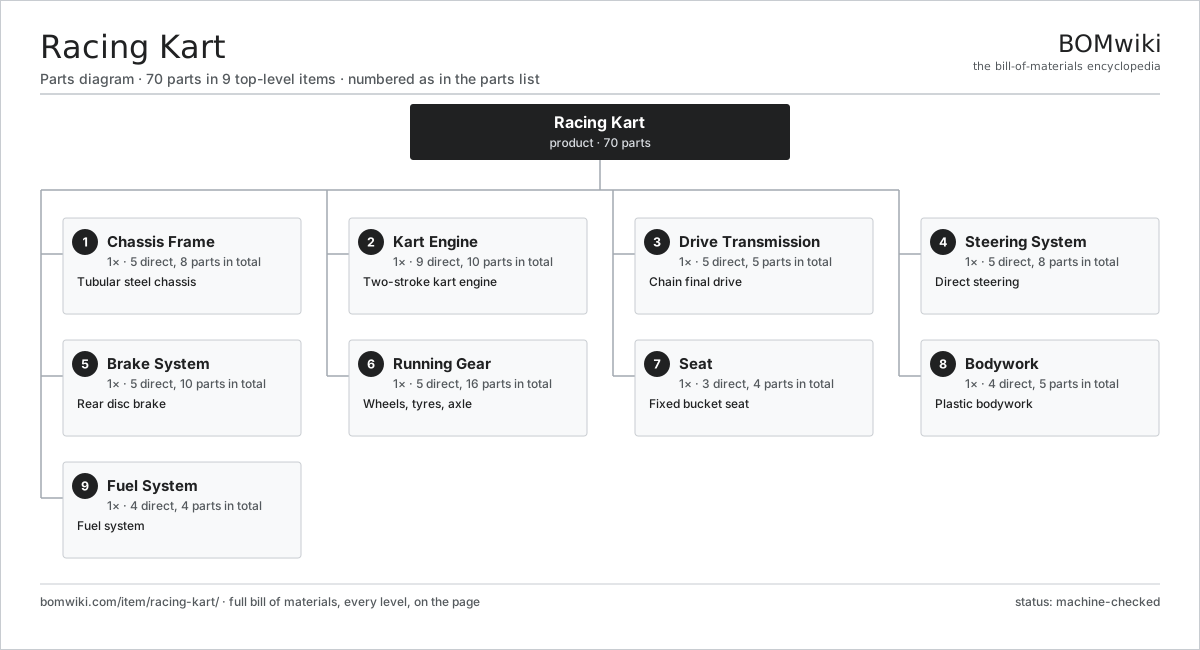
| # | Part | Qty | What it does |
|---|---|---|---|
| 1 | Chassis Frame 5 parts | 1× | Tubular steel chassis |
| 2 | Kart Engine 9 parts | 1× | Two-stroke kart engine |
| 3 | Drive Transmission 5 parts | 1× | Chain final drive |
| 4 | Steering System 5 parts | 1× | Direct steering |
| 5 | Brake System 5 parts | 1× | Rear disc brake |
| 6 | Running Gear 5 parts | 1× | Wheels, tyres, axle |
| 7 | Seat 3 parts | 1× | Fixed bucket seat |
| 8 | Bodywork 4 parts | 1× | Plastic bodywork |
| 9 | Fuel System 4 parts | 1× | Fuel system |
3D model
No 3D model yet. Have a CAD file of this? Add a 3D model. STL renders right on this page; STEP, FreeCAD, and OpenSCAD sources are welcome too (openly licensed, like all 3D models on BOMwiki).
Build & assembly graph
expand / collapse · shared sub-assemblies converge · links to related products · est. labourTap an assembly to expand/collapse · tap a part to open it · use “Open page” for any node · drag to pan, scroll to zoom.
Bill of materials for Racing Kart
9 top-level lines · 58 rows shown · 70 parts total · indented to 3 levels| # | Item / sub-assembly | Part no. | Qty/assy | Ext. qty | Parts | Type |
|---|---|---|---|---|---|---|
| 1 | Chassis Frame 5 parts | racing-kart-frame | 1× | 1 | 8 | assembly |
| 1.1 | Main Chassis Tube | racing-kart-main-tube | 1× | 1 | · | part |
| 1.2 | Bumper | racing-kart-bumper | 4× | 4 | · | part |
| 1.3 | Floor Tray | racing-kart-floor-tray | 1× | 1 | · | part |
| 1.4 | Torsion Bar | racing-kart-torsion-bar | 1× | 1 | · | part |
| 1.5 | Pedal Set | racing-kart-pedal-set | 1× | 1 | · | part |
| 2 | Kart Engine 9 parts | racing-kart-engine | 1× | 1 | 10 | assembly |
| 2.1 | Cylinder | racing-kart-cylinder | 1× | 1 | · | part |
| 2.2 | Crankcase | racing-kart-crankcase | 1× | 1 | · | part |
| 2.3 | Piston | racing-kart-piston | 1× | 1 | · | part |
| 2.4 | Crankshaft | racing-kart-crankshaft | 1× | 1 | · | part |
| 2.5 | Carburettor | racing-kart-carburetor | 1× | 1 | · | part |
| 2.6 | Reed Valve | racing-kart-reed-valve | 1× | 1 | · | part |
| 2.7 | Tuned Exhaust | racing-kart-exhaust | 1× | 1 | · | part |
| 2.8 | Spark Plug | spark-plug | 1× | 1 | · | part |
| 2.9 | Ball Bearing | ball-bearing | 2× | 2 | · | part |
| 3 | Drive Transmission 5 parts | racing-kart-transmission | 1× | 1 | 5 | assembly |
| 3.1 | Centrifugal Clutch | racing-kart-clutch | 1× | 1 | · | part |
| 3.2 | Engine Sprocket | racing-kart-engine-sprocket | 1× | 1 | · | part |
| 3.3 | Axle Sprocket | racing-kart-axle-sprocket | 1× | 1 | · | part |
| 3.4 | Drive Chain | racing-kart-chain | 1× | 1 | · | part |
| 3.5 | Chain Guard | racing-kart-chain-guard | 1× | 1 | · | part |
| 4 | Steering System 5 parts | racing-kart-steering | 1× | 1 | 8 | assembly |
| 4.1 | Steering Wheel | racing-kart-steering-wheel | 1× | 1 | · | part |
| 4.2 | Steering Column | racing-kart-steering-column | 1× | 1 | · | part |
| 4.3 | Stub Axle | racing-kart-stub-axle | 2× | 2 | · | part |
| 4.4 | Track Rod | racing-kart-track-rod | 2× | 2 | · | part |
| 4.5 | Kingpin Spindle | racing-kart-spindle | 2× | 2 | · | part |
| 5 | Brake System 5 parts | racing-kart-brakes | 1× | 1 | 10 | assembly |
| 5.1 | Brake Disc | racing-kart-brake-disc | 1× | 1 | · | part |
| 5.2 | Brake Caliper 4 parts | racing-kart-brake-caliper | 1× | 1 | 6 | assembly |
| 5.2.1 | Caliper Body | caliper-body | 1× | 1 | · | part |
| 5.2.2 | Caliper Piston | caliper-piston | 2× | 2 | · | part |
| 5.2.3 | O-Ring Set | oring-set | 2× | 2 | · | part |
| 5.2.4 | Bleed Screw | bleed-screw | 1× | 1 | · | part |
| 5.3 | Brake Pad Set | brake-pad-set | 1× | 1 | · | part |
| 5.4 | Master Cylinder | racing-kart-master-cylinder | 1× | 1 | · | part |
| 5.5 | Brake Line | racing-kart-brake-line | 1× | 1 | · | part |
| 6 | Running Gear 5 parts | racing-kart-running-gear | 1× | 1 | 16 | assembly |
| 6.1 | Rear Axle | racing-kart-rear-axle | 1× | 1 | · | part |
| 6.2 | Ball Bearing | ball-bearing | 3× | 3 | · | part |
| 6.3 | Wheel Rim | racing-kart-wheel | 4× | 4 | · | part |
| 6.4 | Racing Tyre | racing-kart-tyre | 4× | 4 | · | part |
| 6.5 | Wheel Hub | racing-kart-hub | 4× | 4 | · | part |
| 7 | Seat 3 parts | racing-kart-seat | 1× | 1 | 4 | assembly |
| 7.1 | Seat Shell | racing-kart-seat-shell | 1× | 1 | · | part |
| 7.2 | Seat Strut | racing-kart-seat-strut | 2× | 2 | · | part |
| 7.3 | Fastener Set | fastener-set | 1× | 1 | · | part |
| 8 | Bodywork 4 parts | racing-kart-bodywork | 1× | 1 | 5 | assembly |
| 8.1 | Nose Cone | racing-kart-nose-cone | 1× | 1 | · | part |
| 8.2 | Side Pod | racing-kart-side-pod | 2× | 2 | · | part |
| 8.3 | Front Fairing | racing-kart-front-fairing | 1× | 1 | · | part |
| 8.4 | Number Panel | racing-kart-number-panel | 1× | 1 | · | part |
| 9 | Fuel System 4 parts | racing-kart-fuel-system | 1× | 1 | 4 | assembly |
| 9.1 | Fuel Tank | racing-kart-fuel-tank | 1× | 1 | · | part |
| 9.2 | Fuel Pump | racing-kart-fuel-pump | 1× | 1 | · | part |
| 9.3 | Fuel Filter | racing-kart-fuel-filter | 1× | 1 | · | part |
| 9.4 | Fuel Line | racing-kart-fuel-line | 1× | 1 | · | part |
Related products
same domain, ranked by shared parts Convertible Car
1,727 parts · shares 6 with this page
Convertible Car
1,727 parts · shares 6 with this page
 Coupe Car
1,617 parts · shares 6 with this page
Coupe Car
1,617 parts · shares 6 with this page
 Crossover SUV
1,653 parts · shares 6 with this page
Crossover SUV
1,653 parts · shares 6 with this page
 Funeral Coach
539 parts · shares 6 with this page
Funeral Coach
539 parts · shares 6 with this page
 Hatchback Car
18,053 parts · shares 6 with this page
Hatchback Car
18,053 parts · shares 6 with this page
 Hot Hatch
1,186 parts · shares 6 with this page
Hot Hatch
1,186 parts · shares 6 with this page
Sourcing: possible vendors
Browse the supplier directory → Prices, MOQ, and lead times are algorithmic estimates, not quotes, and not claims about these companies. Company mappings are curated by keyword; est. price band $8k–$90k. How estimates work| Vendor | HQ | Specialty | MOQ | Lead time |
|---|---|---|---|---|
|
🇯🇵Toyota
global.toyota ↗
|
Toyota City, JP | Automaker | made to order | 16–28 wks |
| volkswagen-group.com ↗ | Wolfsburg, DE | Automaker | made to order | 16–28 wks |
| gm.com ↗ | Detroit, US | Automaker | made to order | 16–28 wks |
| hyundai.com ↗ | Seoul, KR | Automaker | made to order | 16–28 wks |
|
🇨🇳BYD
byd.com ↗
|
Shenzhen, CN | EV & battery manufacturer | made to order | 16–28 wks |
997-word article