Fuel Tanker Truck
ProductOverview
A fuel tanker truck is an articulated tanker that carries refined petroleum products, mainly gasoline and diesel, from terminals and refineries to filling stations and bulk customers. It is a tractor-pulled semi-trailer built around an aluminium fuel barrel divided into compartments so several grades can be hauled in one trip and so partial loads stay stable. The design is governed by transport regulations such as DOT 406 in North America and ADR in Europe, which set the shell thickness, the relief and rollover protection, and the discharge equipment.
The trailer rides on a steel chassis that cradles the barrel and carries the running gear. Product moves through the discharge piping and is loaded from the bottom, while displaced vapor is captured by the vapor recovery system. A pump and meter handle metered delivery, and the safety systems guard against overfill, static ignition, and spills.
Barrel and compartments
The barrel is the heart of the trailer. Its shell is rolled from 5454 aluminium alloy in an elliptical cross section, which keeps the centre of gravity low for a given volume and helps the loaded trailer resist rollover. Inside, liquid-tight bulkheads split the barrel into four to six compartments, and perforated surge baffles within each compartment limit the forward and side surge of fuel under braking and cornering.
Each compartment has a top manhole with a hinged lid, a pressure-vacuum vent that opens at a set pressure to relieve vapor and prevent the shell collapsing during discharge, and a fusible relief that opens in a fire. The top fittings sit inside rollover rails that protect them if the trailer overturns.
Loading and discharge
Modern petroleum tankers load from the bottom. The discharge piping carries API couplers that mate with dry-break arms at the loading rack, so fuel enters without an open hatch and without vapor escaping. Inside each compartment an internal footvalve sits at the bottom; it is air-operated and shuts automatically if a discharge line is sheared, which is the main spill protection. Product flows through the discharge manifold and the per-compartment discharge valves to the outlet.
Vapor recovery and safety
The vapor recovery system captures the gasoline vapor pushed out of the compartments as they fill. A vapor header ties the compartment vents together and routes them to a single vapor adapter that connects to the rack vapor arm, so vapor returns to the terminal instead of venting to atmosphere.
The safety systems are central to the design. Overfill sensors in each compartment signal the rack to stop loading before fuel reaches the top. A grounding reel drains static charge to the rack before any flow starts, since flowing fuel generates static that could ignite vapor. An emergency shutoff closes every footvalue with one pull, and pressure sensors watch the lines.
Pump, meter, and delivery
Many tankers carry a pump and meter for delivering to sites without their own pumps. The product pump is a sliding-vane pump driven by the tractor PTO, and the flow meter is a positive-displacement type that measures delivered litres for custody transfer. The register records the volume and prints a ticket, and a hose reel carries the bonded delivery hose.
Running gear and electrical
The running gear uses axles on air springs for a level ride, with wheel brakes that combine a rotor, a caliper, and an ABS sensor feeding the ABS module. ABS matters more on a tanker than on dry freight because the moving liquid can upset stability during a hard stop. The electrical system uses hazardous-area lamps and sealed harnessing rated for flammable atmospheres, since any spark near fuel vapor is dangerous.
Variants and use
A typical delivery cycle starts at the terminal loading rack. The driver bonds the trailer with the grounding reel, connects the bottom-loading arms to the API couplers and the vapor arm to the vapor adapter, and loads each compartment until its overfill sensor signals the rack to stop. At the filling station the driver connects the discharge valves to the site fill points, opens the footvalves, and drains each compartment, usually by gravity, into the underground tanks. The pressure-vacuum vents let air back in so the shell does not collapse as it empties.
Trailers differ mainly in compartment count, capacity, and whether they carry pumping equipment. Aviation refuellers add filtration and deadman controls. LPG and chemical road tankers use thick pressure-rated steel shells with no compartments, since their cargo is carried under pressure rather than at atmosphere. Some trailers add a product pump and meter for delivering to farms and sites without their own pumping equipment. The compartmented aluminium gravity-discharge tanker described here is the workhorse that keeps retail fuel stations supplied, and its design is dominated throughout by the need to move a flammable liquid without sparks, spills, or vapor release.
Fuel Tanker Truck parts and their functions
8 top-level parts · 160 parts in total · full bill of materials below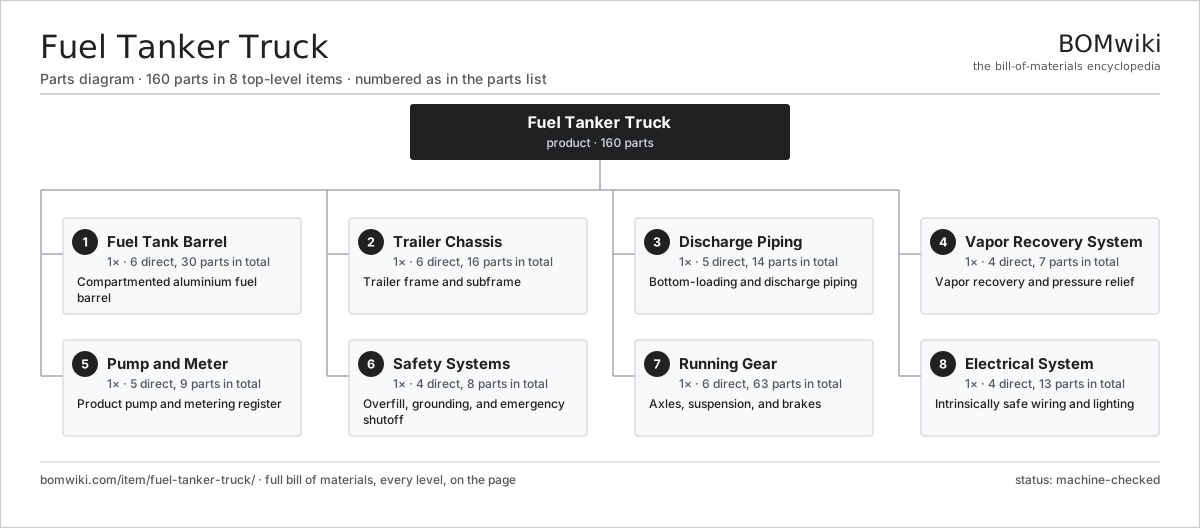
| # | Part | Qty | What it does |
|---|---|---|---|
| 1 | Fuel Tank Barrel 6 parts | 1× | Compartmented aluminium fuel barrel |
| 2 | Trailer Chassis 6 parts | 1× | Trailer frame and subframe |
| 3 | Discharge Piping 5 parts | 1× | Bottom-loading and discharge piping |
| 4 | Vapor Recovery System 4 parts | 1× | Vapor recovery and pressure relief |
| 5 | Pump and Meter 5 parts | 1× | Product pump and metering register |
| 6 | Safety Systems 4 parts | 1× | Overfill, grounding, and emergency shutoff |
| 7 | Running Gear 6 parts | 1× | Axles, suspension, and brakes |
| 8 | Electrical System 4 parts | 1× | Intrinsically safe wiring and lighting |
3D model
No 3D model yet. Have a CAD file of this? Add a 3D model. STL renders right on this page; STEP, FreeCAD, and OpenSCAD sources are welcome too (openly licensed, like all 3D models on BOMwiki).
Build & assembly graph
expand / collapse · shared sub-assemblies converge · links to related products · est. labourTap an assembly to expand/collapse · tap a part to open it · use “Open page” for any node · drag to pan, scroll to zoom.
Bill of materials for Fuel Tanker Truck
8 top-level lines · 67 rows shown · 160 parts total · indented to 3 levels| # | Item / sub-assembly | Part no. | Qty/assy | Ext. qty | Parts | Type |
|---|---|---|---|---|---|---|
| 1 | Fuel Tank Barrel 6 parts | fuel-tanker-truck-tank | 1× | 1 | 30 | assembly |
| 1.1 | Barrel Shell | fuel-tanker-truck-tank-shell | 1× | 1 | · | part |
| 1.2 | Compartment Bulkhead | fuel-tanker-truck-bulkhead | 4× | 4 | · | part |
| 1.3 | Surge Baffle | fuel-tanker-truck-baffle | 6× | 6 | · | part |
| 1.4 | Manhole Cover 4 parts | fuel-tanker-truck-manhole | 4× | 4 | 4 | assembly |
| 1.4.1 | Manhole Lid | fuel-tanker-truck-manhole-lid | 1× | 4 | · | part |
| 1.4.2 | Pressure-Vacuum Vent | fuel-tanker-truck-pv-vent | 1× | 4 | · | part |
| 1.4.3 | O-Ring Set | oring-set | 1× | 4 | · | part |
| 1.4.4 | Fastener Set | fastener-set | 1× | 4 | · | part |
| 1.5 | Rollover Rail | fuel-tanker-truck-rollover-rail | 2× | 2 | · | part |
| 1.6 | Fastener Set | fastener-set | 1× | 1 | · | part |
| 2 | Trailer Chassis 6 parts | fuel-tanker-truck-chassis | 1× | 1 | 16 | assembly |
| 2.1 | Main Beam | fuel-tanker-truck-chassis-mainbeam | 2× | 2 | · | part |
| 2.2 | Cross Member | fuel-tanker-truck-chassis-crossmember | 5× | 5 | · | part |
| 2.3 | Barrel Saddle | fuel-tanker-truck-saddle | 4× | 4 | · | part |
| 2.4 | Kingpin | fuel-tanker-truck-kingpin | 1× | 1 | · | part |
| 2.5 | Landing Gear 3 parts | fuel-tanker-truck-landing-gear | 1× | 1 | 3 | assembly |
| 2.5.1 | Ball Screw | ball-screw | 1× | 1 | · | part |
| 2.5.2 | Helical Gear Pair | gear-pair | 1× | 1 | · | part |
| 2.5.3 | Fastener Set | fastener-set | 1× | 1 | · | part |
| 2.6 | Fastener Set | fastener-set | 1× | 1 | · | part |
| 3 | Discharge Piping 5 parts | fuel-tanker-truck-discharge | 1× | 1 | 14 | assembly |
| 3.1 | Internal Footvalve | fuel-tanker-truck-footvalve | 4× | 4 | · | part |
| 3.2 | API Coupler | fuel-tanker-truck-api-coupler | 4× | 4 | · | part |
| 3.3 | Discharge Manifold | fuel-tanker-truck-manifold | 1× | 1 | · | part |
| 3.4 | Discharge Valve | fuel-tanker-truck-discharge-valve | 4× | 4 | · | part |
| 3.5 | O-Ring Set | oring-set | 1× | 1 | · | part |
| 4 | Vapor Recovery System 4 parts | fuel-tanker-truck-vapor-recovery | 1× | 1 | 7 | assembly |
| 4.1 | Vapor Header | fuel-tanker-truck-vapor-header | 1× | 1 | · | part |
| 4.2 | Vapor Adapter | fuel-tanker-truck-vapor-adapter | 1× | 1 | · | part |
| 4.3 | Pressure-Vacuum Vent | fuel-tanker-truck-pv-vent | 4× | 4 | · | part |
| 4.4 | O-Ring Set | oring-set | 1× | 1 | · | part |
| 5 | Pump and Meter 5 parts | fuel-tanker-truck-pump-meter | 1× | 1 | 9 | assembly |
| 5.1 | Product Pump | fuel-tanker-truck-product-pump | 1× | 1 | · | part |
| 5.2 | Flow Meter | fuel-tanker-truck-meter | 1× | 1 | · | part |
| 5.3 | Register 4 parts | fuel-tanker-truck-register | 1× | 1 | 4 | assembly |
| 5.3.1 | Bare PCB | pcb-bare | 1× | 1 | · | part |
| 5.3.2 | Microcontroller | mcu | 1× | 1 | · | part |
| 5.3.3 | LCD Panel | lcd-panel | 1× | 1 | · | part |
| 5.3.4 | Connector | connector | 1× | 1 | · | part |
| 5.4 | Hose Reel | fuel-tanker-truck-reel | 1× | 1 | · | part |
| 5.5 | Oil Seal | oil-seal | 2× | 2 | · | part |
| 6 | Safety Systems 4 parts | fuel-tanker-truck-safety | 1× | 1 | 8 | assembly |
| 6.1 | Overfill Sensor | fuel-tanker-truck-overfill-sensor | 4× | 4 | · | part |
| 6.2 | Grounding Reel | fuel-tanker-truck-grounding-reel | 1× | 1 | · | part |
| 6.3 | Emergency Shutoff | fuel-tanker-truck-shutoff | 1× | 1 | · | part |
| 6.4 | Pressure Sensor | pressure-sensor | 2× | 2 | · | part |
| 7 | Running Gear 6 parts | fuel-tanker-truck-running-gear | 1× | 1 | 63 | assembly |
| 7.1 | Axle | fuel-tanker-truck-axle | 3× | 3 | · | part |
| 7.2 | Air Spring | fuel-tanker-truck-air-spring | 6× | 6 | · | part |
| 7.3 | Wheel Brake 4 parts | fuel-tanker-truck-brake | 6× | 6 | 4 | assembly |
| 7.3.1 | Brake Rotor | fuel-tanker-truck-brake-rotor | 1× | 6 | · | part |
| 7.3.2 | Brake Caliper | fuel-tanker-truck-brake-caliper | 1× | 6 | · | part |
| 7.3.3 | ABS Sensor | fuel-tanker-truck-abs-sensor | 1× | 6 | · | part |
| 7.3.4 | Fastener Set | fastener-set | 1× | 6 | · | part |
| 7.4 | Wheel and Tire | fuel-tanker-truck-wheel | 12× | 12 | · | part |
| 7.5 | Ball Bearing | ball-bearing | 12× | 12 | · | part |
| 7.6 | Oil Seal | oil-seal | 6× | 6 | · | part |
| 8 | Electrical System 4 parts | fuel-tanker-truck-electrical | 1× | 1 | 13 | assembly |
| 8.1 | Hazardous-Area Lamp | fuel-tanker-truck-light | 6× | 6 | · | part |
| 8.2 | ABS Module 4 parts | fuel-tanker-truck-abs-module | 1× | 1 | 5 | assembly |
| 8.2.1 | Bare PCB | pcb-bare | 1× | 1 | · | part |
| 8.2.2 | Microcontroller | mcu | 1× | 1 | · | part |
| 8.2.3 | Relay | relay | 2× | 2 | · | part |
| 8.2.4 | Connector | connector | 1× | 1 | · | part |
| 8.3 | Wire Bundle | wire-bundle | 1× | 1 | · | part |
| 8.4 | Connector | connector | 1× | 1 | · | part |
Related products
same domain, ranked by shared parts Milk Tanker Truck
147 parts · shares 6 with this page
Milk Tanker Truck
147 parts · shares 6 with this page
 Livestock Truck
292 parts · shares 4 with this page
Livestock Truck
292 parts · shares 4 with this page
 Grand Tourer
2,233 parts · shares 3 with this page
Grand Tourer
2,233 parts · shares 3 with this page
 Dump Trailer
127 parts · shares 3 with this page
Dump Trailer
127 parts · shares 3 with this page
 Bulk Feed Truck
237 parts · shares 5 with this page
Bulk Feed Truck
237 parts · shares 5 with this page
 Coupe Car
1,617 parts · shares 5 with this page
Coupe Car
1,617 parts · shares 5 with this page
Sourcing: possible vendors
Browse the supplier directory → Prices, MOQ, and lead times are algorithmic estimates, not quotes, and not claims about these companies. Company mappings are curated by keyword; est. price band $8k–$90k. How estimates work| Vendor | HQ | Specialty | MOQ | Lead time |
|---|---|---|---|---|
|
🇯🇵Toyota
global.toyota ↗
|
Toyota City, JP | Automaker | made to order | 16–28 wks |
| volkswagen-group.com ↗ | Wolfsburg, DE | Automaker | made to order | 16–28 wks |
| gm.com ↗ | Detroit, US | Automaker | made to order | 16–28 wks |
| hyundai.com ↗ | Seoul, KR | Automaker | made to order | 16–28 wks |
|
🇨🇳BYD
byd.com ↗
|
Shenzhen, CN | EV & battery manufacturer | made to order | 16–28 wks |
1,047-word article