Chick Brooder
ProductOverview
A chick brooder is a mobile heating system that allows a farmer or hobbyist to raise day-old chicks without a dedicated building. Instead of constructing a chick house, the brooder provides a localized warm zone, typically a 1–2 m² area under a heat lamp, surrounded by a temporary pen. Newly hatched chicks, which cannot regulate body temperature, huddle under the radiant heat; as they grow and develop feathers, they retreat to the cooler edges of the pen. Over 6–8 weeks, the farmer gradually reduces the heat (stepping temperature down 0.5 °C per week) until chicks can live in ambient conditions.
The Chick Brooder is fundamentally simpler than an Egg Incubator: it does not control humidity or turn eggs, and it does not require a sealed enclosure. A heat lamp, a pen wall, a water drinker, and a feed hopper are sufficient. The critical skill is temperature management, too hot and chicks become dehydrated and die of heat stress; too cold and they pile up, suffocate each other, and succumb to Ascites. Dead chicks on arrival (DOA) or in the first week point to brooding error.
Heating and radiant zone
The Heating System subsystem uses a single infra-red or ceramic Heat Lamp Bulb, typically 150–250 W for small flocks (50 chicks) or 300–500 W for 100+ chicks. The lamp mounts in a Lamp Socket at the tip of a Horizontal Arm, which extends from a central Support Pole over the middle of the Pen Enclosure. The socket is rated for continuous 250+ W operation; ceramic elements are preferred because they emit infra-red only, not visible light that can trigger stress or feather-pecking.
A Reflector Shield or Protective Guard Cage parabolic reflector concentrates the heat downward and protects chicks and humans from burns. The shield also allows the operator to adjust height by raising or lowering the arm, which tunes the zone temperature: moving the lamp 5 cm higher drops the floor temperature by roughly 1 °C. Heat distribution is inherently non-uniform, the zone directly beneath the lamp is hottest, and edges are cooler, which is intentional: chicks self-regulate, moving into heat when cold and backing away when warm.
On day 1, the operator sets the zone temperature to 35 °C (measured at chick height, typically 10–15 cm above the litter). Every 7 days, the lamp is raised (or dimmer reduced) to drop the setpoint by 0.5 °C, so by week 8 (day 56) the zone is back to ambient room temperature (20–25 °C). At that point, the brooder is unnecessary and can be removed.
Temperature control
Modern brooders use a Temperature Control or Control Board with a Temperature Probe placed at chick level in the pen. Simple designs use a mechanical thermostat that switches the Dimmer Control on and off; more sophisticated controllers employ a PID loop or stepped relay to hold temperature within 1 °C. The critical detail is sensor placement: if the probe is mounted on the heat lamp structure, it reads artificially high and under-heats the chicks. The sensor should hang at the same height as the chicks' backs.
The pen
The Pen Enclosure is an open-bottomed enclosure, usually a circle or square made of Pen Walls (hardware cloth or plastic netting, 30–60 cm tall) held up by Corner Post (lightweight stakes or rods). The open bottom prevents condensation and allows litter to be packed and debris swept clear from underneath. A Access Gate provides access for feeding, watering, and catching chicks. Pen diameter is typically 1.5–2.5 m for a small homestead (50 chicks) and up to 3–4 m for larger operations.
The pen confines chicks to the brooded area but does not house them; it prevents them from wandering into a cold part of the barn and does not need to be insulated or draft-free. Chicks will dust bathe in litter, roost on low perches if provided, and spend their early life pecking, running, and vocalizing constantly.
Feeding and watering
Feeder Assembly are placed along the inside of the pen wall, outside the footprint of the heat lamp (so they do not get dangerously hot). Most small operations use gravity-feed Feed Hopper systems: a conical plastic container sits above a shallow pan or trough, and feed gravity-flows to the Feed Trough. Early chicks eat starter crumble (finely ground feed, 20–24 % protein); larger feeders are introduced at week 4.
Water is equally critical, dehydrated chicks fail to grow and are prone to coccidiosis. A Water Drinker drinker (bell-type, or a Nipple Valve valve system) is filled daily or connected to a slow dripper. Nipple drinkers reduce spillage and caking of litter, but chicks must learn to peck them; naive chicks sometimes need to be shown the drinker by the operator's finger or a pen-mate.
Litter management
Chicks are messy; they defecate constantly and their urine mixes with feces, creating damp, ammonia-rich litter within days. The Litter System begins as a base layer of Litter Base Sheet (cardboard or burlap) that absorbs the worst spills, topped by 5–10 cm of Bedding Material (pine shavings or sand; cedar and walnut are toxic to birds). The litter is raked or stirred daily to break up cakes, and it is replaced weekly. A wet litter under the drinker is a common source of disease, coccidiosis, aspergillosis, and other infections thrive in damp conditions.
A Heat-Dry Pad (optional) is sometimes used as a thin mat directly beneath the heat lamp to keep that zone bone-dry.
Growth phases
Weeks 1–3 (brooding): Chicks are entirely dependent on the heat lamp; they spend 80–90 % of their time under it, sleeping in a huddled mass and waking only to eat, drink, and defecate. Mortality is highest in the first 48 hours (DOA is normal) and at the transition points if temperature is mismanaged.
Weeks 4–6 (feathering): As feathers develop, chicks spend more time away from the heat, exploring the pen and pecking at litter (which provides minerals and fiber). Temperature is reduced every week. Pecking order is established; a few chicks will dominate feeding and watering spots.
Weeks 7–8 (weaning): Temperature is at or near ambient; the heat lamp can be removed entirely. Chicks are moved to a larger housing (if they are pullets destined for layers) or fattened further before processing (if meat birds).
After 8–10 weeks, a brooded bird is no longer called a chick; it is a grower, and it can live without supplemental heat if housed out of extreme weather.
Chick Brooder parts and their functions
6 top-level parts · 32 parts in total · full bill of materials below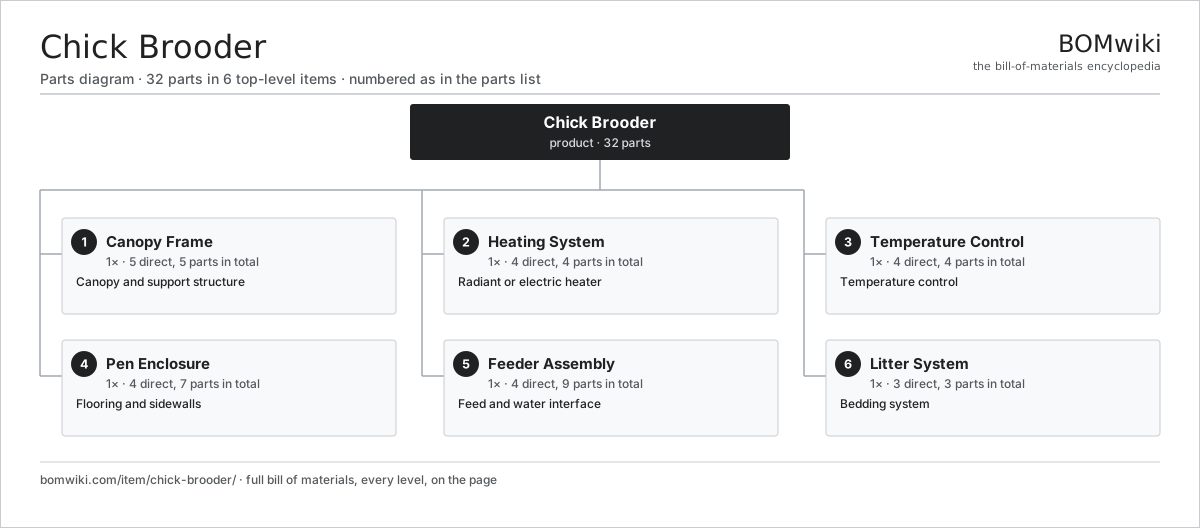
| # | Part | Qty | What it does |
|---|---|---|---|
| 1 | Canopy Frame 5 parts | 1× | Canopy and support structure |
| 2 | Heating System 4 parts | 1× | Radiant or electric heater |
| 3 | Temperature Control 4 parts | 1× | Temperature control |
| 4 | Pen Enclosure 4 parts | 1× | Flooring and sidewalls |
| 5 | Feeder Assembly 4 parts | 1× | Feed and water interface |
| 6 | Litter System 3 parts | 1× | Bedding system |
3D model
No 3D model yet. Have a CAD file of this? Add a 3D model. STL renders right on this page; STEP, FreeCAD, and OpenSCAD sources are welcome too (openly licensed, like all 3D models on BOMwiki).
Build & assembly graph
expand / collapse · shared sub-assemblies converge · links to related products · est. labourTap an assembly to expand/collapse · tap a part to open it · use “Open page” for any node · drag to pan, scroll to zoom.
Bill of materials for Chick Brooder
6 top-level lines · 30 rows shown · 32 parts total · indented to 3 levels| # | Item / sub-assembly | Part no. | Qty/assy | Ext. qty | Parts | Type |
|---|---|---|---|---|---|---|
| 1 | Canopy Frame 5 parts | chick-brooder-frame | 1× | 1 | 5 | assembly |
| 1.1 | Support Pole | chick-brooder-pole | 1× | 1 | · | part |
| 1.2 | Horizontal Arm | chick-brooder-arm | 1× | 1 | · | part |
| 1.3 | Reflector Shield | chick-brooder-canopy-shield | 1× | 1 | · | part |
| 1.4 | Fastener Set | fastener-set | 1× | 1 | · | part |
| 1.5 | Coil Spring | coil-spring | 1× | 1 | · | part |
| 2 | Heating System 4 parts | chick-brooder-heating | 1× | 1 | 4 | assembly |
| 2.1 | Lamp Socket | chick-brooder-lamp-socket | 1× | 1 | · | part |
| 2.2 | Heat Lamp Bulb | chick-brooder-heating-element | 1× | 1 | · | part |
| 2.3 | Protective Guard Cage | chick-brooder-safety-guard | 1× | 1 | · | part |
| 2.4 | Dimmer Control | chick-brooder-dimmer | 1× | 1 | · | part |
| 3 | Temperature Control 4 parts | chick-brooder-thermostat | 1× | 1 | 4 | assembly |
| 3.1 | Temperature Probe | chick-brooder-temp-sensor | 1× | 1 | · | part |
| 3.2 | Control Board | chick-brooder-control-board | 1× | 1 | · | part |
| 3.3 | Relay | relay | 1× | 1 | · | part |
| 3.4 | Connector | connector | 1× | 1 | · | part |
| 4 | Pen Enclosure 4 parts | chick-brooder-pen | 1× | 1 | 7 | assembly |
| 4.1 | Pen Walls | chick-brooder-pen-walls | 1× | 1 | · | part |
| 4.2 | Corner Post | chick-brooder-pen-corners | 4× | 4 | · | part |
| 4.3 | Access Gate | chick-brooder-pen-gate | 1× | 1 | · | part |
| 4.4 | Fastener Set | fastener-set | 1× | 1 | · | part |
| 5 | Feeder Assembly 4 parts | chick-brooder-feeders | 1× | 1 | 9 | assembly |
| 5.1 | Feed Hopper | chick-brooder-feed-hopper | 2× | 2 | · | part |
| 5.2 | Water Drinker | chick-brooder-waterer | 2× | 2 | · | part |
| 5.3 | Feed Trough | chick-brooder-feed-trough | 1× | 1 | · | part |
| 5.4 | Nipple Valve | chick-brooder-waterer-nipple | 4× | 4 | · | part |
| 6 | Litter System 3 parts | chick-brooder-litter | 1× | 1 | 3 | assembly |
| 6.1 | Litter Base Sheet | chick-brooder-litter-base | 1× | 1 | · | part |
| 6.2 | Bedding Material | chick-brooder-litter-material | 1× | 1 | · | part |
| 6.3 | Heat-Dry Pad | chick-brooder-drying-pad | 1× | 1 | · | part |
Something wrong in this list? Report a problem with this BOM.
Related products
same domain, ranked by shared parts Articulated Tractor
1,229 parts · shares 2 with this page
 Boom Sprayer
356 parts · shares 2 with this page
 Cane Harvester
287 parts · shares 2 with this page
 Center-Pivot Irrigator
945 parts · shares 2 with this page
 Egg Incubator
47 parts · shares 2 with this page
 Feed Pusher Robot
93 parts · shares 2 with this page
Sourcing: possible vendors
Browse the supplier directory → Prices, MOQ, and lead times are algorithmic estimates, not quotes, and not claims about these companies. Company mappings are curated by keyword; est. price band $5k–$800k. How estimates work| Vendor | HQ | Specialty | MOQ | Lead time |
|---|---|---|---|---|
| deere.com ↗ | Moline, US | Agriculture & turf | made to order | 14–24 wks |
| cnh.com ↗ | Basildon, GB | Agriculture (Case IH, New Holland) | made to order | 14–24 wks |
|
🇺🇸AGCO
agcocorp.com ↗
|
Duluth, US | Agriculture (Fendt, Massey Ferguson) | made to order | 14–24 wks |
|
🇩🇪Claas
claas.com ↗
|
Harsewinkel, DE | Harvesters & tractors | made to order | 14–24 wks |
|
🇯🇵Kubota
kubota.com ↗
|
Osaka, JP | Compact tractors & equipment | made to order | 14–24 wks |
1,141-word article