Subsoiler
ProductOverview
A subsoiler, also called a ripper, breaks up the dense compacted layer that forms below the depth a plow or disc normally reaches. Years of tillage and traffic at the same depth, plus the weight of machinery, press the soil just under the worked layer into a hard pan that roots cannot push through and water cannot drain past. The subsoiler pulls narrow, strong legs down below that pan and lifts the soil enough to crack it apart, restoring a path for roots, air, and water. It does this without turning the soil over, so the surface and its residue are left mostly undisturbed.
The work is done by a few Ripper Shank legs bolted to a heavy Main Toolbar, each ending in a hardened Point and Wings. A Cutting Coulter ahead of each shank cuts through residue, Depth Gauge Wheel units set the depth, and a Trip Protection device protects each shank from buried rocks. The whole tool couples to a powerful tractor through the Three-Point Hitch.
The toolbar and forces involved
Deep tillage produces some of the highest pulling loads in farming, so the Main Toolbar is built heavy. Its Box Beam is thick-wall box steel that resists the bending and twisting of dragging legs through firm soil, stiffened by Gusset plates at each shank station and capped by Sheet Metal Panel end plates. Each shank fixes with a Shank Clamp that slides along the beam, so the operator can set shank spacing to suit the crop and the tractor power available. Spacing matters because shanks set too far apart leave unbroken ridges between them and too close together waste power.
Shanks and points
The Ripper Shank is the working leg. Its forged Shank Leg reaches below the pan and, as it is pulled forward, lifts the soil ahead of it just enough to fracture it along natural planes rather than smearing or pulverizing it. A Wear Shin on the leading face takes the abrasion of soil flowing past, and the Mounting Shaft ties the leg into its clamp or trip. At the bottom, the Point and Wings carries a hard-faced Ripper Tip that does the actual cutting at depth and wears fastest of any part. Optional Lift Wing elements bolt on behind the tip with Point Bolt hardware to lift and shatter a wider band of soil, which fractures more ground per pass at the cost of more pulling force.
Setting and holding depth
The benefit of subsoiling comes from running just below the pan, so depth control matters. The Depth Gauge Wheel unit carries a Gauge Wheel on a Wheel Arm, set by a Depth Crank, that rides the surface and stops the shanks diving deeper than intended as soil firmness changes. Running too shallow leaves the pan intact, while running too deep wastes a great deal of fuel for no gain, since the dense layer is only so thick. The gauge wheels also keep the depth even across the toolbar so every shank does its share.
Residue cutting and rock protection
Crop residue on the surface can wrap and plug a shank, so a Cutting Coulter runs ahead of each one. Its sharp Coulter Disc on a Coulter Arm, pressed down by a Coil Spring and turning on a Ball Bearing, slices a clean slot through stalks and trash so the shank enters cleanly. This lets the tool work in heavy residue without raking it into piles, which is important where residue is kept on the surface for erosion control.
Buried rocks are the other hazard, because a shank that snags a stone at depth and full speed could otherwise bend the frame. The Trip Protection device guards against this. A heavy Trip Spring Pack pack holds the shank down through normal loads but yields when a rock pushes past the set force, letting the Trip Arm swing the shank up and back over the obstacle. A Reset Latch and Coil Spring then snap it back to working position once clear. On simpler tools a shear bolt does the same job by breaking, but the spring reset avoids stopping the field.
Hitch, use, and limits
The tool couples through the Three-Point Hitch, whose heavy Hitch Mast, Lower Link Pin pins, and Top Link Pin are sized for the high draft and the strong downward pull the shanks generate. There is no power takeoff, since all the work is done by pulling.
Subsoiling is done where compaction is limiting the crop, often in tracks left by harvest traffic, in headlands, or across fields that have been worked to the same depth for years. It is most effective when the soil below the pan is dry enough to crack and shatter rather than smear, which usually means working in late summer or after harvest rather than in wet spring soil. The job is heavy on fuel and needs a high-power tractor, often thirty to sixty kilowatts of engine for each shank, so farmers subsoil only when the gain in rooting and drainage justifies the cost, and they avoid doing it more often than the compaction actually requires.
Subsoiler parts and their functions
7 top-level parts · 77 parts in total · full bill of materials below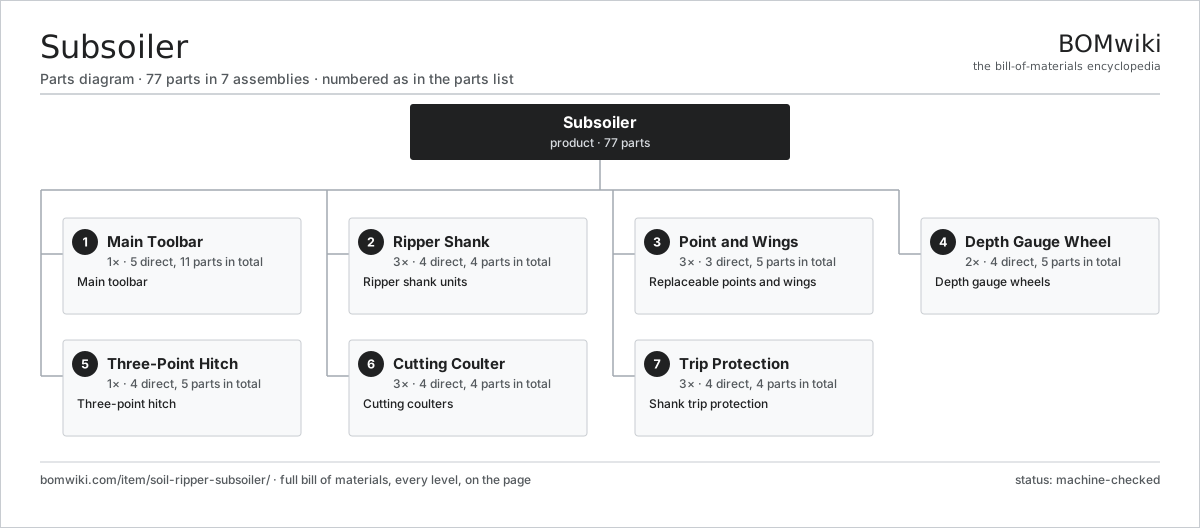
| # | Part | Qty | What it does |
|---|---|---|---|
| 1 | Main Toolbar 5 parts | 1× | Main toolbar |
| 2 | Ripper Shank 4 parts | 3× | Ripper shank units |
| 3 | Point and Wings 3 parts | 3× | Replaceable points and wings |
| 4 | Depth Gauge Wheel 4 parts | 2× | Depth gauge wheels |
| 5 | Three-Point Hitch 4 parts | 1× | Three-point hitch |
| 6 | Cutting Coulter 4 parts | 3× | Cutting coulters |
| 7 | Trip Protection 4 parts | 3× | Shank trip protection |
3D model
No 3D model yet. Have a CAD file of this? Add a 3D model — STL renders right on this page; STEP, FreeCAD, and OpenSCAD sources are welcome too (openly licensed, like all 3D models on BOMwiki).
Build & assembly graph
expand / collapse · shared sub-assemblies converge · links to related products · est. labourTap an assembly to expand/collapse · tap a part to open it · use “Open page” for any node · drag to pan, scroll to zoom.
Bill of materials for Subsoiler
7 top-level lines · 35 rows shown · 77 parts total · indented to 3 levels| # | Item / sub-assembly | Part no. | Qty/assy | Ext. qty | Parts | Type |
|---|---|---|---|---|---|---|
| 1 | Main Toolbar 5 parts | soil-ripper-subsoiler-toolbar | 1× | 1 | 11 | assembly |
| 1.1 | Box Beam | soil-ripper-subsoiler-beam | 1× | 1 | · | part |
| 1.2 | Shank Clamp | soil-ripper-subsoiler-shank-clamp | 3× | 3 | · | part |
| 1.3 | Gusset | soil-ripper-subsoiler-gusset | 4× | 4 | · | part |
| 1.4 | Sheet Metal Panel | sheet-panel | 2× | 2 | · | part |
| 1.5 | Fastener Set | fastener-set | 1× | 1 | · | part |
| 2 | Ripper Shank 4 parts | soil-ripper-subsoiler-shank-unit | 3× | 3 | 4 | assembly |
| 2.1 | Shank Leg | soil-ripper-subsoiler-shank-leg | 1× | 3 | · | part |
| 2.2 | Wear Shin | soil-ripper-subsoiler-shank-shin | 1× | 3 | · | part |
| 2.3 | Mounting Shaft | soil-ripper-subsoiler-shank-shaft | 1× | 3 | · | part |
| 2.4 | Fastener Set | fastener-set | 1× | 3 | · | part |
| 3 | Point and Wings 3 parts | soil-ripper-subsoiler-point | 3× | 3 | 5 | assembly |
| 3.1 | Ripper Tip | soil-ripper-subsoiler-tip | 1× | 3 | · | part |
| 3.2 | Lift Wing | soil-ripper-subsoiler-wing | 2× | 6 | · | part |
| 3.3 | Point Bolt | soil-ripper-subsoiler-point-bolt | 2× | 6 | · | part |
| 4 | Depth Gauge Wheel 4 parts | soil-ripper-subsoiler-depth-wheel | 2× | 2 | 5 | assembly |
| 4.1 | Gauge Wheel | soil-ripper-subsoiler-gauge-wheel | 1× | 2 | · | part |
| 4.2 | Depth Crank | soil-ripper-subsoiler-depth-crank | 1× | 2 | · | part |
| 4.3 | Wheel Arm | soil-ripper-subsoiler-wheel-arm | 1× | 2 | · | part |
| 4.4 | Ball Bearing | ball-bearing | 2× | 4 | · | part |
| 5 | Three-Point Hitch 4 parts | soil-ripper-subsoiler-hitch | 1× | 1 | 5 | assembly |
| 5.1 | Hitch Mast | soil-ripper-subsoiler-hitch-mast | 1× | 1 | · | part |
| 5.2 | Lower Link Pin | soil-ripper-subsoiler-lower-pin | 2× | 2 | · | part |
| 5.3 | Top Link Pin | soil-ripper-subsoiler-top-pin | 1× | 1 | · | part |
| 5.4 | Fastener Set | fastener-set | 1× | 1 | · | part |
| 6 | Cutting Coulter 4 parts | soil-ripper-subsoiler-coulter | 3× | 3 | 4 | assembly |
| 6.1 | Coulter Disc | soil-ripper-subsoiler-coulter-disc | 1× | 3 | · | part |
| 6.2 | Coulter Arm | soil-ripper-subsoiler-coulter-arm | 1× | 3 | · | part |
| 6.3 | Coil Spring | coil-spring | 1× | 3 | · | part |
| 6.4 | Ball Bearing | ball-bearing | 1× | 3 | · | part |
| 7 | Trip Protection 4 parts | soil-ripper-subsoiler-trip | 3× | 3 | 4 | assembly |
| 7.1 | Trip Spring Pack | soil-ripper-subsoiler-trip-spring | 1× | 3 | · | part |
| 7.2 | Trip Arm | soil-ripper-subsoiler-trip-arm | 1× | 3 | · | part |
| 7.3 | Reset Latch | soil-ripper-subsoiler-reset-latch | 1× | 3 | · | part |
| 7.4 | Coil Spring | coil-spring | 1× | 3 | · | part |
Related products
same domain, ranked by shared parts Feed Grinder Mixer
368 parts · shares 2 with this page
Feed Grinder Mixer
368 parts · shares 2 with this page
 Grain Bagger
206 parts · shares 2 with this page
Grain Bagger
206 parts · shares 2 with this page
 Grape Harvester
69 parts · shares 2 with this page
Grape Harvester
69 parts · shares 2 with this page
 Mobile Grain Dryer
554 parts · shares 2 with this page
Mobile Grain Dryer
554 parts · shares 2 with this page
 Silage Trailer
185 parts · shares 2 with this page
Silage Trailer
185 parts · shares 2 with this page
 Strip-Till Implement
124 parts · shares 2 with this page
Strip-Till Implement
124 parts · shares 2 with this page
Sourcing: possible vendors
Prices, MOQ, and lead times are algorithmic estimates, not quotes, and not claims about these companies. Company mappings are curated by keyword; est. price band $5k–$800k. How estimates work| Vendor | HQ | Specialty | MOQ | Lead time |
|---|---|---|---|---|
| deere.com ↗ | Moline, US | Agriculture & turf | made to order | 14–24 wks |
| cnh.com ↗ | Basildon, GB | Agriculture (Case IH, New Holland) | made to order | 14–24 wks |
|
🇺🇸AGCO
agcocorp.com ↗
|
Duluth, US | Agriculture (Fendt, Massey Ferguson) | made to order | 14–24 wks |
|
🇩🇪Claas
claas.com ↗
|
Harsewinkel, DE | Harvesters & tractors | made to order | 14–24 wks |
|
🇯🇵Kubota
kubota.com ↗
|
Osaka, JP | Compact tractors & equipment | made to order | 14–24 wks |
935-word article