Rice Transplanter
ProductOverview
A rice transplanter is a mounted agricultural machine that mechanically plants pre-nursed rice seedlings into flooded paddies. Instead of hand-transplanting (which requires a labor force of 4–6 workers per hectare), the Planting Unit does the work of a person, allowing an operator to establish a hectare in 2–3 hours. The machine floats on buoyant Float Frame & Floats chambers and moves through water via a small gasoline Gasoline Engine. The Seedling Hopper & Feed grips seedlings one by one from standard nursery trays and feeds them to the planting fingers, which grip and push each seedling into the mud at a preset depth and spacing.
Transplanters are dominant in Asia, where land scarcity makes intensive paddies the norm. Varieties exist from hand-fed walk-behind units to 6–8 row powered rigs; the 4-row riding machine is the most common in Southeast Asian smallholder farming. Modern units use hydraulic depth control or simple mechanical linkages; electronic control has not displaced mechanical designs due to the corrosive paddy environment and farmer preference for field-repairable machines.
How it works
The Gasoline Engine runs continuously during operation. Its power is routed through a Centrifugal Clutch that engages above idle speed. The Gearbox offers 3–4 forward speeds; the operator selects a speed that matches the transplanting rhythm. The Final Drive Chain connects the gearbox to the main Main Timing Crank, which rotates once per planting cycle.
As the crank rotates, it operates a series of push-rods and lever arms connected to the Planting Fingers. At the start of the cycle, the fingers open and grip a seedling that was just advanced by the Picker Wheel Assembly. The fingers close, gripping the seedling. As the crank continues, the push-rod raises the closed fingers out of the Hopper Frame, lifts the seedling vertically, and then drives it forward and downward through the Drop Tube into the soil. At the bottom of the stroke, a cam or stop forces the fingers open, releasing the seedling in the mud. The Depth Gauge Wheels maintain uniform depth by keeping the planting frame suspended above the paddy bottom.
The seedling spacing is set by the gear ratio and the number of planting cycles per engine revolution. A 4-row machine transplants 4 seedlings with each cycle, so adjusting the gearbox speed varies the planting density. Operators typically work at 0.3–0.6 m/s (slow walk pace) to allow time for the soil to resist the seedling without pulling it back out.
Seedling supply and hopper
The Tray Guides align seedling trays in the Hopper Frame. A small electric or gasoline Feed Motor drives the Picker Wheel Assembly, whose fingers pluck seedlings from the tray and index them into the planting unit's in-feed zone. The Seedling Sensor detects the presence of a seedling and can interrupt the feed motor if the hopper runs empty, preventing the planting fingers from running dry and getting damaged. Most machines hold 4–6 trays in the hopper simultaneously.
Floating and steering
The Float Chambers are sealed pontoons welded to the main frame. The buoyancy is calculated to float the machine and operator at a draft of 150–200 mm, allowing operation in paddies that are at least 150 mm deep. Steering is done via Steering Cylinders fed by a small Hydraulic Pump driven off the engine. The operator pulls left or right on the Steering Joystick to activate the Steering Valve, directing hydraulic flow to the cylinder. The cylinders push or pull the Float Chambers, pivoting the machine about its center.
Because the machine floats, there are no wheels or tracks; this eliminates the ground drag of paddy soil. However, turning radius is large (2.5–3.5 m), and floating also means steering response is slow. Operators must plan their rows and turns before entering the paddy.
Depth control and field adjustment
The Depth Control System system uses a mechanical Depth Adjustment Rod with a Depth Scale mounted on the platform. The operator loosens a locking pin, pulls or pushes the adjustment lever, and locks it at the desired depth mark. This raises or lowers the Depth Gauge Wheels, which rest on the paddy bottom and support the frame. The gauge wheels typically measure 200–250 mm diameter and must be tracked to stay in the furrows of the planting fingers.
Typical working depth is 35–45 mm in standing water. Shallow planting risks seedling flotation or herbicide wash-out; too deep and the seedling may not have enough buoyancy to straighten its leaf blade after insertion.
Operator ergonomics
The Operator Platform & Controls is usually an open or semi-enclosed seat bolted above the floats. The Feed Rate Control is a lever or cable that the operator can tweak on the fly to fine-tune seedling advance if rows are slow to plant. The Depth Control Lever is set before entering the field and usually not adjusted mid-operation. Operators sit facing forward and must watch the planting action and paddy border to maintain straight rows.
Maintenance and reliability
The planting mechanism is entirely mechanical: no hydraulics, no electronics, no sensors beyond the seedling detector. Spring Finger Springs occasionally fatigue; Planting Fingers wear and must be sharpened or replaced. The Gasoline Engine is a standard small gasoline unit shared with many portable farm pumps, so spare parts and field repair knowledge are common. Rust from paddy water is the main durability challenge; farmers usually drain and dry the machine between seasons.
Machines are repaired at the village level, not in factories. A burned-out Feed Motor is swapped, a bent Depth Adjustment Rod is straightened, a cracked Float Chamber is welded or patched with automotive fiberglass patch kits.
Rice Transplanter parts and their functions
8 top-level parts · 70 parts in total · full bill of materials below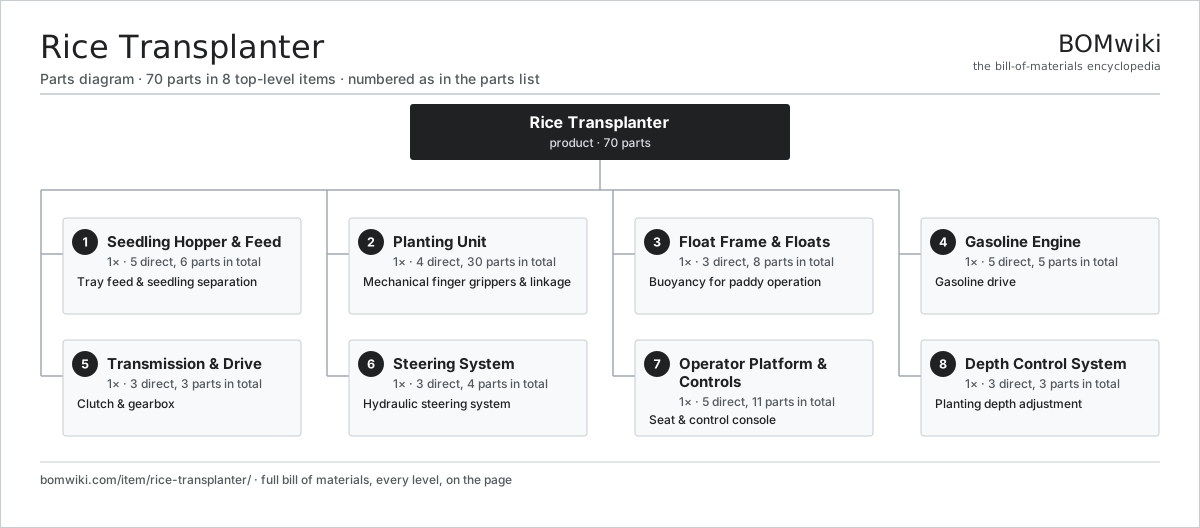
| # | Part | Qty | What it does |
|---|---|---|---|
| 1 | Seedling Hopper & Feed 5 parts | 1× | Tray feed & seedling separation |
| 2 | Planting Unit 4 parts | 1× | Mechanical finger grippers & linkage |
| 3 | Float Frame & Floats 3 parts | 1× | Buoyancy for paddy operation |
| 4 | Gasoline Engine 5 parts | 1× | Gasoline drive |
| 5 | Transmission & Drive 3 parts | 1× | Clutch & gearbox |
| 6 | Steering System 3 parts | 1× | Hydraulic steering system |
| 7 | Operator Platform & Controls 5 parts | 1× | Seat & control console |
| 8 | Depth Control System 3 parts | 1× | Planting depth adjustment |
3D model
No 3D model yet. Have a CAD file of this? Add a 3D model. STL renders right on this page; STEP, FreeCAD, and OpenSCAD sources are welcome too (openly licensed, like all 3D models on BOMwiki).
Build & assembly graph
expand / collapse · shared sub-assemblies converge · links to related products · est. labourTap an assembly to expand/collapse · tap a part to open it · use “Open page” for any node · drag to pan, scroll to zoom.
Bill of materials for Rice Transplanter
8 top-level lines · 48 rows shown · 70 parts total · indented to 3 levels| # | Item / sub-assembly | Part no. | Qty/assy | Ext. qty | Parts | Type |
|---|---|---|---|---|---|---|
| 1 | Seedling Hopper & Feed 5 parts | rice-transplanter-seedling-hopper | 1× | 1 | 6 | assembly |
| 1.1 | Hopper Frame | rice-transplanter-hopper-frame | 1× | 1 | · | part |
| 1.2 | Tray Guide | rice-transplanter-tray-guide | 2× | 2 | · | part |
| 1.3 | Picker Wheel Assembly | rice-transplanter-picker-wheel | 1× | 1 | · | part |
| 1.4 | Seedling Sensor | rice-transplanter-seedling-sensor | 1× | 1 | · | part |
| 1.5 | Feed Motor | rice-transplanter-feed-motor | 1× | 1 | · | part |
| 2 | Planting Unit 4 parts | rice-transplanter-planting-unit | 1× | 1 | 30 | assembly |
| 2.1 | Planting Frame | rice-transplanter-planting-frame | 1× | 1 | · | part |
| 2.2 | Single Row Planting Unit 4 parts | rice-transplanter-planting-row-unit | 4× | 4 | 6 | assembly |
| 2.2.1 | Planting Finger | rice-transplanter-planting-finger | 2× | 8 | · | part |
| 2.2.2 | Finger Spring | rice-transplanter-finger-spring | 2× | 8 | · | part |
| 2.2.3 | Finger Bracket | rice-transplanter-finger-bracket | 1× | 4 | · | part |
| 2.2.4 | Drop Tube | rice-transplanter-drop-tube | 1× | 4 | · | part |
| 2.3 | Main Timing Crank | rice-transplanter-linkage-crank | 1× | 1 | · | part |
| 2.4 | Depth Gauge Wheel | rice-transplanter-depth-wheel | 4× | 4 | · | part |
| 3 | Float Frame & Floats 3 parts | rice-transplanter-float-frame | 1× | 1 | 8 | assembly |
| 3.1 | Float Chamber | rice-transplanter-float-chamber | 2× | 2 | · | part |
| 3.2 | Cross Member | rice-transplanter-frame-cross-member | 2× | 2 | · | part |
| 3.3 | Mud Guard | rice-transplanter-mud-guard | 4× | 4 | · | part |
| 4 | Gasoline Engine 5 parts | rice-transplanter-engine | 1× | 1 | 5 | assembly |
| 4.1 | Engine Block | rice-transplanter-engine-block | 1× | 1 | · | part |
| 4.2 | Cylinder Head | rice-transplanter-cylinder-head | 1× | 1 | · | part |
| 4.3 | Carburetor | rice-transplanter-carburetor | 1× | 1 | · | part |
| 4.4 | Air Filter | rice-transplanter-air-filter | 1× | 1 | · | part |
| 4.5 | Exhaust Manifold | rice-transplanter-exhaust-manifold | 1× | 1 | · | part |
| 5 | Transmission & Drive 3 parts | rice-transplanter-transmission | 1× | 1 | 3 | assembly |
| 5.1 | Centrifugal Clutch | rice-transplanter-centrifugal-clutch | 1× | 1 | · | part |
| 5.2 | Gearbox | rice-transplanter-gearbox | 1× | 1 | · | part |
| 5.3 | Final Drive Chain | rice-transplanter-final-drive-chain | 1× | 1 | · | part |
| 6 | Steering System 3 parts | rice-transplanter-steering | 1× | 1 | 4 | assembly |
| 6.1 | Steering Cylinder | rice-transplanter-steering-cylinder | 2× | 2 | · | part |
| 6.2 | Steering Valve | rice-transplanter-steering-valve | 1× | 1 | · | part |
| 6.3 | Hydraulic Pump | rice-transplanter-hydraulic-pump | 1× | 1 | · | part |
| 7 | Operator Platform & Controls 5 parts | rice-transplanter-operator-platform | 1× | 1 | 11 | assembly |
| 7.1 | Platform Frame | rice-transplanter-platform-frame | 1× | 1 | · | part |
| 7.2 | Seat Assembly 5 parts | seat-assembly | 1× | 1 | 7 | assembly |
| 7.2.1 | Seat Frame | seat-frame | 1× | 1 | · | part |
| 7.2.2 | Seat Foam | seat-foam | 2× | 2 | · | part |
| 7.2.3 | Seat Cover | seat-cover | 1× | 1 | · | part |
| 7.2.4 | Seat Motor | seat-motor | 2× | 2 | · | part |
| 7.2.5 | Seat Heater Mat | seat-heater | 1× | 1 | · | part |
| 7.3 | Steering Joystick | rice-transplanter-steering-joystick | 1× | 1 | · | part |
| 7.4 | Depth Control Lever | rice-transplanter-depth-lever | 1× | 1 | · | part |
| 7.5 | Feed Rate Control | rice-transplanter-feed-control | 1× | 1 | · | part |
| 8 | Depth Control System 3 parts | rice-transplanter-depth-control | 1× | 1 | 3 | assembly |
| 8.1 | Depth Adjustment Rod | rice-transplanter-depth-adjustment-rod | 1× | 1 | · | part |
| 8.2 | Depth Scale | rice-transplanter-depth-scale | 1× | 1 | · | part |
| 8.3 | Depth Linkage | rice-transplanter-depth-linkage | 1× | 1 | · | part |
Something wrong in this list? Report a problem with this BOM.
Related products
same domain, ranked by shared parts Agricultural Tractor
306 parts · shares 6 with this page
Agricultural Tractor
306 parts · shares 6 with this page
 Cane Harvester
287 parts · shares 6 with this page
Cane Harvester
287 parts · shares 6 with this page
 Combine Harvester
203 parts · shares 6 with this page
Combine Harvester
203 parts · shares 6 with this page
 Cotton Picker
2,623 parts · shares 6 with this page
Cotton Picker
2,623 parts · shares 6 with this page
 Cotton Stripper
208 parts · shares 6 with this page
Cotton Stripper
208 parts · shares 6 with this page
 Feller Buncher
175 parts · shares 6 with this page
Feller Buncher
175 parts · shares 6 with this page
Sourcing: possible vendors
Browse the supplier directory → Prices, MOQ, and lead times are algorithmic estimates, not quotes, and not claims about these companies. Company mappings are curated by keyword; est. price band $5k–$800k. How estimates work| Vendor | HQ | Specialty | MOQ | Lead time |
|---|---|---|---|---|
| deere.com ↗ | Moline, US | Agriculture & turf | made to order | 14–24 wks |
| cnh.com ↗ | Basildon, GB | Agriculture (Case IH, New Holland) | made to order | 14–24 wks |
|
🇺🇸AGCO
agcocorp.com ↗
|
Duluth, US | Agriculture (Fendt, Massey Ferguson) | made to order | 14–24 wks |
|
🇩🇪Claas
claas.com ↗
|
Harsewinkel, DE | Harvesters & tractors | made to order | 14–24 wks |
|
🇯🇵Kubota
kubota.com ↗
|
Osaka, JP | Compact tractors & equipment | made to order | 14–24 wks |
1,027-word article