Inverted Microscope
ProductOverview
An inverted microscope is an optical microscope with the objective lens below the specimen stage, opposite the standard upright configuration. This design allows observation of cell cultures directly in culture dishes, Petri plates, and flasks without removal or coverslip mounting. The inverted geometry is standard for cell biology, tissue engineering, and live-cell imaging in research and clinical laboratories.
The Objective Nosepiece carries four objectives (typically 4×, 10×, 20×, 40×, and 100× oil immersion), providing magnification from low-power overview to sub-micron detail. The Stage Assembly motorized XY stage positions samples with sub-5 μm repeatability, while the Focus Mechanism provides motorized Z-focus. The Light Source (LED or halogen) illuminates specimens via a Condenser Assembly below the stage. The Eyepiece Assembly enables visual observation, and the Camera Port captures digital images for quantitative analysis.
How it works
Light from the Light Source is partially scattered by a Field Diaphragm to define the illumination boundary. The light passes through the Condenser Lens (Aplanatic condenser, 1.4 NA), which focuses the collimated beam onto the specimen from below. An Iris Diaphragm adjusts the cone angle, balancing contrast and resolution (smaller aperture = higher contrast but lower resolution; wider aperture = higher NA and resolution but lower contrast).
Light from the illuminated specimen passes upward through the 10× Objective (or other selected objective from the Objective Nosepiece). The objective, with numerical aperture typically 0.25–1.4 NA, captures scattered and refracted light and forms a magnified intermediate image. This image travels up the infinity-corrected optical path through the Optical Tube, where a Beam Splitter Turret dichroic mirror can redirect light to different optical ports (brightfield observation, fluorescence excitation, or camera).
For visual observation, light passes through the binocular Eyepiece Assembly (10× eyepieces, giving 100×–1000× total magnification depending on objective). The Focus Mechanism uses a Z Stepper Motor and Ball Screw for motorized fine focus, adjustable via computer control or manual knob override.
For digital imaging, light is directed to the Camera Port, which houses a Camera Adapter coupling a USB 3.0 or GigE Camera Interface camera. The Relay Lens may magnify or demagnify the intermediate image to match the camera sensor size (typically 1/3-inch or 2/3-inch for life sciences cameras). Frame rates of 10–60 fps at 2–20 Mpixel resolution allow real-time or slow-motion capture.
The Motorized Stage positioned under the objectives allows scanning multiple fields of view, creating high-resolution tile montages or autofocus stacks. The Dish Holder accepts standard 35 mm Petri dishes, 60 mm plates, and even 100 mm dishes without plate removal, essential for continuous time-lapse imaging of live cells.
Optical design principles
Inverted microscope objectives are long-working-distance designs (compared to upright counterparts) because the stage, culture dish, and petri dish walls take up space. A 10× inverted objective has ~7 mm working distance, allowing room for the dish bottom to be within focus. Higher magnifications sacrifice working distance for resolution: the 100× oil immersion objective has only 0.13 mm working distance and requires immersion oil between lens and coverslip.
The Condenser Lens is an Aplanatic (or Abbe) condenser, designed for 1.4 NA and color correction. Proper condenser focus and iris adjustment are critical: a misaligned condenser reduces contrast and introduces vignetting. Most inverted microscopes include a Condenser Mount with micrometer focus for fine adjustment.
Fluorescence and multi-wavelength imaging
For fluorescence imaging, the Light Source may be a multi-color LED (white, 460 nm blue, 530 nm green) or arc lamp. The Beam Splitter Turret turret holds dichroic mirrors (e.g., 488 nm excitation, 515 nm emission for GFP) that direct excitation light toward the objective while passing emitted fluorescence to the eyepiece or camera. This architecture allows rapid channel switching for multi-color imaging.
Live-cell imaging
The inverted geometry and motorized stage make it ideal for continuous monitoring of living cell cultures. The Stage Assembly motorized stage and Focus Mechanism autofocus maintain sample position despite thermal drift or mechanical vibration. Time-lapse sequences over hours or days document cell division, migration, or response to stimuli without disturbing the culture environment.
Inverted Microscope parts and their functions
8 top-level parts · 34 parts in total · full bill of materials below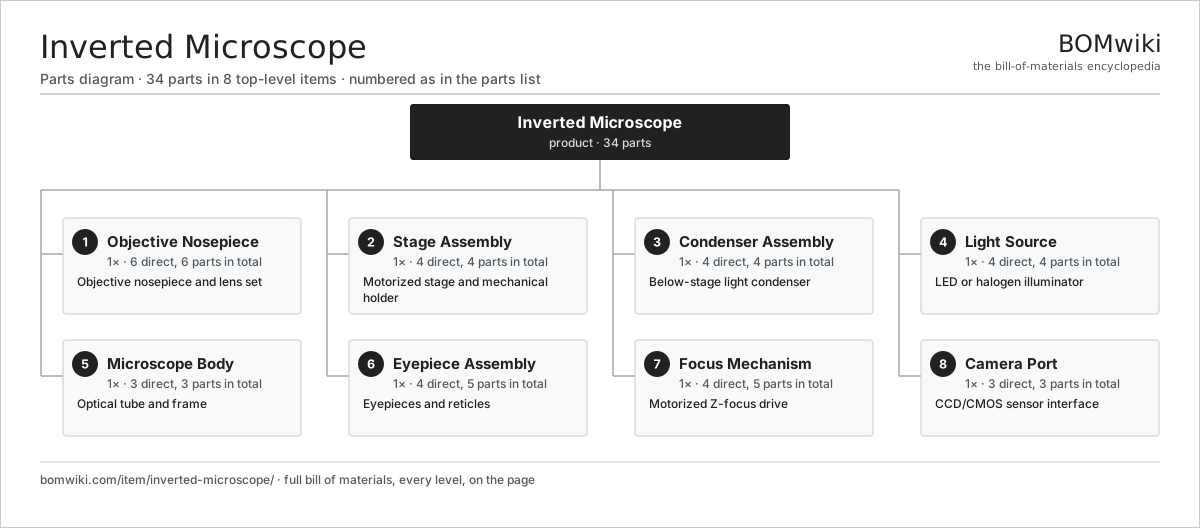
| # | Part | Qty | What it does |
|---|---|---|---|
| 1 | Objective Nosepiece 6 parts | 1× | Objective nosepiece and lens set |
| 2 | Stage Assembly 4 parts | 1× | Motorized stage and mechanical holder |
| 3 | Condenser Assembly 4 parts | 1× | Below-stage light condenser |
| 4 | Light Source 4 parts | 1× | LED or halogen illuminator |
| 5 | Microscope Body 3 parts | 1× | Optical tube and frame |
| 6 | Eyepiece Assembly 4 parts | 1× | Eyepieces and reticles |
| 7 | Focus Mechanism 4 parts | 1× | Motorized Z-focus drive |
| 8 | Camera Port 3 parts | 1× | CCD/CMOS sensor interface |
3D model
No 3D model yet. Have a CAD file of this? Add a 3D model. STL renders right on this page; STEP, FreeCAD, and OpenSCAD sources are welcome too (openly licensed, like all 3D models on BOMwiki).
Build & assembly graph
expand / collapse · shared sub-assemblies converge · links to related products · est. labourTap an assembly to expand/collapse · tap a part to open it · use “Open page” for any node · drag to pan, scroll to zoom.
Bill of materials for Inverted Microscope
8 top-level lines · 40 rows shown · 34 parts total · indented to 3 levels| # | Item / sub-assembly | Part no. | Qty/assy | Ext. qty | Parts | Type |
|---|---|---|---|---|---|---|
| 1 | Objective Nosepiece 6 parts | inverted-microscope-optical-turret | 1× | 1 | 6 | assembly |
| 1.1 | 10× Objective | inverted-microscope-objective-10x | 1× | 1 | · | part |
| 1.2 | 20× Objective | inverted-microscope-objective-20x | 1× | 1 | · | part |
| 1.3 | 40× Objective | inverted-microscope-objective-40x | 1× | 1 | · | part |
| 1.4 | 100× Oil Objective | inverted-microscope-objective-100x | 1× | 1 | · | part |
| 1.5 | Turret Body | inverted-microscope-turret-body | 1× | 1 | · | part |
| 1.6 | Focus Knobs | inverted-microscope-focus-adjust-knob | 1× | 1 | · | part |
| 2 | Stage Assembly 4 parts | inverted-microscope-stage-assembly | 1× | 1 | 4 | assembly |
| 2.1 | Motorized Stage | inverted-microscope-motorized-stage | 1× | 1 | · | part |
| 2.2 | Stage Plate | inverted-microscope-stage-top | 1× | 1 | · | part |
| 2.3 | Dish Holder | inverted-microscope-dish-holder | 1× | 1 | · | part |
| 2.4 | Mechanical Stage | inverted-microscope-mechanical-stage | 1× | 1 | · | part |
| 3 | Condenser Assembly 4 parts | inverted-microscope-condenser-assembly | 1× | 1 | 4 | assembly |
| 3.1 | Condenser Lens | inverted-microscope-condenser-lens | 1× | 1 | · | part |
| 3.2 | Iris Diaphragm | inverted-microscope-iris-diaphragm | 1× | 1 | · | part |
| 3.3 | Condenser Mount | inverted-microscope-condenser-mount | 1× | 1 | · | part |
| 3.4 | Filter Turret | inverted-microscope-filter-turret | 1× | 1 | · | part |
| 4 | Light Source 4 parts | inverted-microscope-light-source | 1× | 1 | 4 | assembly |
| 4.1 | LED Array | inverted-microscope-led-array | 1× | 1 | · | part |
| 4.2 | Lamp Housing | inverted-microscope-lamp-housing | 1× | 1 | · | part |
| 4.3 | Field Diaphragm | inverted-microscope-field-diaphragm | 1× | 1 | · | part |
| 4.4 | Light Power Supply | inverted-microscope-light-power-supply | 1× | 1 | · | part |
| 5 | Microscope Body 3 parts | inverted-microscope-microscope-body | 1× | 1 | 3 | assembly |
| 5.1 | Optical Tube | inverted-microscope-optical-tube | 1× | 1 | · | part |
| 5.2 | Beam Splitter Turret | inverted-microscope-beam-splitter | 1× | 1 | · | part |
| 5.3 | Frame | inverted-microscope-microscope-frame | 1× | 1 | · | part |
| 6 | Eyepiece Assembly 4 parts | inverted-microscope-eyepiece-assembly | 1× | 1 | 5 | assembly |
| 6.1 | 10× Eyepiece | inverted-microscope-eyepiece-10x | 2× | 2 | · | part |
| 6.2 | Focusing Eyepiece | inverted-microscope-focusing-eyepiece | 1× | 1 | · | part |
| 6.3 | Reticle Holder | inverted-microscope-reticle-holder | 1× | 1 | · | part |
| 6.4 | Eyepiece Tube | inverted-microscope-eyepiece-tube | 1× | 1 | · | part |
| 7 | Focus Mechanism 4 parts | inverted-microscope-focus-mechanism | 1× | 1 | 5 | assembly |
| 7.1 | Z Stepper Motor | inverted-microscope-stepper-motor-z | 1× | 1 | · | part |
| 7.2 | Ball Screw | inverted-microscope-ball-screw-z | 1× | 1 | · | part |
| 7.3 | Linear Bearing | inverted-microscope-linear-bearing-z | 2× | 2 | · | part |
| 7.4 | Position Sensor | inverted-microscope-position-sensor | 1× | 1 | · | part |
| 8 | Camera Port 3 parts | inverted-microscope-camera-port | 1× | 1 | 3 | assembly |
| 8.1 | Camera Adapter | inverted-microscope-camera-adapter | 1× | 1 | · | part |
| 8.2 | Relay Lens | inverted-microscope-relay-lens | 1× | 1 | · | part |
| 8.3 | Camera Interface | inverted-microscope-camera-connector | 1× | 1 | · | part |
Something wrong in this list? Report a problem with this BOM.
Sourcing: possible vendors
Browse the supplier directory → Prices, MOQ, and lead times are algorithmic estimates, not quotes, and not claims about these companies. Company mappings are curated by keyword; est. price band $1k–$500k. How estimates work| Vendor | HQ | Specialty | MOQ | Lead time |
|---|---|---|---|---|
| thermofisher.com ↗ | Waltham, US | Lab instruments | 100 units | 10–18 wks |
|
🇺🇸Agilent
agilent.com ↗
|
Santa Clara, US | Analytical instruments | 100 units | 10–18 wks |
|
🇺🇸Bruker
bruker.com ↗
|
Billerica, US | Scientific instruments | 100 units | 10–18 wks |
|
🇯🇵Shimadzu
shimadzu.com ↗
|
Kyoto, JP | Analytical instruments | 100 units | 10–18 wks |
|
🇺🇸Waters
waters.com ↗
|
Milford, US | Chromatography & MS | 100 units | 10–18 wks |
752-word article