Overhead Line Conductor Bundle
ProductOverview
An overhead line conductor bundle is the set of cables that actually carry power between transmission towers, plus all the hardware that supports, spaces, joins, and protects them. The bare conductor looks like a simple rope of wire, but it is engineered to do two contradictory things at once: conduct hundreds of megawatts with as little resistive loss as possible, and survive its own weight, wind, ice, and decades of temperature cycling without sagging into the ground or fatiguing apart. At the highest voltages a single cable cannot do this efficiently, so the phase is split into a bundle of identical sub-conductors held apart by spacers.
A complete bundle is built from the ACSR sub-conductors themselves, an earthwire or OPGW strung above them, a spacer and damper set, suspension and tension fittings at the towers, a joint and repair set, and an accessory set of markers and monitors.
The Conductor Itself
The workhorse is the ACSR sub-conductor, aluminum conductor steel reinforced. It solves a basic material conflict: aluminum conducts well and is light but is mechanically weak, while steel is strong but a poor conductor. ACSR puts a core of high-tensile steel core strands at the center to take the mechanical tension, and wraps it in layers of aluminum strands that carry almost all of the current. Because alternating current concentrates near the surface through the skin effect, putting the conducting aluminum on the outside and the non-conducting steel at the center costs little conductivity. The strands are laid helically in alternating directions so the cable holds together and flexes without unraveling, and the steel core is packed with core grease to keep moisture from corroding it. Conductors are sold by code names like Drake, Zebra, and Moose that fix the exact strand count and size.
Shielding and Communication
Above the live phases runs the earthwire, positioned to intercept lightning strokes before they hit a conductor. Modern lines make this wire do double duty as optical-ground wire: an OPGW core tube at the cable center protects an optical fiber unit while aluminum-clad steel strands around it provide the strength and the conductive path to drain lightning current to the towers. The fibers carry the utility's own protection signalling and communications along the same right-of-way as the power.
Bundling, Spacing, and Damping
At 400 kV and above, the electric field at the surface of a single conductor would be high enough to ionize the surrounding air, causing corona discharge that wastes power, generates audible hum and radio interference, and erodes the metal. Splitting the phase into a bundle of two, three, or four sub-conductors enlarges the effective diameter and lowers the surface field below the corona threshold. The spacer set keeps the geometry correct. A bundle spacer holds the sub-conductors at their design spacing, and a spacer damper adds elastomer joints that absorb the subspan oscillation where sub-conductors slap together in wind.
A separate problem is aeolian vibration: a steady crosswind sheds vortices that make the whole conductor hum at a few hundred hertz, a tiny motion that, repeated millions of times, fatigues the strands where they enter a clamp. A Stockbridge damper hung near each support detunes this vibration, and armor rods wrapped around the conductor at the clamp spread the bending stress over a longer length.
Supporting and Terminating
The conductor reaches a tower in one of two ways. At a tangent tower it simply passes through on a suspension fitting, where a suspension clamp lined with an armor-grip preform carries the conductor weight on a vertical insulator string. Where the line changes direction or ends, it is anchored by a tension fitting: a compression dead-end clamp holds the full tension, and a slack jumper loop carries the current around the tower to the next span without putting the structure under that pull.
Joining and Repair
Conductor is manufactured in finite drum lengths and occasionally damaged in service, so spans need splices. A compression joint crimps an aluminum and steel sleeve over the conductor ends to restore both conductivity and full tensile strength at mid-span. Localized strand damage is patched with a repair sleeve, and an implosive sleeve gives a fast, uniform field splice formed by a controlled detonation that swages the sleeve onto the conductor.
Accessories and Use
Spans crossing flight paths, rivers, or roads carry an accessory set: marker balls and an aerial marker light for aircraft visibility, bird flight diverters to cut collisions, and increasingly a line monitoring sensor that measures real conductor temperature and sag so operators can push more current through on cool, windy days through dynamic line rating. The bundled ACSR conductor remains the standard for overhead AC transmission because it is cheap per delivered megawatt, repairable in the field, and proven over a century of service, though high-temperature low-sag conductors with composite cores are now used to uprate existing lines without taller towers.
Overhead Line Conductor Bundle parts and their functions
7 top-level parts · 385 parts in total · full bill of materials below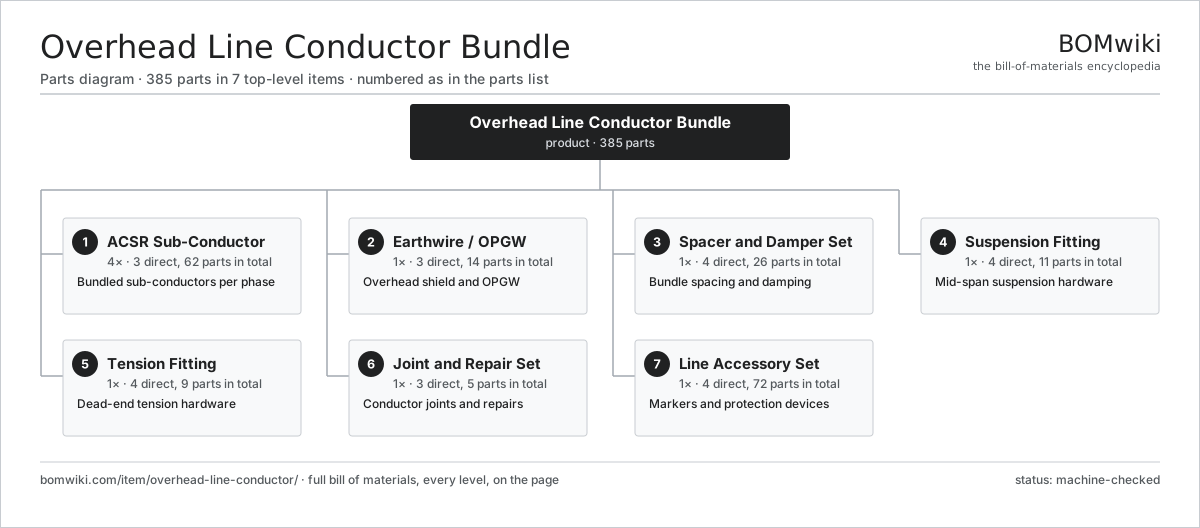
| # | Part | Qty | What it does |
|---|---|---|---|
| 1 | ACSR Sub-Conductor 3 parts | 4× | Bundled sub-conductors per phase |
| 2 | Earthwire / OPGW 3 parts | 1× | Overhead shield and OPGW |
| 3 | Spacer and Damper Set 4 parts | 1× | Bundle spacing and damping |
| 4 | Suspension Fitting 4 parts | 1× | Mid-span suspension hardware |
| 5 | Tension Fitting 4 parts | 1× | Dead-end tension hardware |
| 6 | Joint and Repair Set 3 parts | 1× | Conductor joints and repairs |
| 7 | Line Accessory Set 4 parts | 1× | Markers and protection devices |
3D model
No 3D model yet. Have a CAD file of this? Add a 3D model. STL renders right on this page; STEP, FreeCAD, and OpenSCAD sources are welcome too (openly licensed, like all 3D models on BOMwiki).
Build & assembly graph
expand / collapse · shared sub-assemblies converge · links to related products · est. labourTap an assembly to expand/collapse · tap a part to open it · use “Open page” for any node · drag to pan, scroll to zoom.
Bill of materials for Overhead Line Conductor Bundle
7 top-level lines · 38 rows shown · 385 parts total · indented to 3 levels| # | Item / sub-assembly | Part no. | Qty/assy | Ext. qty | Parts | Type |
|---|---|---|---|---|---|---|
| 1 | ACSR Sub-Conductor 3 parts | olc-acsr-conductor | 4× | 4 | 62 | assembly |
| 1.1 | Aluminum Strand | olc-aluminum-strand | 54× | 216 | · | part |
| 1.2 | Steel Core Strand | olc-steel-core-strand | 7× | 28 | · | part |
| 1.3 | Core Grease | olc-strand-grease | 1× | 4 | · | part |
| 2 | Earthwire / OPGW 3 parts | olc-earthwire | 1× | 1 | 14 | assembly |
| 2.1 | OPGW Core Tube | olc-opgw-core-tube | 1× | 1 | · | part |
| 2.2 | Optical Fiber Unit | olc-optical-fiber-unit | 1× | 1 | · | part |
| 2.3 | Aluminum-Clad Steel Strand | olc-alclad-strand | 12× | 12 | · | part |
| 3 | Spacer and Damper Set 4 parts | olc-spacer-damper-set | 1× | 1 | 26 | assembly |
| 3.1 | Bundle Spacer | olc-bundle-spacer | 8× | 8 | · | part |
| 3.2 | Spacer Damper | olc-spacer-damper | 6× | 6 | · | part |
| 3.3 | Stockbridge Damper | olc-stockbridge-damper | 4× | 4 | · | part |
| 3.4 | Armor Rod | olc-armor-rod | 8× | 8 | · | part |
| 4 | Suspension Fitting 4 parts | olc-suspension-fitting | 1× | 1 | 11 | assembly |
| 4.1 | Suspension Clamp | olc-suspension-clamp | 4× | 4 | · | part |
| 4.2 | Armor-Grip Preform | olc-armor-grip-preform | 4× | 4 | · | part |
| 4.3 | Yoke Plate | olc-yoke-plate | 1× | 1 | · | part |
| 4.4 | Ball-and-Socket Link | ais-ball-socket-link | 2× | 2 | · | part |
| 5 | Tension Fitting 4 parts | olc-tension-fitting | 1× | 1 | 9 | assembly |
| 5.1 | Dead-End Clamp | olc-deadend-clamp | 4× | 4 | · | part |
| 5.2 | Jumper Loop | olc-jumper-loop | 1× | 1 | · | part |
| 5.3 | Jumper Spacer | olc-jumper-spacer | 2× | 2 | · | part |
| 5.4 | Corona Ring | olc-corona-ring | 2× | 2 | · | part |
| 6 | Joint and Repair Set 3 parts | olc-joint-set | 1× | 1 | 5 | assembly |
| 6.1 | Compression Joint | olc-compression-joint | 2× | 2 | · | part |
| 6.2 | Repair Sleeve | olc-repair-sleeve | 2× | 2 | · | part |
| 6.3 | Implosive Splice Sleeve | olc-implosive-sleeve | 1× | 1 | · | part |
| 7 | Line Accessory Set 4 parts | olc-accessory-set | 1× | 1 | 72 | assembly |
| 7.1 | Aircraft Marker Ball | olc-aircraft-marker-ball | 2× | 2 | · | part |
| 7.2 | Bird Flight Diverter | olc-bird-flight-diverter | 4× | 4 | · | part |
| 7.3 | Line Monitoring Sensor 6 parts | olc-line-monitor | 1× | 1 | 65 | assembly |
| 7.3.1 | Bare PCB | pcb-bare | 1× | 1 | · | part |
| 7.3.2 | Microcontroller | mcu | 1× | 1 | · | part |
| 7.3.3 | Current Sensor | current-sensor | 1× | 1 | · | part |
| 7.3.4 | Pressure Sensor | pressure-sensor | 1× | 1 | · | part |
| 7.3.5 | Power Supply | power-supply | 1× | 1 | · | part |
| 7.3.6 | SMD Passive (R/C/L) | smd-passives | 60× | 60 | · | part |
| 7.4 | Aerial Marker Light | olc-aerial-marker-light | 1× | 1 | · | part |
Related products
same domain, ranked by shared parts Home Battery Storage
292 parts · shares 1 with this page
Home Battery Storage
292 parts · shares 1 with this page
 Air-Insulated Substation Bay
1,329 parts · shares 2 with this page
Air-Insulated Substation Bay
1,329 parts · shares 2 with this page
 HV Transmission Tower
239 parts · shares 2 with this page
Bottom Ash Handling System
1,782 parts · shares 2 with this page
HV Transmission Tower
239 parts · shares 2 with this page
Bottom Ash Handling System
1,782 parts · shares 2 with this page
 Coal Pulverizer Mill
313 parts · shares 2 with this page
Coal Pulverizer Mill
313 parts · shares 2 with this page
 Combined Heat and Power Unit
522 parts · shares 2 with this page
Combined Heat and Power Unit
522 parts · shares 2 with this page
Sourcing: possible vendors
Browse the supplier directory → Prices, MOQ, and lead times are algorithmic estimates, not quotes, and not claims about these companies. Company mappings are curated by keyword; est. price band $5k–$50M. How estimates work| Vendor | HQ | Specialty | MOQ | Lead time |
|---|---|---|---|---|
| gevernova.com ↗ | Cambridge, US | Power generation | made to order | 20–40 wks |
| siemens-energy.com ↗ | Munich, DE | Power & grid | made to order | 20–40 wks |
| hitachienergy.com ↗ | Zurich, CH | Grid & transformers | made to order | 20–40 wks |
|
🇨🇭ABB
abb.com ↗
|
Zurich, CH | Electrification & automation | made to order | 20–40 wks |
| se.com ↗ | Rueil-Malmaison, FR | Electrical & automation | made to order | 20–40 wks |
939-word article