Anti-Icing Brine Sprayer
ProductOverview
An anti-icing brine sprayer is a specialized truck that applies concentrated salt solution to pavement before and immediately after snowfall to prevent ice bonding. Road salt brine, a 20–23% sodium chloride solution, works at lower temperatures than solid salt alone because the solution suppresses the freezing point of water; salted wet pavement can remain unfrozen at −6 °C or colder depending on concentration. The truck carries 4000–6000 L of brine in sealed stainless-steel tanks and sprays it in a fine mist across the road using low-pressure nozzles, achieving a uniform 50–200 L/km application metered by truck ground speed.
The design combines positive-displacement pump hydraulics with electronic speed control. Unlike solid-salt spreaders, which meter granular material, the brine truck must maintain constant wetness of the road surface, too light an application misses coverage, too heavy wastes product. The electronic Electronic Controller adjusts the pump motor speed to maintain the operator's target rate (L/km) regardless of traffic speed, achieving near-perfect uniformity over the entire route.
Tanks and containment
The Brine Tanks are typically a pair of welded stainless-steel (304 or 316L grade) reservoirs in a side-by-side or tandem configuration. Each Tank Shell is rated for 2–3 bar internal pressure and designed with minimal dead space to prevent sediment settlement. The Slosh Baffle (internal divider) dampens brine sloshing during acceleration and braking, preventing surge loads on the frame and suspension.
The Access Hatch is a hinged or bolted hatch allowing drain and cleaning. The Level Gauge sight glasses show fill level at a glance; low-level alarms are wired to the cab. A Fill Cap at the top has a 200 µm strainer screen preventing sediment entry. At the bottom, a full-port Drain Valve allows rapid drain-down at season end. An Air Vent allows air ingress as brine sprays, preventing tank collapse.
The Drip Pan beneath the tank assembly catches minor seepage and spill. Environmental regulations in most jurisdictions require secondary containment rated for 110% of tank volume, either an integrated pan or a removable steel tray beneath the entire chassis.
Pump and pressure system
The Pump and Drive System includes a Transfer Pump (typically a gear pump or peristaltic pump) driven by a Drive Motor. Gear pumps are standard because they can handle suspended salt crystals without damage; diaphragm or peristaltic designs work well for saturated brine with minimal sediment. The pump draws from the tank bottom via a Suction Line fitted with a submerged strainer, delivering 20–50 L/min at 2–4 bar to the Spray Bar Manifold.
Pressure is kept low (2–4 bar vs. 200+ bar in hydraulic systems) to minimize nozzle wear and prevent atomization into a fog that drifts with wind. A Relief Valve set at 3–5 bar protects against clogging; if the spray bar clogs, excess flow vents back to the tank rather than rupturing hoses.
Most modern units use a three-phase AC motor powered through a DC–AC inverter from the truck alternator (some use a 24 V DC motor for simpler wiring). The motor is sized so it draws under 60 A at full speed, safe on a truck 100–120 A alternator. Older units used PTO-driven gear pumps from the transmission, losing efficiency in idling traffic but requiring no electrical modifications.
Spray manifold and nozzles
The Spray Bar Manifold is an aluminum or stainless Boom Tube extending 3–4 m across the truck rear. Mounted under the boom are 8–12 low-pressure Spray Nozzle (typically 0.8–1.2 gpm each at 3 bar) that atomize brine into a 30° flat fan pattern. The Manifold Block behind the boom distributes pump pressure equally to each nozzle, with individual pressure ports and shut-off solenoids for independent nozzle control.
The spray pattern is designed to cover the full lane width at typical application heights (0.3–0.5 m above pavement) with no gaps or heavy overlap. As the truck moves, the moving nozzles trace continuous wetness lines across the road. The low operating pressure (2–4 bar) avoids wind drift; salt brine droplets are relatively heavy and fall quickly. Nozzles are often arranged in staggered rows (some tilted inboard, some outboard) to create overlapping coverage and account for wind.
Electronic speed control
The Electronic Controller continuously monitors truck ground speed via a Speed Sensor (GPS receiver or ABS wheel-speed signal) and compares it to the operator's target application rate set on the Display Unit. The Controller PCB modulates the Motor Drive (PWM or VFD) to adjust pump speed in real time.
A Flow Meter in the discharge line provides feedback so the controller can trim motor output to match the target L/km. If the truck slows in traffic, the controller spins the motor faster to maintain constant brine volume per distance traveled; if the truck accelerates on an open road, the motor slows. This feedback loop eliminates over-application at stops and under-application in acceleration, achieving ±5% uniformity across the entire route.
Operators set the application rate on the Display Unit based on forecast conditions and pavement temperature. Pre-storm application (24–48 hours before snow) uses light rates (50–75 L/km) to prevent ice bonding. Immediate post-storm application uses heavier rates (150–200 L/km) to suppress refreezing of residual moisture.
Truck platform and containment
The Truck Platform is a light-duty single-axle truck (Isuzu, Hino, or similar 7–8 tonne platform). The Frame Structure is reinforced to support up to 6 tonnes of liquid in a low center of gravity, tuned suspension to avoid roll on corners. The Suspension System (air springs or upgraded leaf springs) is chosen to maintain level attitude when tank is partially empty.
Brine is corrosive to steel but inert to stainless steel and polyethylene. Exposed steel components (frame, suspension) are typically coated or stainless-plated. Hoses are standard marine-grade rubber (EPDM) rated for salt solution. Fasteners are typically stainless (A2-70 or better) to resist corrosion.
Environmental containment is critical. The Drip Pan catches drips during fill and discharge. Many jurisdictions require the truck to be washed after seasonal use and the washwater recycled or treated before discharge. Secondary containment volume must equal 110% of tank volume, either integral or portable.
Safety and operation
The Safety and Environmental Containment assembly includes a Pressure Relief vent in the tank top (manual or automatic) that prevents overpressure if the pump is left running with the spray bar blocked. The Emergency Stop button in the cab instantly kills the motor, stopping spray in case of a ruptured hose or nozzle runaway.
A Warning Placard meeting DOT or provincial hazmat requirements is mounted on the tank. Road salt solution is non-flammable and non-toxic, but the placard indicates corrosive liquid and identifies the product for responders.
Typical operation: the truck is filled at a brine plant (24 hours before storm), the driver sets the application rate on the display (75 L/km for pre-treatment, 150 L/km for post-storm), and drives the assigned route. The pump and motor are activated, and the truck traverses the entire road network at a steady speed. The electronic metering maintains constant line application. On multi-lane roads, the truck may make a pass on each lane, or wider boom coverage may address both lanes in one pass.
Anti-Icing Brine Sprayer parts and their functions
7 top-level parts · 77 parts in total · full bill of materials below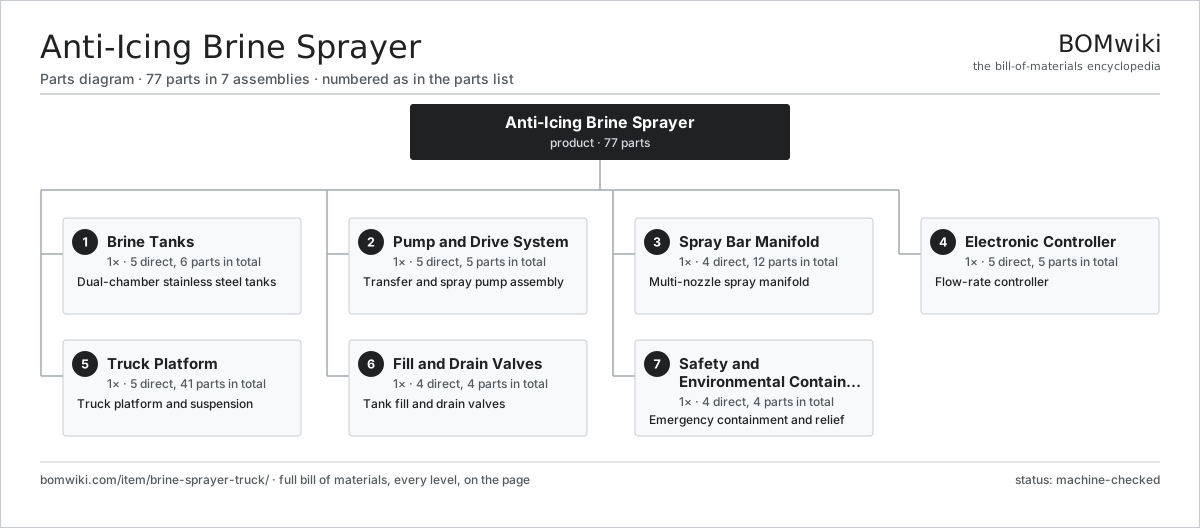
| # | Part | Qty | What it does |
|---|---|---|---|
| 1 | Brine Tanks 5 parts | 1× | Dual-chamber stainless steel tanks |
| 2 | Pump and Drive System 5 parts | 1× | Transfer and spray pump assembly |
| 3 | Spray Bar Manifold 4 parts | 1× | Multi-nozzle spray manifold |
| 4 | Electronic Controller 5 parts | 1× | Flow-rate controller |
| 5 | Truck Platform 5 parts | 1× | Truck platform and suspension |
| 6 | Fill and Drain Valves 4 parts | 1× | Tank fill and drain valves |
| 7 | Safety and Environmental Containment 4 parts | 1× | Emergency containment and relief |
3D model
No 3D model yet. Have a CAD file of this? Add a 3D model — STL renders right on this page; STEP, FreeCAD, and OpenSCAD sources are welcome too (openly licensed, like all 3D models on BOMwiki).
Build & assembly graph
expand / collapse · shared sub-assemblies converge · links to related products · est. labourTap an assembly to expand/collapse · tap a part to open it · use “Open page” for any node · drag to pan, scroll to zoom.
Bill of materials for Anti-Icing Brine Sprayer
7 top-level lines · 44 rows shown · 77 parts total · indented to 3 levels| # | Item / sub-assembly | Part no. | Qty/assy | Ext. qty | Parts | Type |
|---|---|---|---|---|---|---|
| 1 | Brine Tanks 5 parts | brine-sprayer-truck-tanks | 1× | 1 | 6 | assembly |
| 1.1 | Tank Shell | brine-sprayer-truck-tank-shell | 1× | 1 | · | part |
| 1.2 | Slosh Baffle | brine-sprayer-truck-tank-baffle | 1× | 1 | · | part |
| 1.3 | Access Hatch | brine-sprayer-truck-tank-access | 1× | 1 | · | part |
| 1.4 | Level Gauge | brine-sprayer-truck-tank-gauge | 2× | 2 | · | part |
| 1.5 | Tank Brackets | brine-sprayer-truck-tank-supports | 1× | 1 | · | part |
| 2 | Pump and Drive System 5 parts | brine-sprayer-truck-pump-system | 1× | 1 | 5 | assembly |
| 2.1 | Transfer Pump | brine-sprayer-truck-transfer-pump | 1× | 1 | · | part |
| 2.2 | Drive Motor | brine-sprayer-truck-electric-motor | 1× | 1 | · | part |
| 2.3 | Suction Line | brine-sprayer-truck-suction-hose | 1× | 1 | · | part |
| 2.4 | Discharge Line | brine-sprayer-truck-pressure-line | 1× | 1 | · | part |
| 2.5 | Relief Valve | brine-sprayer-truck-relief-valve | 1× | 1 | · | part |
| 3 | Spray Bar Manifold 4 parts | brine-sprayer-truck-spray-bar | 1× | 1 | 12 | assembly |
| 3.1 | Boom Tube | brine-sprayer-truck-boom-tube | 1× | 1 | · | part |
| 3.2 | Spray Nozzle | brine-sprayer-truck-nozzle | 8× | 8 | · | part |
| 3.3 | Manifold Block | brine-sprayer-truck-manifold-block | 1× | 1 | · | part |
| 3.4 | Boom Mount | brine-sprayer-truck-boom-bracket | 2× | 2 | · | part |
| 4 | Electronic Controller 5 parts | brine-sprayer-truck-control-unit | 1× | 1 | 5 | assembly |
| 4.1 | Controller PCB | brine-sprayer-truck-controller-board | 1× | 1 | · | part |
| 4.2 | Speed Sensor | brine-sprayer-truck-speed-input | 1× | 1 | · | part |
| 4.3 | Motor Drive | brine-sprayer-truck-motor-drive | 1× | 1 | · | part |
| 4.4 | Flow Meter | brine-sprayer-truck-flow-meter | 1× | 1 | · | part |
| 4.5 | Display Unit | brine-sprayer-truck-display | 1× | 1 | · | part |
| 5 | Truck Platform 5 parts | brine-sprayer-truck-chassis | 1× | 1 | 41 | assembly |
| 5.1 | Frame Structure | brine-sprayer-truck-frame | 1× | 1 | · | part |
| 5.2 | Suspension System | brine-sprayer-truck-suspension | 1× | 1 | · | part |
| 5.3 | Wheel Assembly 5 parts | wheel-assembly | 4× | 4 | 9 | assembly |
| 5.3.1 | Alloy Wheel | alloy-wheel | 1× | 4 | · | part |
| 5.3.2 | Tire | tire | 1× | 4 | · | part |
| 5.3.3 | TPMS Sensor | tpms-sensor | 1× | 4 | · | part |
| 5.3.4 | Lug Nut | lug-nut | 5× | 20 | · | part |
| 5.3.5 | Valve Stem | valve-stem | 1× | 4 | · | part |
| 5.4 | 12 V Battery | lv-battery | 2× | 2 | · | part |
| 5.5 | Radiator | radiator | 1× | 1 | · | part |
| 6 | Fill and Drain Valves 4 parts | brine-sprayer-truck-fill-system | 1× | 1 | 4 | assembly |
| 6.1 | Fill Cap | brine-sprayer-truck-fill-cap | 1× | 1 | · | part |
| 6.2 | Drain Valve | brine-sprayer-truck-drain-valve | 1× | 1 | · | part |
| 6.3 | Air Vent | brine-sprayer-truck-air-vent | 1× | 1 | · | part |
| 6.4 | Strainer Basket | brine-sprayer-truck-strainer-basket | 1× | 1 | · | part |
| 7 | Safety and Environmental Containment 4 parts | brine-sprayer-truck-safety | 1× | 1 | 4 | assembly |
| 7.1 | Drip Pan | brine-sprayer-truck-drip-pan | 1× | 1 | · | part |
| 7.2 | Pressure Relief | brine-sprayer-truck-pressure-relief | 1× | 1 | · | part |
| 7.3 | Emergency Stop | brine-sprayer-truck-emergency-stop | 1× | 1 | · | part |
| 7.4 | Warning Placard | brine-sprayer-truck-warning-placard | 1× | 1 | · | part |
Related products
same domain, ranked by shared parts Articulating Boom Lift
189 parts · shares 8 with this page
Articulating Boom Lift
189 parts · shares 8 with this page
 Backhoe Loader
278 parts · shares 8 with this page
Backhoe Loader
278 parts · shares 8 with this page
 Concrete Mixer Truck
286 parts · shares 8 with this page
Concrete Mixer Truck
286 parts · shares 8 with this page
 Concrete Pump Truck
282 parts · shares 8 with this page
Concrete Pump Truck
282 parts · shares 8 with this page
 Dump Truck
331 parts · shares 8 with this page
Dump Truck
331 parts · shares 8 with this page
 Motor Grader
224 parts · shares 8 with this page
Motor Grader
224 parts · shares 8 with this page
Sourcing: possible vendors
Prices, MOQ, and lead times are algorithmic estimates, not quotes, and not claims about these companies. Company mappings are curated by keyword; est. price band $15k–$2M. How estimates work| Vendor | HQ | Specialty | MOQ | Lead time |
|---|---|---|---|---|
| caterpillar.com ↗ | Irving, US | Construction & mining equipment | made to order | 16–28 wks |
|
🇯🇵Komatsu
komatsu.com ↗
|
Tokyo, JP | Construction & mining equipment | made to order | 16–28 wks |
|
🇸🇪Volvo CE
volvoce.com ↗
|
Gothenburg, SE | Construction equipment | made to order | 16–28 wks |
|
🇨🇭Liebherr
liebherr.com ↗
|
Bulle, CH | Cranes & heavy equipment | made to order | 16–28 wks |
|
🇨🇳XCMG
xcmg.com ↗
|
Xuzhou, CN | Construction machinery | made to order | 16–28 wks |
1,329-word article