Cold In-Place Recycling Train
ProductOverview
A cold in-place recycling train rebuilds a worn road using the road itself as the raw material, without trucking it away or heating it. A line of machines moves together: the lead machine grinds up the existing pavement, a tanker meters in water and binder, a mixer blends them, a paver lays the result back down, and a roller compacts it. The whole reclaimed layer is produced and placed in a single pass at ambient temperature, which is where the word cold comes from. Because no material leaves the site and nothing is heated, the method is cheaper and lower in energy and emissions than digging out and replacing a road, and it suits long rural rehabilitation work where hauling distances are large.
The train is the Milling Machine cutting the road, the Additive Tanker supplying additives, the Mixing Pugmill mixing, the Placement Paver placing the mat, and the Compaction Roller compacting it, all tied together by the Train Control Link.
Milling the existing road
The Milling Machine does the heavy work. Its Cutter Drum is studded with rows of Carbide Pick teeth, each a tungsten-carbide tip held in a Pick Holder so it can rotate and self-sharpen as it cuts. The drum grinds the bound pavement into loose granulate and flighting moves the cuttings toward a Collecting Conveyor. The machine rides on Crawler Track crawlers over the rough cut, is powered by a Power Unit diesel and hydraulic unit, and holds its cut with a Levelling System system. That system uses a Grade Sensor for depth and a Slope Sensor for cross slope, trimming the side legs through Levelling Valve units so the recycled layer comes out to grade.
Adding water and binder
Loose granulate has no binder left to hold it, so the Additive Tanker adds it back. It carries a Water Tank for compaction moisture and a Emulsion Tank of bitumen emulsion, each fed by a Dosing Pump that meters in proportion to material throughput so the recipe holds at any speed. For some jobs the train uses foamed bitumen instead, produced by the Foaming Unit: water injected into hot bitumen flashes to steam in an Expansion Chamber and blows the binder into a foam that coats the cold aggregate, sprayed through Foam Nozzle jets. Foam lets hot bitumen wet cold stone, which a plain liquid binder cannot do well.
Mixing into a uniform base
The Mixing Pugmill blends granulate, water, and binder into one material. Two counter-rotating Mixing Shaft units carry many Mixing Paddle blades that fold the binder through the aggregate inside a wear-lined Mixing Trough, driven by the Mixer Drive. Twin shafts turning against each other give the intense, short-residence mixing needed to coat every particle before the mix moves on to the paver. The result is a recycled base course with fresh binder distributed evenly through old aggregate.
Placing and compacting
The Placement Paver lays the mix back across the lane. A Paver Hopper buffers it, Spreading Auger augers spread it across the width, and a Screed strikes it off to a smooth mat using a Screed Plate and Screed Vibrator units, with mat thickness set by the Tow-Point Cylinder tow points. Finally the Compaction Roller follows with vibratory Roller Drum drums driven by Eccentric Shaft shafts to bring the layer to target density, kept clean by a Drum Water Spray.
Synchronising the train
The train only works if every machine moves at the matched speed, because the milling rate sets how much material the mixer and paver must handle. The Train Control Link manages this. A Master Controller reads each machines Ground-Speed Sensor and trims their drives so the train advances as one unit, keeping the dosing in step with the milling rate. In service the train moves at several metres per minute, and behind it a finished recycled base is left ready to cure and, after a wearing course is added, carry traffic. The method depends on getting the binder type, moisture, and compaction right for the old material, so field testing of the milled granulate drives the recipe the Additive Tanker doses.
Curing and limitations
A cold recycled layer is not finished the moment it is rolled. Because it is built at ambient temperature with an emulsion or foamed binder, it needs time to cure as the water leaves and the binder gains strength, which can take days to weeks depending on weather. During this period light traffic can usually run on it, but the wearing course is held off until the layer has cured enough, so timing the job around the forecast matters. The method also depends on the existing road having enough sound material to recycle: if the old pavement is too thin, too wet, or contaminated, cold recycling may not produce a strong enough base and a full reconstruction is needed instead. Where the road suits it, treating the whole damaged layer in one pass and reusing all of its material is what makes cold in-place recycling so much cheaper than digging out and hauling in replacement, and the synchronised train is what lets the work proceed continuously at a steady rate rather than in slow stop-start stages.
Cold In-Place Recycling Train parts and their functions
6 top-level parts · 657 parts in total · full bill of materials below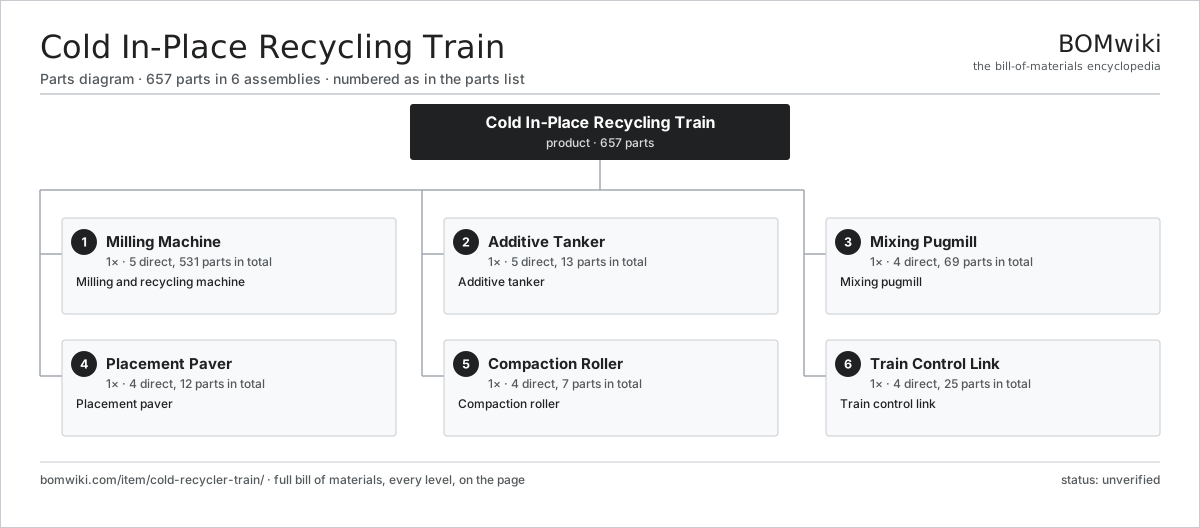
| # | Part | Qty | What it does |
|---|---|---|---|
| 1 | Milling Machine 5 parts | 1× | Milling and recycling machine |
| 2 | Additive Tanker 5 parts | 1× | Additive tanker |
| 3 | Mixing Pugmill 4 parts | 1× | Mixing pugmill |
| 4 | Placement Paver 4 parts | 1× | Placement paver |
| 5 | Compaction Roller 4 parts | 1× | Compaction roller |
| 6 | Train Control Link 4 parts | 1× | Train control link |
3D model
No 3D model yet. Have a CAD file of this? Add a 3D model — STL renders right on this page; STEP, FreeCAD, and OpenSCAD sources are welcome too (openly licensed, like all 3D models on BOMwiki).
Build & assembly graph
expand / collapse · shared sub-assemblies converge · links to related products · est. labourTap an assembly to expand/collapse · tap a part to open it · use “Open page” for any node · drag to pan, scroll to zoom.
Bill of materials for Cold In-Place Recycling Train
6 top-level lines · 64 rows shown · 657 parts total · indented to 3 levels| # | Item / sub-assembly | Part no. | Qty/assy | Ext. qty | Parts | Type |
|---|---|---|---|---|---|---|
| 1 | Milling Machine 5 parts | cold-recycler-train-milling-unit | 1× | 1 | 531 | assembly |
| 1.1 | Cutter Drum 4 parts | cold-recycler-train-cutter-drum | 1× | 1 | 323 | assembly |
| 1.1.1 | Carbide Pick | cold-recycler-train-pick | 160× | 160 | · | part |
| 1.1.2 | Pick Holder | cold-recycler-train-pick-holder | 160× | 160 | · | part |
| 1.1.3 | Drum Body | cold-recycler-train-drum-body | 1× | 1 | · | part |
| 1.1.4 | Ball Bearing | ball-bearing | 2× | 2 | · | part |
| 1.2 | Crawler Track 3 parts | cold-recycler-train-tracks | 4× | 4 | 45 | assembly |
| 1.2.1 | Track Pad | cold-recycler-train-track-pad | 40× | 160 | · | part |
| 1.2.2 | Track Drive Motor | cold-recycler-train-track-motor | 1× | 4 | · | part |
| 1.2.3 | Ball Bearing | ball-bearing | 4× | 16 | · | part |
| 1.3 | Power Unit 3 parts | cold-recycler-train-engine | 1× | 1 | 4 | assembly |
| 1.3.1 | Diesel Engine | cold-recycler-train-diesel | 1× | 1 | · | part |
| 1.3.2 | Hydraulic Pump | cold-recycler-train-hyd-pump | 2× | 2 | · | part |
| 1.3.3 | Radiator | cold-recycler-train-radiator | 1× | 1 | · | part |
| 1.4 | Levelling System 3 parts | cold-recycler-train-leveling | 1× | 1 | 5 | assembly |
| 1.4.1 | Grade Sensor | cold-recycler-train-grade-sensor | 2× | 2 | · | part |
| 1.4.2 | Slope Sensor | cold-recycler-train-slope-sensor | 1× | 1 | · | part |
| 1.4.3 | Levelling Valve | cold-recycler-train-level-valve | 2× | 2 | · | part |
| 1.5 | Collecting Conveyor 3 parts | cold-recycler-train-collect-conveyor | 1× | 1 | 19 | assembly |
| 1.5.1 | Drive Belt | drive-belt | 1× | 1 | · | part |
| 1.5.2 | Conveyor Roller | cold-recycler-train-conveyor-roller | 8× | 8 | · | part |
| 1.5.3 | Ball Bearing | ball-bearing | 10× | 10 | · | part |
| 2 | Additive Tanker 5 parts | cold-recycler-train-tanker | 1× | 1 | 13 | assembly |
| 2.1 | Water Tank | cold-recycler-train-water-tank | 1× | 1 | · | part |
| 2.2 | Emulsion Tank | cold-recycler-train-emulsion-tank | 1× | 1 | · | part |
| 2.3 | Dosing Pump | cold-recycler-train-dosing-pump | 3× | 3 | · | part |
| 2.4 | Foaming Unit 3 parts | cold-recycler-train-foam-unit | 1× | 1 | 7 | assembly |
| 2.4.1 | Expansion Chamber | cold-recycler-train-expansion-chamber | 1× | 1 | · | part |
| 2.4.2 | Foam Nozzle | cold-recycler-train-foam-nozzle | 4× | 4 | · | part |
| 2.4.3 | Pressure Sensor | pressure-sensor | 2× | 2 | · | part |
| 2.5 | Tanker Chassis | cold-recycler-train-tanker-chassis | 1× | 1 | · | part |
| 3 | Mixing Pugmill 4 parts | cold-recycler-train-pugmill | 1× | 1 | 69 | assembly |
| 3.1 | Mixing Shaft | cold-recycler-train-mix-shaft | 2× | 2 | · | part |
| 3.2 | Mixing Paddle | cold-recycler-train-paddle | 32× | 32 | · | part |
| 3.3 | Mixing Trough | cold-recycler-train-mix-trough | 1× | 1 | · | part |
| 3.4 | Mixer Drive 3 parts | cold-recycler-train-mix-drive | 1× | 1 | 34 | assembly |
| 3.4.1 | Servo Motor 4 parts + deeper › | servo-motor | 1× | 1 | 24 | assembly |
| 3.4.2 | Helical Gearbox 4 parts + deeper › | gearbox | 1× | 1 | 9 | assembly |
| 3.4.3 | Helical Gear Pair | gear-pair | 1× | 1 | · | part |
| 4 | Placement Paver 4 parts | cold-recycler-train-paver | 1× | 1 | 12 | assembly |
| 4.1 | Screed 3 parts | cold-recycler-train-screed | 1× | 1 | 7 | assembly |
| 4.1.1 | Screed Plate | cold-recycler-train-screed-plate | 1× | 1 | · | part |
| 4.1.2 | Heating Element | heating-element | 4× | 4 | · | part |
| 4.1.3 | Screed Vibrator | cold-recycler-train-vibrator | 2× | 2 | · | part |
| 4.2 | Spreading Auger | cold-recycler-train-auger | 2× | 2 | · | part |
| 4.3 | Paver Hopper | cold-recycler-train-hopper | 1× | 1 | · | part |
| 4.4 | Tow-Point Cylinder | cold-recycler-train-tow-cylinder | 2× | 2 | · | part |
| 5 | Compaction Roller 4 parts | cold-recycler-train-roller | 1× | 1 | 7 | assembly |
| 5.1 | Roller Drum | cold-recycler-train-roller-drum | 2× | 2 | · | part |
| 5.2 | Eccentric Shaft | cold-recycler-train-eccentric | 2× | 2 | · | part |
| 5.3 | Roller Power Unit 2 parts | cold-recycler-train-roller-engine | 1× | 1 | 2 | assembly |
| 5.3.1 | Diesel Engine | cold-recycler-train-diesel | 1× | 1 | · | part |
| 5.3.2 | Hydraulic Pump | cold-recycler-train-hyd-pump | 1× | 1 | · | part |
| 5.4 | Drum Water Spray | cold-recycler-train-water-spray | 1× | 1 | · | part |
| 6 | Train Control Link 4 parts | cold-recycler-train-control-link | 1× | 1 | 25 | assembly |
| 6.1 | Master Controller 5 parts | cold-recycler-train-master-plc | 1× | 1 | 19 | assembly |
| 6.1.1 | Bare PCB | pcb-bare | 1× | 1 | · | part |
| 6.1.2 | Microcontroller | mcu | 1× | 1 | · | part |
| 6.1.3 | Relay | relay | 4× | 4 | · | part |
| 6.1.4 | SMD Passive (R/C/L) | smd-passives | 1× | 1 | · | part |
| 6.1.5 | Connector | connector | 12× | 12 | · | part |
| 6.2 | Ground-Speed Sensor | cold-recycler-train-speed-sensor | 4× | 4 | · | part |
| 6.3 | Power Supply | power-supply | 1× | 1 | · | part |
| 6.4 | Wire Bundle | wire-bundle | 1× | 1 | · | part |
Related products
same domain, ranked by shared parts Asphalt Recycler
226 parts · shares 24 with this page
Asphalt Recycler
226 parts · shares 24 with this page
 Gravel Road Grader
181 parts · shares 16 with this page
Gravel Road Grader
181 parts · shares 16 with this page
 Tandem Vibratory Roller
369 parts · shares 22 with this page
Tandem Vibratory Roller
369 parts · shares 22 with this page
 Flat-Top Tower Crane
358 parts · shares 22 with this page
Flat-Top Tower Crane
358 parts · shares 22 with this page
 Tracked Asphalt Paver
1,299 parts · shares 22 with this page
Tracked Asphalt Paver
1,299 parts · shares 22 with this page
 Bridge Girder Launching Gantry
1,542 parts · shares 21 with this page
Bridge Girder Launching Gantry
1,542 parts · shares 21 with this page
Sourcing: possible vendors
Prices, MOQ, and lead times are algorithmic estimates, not quotes, and not claims about these companies. Company mappings are curated by keyword; est. price band $15k–$2M. How estimates work| Vendor | HQ | Specialty | MOQ | Lead time |
|---|---|---|---|---|
| caterpillar.com ↗ | Irving, US | Construction & mining equipment | made to order | 16–28 wks |
|
🇯🇵Komatsu
komatsu.com ↗
|
Tokyo, JP | Construction & mining equipment | made to order | 16–28 wks |
|
🇸🇪Volvo CE
volvoce.com ↗
|
Gothenburg, SE | Construction equipment | made to order | 16–28 wks |
|
🇨🇭Liebherr
liebherr.com ↗
|
Bulle, CH | Cranes & heavy equipment | made to order | 16–28 wks |
|
🇨🇳XCMG
xcmg.com ↗
|
Xuzhou, CN | Construction machinery | made to order | 16–28 wks |
981-word article