Industrial Coffee Roaster
ProductOverview
An industrial coffee roaster turns green coffee beans into the brown, aromatic beans that get ground and brewed. Roasting is a controlled cook: the beans are heated for several minutes while they are tumbled through hot air, so they dry, swell, change color, and develop the hundreds of flavor compounds that green beans do not have. A drum roaster does this in batches. A weighed charge of green beans is dropped into a hot rotating drum, held on a heat curve for eight to sixteen minutes, dumped while still hot, and cooled fast so the roast stops at the target. The machine has to give the roaster fine control over heat and time, because the difference between a light and a dark roast, or between a good and a scorched batch, is a matter of a few degrees and a few seconds.
The machine is organized around the Roast Drum, heated by the Burner System and ventilated by the Airflow System. Green beans are weighed and charged by the Green Bean Feed, the roasted batch is quenched in the Cooling Tray, chaff and stones are pulled out by the Destoner and Cyclone, the drum is turned by the Drive System, and the whole roast curve is run from the Control Cabinet.
Charging the green beans
Every roast starts with an exact weight of green beans, because batch size sets how much heat the charge can absorb and how the curve behaves. Green beans sit in the Green Bean Hopper and are metered by the Feed Auger into the Batch Weigh Bin, a suspended bin resting on three Load Cell sensors. When the target mass is reached, the Charge Gate opens and the beans drop into the already-hot drum. The drum is pre-heated before charging so the beans hit a hot surface and hot air at once; the temperature drop when cold green beans enter is called the turning point, and the roaster watches it closely because it tells whether the charge mass and starting heat were right.
Inside the roast drum
The Roast Drum is a Drum Shell of perforated stainless that turns at 30 to 60 rpm on the Drum Shaft, carried by a Drum Bearing Housing at each end with Ball Bearing sets and an Oil Seal to keep heat off the bearings. Inside, several Tumbling Vane flights lift the bean bed and fold it over on every turn, so no bean sits against the hot shell long enough to scorch and every bean sees the same average heat. The perforations let hot air pass through the bed, which is what carries most of the heat into the beans. The roaster watches progress through the Drum Front Door sight glass and pulls samples with the Bean Trier, a sliding scoop that grabs a few beans without stopping the roast, to judge color and smell. When the batch is done, the Dump Door opens and the whole charge falls into the cooling tray.
Heat and airflow
Heat comes from the Burner System. A Gas Burner fires into the refractory-lined Combustion Box, and the heat is regulated by the Modulating Gas Valve, which varies gas flow continuously so the operator can raise, hold or ease the heat at any point in the curve. The burner is lit by the Ignition Rod and watched by the Flame Sensor, which trips the Gas Safety Valve if the flame ever fails. Heat is useless without air to move it, so the Airflow System runs a Draft Fan that pulls hot gas through the drum and out the Exhaust Duct. The Airflow Damper lets the roaster set airflow separately from burner output, which is a second lever on how fast heat reaches the beans. Several Temperature Thermocouple probes read the bean mass and the air, and those two curves are what the operator and the controller steer by. Around 196 to 205 C in the bean mass the beans pop audibly, the event called first crack, which marks the start of the developed roast.
Cooling and cleaning the batch
Roasting does not stop the instant the beans leave the drum, because a hot bean keeps cooking from its own stored heat. The Cooling Tray kills that residual heat fast. The dumped beans land on the perforated Cooling Pan while the Cooling Fan pulls ambient air up through the bed, and the Stirring Arm rakes the beans so they cool evenly and do not bake on the hot pan. Within three to four minutes the batch is near room temperature and the roast is locked. The cooled beans pass out through the Cooling Discharge Gate to the Destoner and Cyclone, where the Cyclone Body spins chaff and dust out of the air into the sealed Chaff Collector, and the Destoner Column floats the beans on a rising air stream so denser Stone Trap material falls out. Keeping chaff in a sealed Rotary Airlock collector matters, because loose chaff near the burner is a fire risk.
Drive, control and roast profiles
The drum is turned by the Drum Drive Motor through a Gearbox Housing and Helical Gear Pair, with a Drum Speed Encoder holding tumbling speed steady so the bed behaves the same batch to batch. The whole roast is run from the PLC Module, which logs the air and bean curves against time and lets the operator save a recipe so a good roast can be repeated. The LCD Panel shows the live curves and the Variable Frequency Drive trims drum and fan speed. A profile is the record of gas, airflow and time that produced a given cup, and the value of a controlled machine is that the same profile gives the same roast next week, which is what a buyer pays for when they ask for consistent beans batch after batch.
Industrial Coffee Roaster parts and their functions
8 top-level parts · 188 parts in total · full bill of materials below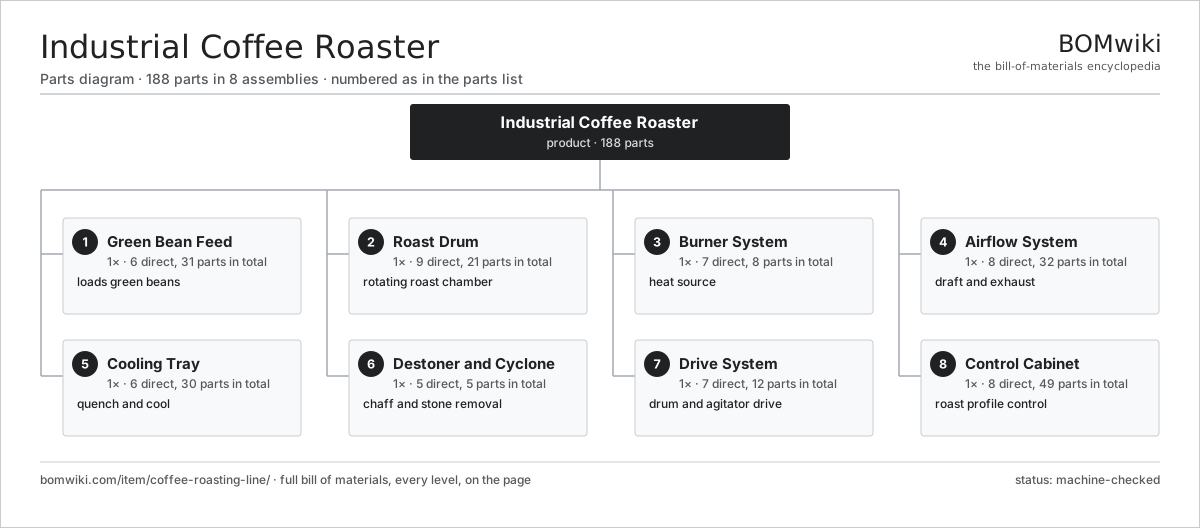
| # | Part | Qty | What it does |
|---|---|---|---|
| 1 | Green Bean Feed 6 parts | 1× | loads green beans |
| 2 | Roast Drum 9 parts | 1× | rotating roast chamber |
| 3 | Burner System 7 parts | 1× | heat source |
| 4 | Airflow System 8 parts | 1× | draft and exhaust |
| 5 | Cooling Tray 6 parts | 1× | quench and cool |
| 6 | Destoner and Cyclone 5 parts | 1× | chaff and stone removal |
| 7 | Drive System 7 parts | 1× | drum and agitator drive |
| 8 | Control Cabinet 8 parts | 1× | roast profile control |
3D model
No 3D model yet. Have a CAD file of this? Add a 3D model — STL renders right on this page; STEP, FreeCAD, and OpenSCAD sources are welcome too (openly licensed, like all 3D models on BOMwiki).
Build & assembly graph
expand / collapse · shared sub-assemblies converge · links to related products · est. labourTap an assembly to expand/collapse · tap a part to open it · use “Open page” for any node · drag to pan, scroll to zoom.
Bill of materials for Industrial Coffee Roaster
8 top-level lines · 84 rows shown · 188 parts total · indented to 3 levels| # | Item / sub-assembly | Part no. | Qty/assy | Ext. qty | Parts | Type |
|---|---|---|---|---|---|---|
| 1 | Green Bean Feed 6 parts | coffee-roasting-line-green-feed | 1× | 1 | 31 | assembly |
| 1.1 | Green Bean Hopper | coffee-roasting-line-green-hopper | 1× | 1 | · | part |
| 1.2 | Batch Weigh Bin | coffee-roasting-line-batch-scale | 1× | 1 | · | part |
| 1.3 | Charge Gate | coffee-roasting-line-charge-gate | 1× | 1 | · | part |
| 1.4 | Feed Auger | coffee-roasting-line-feed-auger | 1× | 1 | · | part |
| 1.5 | Servo Motor 4 parts | servo-motor | 1× | 1 | 24 | assembly |
| 1.5.1 | Stator Assembly 3 parts + deeper › | stator-assembly | 1× | 1 | 3 | assembly |
| 1.5.2 | Rotor Assembly 4 parts + deeper › | rotor-assembly | 1× | 1 | 19 | assembly |
| 1.5.3 | Encoder | encoder | 1× | 1 | · | part |
| 1.5.4 | Motor Housing | motor-housing | 1× | 1 | · | part |
| 1.6 | Load Cell | coffee-roasting-line-load-cell | 3× | 3 | · | part |
| 2 | Roast Drum 9 parts | coffee-roasting-line-roast-drum | 1× | 1 | 21 | assembly |
| 2.1 | Drum Shell | coffee-roasting-line-drum-shell | 1× | 1 | · | part |
| 2.2 | Tumbling Vane | coffee-roasting-line-drum-vane | 8× | 8 | · | part |
| 2.3 | Drum Shaft | coffee-roasting-line-drum-shaft | 1× | 1 | · | part |
| 2.4 | Drum Bearing Housing | coffee-roasting-line-drum-bearing-housing | 2× | 2 | · | part |
| 2.5 | Ball Bearing | ball-bearing | 4× | 4 | · | part |
| 2.6 | Oil Seal | oil-seal | 2× | 2 | · | part |
| 2.7 | Drum Front Door | coffee-roasting-line-front-door | 1× | 1 | · | part |
| 2.8 | Bean Trier | coffee-roasting-line-trier | 1× | 1 | · | part |
| 2.9 | Dump Door | coffee-roasting-line-dump-door | 1× | 1 | · | part |
| 3 | Burner System 7 parts | coffee-roasting-line-burner-system | 1× | 1 | 8 | assembly |
| 3.1 | Gas Burner | coffee-roasting-line-gas-burner | 1× | 1 | · | part |
| 3.2 | Modulating Gas Valve | coffee-roasting-line-modulating-valve | 1× | 1 | · | part |
| 3.3 | Ignition Rod | coffee-roasting-line-ignition-rod | 1× | 1 | · | part |
| 3.4 | Flame Sensor | coffee-roasting-line-flame-sensor | 1× | 1 | · | part |
| 3.5 | Combustion Box | coffee-roasting-line-burner-box | 1× | 1 | · | part |
| 3.6 | Gas Safety Valve | coffee-roasting-line-safety-valve | 2× | 2 | · | part |
| 3.7 | Pressure Sensor | pressure-sensor | 1× | 1 | · | part |
| 4 | Airflow System 8 parts | coffee-roasting-line-airflow-system | 1× | 1 | 32 | assembly |
| 4.1 | Draft Fan | coffee-roasting-line-draft-fan | 1× | 1 | · | part |
| 4.2 | Airflow Damper | coffee-roasting-line-damper | 2× | 2 | · | part |
| 4.3 | Exhaust Duct | coffee-roasting-line-exhaust-duct | 1× | 1 | · | part |
| 4.4 | Fan Motor | coffee-roasting-line-fan-motor | 1× | 1 | · | part |
| 4.5 | Stator Assembly 3 parts | stator-assembly | 1× | 1 | 3 | assembly |
| 4.5.1 | Stator Core (laminations) | stator-core | 1× | 1 | · | part |
| 4.5.2 | Copper Winding | copper-winding | 1× | 1 | · | part |
| 4.5.3 | Slot Insulation | stator-insulation | 1× | 1 | · | part |
| 4.6 | Rotor Assembly 4 parts | rotor-assembly | 1× | 1 | 19 | assembly |
| 4.6.1 | Rotor Shaft | rotor-shaft | 1× | 1 | · | part |
| 4.6.2 | Rotor Core | rotor-core | 1× | 1 | · | part |
| 4.6.3 | Neodymium Magnet | neodymium-magnet | 16× | 16 | · | part |
| 4.6.4 | Ball Bearing | ball-bearing | 1× | 1 | · | part |
| 4.7 | Ball Bearing | ball-bearing | 2× | 2 | · | part |
| 4.8 | Temperature Thermocouple | coffee-roasting-line-temp-thermocouple | 3× | 3 | · | part |
| 5 | Cooling Tray 6 parts | coffee-roasting-line-cooling-tray | 1× | 1 | 30 | assembly |
| 5.1 | Cooling Pan | coffee-roasting-line-cooling-pan | 1× | 1 | · | part |
| 5.2 | Stirring Arm | coffee-roasting-line-stirring-arm | 2× | 2 | · | part |
| 5.3 | Cooling Fan | coffee-roasting-line-cooling-fan | 1× | 1 | · | part |
| 5.4 | Cooling Discharge Gate | coffee-roasting-line-cool-discharge-gate | 1× | 1 | · | part |
| 5.5 | Servo Motor 4 parts | servo-motor | 1× | 1 | 24 | assembly |
| 5.5.1 | Stator Assembly 3 parts + deeper › | stator-assembly | 1× | 1 | 3 | assembly |
| 5.5.2 | Rotor Assembly 4 parts + deeper › | rotor-assembly | 1× | 1 | 19 | assembly |
| 5.5.3 | Encoder | encoder | 1× | 1 | · | part |
| 5.5.4 | Motor Housing | motor-housing | 1× | 1 | · | part |
| 5.6 | Helical Gear Pair | gear-pair | 1× | 1 | · | part |
| 6 | Destoner and Cyclone 5 parts | coffee-roasting-line-destoner-cyclone | 1× | 1 | 5 | assembly |
| 6.1 | Cyclone Body | coffee-roasting-line-cyclone-body | 1× | 1 | · | part |
| 6.2 | Chaff Collector | coffee-roasting-line-chaff-collector | 1× | 1 | · | part |
| 6.3 | Destoner Column | coffee-roasting-line-destoner-column | 1× | 1 | · | part |
| 6.4 | Rotary Airlock | coffee-roasting-line-airlock-valve | 1× | 1 | · | part |
| 6.5 | Stone Trap | coffee-roasting-line-stone-trap | 1× | 1 | · | part |
| 7 | Drive System 7 parts | coffee-roasting-line-drive-system | 1× | 1 | 12 | assembly |
| 7.1 | Drum Drive Motor | coffee-roasting-line-drum-motor | 1× | 1 | · | part |
| 7.2 | Gearbox Housing | gearbox-housing | 1× | 1 | · | part |
| 7.3 | Helical Gear Pair | gear-pair | 2× | 2 | · | part |
| 7.4 | Drive Belt | drive-belt | 1× | 1 | · | part |
| 7.5 | Ball Bearing | ball-bearing | 4× | 4 | · | part |
| 7.6 | Oil Seal | oil-seal | 2× | 2 | · | part |
| 7.7 | Drum Speed Encoder | coffee-roasting-line-speed-encoder | 1× | 1 | · | part |
| 8 | Control Cabinet 8 parts | coffee-roasting-line-control-cabinet | 1× | 1 | 49 | assembly |
| 8.1 | PLC Module 3 parts | coffee-roasting-line-plc | 1× | 1 | · | part |
| 8.1.1 | Bare PCB | pcb-bare | 1× | 1 | · | part |
| 8.1.2 | Microcontroller | mcu | 1× | 1 | · | part |
| 8.1.3 | SMD Passive (R/C/L) | smd-passives | 1× | 1 | · | part |
| 8.2 | LCD Panel | lcd-panel | 1× | 1 | · | part |
| 8.3 | Power Supply | power-supply | 1× | 1 | · | part |
| 8.4 | Relay | relay | 10× | 10 | · | part |
| 8.5 | Connector | connector | 28× | 28 | · | part |
| 8.6 | Wire Bundle | wire-bundle | 1× | 1 | · | part |
| 8.7 | Variable Frequency Drive 2 parts | coffee-roasting-line-vfd | 2× | 2 | · | part |
| 8.7.1 | Bare PCB | pcb-bare | 1× | 2 | · | part |
| 8.7.2 | SMD Passive (R/C/L) | smd-passives | 1× | 2 | · | part |
| 8.8 | Fastener Set | fastener-set | 1× | 1 | · | part |
Related products
same domain, ranked by shared parts Bottle Washing Machine
2,388 parts · shares 23 with this page
Brine Chilling System
239 parts · shares 23 with this page
Egg Breaking and Separating Line
1,126 parts · shares 23 with this page
Bottle Washing Machine
2,388 parts · shares 23 with this page
Brine Chilling System
239 parts · shares 23 with this page
Egg Breaking and Separating Line
1,126 parts · shares 23 with this page
 Flour Milling Plant
2,774 parts · shares 23 with this page
Fruit Grading Line
3,765 parts · shares 23 with this page
Flour Milling Plant
2,774 parts · shares 23 with this page
Fruit Grading Line
3,765 parts · shares 23 with this page
 Hydrostatic Sterilizer
9,247 parts · shares 23 with this page
Hydrostatic Sterilizer
9,247 parts · shares 23 with this page
Sourcing: possible vendors
Prices, MOQ, and lead times are algorithmic estimates, not quotes, and not claims about these companies. Company mappings are curated by keyword; est. price band $1k–$500k. How estimates work| Vendor | HQ | Specialty | MOQ | Lead time |
|---|---|---|---|---|
| gea.com ↗ | Düsseldorf, DE | Process technology | 20 units | 12–20 wks |
| buhlergroup.com ↗ | Uzwil, CH | Food & materials processing | 20 units | 12–20 wks |
| tetrapak.com ↗ | Pully, CH | Food packaging & processing | 20 units | 12–20 wks |
| jbtc.com ↗ | Chicago, US | Food processing equipment | 20 units | 12–20 wks |
| alfalaval.com ↗ | Lund, SE | Heat transfer & separation | 20 units | 12–20 wks |
1,100-word article