Sugar Vacuum Pan
ProductAlso known as: Vacuum Pan
Overview
A sugar vacuum pan, also called a Sugar Vacuum Pan, is the vessel where dissolved sugar is converted into solid crystals. It takes concentrated syrup from the evaporators, around 60 to 70 degrees Brix, and boils it under deep vacuum until sugar crystals grow to the target size in a thick slurry called massecuite. The pan is one of the central machines in a cane or beet sugar factory: every grain of crystal sugar that leaves the plant first formed inside a vacuum pan. The unit shown here is a batch calandria pan, the most common design, in which a Calandria Assembly tube nest provides the heating surface and a Pan Body Assembly holds the boiling charge.
Crystallization is a separation step. The syrup arriving at the pan already contains almost all of the sugar that will be recovered, but it is dissolved in water along with non-sugar impurities. Boiling off the water raises the sugar concentration until the solution is supersaturated, and the dissolved sugar then deposits onto seed crystals. The skill of pan boiling lies in growing crystals that are uniform in size and free of conglomerates, because uneven grain causes losses in the centrifugals downstream and lowers the grade of the final sugar.
Vacuum boiling principle
Sugar degrades and discolors when held hot for long periods. At atmospheric pressure a syrup would have to be boiled near 100 degrees Celsius, and at high Brix the boiling point rises further because of boiling point elevation. To avoid caramelization and color formation, the pan boils under vacuum. The Condenser and Vacuum System holds the vessel at 85 to 95 kPa below atmosphere, which drops the boiling temperature to roughly 60 to 75 degrees Celsius depending on the strike Brix.
The lower temperature protects sucrose and also lets the pan use low-grade heat. Instead of live high-pressure steam, the Steam Inlet Nozzle takes exhaust steam from the turbines or vapor bled from an evaporator effect, typically 0.4 to 1.2 bar gauge. Because that steam is condensing at around 105 to 120 degrees Celsius and the massecuite is boiling near 65 degrees Celsius, there is still a useful temperature difference to drive heat across the tubes even though both streams are mild.
Calandria and heating
The heating surface is the calandria, a short cylindrical steam chest crossed by a nest of vertical tubes. Massecuite fills the Heating Tube Bundle bundle while steam surrounds the tubes inside the Calandria Shell. The tubes are expanded and sealed into the Upper Tube Plate and the Lower Tube Plate, which together fix the heating area, commonly 150 to 600 square meters.
As syrup boils inside the tubes it becomes less dense and rises, then returns down the central Downtake Assembly to the tube inlets, setting up a natural circulation loop. Good circulation keeps every crystal moving past fresh hot surface and prevents local overheating. Condensate from the condensing steam leaves through the Condensate Outlet with a steam trap, and the Incondensable Vent continuously bleeds air and carbon dioxide that would otherwise blanket the tubes and cut the heat transfer. A Steam Baffle Plate spreads steam evenly so the whole nest heats at the same rate.
Crystallization and seeding
A strike begins by drawing syrup into the pan until it just covers the calandria, then concentrating it under vacuum until the solution is slightly supersaturated. At that point the operator introduces fine seed through the Seed Injector, usually a slurry of milled sugar in alcohol or oil. These seed grains give the dissolved sugar a surface to deposit on, so the crystals grow rather than spontaneously nucleating into a dust of fine grain.
From then on the Syrup Feed Valve meters more syrup in step with evaporation, holding the massecuite in the narrow supersaturation band where existing crystals grow but no new ones form. The Feed Distributor Ring spreads incoming syrup over the boiling surface. Operators watch the grain through the Sight Glass and draw samples with the Proof Stick. As the charge thickens toward 92 to 96 degrees Brix, natural circulation slows, so the Mechanical Circulator Assembly turns its Circulator Impeller in the downtake to keep the heavy massecuite moving. When the strike is tight, the Discharge Valve opens and drops the massecuite to a crystallizer or directly to the centrifugals.
Vacuum and condenser
The vacuum is made and held by condensing the vapor that boils off the pan. Vapor leaves through the Vapor Outlet Nozzle into the Barometric Condenser, a direct-contact vessel where cooling water sprayed from a Condenser Spray Nozzle meets the vapor and condenses it almost completely. The collapse of vapor into liquid is what pulls the vacuum.
Condensate and spent injection water drain down the Barometric Leg, a tail pipe about 10 meters tall whose water column balances atmospheric pressure so the condenser stays sealed without a discharge pump. The water collects in the Hotwell Tank. Non-condensable gases that water cannot remove are pulled out by the Vacuum Pump, typically a liquid-ring type. Before the vapor reaches the condenser it passes the Vapor Space Assembly, where a Entrainment Catchall spins out entrained syrup droplets so sugar is not lost up the vapor line, returning it through the Catchall Return Leg.
Materials
Sugar syrup is mildly corrosive and the plant runs continuously through the crushing season, so the wetted parts are stainless steel, usually 304 for the shell and 316L where chloride exposure is higher. The Shell Plate, heads and tube nest are stainless, while the Support Frame Assembly and platforms are carbon steel painted for the humid pan-floor environment. The vessel is lagged with an Insulation Jacket to hold the boiling heat. The Shaft Gland Seal sealing the rotating circulator shaft against the vacuum boundary is a wear item checked each season.
Batch and continuous variants
The pan described here is a batch pan, which boils one strike at a time and is flexible across the different syrups and molasses grades a factory handles. Larger factories also run continuous vacuum pans, long horizontal vessels divided into compartments where massecuite flows from a seeding chamber through successive growing stages and leaves steadily at strike Brix. Continuous pans give a steadier steam demand and tighter grain, while batch pans remain common for high-grade white sugar and for low-grade boilings where conditions change through the strike. Both rely on the same calandria heating, vacuum boiling and seeding principles.
Use
Vacuum pans sit at the heart of the boiling house in cane and beet sugar mills, and the same machine type crystallizes other products such as dextrose, lactose and some fine chemicals. The Control Panel Assembly runs the strike automatically, reading vacuum and steam pressure through a Pressure Sensor, tracking supersaturation with the Brix Probe and stepping feed and steam to hold the crystal growing cleanly from seeding to discharge.
Sugar Vacuum Pan parts and their functions
9 top-level parts · 112 parts in total · full bill of materials below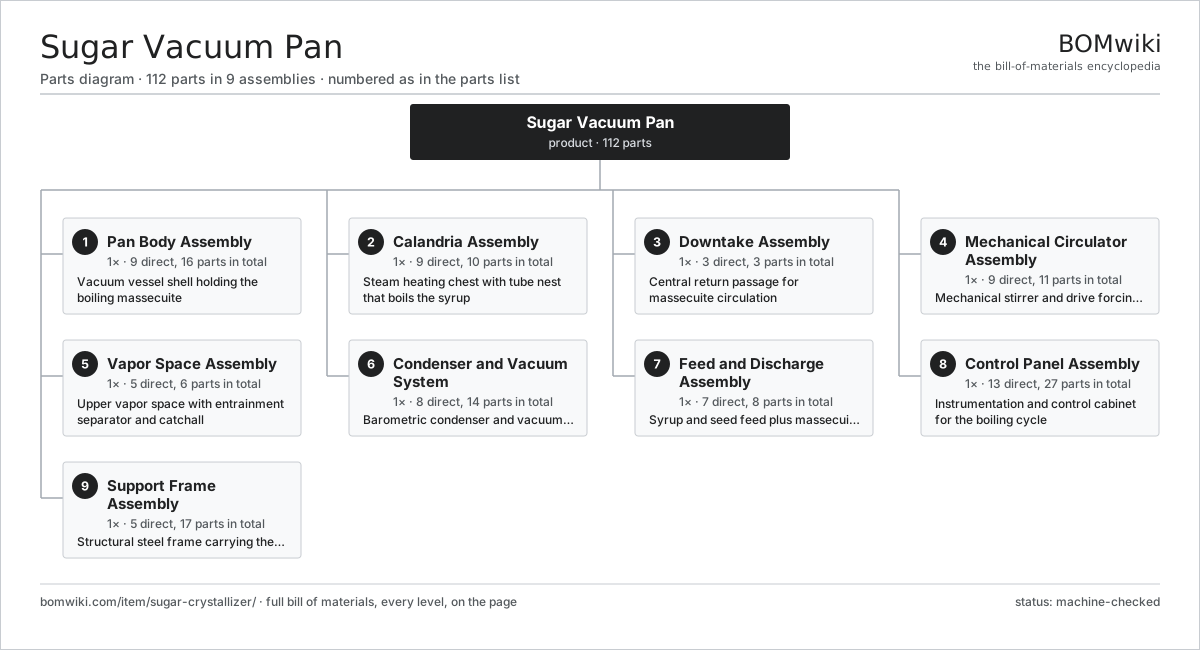
| # | Part | Qty | What it does |
|---|---|---|---|
| 1 | Pan Body Assembly 9 parts | 1× | Vacuum vessel shell holding the boiling massecuite |
| 2 | Calandria Assembly 9 parts | 1× | Steam heating chest with tube nest that boils the syrup |
| 3 | Downtake Assembly 3 parts | 1× | Central return passage for massecuite circulation |
| 4 | Mechanical Circulator Assembly 9 parts | 1× | Mechanical stirrer and drive forcing massecuite circulation |
| 5 | Vapor Space Assembly 5 parts | 1× | Upper vapor space with entrainment separator and catchall |
| 6 | Condenser and Vacuum System 8 parts | 1× | Barometric condenser and vacuum pump maintaining vacuum |
| 7 | Feed and Discharge Assembly 7 parts | 1× | Syrup and seed feed plus massecuite discharge valves |
| 8 | Control Panel Assembly 13 parts | 1× | Instrumentation and control cabinet for the boiling cycle |
| 9 | Support Frame Assembly 5 parts | 1× | Structural steel frame carrying the pan and platforms |
3D model
No 3D model yet. Have a CAD file of this? Add a 3D model — STL renders right on this page; STEP, FreeCAD, and OpenSCAD sources are welcome too (openly licensed, like all 3D models on BOMwiki).
Build & assembly graph
expand / collapse · shared sub-assemblies converge · links to related products · est. labourTap an assembly to expand/collapse · tap a part to open it · use “Open page” for any node · drag to pan, scroll to zoom.
Bill of materials for Sugar Vacuum Pan
9 top-level lines · 77 rows shown · 112 parts total · indented to 3 levels| # | Item / sub-assembly | Part no. | Qty/assy | Ext. qty | Parts | Type |
|---|---|---|---|---|---|---|
| 1 | Pan Body Assembly 9 parts | sugar-crystallizer-pan-body | 1× | 1 | 16 | assembly |
| 1.1 | Shell Plate | sugar-crystallizer-shell-plate | 1× | 1 | · | part |
| 1.2 | Dished Bottom Head | sugar-crystallizer-dished-bottom | 1× | 1 | · | part |
| 1.3 | Top Dome Head | sugar-crystallizer-top-dome | 1× | 1 | · | part |
| 1.4 | Sight Glass | sugar-crystallizer-sight-glass | 4× | 4 | · | part |
| 1.5 | Manway | sugar-crystallizer-manway | 1× | 1 | · | part |
| 1.6 | Proof Stick | sugar-crystallizer-proof-stick | 1× | 1 | · | part |
| 1.7 | Insulation Jacket | sugar-crystallizer-insulation-jacket | 1× | 1 | · | part |
| 1.8 | Fastener Set | fastener-set | 4× | 4 | · | part |
| 1.9 | O-Ring Set | oring-set | 2× | 2 | · | part |
| 2 | Calandria Assembly 9 parts | sugar-crystallizer-calandria | 1× | 1 | 10 | assembly |
| 2.1 | Calandria Shell | sugar-crystallizer-calandria-shell | 1× | 1 | · | part |
| 2.2 | Heating Tube Bundle | sugar-crystallizer-heating-tube | 1× | 1 | · | part |
| 2.3 | Upper Tube Plate | sugar-crystallizer-upper-tube-plate | 1× | 1 | · | part |
| 2.4 | Lower Tube Plate | sugar-crystallizer-lower-tube-plate | 1× | 1 | · | part |
| 2.5 | Steam Inlet Nozzle | sugar-crystallizer-steam-inlet | 1× | 1 | · | part |
| 2.6 | Condensate Outlet | sugar-crystallizer-condensate-outlet | 1× | 1 | · | part |
| 2.7 | Incondensable Vent | sugar-crystallizer-incondensable-vent | 1× | 1 | · | part |
| 2.8 | Steam Baffle Plate | sugar-crystallizer-baffle-plate | 2× | 2 | · | part |
| 2.9 | Heating Element | heating-element | 1× | 1 | · | part |
| 3 | Downtake Assembly 3 parts | sugar-crystallizer-downtake | 1× | 1 | 3 | assembly |
| 3.1 | Downtake Tube | sugar-crystallizer-downtake-tube | 1× | 1 | · | part |
| 3.2 | Downtake Skirt | sugar-crystallizer-downtake-skirt | 1× | 1 | · | part |
| 3.3 | Deflector Cone | sugar-crystallizer-deflector-cone | 1× | 1 | · | part |
| 4 | Mechanical Circulator Assembly 9 parts | sugar-crystallizer-circulator | 1× | 1 | 11 | assembly |
| 4.1 | Circulator Impeller | sugar-crystallizer-impeller | 1× | 1 | · | part |
| 4.2 | Stirrer Shaft | sugar-crystallizer-stirrer-shaft | 1× | 1 | · | part |
| 4.3 | Shaft Gland Seal | sugar-crystallizer-shaft-gland | 1× | 1 | · | part |
| 4.4 | Circulator Drive Motor | sugar-crystallizer-drive-motor | 1× | 1 | · | part |
| 4.5 | Gearbox Housing | gearbox-housing | 1× | 1 | · | part |
| 4.6 | Helical Gear Pair | gear-pair | 1× | 1 | · | part |
| 4.7 | Drive Coupling | sugar-crystallizer-drive-coupling | 1× | 1 | · | part |
| 4.8 | Ball Bearing | ball-bearing | 2× | 2 | · | part |
| 4.9 | Oil Seal | oil-seal | 2× | 2 | · | part |
| 5 | Vapor Space Assembly 5 parts | sugar-crystallizer-vapor-space | 1× | 1 | 6 | assembly |
| 5.1 | Entrainment Catchall | sugar-crystallizer-catchall | 1× | 1 | · | part |
| 5.2 | Vapor Outlet Nozzle | sugar-crystallizer-vapor-outlet | 1× | 1 | · | part |
| 5.3 | Mist Baffle | sugar-crystallizer-mist-baffle | 2× | 2 | · | part |
| 5.4 | Catchall Return Leg | sugar-crystallizer-return-leg | 1× | 1 | · | part |
| 5.5 | Vacuum Relief Valve | sugar-crystallizer-vacuum-relief | 1× | 1 | · | part |
| 6 | Condenser and Vacuum System 8 parts | sugar-crystallizer-condenser-system | 1× | 1 | 14 | assembly |
| 6.1 | Barometric Condenser | sugar-crystallizer-barometric-condenser | 1× | 1 | · | part |
| 6.2 | Barometric Leg | sugar-crystallizer-barometric-leg | 1× | 1 | · | part |
| 6.3 | Condenser Spray Nozzle | sugar-crystallizer-spray-nozzle | 6× | 6 | · | part |
| 6.4 | Vacuum Pump | sugar-crystallizer-vacuum-pump | 1× | 1 | · | part |
| 6.5 | Water Injection Valve | sugar-crystallizer-injection-valve | 1× | 1 | · | part |
| 6.6 | Hotwell Tank | sugar-crystallizer-hotwell | 1× | 1 | · | part |
| 6.7 | Ball Bearing | ball-bearing | 2× | 2 | · | part |
| 6.8 | Oil Seal | oil-seal | 1× | 1 | · | part |
| 7 | Feed and Discharge Assembly 7 parts | sugar-crystallizer-feed-discharge | 1× | 1 | 8 | assembly |
| 7.1 | Syrup Feed Valve | sugar-crystallizer-syrup-feed-valve | 1× | 1 | · | part |
| 7.2 | Seed Injector | sugar-crystallizer-seed-injector | 1× | 1 | · | part |
| 7.3 | Feed Distributor Ring | sugar-crystallizer-feed-distributor | 1× | 1 | · | part |
| 7.4 | Discharge Valve | sugar-crystallizer-discharge-valve | 1× | 1 | · | part |
| 7.5 | Discharge Actuator | sugar-crystallizer-discharge-actuator | 1× | 1 | · | part |
| 7.6 | Cut-over Valve | sugar-crystallizer-cut-over-valve | 1× | 1 | · | part |
| 7.7 | O-Ring Set | oring-set | 2× | 2 | · | part |
| 8 | Control Panel Assembly 13 parts | sugar-crystallizer-control-panel | 1× | 1 | 27 | assembly |
| 8.1 | Pan Controller | sugar-crystallizer-controller | 1× | 1 | · | part |
| 8.2 | Brix Probe | sugar-crystallizer-brix-probe | 1× | 1 | · | part |
| 8.3 | Level Probe | sugar-crystallizer-level-probe | 1× | 1 | · | part |
| 8.4 | Pressure Sensor | pressure-sensor | 2× | 2 | · | part |
| 8.5 | Temperature Probe | sugar-crystallizer-temp-probe | 2× | 2 | · | part |
| 8.6 | LCD Panel | lcd-panel | 1× | 1 | · | part |
| 8.7 | Power Supply | power-supply | 1× | 1 | · | part |
| 8.8 | Bare PCB | pcb-bare | 1× | 1 | · | part |
| 8.9 | Microcontroller | mcu | 1× | 1 | · | part |
| 8.10 | SMD Passive (R/C/L) | smd-passives | 1× | 1 | · | part |
| 8.11 | Relay | relay | 6× | 6 | · | part |
| 8.12 | Connector | connector | 8× | 8 | · | part |
| 8.13 | Wire Bundle | wire-bundle | 1× | 1 | · | part |
| 9 | Support Frame Assembly 5 parts | sugar-crystallizer-support-frame | 1× | 1 | 17 | assembly |
| 9.1 | Vessel Saddle | sugar-crystallizer-saddle | 2× | 2 | · | part |
| 9.2 | Support Column | sugar-crystallizer-column | 4× | 4 | · | part |
| 9.3 | Access Platform | sugar-crystallizer-platform | 1× | 1 | · | part |
| 9.4 | Sheet Metal Panel | sheet-panel | 4× | 4 | · | part |
| 9.5 | Fastener Set | fastener-set | 6× | 6 | · | part |
Related products
same domain, ranked by shared parts Edible Oil Refining Line
3,224 parts · shares 14 with this page
Egg Breaking and Separating Line
1,126 parts · shares 14 with this page
Edible Oil Refining Line
3,224 parts · shares 14 with this page
Egg Breaking and Separating Line
1,126 parts · shares 14 with this page
 Juice Extraction Line
399 parts · shares 14 with this page
Tubular Sterilizer
221 parts · shares 14 with this page
UHT Processing System
1,033 parts · shares 14 with this page
Juice Extraction Line
399 parts · shares 14 with this page
Tubular Sterilizer
221 parts · shares 14 with this page
UHT Processing System
1,033 parts · shares 14 with this page
 Bottle Washing Machine
2,388 parts · shares 13 with this page
Bottle Washing Machine
2,388 parts · shares 13 with this page
Sourcing: possible vendors
Prices, MOQ, and lead times are algorithmic estimates, not quotes, and not claims about these companies. Company mappings are curated by keyword; est. price band $1k–$500k. How estimates work| Vendor | HQ | Specialty | MOQ | Lead time |
|---|---|---|---|---|
| gea.com ↗ | Düsseldorf, DE | Process technology | 20 units | 12–20 wks |
| buhlergroup.com ↗ | Uzwil, CH | Food & materials processing | 20 units | 12–20 wks |
| tetrapak.com ↗ | Pully, CH | Food packaging & processing | 20 units | 12–20 wks |
| jbtc.com ↗ | Chicago, US | Food processing equipment | 20 units | 12–20 wks |
| alfalaval.com ↗ | Lund, SE | Heat transfer & separation | 20 units | 12–20 wks |
1,195-word article