Cold Saw
ProductAlso known as: Circular Cold Saw
Overview
A circular cold saw cuts metal with a large toothed disc turning slowly enough that the cut stays cold. The name comes from how it manages heat: each tooth shears a discrete chip and that chip carries the heat away, so the blade and the workpiece both stay near room temperature. The result is a clean, square, burr-free cut with no heat tint or hardened edge, which is why cold saws are used where the cut surface matters, such as tube that must be welded, bar that feeds a lathe, or finished-length parts that ship without secondary work. The tradeoff is speed: a cold saw is slower per cut than a band saw or abrasive saw on the same section.
The machine is organized around a Saw Head that holds the Cold Saw Blade and pivots on the Base and Column. A Reduction Gearbox reduces motor speed to the low blade speed, the Clamping grips the stock, the Feed Mechanism controls how the blade enters the cut, and the Coolant System and Electrical Control systems support the cycle.
The blade and why it runs slow
The Cold Saw Blade is the heart of the machine. Its Blade Body is a precision tool-steel disc that must stay dead flat under cutting load, and around its rim sit the Blade Teeth, ground and set so each one peels a clean chip. For mild steel a solid high-speed-steel blade is used; for stainless, alloy, or hard materials the teeth carry brazed Carbide Tips. The blade runs at a low rim speed, often well under a tenth of an abrasive saw, so the chip leaves before it can dump its heat back into the blade. That low speed is why a cold saw needs heavy reduction gearing rather than a direct high-speed motor.
Head and spindle
The Saw Head is a rigid Head Casting that pivots on the column and carries the Blade Spindle. The spindle must turn with almost no runout, or the teeth load unevenly and the cut goes rough, so it rides on preloaded Ball Bearings. The blade clamps between a pair of Blade Flanges that hold it square and damp the disc against ringing. A Blade Guard covers the blade when idle and retracts as the head feeds down so only the cutting arc is exposed.
Slowing the blade down
Power comes through the Reduction Gearbox, where a Saw Motor drives a heavy reduction. The box uses a Helical Gear Pair running in a Gearbox Housing sealed by Oil Seals and supported on Ball Bearings, dropping motor speed by a large ratio so the rim speed lands in the cold-cutting range. Many cold saws offer two blade speeds, a slower one for stainless and a faster one for free-cutting steel and aluminium, selected at the motor or through the gearbox.
Clamping and feed
A clean cold-saw cut depends on the work not moving, so the Clamping vise grips it hard. Hardened Vise Jaws close under a Vise Cylinder, and a Chip Deflector throws the hot chips away from the operator. The Feed Mechanism sets how the blade enters the stock. On a manual saw the operator pulls a Feed Lever by feel, easing into the cut and pushing harder once the blade is buried; on an automatic saw a Feed Cylinder meters the rate. A Return Mechanism lifts the head clear after each cut.
Coolant, control, and use
Cold saws need lubrication more than cooling, so the Coolant System system delivers either flood from a Coolant Pump and Coolant Tank, or a fine oil Mist Nozzle for near-dry cutting on small parts. The Electrical Control runs the cycle through a Control Panel and a Foot Switch that frees both hands for the work. Cold saws appear in tube and pipe shops, lathe feed lines, and aluminium extrusion cutoff, anywhere the finished cut surface must be square and free of burrs and heat damage. Larger upcut and pull-down designs handle heavy bar; small swing-frame cold saws serve light fabrication.
Materials, blades, and maintenance
The blade choice follows the material. Solid high-speed-steel blades cut mild steel, brass, and aluminium cleanly and can be resharpened many times by grinding the Blade Teeth faces, which keeps the consumable cost low over a blade life. For stainless steel, tool steel, and high-temperature alloys the carbide-tipped blade with brazed Carbide Tips holds its edge far longer at the cost of a higher purchase price and a more delicate edge that chips if the work is loose. Aluminium gets its own blade geometry with polished gullets and a coolant or wax lubricant so the soft chips do not weld to the teeth. Across all of them the operator sets feed by feel or by program so each tooth takes a chip thick enough to cut rather than rub, since rubbing dulls the edge fast and is the most common cause of premature blade wear. Routine care centers on the blade and the Coolant System system: keeping the flange faces clean so the blade runs true, checking the spindle Ball Bearings for play that would show as a rough cut, and keeping the coolant clean and at strength so the teeth stay lubricated. A well-kept cold saw produces a cut square within a fraction of a degree and a face smooth enough to weld or machine without further preparation, which is the whole reason a shop accepts its slower cutting rate.
Cold Saw parts and their functions
8 top-level parts · 46 parts in total · full bill of materials below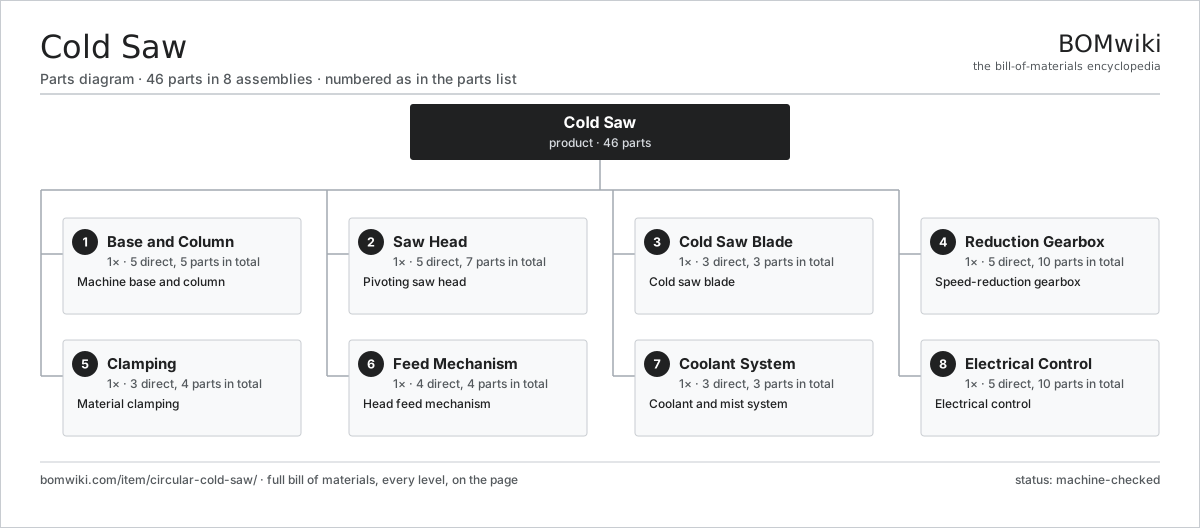
| # | Part | Qty | What it does |
|---|---|---|---|
| 1 | Base and Column 5 parts | 1× | Machine base and column |
| 2 | Saw Head 5 parts | 1× | Pivoting saw head |
| 3 | Cold Saw Blade 3 parts | 1× | Cold saw blade |
| 4 | Reduction Gearbox 5 parts | 1× | Speed-reduction gearbox |
| 5 | Clamping 3 parts | 1× | Material clamping |
| 6 | Feed Mechanism 4 parts | 1× | Head feed mechanism |
| 7 | Coolant System 3 parts | 1× | Coolant and mist system |
| 8 | Electrical Control 5 parts | 1× | Electrical control |
3D model
No 3D model yet. Have a CAD file of this? Add a 3D model — STL renders right on this page; STEP, FreeCAD, and OpenSCAD sources are welcome too (openly licensed, like all 3D models on BOMwiki).
Build & assembly graph
expand / collapse · shared sub-assemblies converge · links to related products · est. labourTap an assembly to expand/collapse · tap a part to open it · use “Open page” for any node · drag to pan, scroll to zoom.
Bill of materials for Cold Saw
8 top-level lines · 41 rows shown · 46 parts total · indented to 3 levels| # | Item / sub-assembly | Part no. | Qty/assy | Ext. qty | Parts | Type |
|---|---|---|---|---|---|---|
| 1 | Base and Column 5 parts | circular-cold-saw-base | 1× | 1 | 5 | assembly |
| 1.1 | Base Casting | circular-cold-saw-base-casting | 1× | 1 | · | part |
| 1.2 | Miter Column | circular-cold-saw-miter-column | 1× | 1 | · | part |
| 1.3 | Work Table | circular-cold-saw-work-table | 1× | 1 | · | part |
| 1.4 | Length Stop | circular-cold-saw-stop-gauge | 1× | 1 | · | part |
| 1.5 | Fastener Set | fastener-set | 1× | 1 | · | part |
| 2 | Saw Head 5 parts | circular-cold-saw-saw-head | 1× | 1 | 7 | assembly |
| 2.1 | Head Casting | circular-cold-saw-head-casting | 1× | 1 | · | part |
| 2.2 | Blade Spindle | circular-cold-saw-spindle | 1× | 1 | · | part |
| 2.3 | Blade Flange | circular-cold-saw-blade-flange | 2× | 2 | · | part |
| 2.4 | Blade Guard | circular-cold-saw-blade-guard | 1× | 1 | · | part |
| 2.5 | Ball Bearing | ball-bearing | 2× | 2 | · | part |
| 3 | Cold Saw Blade 3 parts | circular-cold-saw-blade | 1× | 1 | 3 | assembly |
| 3.1 | Blade Body | circular-cold-saw-blade-body | 1× | 1 | · | part |
| 3.2 | Blade Teeth | circular-cold-saw-blade-tooth | 1× | 1 | · | part |
| 3.3 | Carbide Tip | circular-cold-saw-carbide-tip | 1× | 1 | · | part |
| 4 | Reduction Gearbox 5 parts | circular-cold-saw-gearbox | 1× | 1 | 10 | assembly |
| 4.1 | Saw Motor | circular-cold-saw-saw-motor | 1× | 1 | · | part |
| 4.2 | Helical Gear Pair | gear-pair | 2× | 2 | · | part |
| 4.3 | Gearbox Housing | gearbox-housing | 1× | 1 | · | part |
| 4.4 | Ball Bearing | ball-bearing | 4× | 4 | · | part |
| 4.5 | Oil Seal | oil-seal | 2× | 2 | · | part |
| 5 | Clamping 3 parts | circular-cold-saw-clamping | 1× | 1 | 4 | assembly |
| 5.1 | Vise Jaw | circular-cold-saw-vise-jaw | 2× | 2 | · | part |
| 5.2 | Vise Cylinder | circular-cold-saw-vise-cylinder | 1× | 1 | · | part |
| 5.3 | Chip Deflector | circular-cold-saw-chip-deflector | 1× | 1 | · | part |
| 6 | Feed Mechanism 4 parts | circular-cold-saw-feed | 1× | 1 | 4 | assembly |
| 6.1 | Feed Lever | circular-cold-saw-feed-lever | 1× | 1 | · | part |
| 6.2 | Feed Cylinder | circular-cold-saw-feed-cylinder | 1× | 1 | · | part |
| 6.3 | Return Mechanism | circular-cold-saw-return-spring | 1× | 1 | · | part |
| 6.4 | Coil Spring | coil-spring | 1× | 1 | · | part |
| 7 | Coolant System 3 parts | circular-cold-saw-coolant | 1× | 1 | 3 | assembly |
| 7.1 | Coolant Pump | circular-cold-saw-coolant-pump | 1× | 1 | · | part |
| 7.2 | Coolant Tank | circular-cold-saw-coolant-tank | 1× | 1 | · | part |
| 7.3 | Mist Nozzle | circular-cold-saw-mist-nozzle | 1× | 1 | · | part |
| 8 | Electrical Control 5 parts | circular-cold-saw-control | 1× | 1 | 10 | assembly |
| 8.1 | Control Panel | circular-cold-saw-control-panel | 1× | 1 | · | part |
| 8.2 | Foot Switch | circular-cold-saw-foot-switch | 1× | 1 | · | part |
| 8.3 | Relay | relay | 3× | 3 | · | part |
| 8.4 | Connector | connector | 4× | 4 | · | part |
| 8.5 | Wire Bundle | wire-bundle | 1× | 1 | · | part |
Related products
same domain, ranked by shared parts Bevel Gear Generator
201 parts · shares 3 with this page
Blanking Press Line
350 parts · shares 3 with this page
Bevel Gear Generator
201 parts · shares 3 with this page
Blanking Press Line
350 parts · shares 3 with this page
 Capstan Lathe
197 parts · shares 3 with this page
Centering and Facing Machine
1,419 parts · shares 3 with this page
Chain Link Welding Machine
440 parts · shares 3 with this page
Capstan Lathe
197 parts · shares 3 with this page
Centering and Facing Machine
1,419 parts · shares 3 with this page
Chain Link Welding Machine
440 parts · shares 3 with this page
 Continuous Belt Furnace
130 parts · shares 3 with this page
Continuous Belt Furnace
130 parts · shares 3 with this page
Sourcing: possible vendors
Prices, MOQ, and lead times are algorithmic estimates, not quotes, and not claims about these companies. Company mappings are curated by keyword; est. price band $10k–$1M. How estimates work| Vendor | HQ | Specialty | MOQ | Lead time |
|---|---|---|---|---|
|
🇩🇪DMG MORI
dmgmori.com ↗
|
Bielefeld, DE | Machine tools | 5 units | 12–20 wks |
|
🇯🇵Mazak
mazak.com ↗
|
Oguchi, JP | Machine tools | 5 units | 12–20 wks |
| haascnc.com ↗ | Oxnard, US | CNC machine tools | 5 units | 12–20 wks |
|
🇯🇵Okuma
okuma.com ↗
|
Niwa, JP | Machine tools | 5 units | 12–20 wks |
|
🇩🇪Trumpf
trumpf.com ↗
|
Ditzingen, DE | Laser & sheet-metal machines | 5 units | 12–20 wks |
1,023-word article