EDM Hole Drilling Machine
ProductOverview
An EDM hole drilling machine bores small, deep, accurate holes in metals that are too hard, too tough, or too thin to drill with a twist drill. It works by electrical discharge machining, so it removes metal with sparks rather than with a cutting edge, and it does not care how hard the workpiece is. The machine is built around a rotating hollow electrode tube that is fed straight down into the work while high-pressure dielectric fluid flushes through the bore of the tube. Each spark erodes a tiny crater, and thousands of sparks per second sink the tube into the metal as a clean round hole. Because the electrode never touches the work and exerts almost no force, the process drills holes that a drill bit would never survive, including holes deeper than 100 times their diameter.
The machine looks like a small precision drill press with a fluid plant attached. A Machine Frame carries a Z-Axis Column and a XYZ Positioning Table that places the workpiece under the tool. The Electrode Spindle (W-Axis) rotates and feeds the electrode, a Ceramic Guide Head steadies it close to the work, the High-Pressure Flushing System pushes fluid through the tube, the Pulse Generator supplies the sparks, and the Dielectric Tank and Filtration keeps the fluid clean. The CNC Control Cabinet ties the four axes and the spark control into one cycle, and a Electrode Tube Changer swaps tubes so a hole pattern runs without an operator.
How the Spark Erodes Metal
The cutting action is a stream of controlled electric sparks across a small gap between the electrode and the workpiece, both submerged in the dielectric fluid. The Pulse Generator charges that gap to about 100 V until the fluid breaks down and a spark jumps across, melting and vaporizing a microscopic spot on the work. The Switching Power Module switches discharge current up to 60 A in pulses lasting 1 to 200 microseconds, and the Pulse Control Board sets the on-time, off-time, and peak current to suit the material. Between pulses the gap deionizes and the flushing fluid carries away the molten debris before the next spark fires. The Gap Sensing Board reads the gap voltage on every pulse to tell a good spark from a short or an open gap, and the Discharge Current Shunt confirms the energy each pulse delivers.
The electrode wears as it works, so the machine cannot simply push to a fixed depth. The W-Axis Feed Servo runs the W-Axis Feed Screw under closed-loop control, advancing the electrode only as fast as the metal erodes, typically 0.5 to 3 mm/min. The W-Axis Linear Scale measures true depth, and when the Break-Through Detector sees the gap and the flushing back-pressure drop, it knows the electrode has broken through the far wall and stops the feed.
Electrode and Flushing
The tool is a thin hollow tube held in the Electrode Collet Chuck and spun by the Electrode Rotation Motor at 100 to 1000 rpm. Rotation keeps the wear and the spark even all the way around the tube, so the hole stays round even as the Electrode Tube shortens. Pulse current reaches the spinning electrode through a Electrode Power Brush, a sliding silver-graphite contact that handles the full discharge current without arcing.
Flushing is what makes deep small holes possible. The High-Pressure Flushing System uses a High-Pressure Plunger Pump to force dielectric through the central bore of the electrode at 70 to 150 bar. The fluid shoots out the tip, washes the molten debris up the narrow annular gap around the tube, and cools the spark zone. Without that internal flush the gap would fill with swarf and the sparks would stop or arc. A Pressure Regulator sets the bore pressure to match the electrode size and a Pulsation Accumulator smooths the plunger pulses so the flow stays steady. The dielectric reaches the spinning tube through a Rotary Dielectric Union, a rotating high-pressure coupling.
A slender tube under 1 mm across would buckle the moment it touched the work, so the Ceramic Guide Head supports it within a few millimeters of the spark. A Ceramic Electrode Guide of zirconia or ruby holds the electrode with about 5 micron clearance, and the machine carries a Guide Insert Set set so every electrode diameter has a matched bore. The guide is what lets the machine reach aspect ratios over 100:1.
Dielectric Plant
The fluid is part of the process, not just a coolant. Water-based machines run deionized water; oil-based machines run a hydrocarbon dielectric. Either way the Dielectric Tank and Filtration keeps it clean and at the right conductivity. The Return Pump pulls spent fluid from the work tank, the Filter Cartridge cartridges remove eroded swarf down to a few microns, and the Deionizer Resin Bed bed holds water conductivity near 10 to 20 microsiemens per centimeter so the spark gap fires the same way every pulse. A Conductivity Cell watches that value, and a Fluid Chiller holds the fluid temperature within a kelvin so thermal drift does not move the hole position over a long pattern.
Axes and Control
Hole position comes from the XYZ Positioning Table. The X-Axis Slide and Y-Axis Slide cross slides place the work under the electrode to 1 micron, each closed to a Glass Position Scale, and the Z-Axis Column sets the standoff before the W-axis feeds the tube down. The work sits in the Work Tank on the Workpiece Clamp. The CNC Controller runs the program: it positions the table, selects pulse parameters per material, drives the gap servo from the spark feedback, and changes electrodes when the Tube Length Sensor reports a tube is nearly consumed. Each axis runs through its own Servo Drive, and the operator sets up jobs at the Operator Panel.
Applications and Variants
Small-hole EDM, also called fast-hole drilling or hole popping, is used wherever holes must be small, deep, and exact in hard metal. The classic job is the array of cooling holes in turbine blades and vanes, drilled into nickel superalloys. The machine also drills the starter holes that thread the wire on a wire-EDM machine, the spray holes in fuel injector nozzles, and holes in carbide and hardened tool steel that no drill can touch. Variants range from single-axis bench units to multi-axis CNC machines with the Electrode Tube Changer running unattended hole patterns, and from water dielectric for speed to oil dielectric for the finest electrodes.
EDM Hole Drilling Machine parts and their functions
9 top-level parts · 540 parts in total · full bill of materials below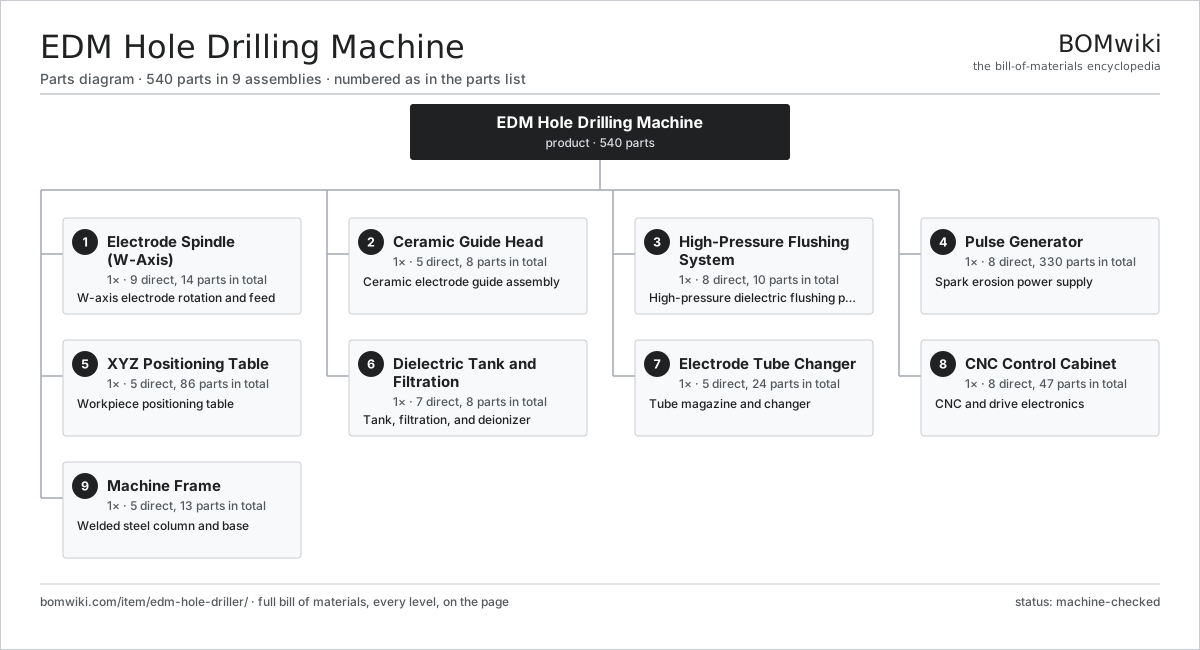
| # | Part | Qty | What it does |
|---|---|---|---|
| 1 | Electrode Spindle (W-Axis) 9 parts | 1× | W-axis electrode rotation and feed |
| 2 | Ceramic Guide Head 5 parts | 1× | Ceramic electrode guide assembly |
| 3 | High-Pressure Flushing System 8 parts | 1× | High-pressure dielectric flushing pump |
| 4 | Pulse Generator 8 parts | 1× | Spark erosion power supply |
| 5 | XYZ Positioning Table 5 parts | 1× | Workpiece positioning table |
| 6 | Dielectric Tank and Filtration 7 parts | 1× | Tank, filtration, and deionizer |
| 7 | Electrode Tube Changer 5 parts | 1× | Tube magazine and changer |
| 8 | CNC Control Cabinet 8 parts | 1× | CNC and drive electronics |
| 9 | Machine Frame 5 parts | 1× | Welded steel column and base |
3D model
No 3D model yet. Have a CAD file of this? Add a 3D model — STL renders right on this page; STEP, FreeCAD, and OpenSCAD sources are welcome too (openly licensed, like all 3D models on BOMwiki).
Build & assembly graph
expand / collapse · shared sub-assemblies converge · links to related products · est. labourTap an assembly to expand/collapse · tap a part to open it · use “Open page” for any node · drag to pan, scroll to zoom.
Bill of materials for EDM Hole Drilling Machine
9 top-level lines · 84 rows shown · 540 parts total · indented to 3 levels| # | Item / sub-assembly | Part no. | Qty/assy | Ext. qty | Parts | Type |
|---|---|---|---|---|---|---|
| 1 | Electrode Spindle (W-Axis) 9 parts | edh-electrode-spindle | 1× | 1 | 14 | assembly |
| 1.1 | Rotary Dielectric Union | edh-rotary-union | 1× | 1 | · | part |
| 1.2 | Electrode Collet Chuck | edh-collet-chuck | 1× | 1 | · | part |
| 1.3 | Electrode Rotation Motor | edh-spindle-motor | 1× | 1 | · | part |
| 1.4 | W-Axis Feed Screw | edh-feed-screw | 1× | 1 | · | part |
| 1.5 | W-Axis Feed Servo | edh-feed-servo | 1× | 1 | · | part |
| 1.6 | Feed-Axis Linear Guide | edh-feed-guide | 2× | 2 | · | part |
| 1.7 | W-Axis Linear Scale | edh-feed-scale | 1× | 1 | · | part |
| 1.8 | Ball Bearing | ball-bearing | 4× | 4 | · | part |
| 1.9 | Electrode Power Brush | edh-power-brush | 2× | 2 | · | part |
| 2 | Ceramic Guide Head 5 parts | edh-guide-head | 1× | 1 | 8 | assembly |
| 2.1 | Ceramic Electrode Guide | edh-ceramic-guide | 1× | 1 | · | part |
| 2.2 | Guide Holder | edh-guide-holder | 1× | 1 | · | part |
| 2.3 | Guide Seal | edh-guide-seal | 1× | 1 | · | part |
| 2.4 | Guide Insert Set | edh-wire-guide-insert | 4× | 4 | · | part |
| 2.5 | Splash Shroud | edh-splash-shroud | 1× | 1 | · | part |
| 3 | High-Pressure Flushing System 8 parts | edh-flushing-system | 1× | 1 | 10 | assembly |
| 3.1 | High-Pressure Plunger Pump | edh-hp-pump | 1× | 1 | · | part |
| 3.2 | Flushing Pump Motor | edh-pump-motor | 1× | 1 | · | part |
| 3.3 | Pressure Regulator | edh-pressure-regulator | 1× | 1 | · | part |
| 3.4 | Pulsation Accumulator | edh-pressure-accumulator | 1× | 1 | · | part |
| 3.5 | Pre-Pump Filter | edh-flush-filter | 1× | 1 | · | part |
| 3.6 | Pressure Sensor | pressure-sensor | 2× | 2 | · | part |
| 3.7 | High-Pressure Hose | edh-hp-hose | 2× | 2 | · | part |
| 3.8 | O-Ring Set | oring-set | 1× | 1 | · | part |
| 4 | Pulse Generator 8 parts | edh-pulse-generator | 1× | 1 | 330 | assembly |
| 4.1 | Switching Power Module | edh-power-module | 1× | 1 | · | part |
| 4.2 | Pulse Control Board 3 parts | edh-pulse-control-board | 1× | 1 | 122 | assembly |
| 4.2.1 | Bare PCB | pcb-bare | 1× | 1 | · | part |
| 4.2.2 | Microcontroller | mcu | 1× | 1 | · | part |
| 4.2.3 | SMD Passive (R/C/L) | smd-passives | 120× | 120 | · | part |
| 4.3 | Gap Sensing Board | edh-gap-sensor-board | 1× | 1 | · | part |
| 4.4 | Discharge Current Shunt | edh-current-shunt | 1× | 1 | · | part |
| 4.5 | Discharge Lead | edh-hv-cable | 2× | 2 | · | part |
| 4.6 | Power Supply | power-supply | 1× | 1 | · | part |
| 4.7 | SMD Passive (R/C/L) | smd-passives | 200× | 200 | · | part |
| 4.8 | Bare PCB | pcb-bare | 2× | 2 | · | part |
| 5 | XYZ Positioning Table 5 parts | edh-xyz-table | 1× | 1 | 86 | assembly |
| 5.1 | X-Axis Slide 4 parts | edh-x-axis | 1× | 1 | 28 | assembly |
| 5.1.1 | Ball Screw | ball-screw | 1× | 1 | · | part |
| 5.1.2 | Linear Guide Rail | linear-guide | 2× | 2 | · | part |
| 5.1.3 | Servo Motor 4 parts + deeper › | servo-motor | 1× | 1 | 24 | assembly |
| 5.1.4 | Glass Position Scale | edh-glass-scale | 1× | 1 | · | part |
| 5.2 | Y-Axis Slide 4 parts | edh-y-axis | 1× | 1 | 28 | assembly |
| 5.2.1 | Ball Screw | ball-screw | 1× | 1 | · | part |
| 5.2.2 | Linear Guide Rail | linear-guide | 2× | 2 | · | part |
| 5.2.3 | Servo Motor 4 parts + deeper › | servo-motor | 1× | 1 | 24 | assembly |
| 5.2.4 | Glass Position Scale | edh-glass-scale | 1× | 1 | · | part |
| 5.3 | Z-Axis Column 4 parts | edh-z-column | 1× | 1 | 28 | assembly |
| 5.3.1 | Ball Screw | ball-screw | 1× | 1 | · | part |
| 5.3.2 | Linear Guide Rail | linear-guide | 2× | 2 | · | part |
| 5.3.3 | Servo Motor 4 parts + deeper › | servo-motor | 1× | 1 | 24 | assembly |
| 5.3.4 | Glass Position Scale | edh-glass-scale | 1× | 1 | · | part |
| 5.4 | Workpiece Clamp | edh-work-clamp | 1× | 1 | · | part |
| 5.5 | Work Tank | edh-work-tank | 1× | 1 | · | part |
| 6 | Dielectric Tank and Filtration 7 parts | edh-dielectric-plant | 1× | 1 | 8 | assembly |
| 6.1 | Dielectric Tank | edh-dielectric-tank | 1× | 1 | · | part |
| 6.2 | Return Pump | edh-return-pump | 1× | 1 | · | part |
| 6.3 | Filter Cartridge | edh-paper-filter | 2× | 2 | · | part |
| 6.4 | Deionizer Resin Bed | edh-deionizer-resin | 1× | 1 | · | part |
| 6.5 | Conductivity Cell | edh-conductivity-cell | 1× | 1 | · | part |
| 6.6 | Fluid Chiller | edh-fluid-chiller | 1× | 1 | · | part |
| 6.7 | O-Ring Set | oring-set | 1× | 1 | · | part |
| 7 | Electrode Tube Changer 5 parts | edh-electrode-changer | 1× | 1 | 24 | assembly |
| 7.1 | Tube Magazine | edh-tube-magazine | 1× | 1 | · | part |
| 7.2 | Changer Gripper | edh-changer-gripper | 1× | 1 | · | part |
| 7.3 | Magazine Indexer | edh-changer-actuator | 1× | 1 | · | part |
| 7.4 | Electrode Tube | edh-electrode-tube | 20× | 20 | · | part |
| 7.5 | Tube Length Sensor | edh-tube-length-sensor | 1× | 1 | · | part |
| 8 | CNC Control Cabinet 8 parts | edh-cnc-cabinet | 1× | 1 | 47 | assembly |
| 8.1 | CNC Controller | edh-cnc-unit | 1× | 1 | · | part |
| 8.2 | Servo Drive | edh-servo-drive | 4× | 4 | · | part |
| 8.3 | Operator Panel | edh-operator-panel | 1× | 1 | · | part |
| 8.4 | Break-Through Detector | edh-breakthrough-sensor | 1× | 1 | · | part |
| 8.5 | Power Supply | power-supply | 1× | 1 | · | part |
| 8.6 | Relay | relay | 8× | 8 | · | part |
| 8.7 | Connector | connector | 30× | 30 | · | part |
| 8.8 | Wire Bundle | wire-bundle | 1× | 1 | · | part |
| 9 | Machine Frame 5 parts | edh-machine-frame | 1× | 1 | 13 | assembly |
| 9.1 | Base Casting | edh-base-casting | 1× | 1 | · | part |
| 9.2 | Vertical Column | edh-column | 1× | 1 | · | part |
| 9.3 | Leveling Foot | edh-leveling-foot | 4× | 4 | · | part |
| 9.4 | Enclosure Panel | edh-frame-panel | 6× | 6 | · | part |
| 9.5 | Fastener Set | fastener-set | 1× | 1 | · | part |
Related products
same domain, ranked by shared parts Bevel Gear Generator
201 parts · shares 4 with this page
Camshaft Grinder
489 parts · shares 4 with this page
Centering and Facing Machine
1,419 parts · shares 4 with this page
Bevel Gear Generator
201 parts · shares 4 with this page
Camshaft Grinder
489 parts · shares 4 with this page
Centering and Facing Machine
1,419 parts · shares 4 with this page
 CNC Lathe
511 parts · shares 4 with this page
CNC Lathe
511 parts · shares 4 with this page
 CO2 Laser Cutting Machine
227 parts · shares 4 with this page
CO2 Laser Cutting Machine
227 parts · shares 4 with this page
Sourcing: possible vendors
Prices, MOQ, and lead times are algorithmic estimates, not quotes, and not claims about these companies. Company mappings are curated by keyword; est. price band $10k–$1M. How estimates work| Vendor | HQ | Specialty | MOQ | Lead time |
|---|---|---|---|---|
|
🇩🇪DMG MORI
dmgmori.com ↗
|
Bielefeld, DE | Machine tools | 5 units | 12–20 wks |
|
🇯🇵Mazak
mazak.com ↗
|
Oguchi, JP | Machine tools | 5 units | 12–20 wks |
| haascnc.com ↗ | Oxnard, US | CNC machine tools | 5 units | 12–20 wks |
|
🇯🇵Okuma
okuma.com ↗
|
Niwa, JP | Machine tools | 5 units | 12–20 wks |
|
🇩🇪Trumpf
trumpf.com ↗
|
Ditzingen, DE | Laser & sheet-metal machines | 5 units | 12–20 wks |
1,114-word article