Expanded Metal Machine
ProductOverview
An expanded metal machine turns a solid sheet of metal into an open diamond mesh without removing any material. It does this by slitting the sheet with a toothed knife and, in the same stroke, lifting and stretching each slit so the metal opens into a row of diamond-shaped strands joined at bonds. The sheet feeds forward one strand width, the knife shifts half a diamond sideways, and the next row is cut offset from the last, building the familiar staggered diamond pattern. Because no metal is punched out, an expanded sheet covers far more area than its weight of flat stock and stays in one piece, which is why expanded metal is used for grating, walkways, screens, guards, filters, and plaster lath.
The strip comes from the Uncoiler and Feed into the Cutting Head, where the Knife Die Set both cuts and stretches the mesh. The Feed Advance moves the strip between strokes, the Crank Drive powers the high-force stroke, the optional Flattening Mill presses the mesh flat, and the Cutoff Shear cuts sheets to length. The Frame and Guards absorbs the cutting shock and the Control System sets the pattern.
How slitting and stretching make the mesh
The whole process happens in one tool. The Knife Die Set is a matched pair of toothed knives: the Upper Knife descends past the Lower Knife, and where their teeth pass they shear a row of short slits in the strip. The same teeth are shaped so that as they cut they also push the metal between slits upward, drawing it into the strands that form one side of each diamond. A Stripper then frees the formed mesh from the teeth as the knife lifts.
This is the key idea: the cut and the stretch are a single action. The knife does not just slit the sheet, it forms it, so each stroke produces a complete row of half-diamonds bonded to the row before. The knives are tool steel because they cut and form metal on every stroke at high speed and wear hard; they sit in Die Shoe blocks that set shear clearance precisely, since too much clearance tears the strand and too little dulls the knife.
Indexing and feed set the diamond size
The diamond pattern comes from two motions between strokes. The Feed Advance pushes the strip forward by a set amount, which becomes the strand width and the short way of the diamond. Its Feed Gripper jaws and Feed Rack fix that increment, held against the cutting reaction by the Index Pawl. At the same time the Half-Step Index Cam in the cutting head shifts the knife sideways by half a diamond, so each row is offset from the last and the slits of one row land in the middle of the strands of the next. Together the advance and the half-step index define the long way and short way of the diamond, the two numbers that name an expanded-metal pattern.
Drive and the cutting stroke
Slitting and stretching steel on every stroke is a high, sharp load, so the Crank Drive is built like a press drive. A heavy Flywheel stores energy from the Servo Motor between strokes and releases it through the Crankshaft and Connecting Rod into the Cutting Ram, which carries the upper knife. The Clutch and Brake couples the flywheel to the crank for a run and stops the ram cleanly at the top of its stroke. The ram itself runs in adjustable Ram Gib guides so it descends with no side play, which keeps the knife shearing true against its mate.
Flattening, shearing, and finishing
Mesh as it leaves the head is raised: the strands stand proud of the original sheet plane and the surface has a three-dimensional texture, which is standard expanded metal used where grip or stiffness helps. For flat applications the Flattening Mill presses the mesh between two hardened Flattening Roll rolls, squeezing the strands back into one plane to make flattened expanded metal, which is smoother and slightly larger in the diamond. The Cutoff Shear then cuts the continuous mesh to ordered sheet length, its Shear Blade driven through the full width against the Shear Anvil, and sheets stack off the Run-off Table.
Materials, variants, and use
The machine runs low-carbon steel most often, but also stainless, aluminium, and copper alloys, with thickness from thin sheet for filters and lath up to plate several millimetres thick for heavy grating and security screens. A machine is built around a strip-width and thickness range and a die that sets the diamond pattern; changing pattern means changing the Knife Die Set and resetting the Feed Advance. Output is described as raised or flattened and by its long-way and short-way diamond dimensions and strand size. The expanded metal these machines make goes into industrial walkways and stair treads, machine guards, fence and infill panels, sunshades and facades, filter and battery-plate substrate, and metal lath for plaster, anywhere an open sheet that stays in one piece is wanted.
Frame and control
Because every stroke shocks the structure, the Base Weldment is massive and the lower die mounts on a thick Bolster Plate so the cutting reaction goes straight into the frame rather than flexing it. The knife zone is closed off by interlocked Sheet Metal Panel guards. The Control System runs the cycle: an PLC sets stroke rate and feed increment, sequences the clutch, feed, and index, and runs the shear to a programmed sheet length, with the operator setting pattern and length at the LCD Panel. Holding the feed increment and the half-step index exactly is what keeps the diamond pattern uniform down a long run.
Expanded Metal Machine parts and their functions
9 top-level parts · 276 parts in total · full bill of materials below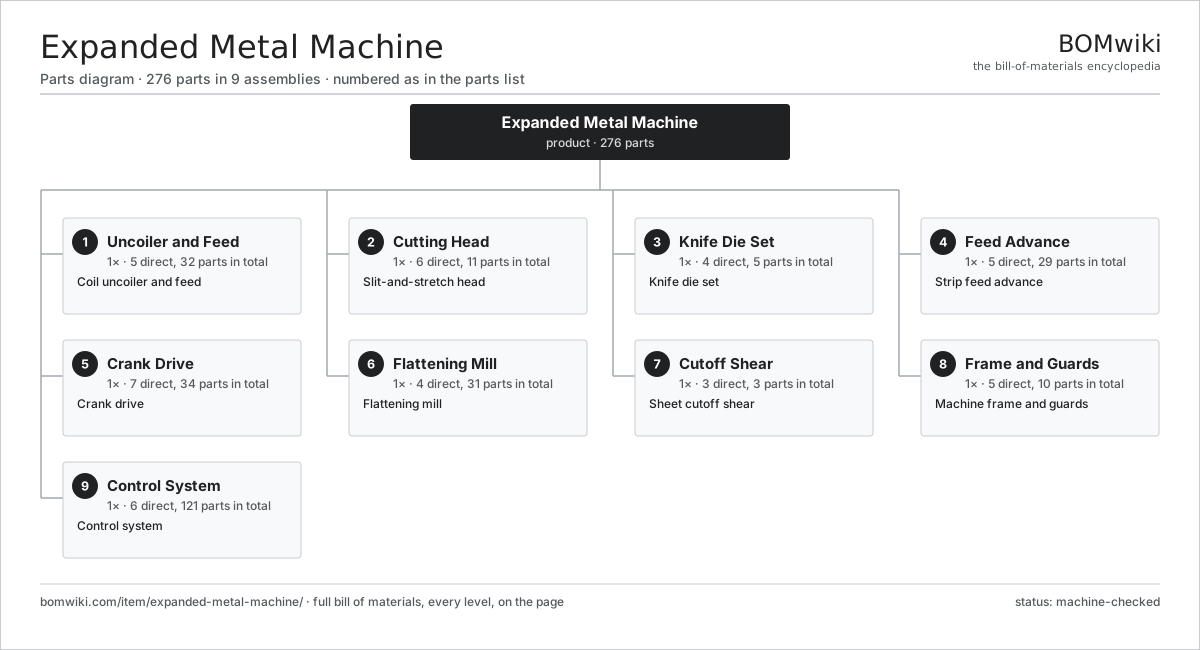
| # | Part | Qty | What it does |
|---|---|---|---|
| 1 | Uncoiler and Feed 5 parts | 1× | Coil uncoiler and feed |
| 2 | Cutting Head 6 parts | 1× | Slit-and-stretch head |
| 3 | Knife Die Set 4 parts | 1× | Knife die set |
| 4 | Feed Advance 5 parts | 1× | Strip feed advance |
| 5 | Crank Drive 7 parts | 1× | Crank drive |
| 6 | Flattening Mill 4 parts | 1× | Flattening mill |
| 7 | Cutoff Shear 3 parts | 1× | Sheet cutoff shear |
| 8 | Frame and Guards 5 parts | 1× | Machine frame and guards |
| 9 | Control System 6 parts | 1× | Control system |
3D model
No 3D model yet. Have a CAD file of this? Add a 3D model — STL renders right on this page; STEP, FreeCAD, and OpenSCAD sources are welcome too (openly licensed, like all 3D models on BOMwiki).
Build & assembly graph
expand / collapse · shared sub-assemblies converge · links to related products · est. labourTap an assembly to expand/collapse · tap a part to open it · use “Open page” for any node · drag to pan, scroll to zoom.
Bill of materials for Expanded Metal Machine
9 top-level lines · 73 rows shown · 276 parts total · indented to 3 levels| # | Item / sub-assembly | Part no. | Qty/assy | Ext. qty | Parts | Type |
|---|---|---|---|---|---|---|
| 1 | Uncoiler and Feed 5 parts | expanded-metal-machine-uncoiler | 1× | 1 | 32 | assembly |
| 1.1 | Expanding Mandrel | expanded-metal-machine-mandrel | 1× | 1 | · | part |
| 1.2 | Pinch Roll | expanded-metal-machine-pinch-rolls | 2× | 2 | · | part |
| 1.3 | Strip Edge Guide | expanded-metal-machine-strip-guide | 1× | 1 | · | part |
| 1.4 | Ball Bearing | ball-bearing | 4× | 4 | · | part |
| 1.5 | Servo Motor 4 parts | servo-motor | 1× | 1 | 24 | assembly |
| 1.5.1 | Stator Assembly 3 parts + deeper › | stator-assembly | 1× | 1 | 3 | assembly |
| 1.5.2 | Rotor Assembly 4 parts + deeper › | rotor-assembly | 1× | 1 | 19 | assembly |
| 1.5.3 | Encoder | encoder | 1× | 1 | · | part |
| 1.5.4 | Motor Housing | motor-housing | 1× | 1 | · | part |
| 2 | Cutting Head 6 parts | expanded-metal-machine-cutting-head | 1× | 1 | 11 | assembly |
| 2.1 | Cutting Ram | expanded-metal-machine-ram | 1× | 1 | · | part |
| 2.2 | Ram Gib | expanded-metal-machine-ram-gib | 4× | 4 | · | part |
| 2.3 | Knife Bar | expanded-metal-machine-knife-bar | 1× | 1 | · | part |
| 2.4 | Half-Step Index Cam | expanded-metal-machine-index-cam | 1× | 1 | · | part |
| 2.5 | Coil Spring | coil-spring | 2× | 2 | · | part |
| 2.6 | Ball Bearing | ball-bearing | 2× | 2 | · | part |
| 3 | Knife Die Set 4 parts | expanded-metal-machine-die-set | 1× | 1 | 5 | assembly |
| 3.1 | Upper Knife | expanded-metal-machine-upper-knife | 1× | 1 | · | part |
| 3.2 | Lower Knife | expanded-metal-machine-lower-knife | 1× | 1 | · | part |
| 3.3 | Die Shoe | expanded-metal-machine-die-shoe | 2× | 2 | · | part |
| 3.4 | Stripper | expanded-metal-machine-stripper | 1× | 1 | · | part |
| 4 | Feed Advance 5 parts | expanded-metal-machine-feed-advance | 1× | 1 | 29 | assembly |
| 4.1 | Feed Gripper | expanded-metal-machine-feed-gripper | 2× | 2 | · | part |
| 4.2 | Feed Rack | expanded-metal-machine-feed-rack | 1× | 1 | · | part |
| 4.3 | Index Pawl | expanded-metal-machine-feed-pawl | 1× | 1 | · | part |
| 4.4 | Servo Motor 4 parts | servo-motor | 1× | 1 | 24 | assembly |
| 4.4.1 | Stator Assembly 3 parts + deeper › | stator-assembly | 1× | 1 | 3 | assembly |
| 4.4.2 | Rotor Assembly 4 parts + deeper › | rotor-assembly | 1× | 1 | 19 | assembly |
| 4.4.3 | Encoder | encoder | 1× | 1 | · | part |
| 4.4.4 | Motor Housing | motor-housing | 1× | 1 | · | part |
| 4.5 | Ball Screw | ball-screw | 1× | 1 | · | part |
| 5 | Crank Drive 7 parts | expanded-metal-machine-drive | 1× | 1 | 34 | assembly |
| 5.1 | Flywheel | expanded-metal-machine-flywheel | 1× | 1 | · | part |
| 5.2 | Crankshaft | expanded-metal-machine-crankshaft | 1× | 1 | · | part |
| 5.3 | Connecting Rod | expanded-metal-machine-connecting-rod | 1× | 1 | · | part |
| 5.4 | Clutch and Brake | expanded-metal-machine-clutch-brake | 1× | 1 | · | part |
| 5.5 | Helical Gear Pair | gear-pair | 2× | 2 | · | part |
| 5.6 | Servo Motor 4 parts | servo-motor | 1× | 1 | 24 | assembly |
| 5.6.1 | Stator Assembly 3 parts + deeper › | stator-assembly | 1× | 1 | 3 | assembly |
| 5.6.2 | Rotor Assembly 4 parts + deeper › | rotor-assembly | 1× | 1 | 19 | assembly |
| 5.6.3 | Encoder | encoder | 1× | 1 | · | part |
| 5.6.4 | Motor Housing | motor-housing | 1× | 1 | · | part |
| 5.7 | Ball Bearing | ball-bearing | 4× | 4 | · | part |
| 6 | Flattening Mill 4 parts | expanded-metal-machine-flattener | 1× | 1 | 31 | assembly |
| 6.1 | Flattening Roll | expanded-metal-machine-flatten-roll | 2× | 2 | · | part |
| 6.2 | Roll Frame | expanded-metal-machine-roll-frame | 1× | 1 | · | part |
| 6.3 | Ball Bearing | ball-bearing | 4× | 4 | · | part |
| 6.4 | Servo Motor 4 parts | servo-motor | 1× | 1 | 24 | assembly |
| 6.4.1 | Stator Assembly 3 parts + deeper › | stator-assembly | 1× | 1 | 3 | assembly |
| 6.4.2 | Rotor Assembly 4 parts + deeper › | rotor-assembly | 1× | 1 | 19 | assembly |
| 6.4.3 | Encoder | encoder | 1× | 1 | · | part |
| 6.4.4 | Motor Housing | motor-housing | 1× | 1 | · | part |
| 7 | Cutoff Shear 3 parts | expanded-metal-machine-shear | 1× | 1 | 3 | assembly |
| 7.1 | Shear Blade | expanded-metal-machine-shear-blade | 1× | 1 | · | part |
| 7.2 | Shear Cylinder | expanded-metal-machine-shear-cylinder | 1× | 1 | · | part |
| 7.3 | Shear Anvil | expanded-metal-machine-shear-anvil | 1× | 1 | · | part |
| 8 | Frame and Guards 5 parts | expanded-metal-machine-frame | 1× | 1 | 10 | assembly |
| 8.1 | Base Weldment | expanded-metal-machine-base-weldment | 1× | 1 | · | part |
| 8.2 | Bolster Plate | expanded-metal-machine-bolster | 1× | 1 | · | part |
| 8.3 | Sheet Metal Panel | sheet-panel | 6× | 6 | · | part |
| 8.4 | Run-off Table | expanded-metal-machine-runoff-table | 1× | 1 | · | part |
| 8.5 | Fastener Set | fastener-set | 1× | 1 | · | part |
| 9 | Control System 6 parts | expanded-metal-machine-control | 1× | 1 | 121 | assembly |
| 9.1 | PLC 3 parts | expanded-metal-machine-plc | 1× | 1 | 102 | assembly |
| 9.1.1 | Bare PCB | pcb-bare | 1× | 1 | · | part |
| 9.1.2 | Microcontroller | mcu | 1× | 1 | · | part |
| 9.1.3 | SMD Passive (R/C/L) | smd-passives | 100× | 100 | · | part |
| 9.2 | LCD Panel | lcd-panel | 1× | 1 | · | part |
| 9.3 | Power Supply | power-supply | 1× | 1 | · | part |
| 9.4 | Relay | relay | 6× | 6 | · | part |
| 9.5 | Wire Bundle | wire-bundle | 1× | 1 | · | part |
| 9.6 | Connector | connector | 10× | 10 | · | part |
Related products
same domain, ranked by shared parts Compression Spring Coiler
1,167 parts · shares 6 with this page
Compression Spring Coiler
1,167 parts · shares 6 with this page
 Crankshaft Grinder
511 parts · shares 6 with this page
Crankshaft Grinder
511 parts · shares 6 with this page
 Creep-Feed Grinder
571 parts · shares 6 with this page
Creep-Feed Grinder
571 parts · shares 6 with this page
 Radial Forging Machine
288 parts · shares 6 with this page
Radial Forging Machine
288 parts · shares 6 with this page
Sourcing: possible vendors
Prices, MOQ, and lead times are algorithmic estimates, not quotes, and not claims about these companies. Company mappings are curated by keyword; est. price band $10k–$1M. How estimates work| Vendor | HQ | Specialty | MOQ | Lead time |
|---|---|---|---|---|
|
🇩🇪DMG MORI
dmgmori.com ↗
|
Bielefeld, DE | Machine tools | 5 units | 12–20 wks |
|
🇯🇵Mazak
mazak.com ↗
|
Oguchi, JP | Machine tools | 5 units | 12–20 wks |
| haascnc.com ↗ | Oxnard, US | CNC machine tools | 5 units | 12–20 wks |
|
🇯🇵Okuma
okuma.com ↗
|
Niwa, JP | Machine tools | 5 units | 12–20 wks |
|
🇩🇪Trumpf
trumpf.com ↗
|
Ditzingen, DE | Laser & sheet-metal machines | 5 units | 12–20 wks |
1,051-word article