Electrochemical Grinder
ProductOverview
Electrochemical grinding removes metal two ways at once. A conductive abrasive wheel turns against the work the way an ordinary grinder does, but the wheel is also the cathode of an electrolytic cell and the work is the anode. Most of the stock, usually 85 to 95 percent of it, is dissolved electrochemically by the current passing through a salt electrolyte in the gap; the proud abrasive grit does the remaining mechanical work, scraping off the soft oxide film the current leaves behind and setting the gap that the wheel runs at. Because so little metal is cut mechanically, the wheel barely wears, the work stays cool, and there is no grinding burn, no heat-affected layer and no burr. That makes the process the tool of choice for hard, tough or heat-sensitive materials: carbide, hardened tool steel, nickel and cobalt superalloys, surgical needles and honeycomb seals.
This machine grinds flat and form surfaces. The work is clamped on the Worktable & Fixture through the Anode Work Clamp, which feeds it the positive current. Above it the Conductive Wheel Head turns the Conductive Grinding Wheel and carries the negative current to it through carbon brushes. Electrolyte floods the gap between them, and a low-voltage, high-current supply drives the dissolution.
How the process works
The chemistry is anodic dissolution. When current flows from the work through the electrolyte to the wheel, metal atoms at the work surface give up electrons and go into solution as metal ions, which then combine with hydroxide to form an insoluble sludge. The rate follows Faraday's law, so removal is set by the current, not by wheel pressure. The grit only needs to touch lightly: it holds the Conductive Grinding Wheel face a few hundredths of a millimetre off the work and wipes away the passive film that would otherwise stall the reaction. Light contact is why the wheel lasts so long and why even brittle carbide grinds without chipping.
Holding that small gap is the control problem. The Feed Servo meters the wheel into the work in microns while the Current Regulator watches the current through the Current Shunt. If the gap opens the current falls and the control feeds faster; if it closes the current rises and the control eases off. Abrasion and electrolysis stay in step only because feed and current are regulated against each other.
DC power supply
Electrolysis wants a lot of current at very little voltage, the opposite of mains power, so the DC Electrolysis Supply starts with a Step-Down Transformer that drops 400 V to a handful of volts and steps the current up to match. A Rectifier Stack of heavy diodes turns that into smooth DC, and copper DC Busbar carries it to the Cathode Current Brush on the spindle and to the anode clamp on the table. A few volts across the gap may push hundreds of amperes, so every joint is sized for the heat and the rectifier runs behind cooling fans. The supply is current-regulated rather than voltage-regulated, because it is the current that sets the metal-removal rate.
Electrolyte system
The electrolyte does three jobs: it carries the current, it flushes the dissolved metal out of the gap, and it cools the work. The Electrolyte System pumps a sodium-nitrate or sodium-chloride solution through Gap Nozzle jets into the gap at high flow. Sodium nitrate is favoured where corrosion and dimensional control matter; sodium chloride removes metal faster but is more aggressive. The reaction throws off metal-hydroxide sludge continuously, so the fluid passes through a Sludge Filter before it returns to the tank, and a Conductivity Probe watches the solution strength so the dissolution rate does not drift as salts deplete.
Materials and construction
Everything wetted by electrolyte is built to resist a warm salt solution. The Stainless Table Top is 316 stainless, the Electrolyte Tank is polypropylene, and the Electrolyte Pump runs a plastic impeller. The Base Casting is heavy cast iron for rigidity and damping, and the spindle runs on angular-contact bearings for the radial stiffness the grinding step needs. Insulation is as important as strength: the Insulating Bush and the Table Insulator keep the cell current confined to the wheel-and-work loop and off the frame, which is both an efficiency and a safety matter.
Use and variants
Operators set the current for the alloy and the area being ground, set a feed rate, and let the machine hold the gap. A common job is sharpening and form grinding carbide tooling, where ECG leaves a clean edge with none of the micro- cracks that hard mechanical grinding can open. Surface machines like this one grind flats and shoulders; cylindrical, internal and form variants apply the same cathode-wheel idea to round and profiled work, and electrochemical cutoff machines slice thin-walled tube and honeycomb with almost no burr. The trade-offs are the same across the family: very low tool wear and burr-free, stress-free surfaces, against the cost of a DC plant and an electrolyte system to maintain.
Safety
The cell is live and the fluid is conductive, so the Enclosure & Guards seals the work zone and the Interlock Switch drops the DC supply the moment a guard opens. Hydrogen is released at the cathode wheel, so the Mist Extractor clears the enclosure of both electrolyte mist and gas, and the Emergency Stop kills current, spindle and pump together.
Electrochemical Grinder parts and their functions
8 top-level parts · 425 parts in total · full bill of materials below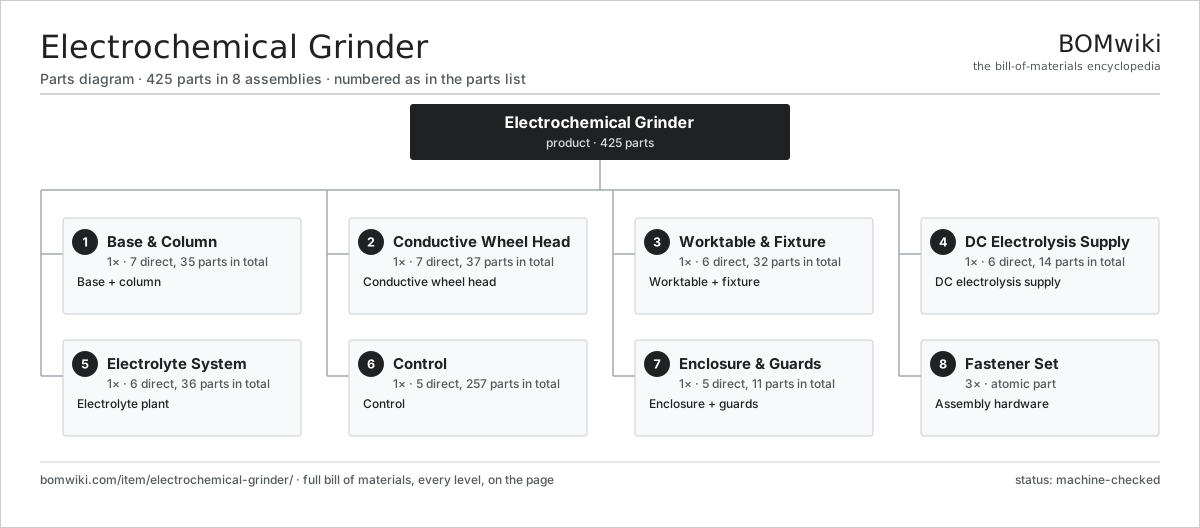
| # | Part | Qty | What it does |
|---|---|---|---|
| 1 | Base & Column 7 parts | 1× | Base + column |
| 2 | Conductive Wheel Head 7 parts | 1× | Conductive wheel head |
| 3 | Worktable & Fixture 6 parts | 1× | Worktable + fixture |
| 4 | DC Electrolysis Supply 6 parts | 1× | DC electrolysis supply |
| 5 | Electrolyte System 6 parts | 1× | Electrolyte plant |
| 6 | Control 5 parts | 1× | Control |
| 7 | Enclosure & Guards 5 parts | 1× | Enclosure + guards |
| 8 | Fastener Set | 3× | Assembly hardware |
3D model
No 3D model yet. Have a CAD file of this? Add a 3D model — STL renders right on this page; STEP, FreeCAD, and OpenSCAD sources are welcome too (openly licensed, like all 3D models on BOMwiki).
Build & assembly graph
expand / collapse · shared sub-assemblies converge · links to related products · est. labourTap an assembly to expand/collapse · tap a part to open it · use “Open page” for any node · drag to pan, scroll to zoom.
Bill of materials for Electrochemical Grinder
8 top-level lines · 83 rows shown · 425 parts total · indented to 3 levels| # | Item / sub-assembly | Part no. | Qty/assy | Ext. qty | Parts | Type |
|---|---|---|---|---|---|---|
| 1 | Base & Column 7 parts | ecg-machine-base | 1× | 1 | 35 | assembly |
| 1.1 | Base Casting | ecg-base-casting | 1× | 1 | · | part |
| 1.2 | Column | ecg-column | 1× | 1 | · | part |
| 1.3 | Down-Feed Screw | ecg-feed-screw | 1× | 1 | · | part |
| 1.4 | Feed Servo 5 parts | ecg-feed-servo | 1× | 1 | 26 | assembly |
| 1.4.1 | Stator Assembly 3 parts + deeper › | stator-assembly | 1× | 1 | 3 | assembly |
| 1.4.2 | Rotor Assembly 4 parts + deeper › | rotor-assembly | 1× | 1 | 19 | assembly |
| 1.4.3 | Motor Housing | motor-housing | 1× | 1 | · | part |
| 1.4.4 | Ball Bearing | ball-bearing | 2× | 2 | · | part |
| 1.4.5 | Feed Encoder | ecg-feed-encoder | 1× | 1 | · | part |
| 1.5 | Linear Guide Rail | linear-guide | 2× | 2 | · | part |
| 1.6 | Ball Bearing | ball-bearing | 2× | 2 | · | part |
| 1.7 | Fastener Set | fastener-set | 2× | 2 | · | part |
| 2 | Conductive Wheel Head 7 parts | ecg-spindle-head | 1× | 1 | 37 | assembly |
| 2.1 | Spindle Motor 4 parts | ecg-spindle-motor | 1× | 1 | 25 | assembly |
| 2.1.1 | Stator Assembly 3 parts + deeper › | stator-assembly | 1× | 1 | 3 | assembly |
| 2.1.2 | Rotor Assembly 4 parts + deeper › | rotor-assembly | 1× | 1 | 19 | assembly |
| 2.1.3 | Motor Housing | motor-housing | 1× | 1 | · | part |
| 2.1.4 | Ball Bearing | ball-bearing | 2× | 2 | · | part |
| 2.2 | Spindle Shaft | ecg-spindle-shaft | 1× | 1 | · | part |
| 2.3 | Conductive Grinding Wheel | ecg-grinding-wheel | 1× | 1 | · | part |
| 2.4 | Cathode Current Brush | ecg-current-brush | 2× | 2 | · | part |
| 2.5 | Insulating Bush | ecg-insulation-bush | 2× | 2 | · | part |
| 2.6 | Angular Contact Bearing | angular-bearing | 4× | 4 | · | part |
| 2.7 | Oil Seal | oil-seal | 2× | 2 | · | part |
| 3 | Worktable & Fixture 6 parts | ecg-worktable | 1× | 1 | 32 | assembly |
| 3.1 | Stainless Table Top | ecg-table-top | 1× | 1 | · | part |
| 3.2 | Table Slide | ecg-table-slide | 1× | 1 | · | part |
| 3.3 | Table Feed Servo 4 parts | ecg-table-servo | 1× | 1 | 25 | assembly |
| 3.3.1 | Stator Assembly 3 parts + deeper › | stator-assembly | 1× | 1 | 3 | assembly |
| 3.3.2 | Rotor Assembly 4 parts + deeper › | rotor-assembly | 1× | 1 | 19 | assembly |
| 3.3.3 | Ball Screw | ball-screw | 1× | 1 | · | part |
| 3.3.4 | Ball Bearing | ball-bearing | 2× | 2 | · | part |
| 3.4 | Anode Work Clamp | ecg-anode-clamp | 1× | 1 | · | part |
| 3.5 | Table Insulator | ecg-table-insulator | 2× | 2 | · | part |
| 3.6 | Linear Guide Rail | linear-guide | 2× | 2 | · | part |
| 4 | DC Electrolysis Supply 6 parts | ecg-power-supply-dc | 1× | 1 | 14 | assembly |
| 4.1 | Step-Down Transformer | ecg-transformer | 1× | 1 | · | part |
| 4.2 | Rectifier Stack 2 parts | ecg-rectifier-stack | 1× | 1 | 8 | assembly |
| 4.2.1 | Power Diode | ecg-power-diode | 6× | 6 | · | part |
| 4.2.2 | Heatsink | ecg-heatsink | 2× | 2 | · | part |
| 4.3 | DC Busbar | ecg-dc-busbar | 1× | 1 | · | part |
| 4.4 | Current Shunt | ecg-shunt | 1× | 1 | · | part |
| 4.5 | Cooling Fan | ecg-cooling-fan | 2× | 2 | · | part |
| 4.6 | Power Supply | power-supply | 1× | 1 | · | part |
| 5 | Electrolyte System 6 parts | ecg-electrolyte-system | 1× | 1 | 36 | assembly |
| 5.1 | Electrolyte Tank | ecg-electrolyte-tank | 1× | 1 | · | part |
| 5.2 | Electrolyte Pump 6 parts | ecg-electrolyte-pump | 1× | 1 | 27 | assembly |
| 5.2.1 | Stator Assembly 3 parts + deeper › | stator-assembly | 1× | 1 | 3 | assembly |
| 5.2.2 | Rotor Assembly 4 parts + deeper › | rotor-assembly | 1× | 1 | 19 | assembly |
| 5.2.3 | Motor Housing | motor-housing | 1× | 1 | · | part |
| 5.2.4 | Ball Bearing | ball-bearing | 2× | 2 | · | part |
| 5.2.5 | Oil Seal | oil-seal | 1× | 1 | · | part |
| 5.2.6 | Pump Impeller | ecg-impeller | 1× | 1 | · | part |
| 5.3 | Sludge Filter | ecg-filter-press | 1× | 1 | · | part |
| 5.4 | Gap Nozzle | ecg-nozzle | 2× | 2 | · | part |
| 5.5 | Conductivity Probe | ecg-conductivity-probe | 1× | 1 | · | part |
| 5.6 | Electrolyte Hose | ecg-electrolyte-hose | 4× | 4 | · | part |
| 6 | Control 5 parts | ecg-control | 1× | 1 | 257 | assembly |
| 6.1 | PLC Controller 4 parts | ecg-controller | 1× | 1 | 138 | assembly |
| 6.1.1 | Bare PCB | pcb-bare | 1× | 1 | · | part |
| 6.1.2 | Microcontroller | mcu | 1× | 1 | · | part |
| 6.1.3 | Relay | relay | 6× | 6 | · | part |
| 6.1.4 | SMD Passive (R/C/L) | smd-passives | 130× | 130 | · | part |
| 6.2 | Operator Display 4 parts | ecg-display | 1× | 1 | 43 | assembly |
| 6.2.1 | Bare PCB | pcb-bare | 1× | 1 | · | part |
| 6.2.2 | LCD Panel | lcd-panel | 1× | 1 | · | part |
| 6.2.3 | Touch Digitizer | touch-digitizer | 1× | 1 | · | part |
| 6.2.4 | SMD Passive (R/C/L) | smd-passives | 40× | 40 | · | part |
| 6.3 | Current Regulator 4 parts | ecg-current-regulator | 1× | 1 | 63 | assembly |
| 6.3.1 | Bare PCB | pcb-bare | 1× | 1 | · | part |
| 6.3.2 | Microcontroller | mcu | 1× | 1 | · | part |
| 6.3.3 | Current Sensor | current-sensor | 1× | 1 | · | part |
| 6.3.4 | SMD Passive (R/C/L) | smd-passives | 60× | 60 | · | part |
| 6.4 | Wire Bundle | wire-bundle | 1× | 1 | · | part |
| 6.5 | Connector | connector | 12× | 12 | · | part |
| 7 | Enclosure & Guards 5 parts | ecg-enclosure | 1× | 1 | 11 | assembly |
| 7.1 | Sheet Metal Panel | sheet-panel | 6× | 6 | · | part |
| 7.2 | Splash Door | ecg-splash-door | 1× | 1 | · | part |
| 7.3 | Interlock Switch | ecg-interlock-switch | 2× | 2 | · | part |
| 7.4 | Emergency Stop | ecg-estop | 1× | 1 | · | part |
| 7.5 | Mist Extractor | ecg-mist-extractor | 1× | 1 | · | part |
| 8 | Fastener Set | fastener-set | 3× | 3 | · | part |
Related products
same domain, ranked by shared parts Wire Mesh Welding Machine
841 parts · shares 5 with this page
CNC Metal Spinning Machine
768 parts · shares 6 with this page
Vertical Honing Machine
428 parts · shares 6 with this page
Projection Welding Machine
328 parts · shares 3 with this page
Chain Link Welding Machine
440 parts · shares 3 with this page
Wire Mesh Welding Machine
841 parts · shares 5 with this page
CNC Metal Spinning Machine
768 parts · shares 6 with this page
Vertical Honing Machine
428 parts · shares 6 with this page
Projection Welding Machine
328 parts · shares 3 with this page
Chain Link Welding Machine
440 parts · shares 3 with this page
 Industrial TIG Welder
492 parts · shares 3 with this page
Industrial TIG Welder
492 parts · shares 3 with this page
Sourcing: possible vendors
Prices, MOQ, and lead times are algorithmic estimates, not quotes, and not claims about these companies. Company mappings are curated by keyword; est. price band $10k–$1M. How estimates work| Vendor | HQ | Specialty | MOQ | Lead time |
|---|---|---|---|---|
|
🇩🇪DMG MORI
dmgmori.com ↗
|
Bielefeld, DE | Machine tools | 5 units | 12–20 wks |
|
🇯🇵Mazak
mazak.com ↗
|
Oguchi, JP | Machine tools | 5 units | 12–20 wks |
| haascnc.com ↗ | Oxnard, US | CNC machine tools | 5 units | 12–20 wks |
|
🇯🇵Okuma
okuma.com ↗
|
Niwa, JP | Machine tools | 5 units | 12–20 wks |
|
🇩🇪Trumpf
trumpf.com ↗
|
Ditzingen, DE | Laser & sheet-metal machines | 5 units | 12–20 wks |
925-word article