Lapping Machine
ProductAlso known as: Lapping and Polishing Machine
Overview
Lapping is how parts are made truly flat. Instead of a bonded wheel or stone, the abrasive is loose grit suspended in a fluid, and the part is rubbed against a large flat plate charged with that slurry. The grit rolls and slides between the two surfaces, taking microscopic bites from both, and because the part follows the plate, it slowly takes on the plate's flatness. Lapping removes very little stock but corrects flatness, parallelism and finish to a level grinding cannot reach: a lapped surface can be flat to a fraction of a light band and finished below a hundredth of a micron. It is the final step for seal faces, valve plates, gauge blocks, optical flats, ceramic substrates and semiconductor wafers. Polishing uses the same machine with a softer plate and finer abrasive to bring the surface up to a mirror.
This is a single-plate machine. Parts are held in carriers inside Conditioning Rings & Carriers on the Lap Plate Drive, pressed down by the Down-Pressure System while slurry drips onto the rotating plate from the Slurry System.
How it works
Material removal in lapping follows the Preston relation: the rate is proportional to the contact pressure times the relative speed. That is why this machine puts so much effort into holding both steady. The Plate Gearmotor turns the Lap Plate at a constant slow speed, and the Down-Pressure System applies a set load through the Pressure Head on each ring of parts. Hold pressure and speed even across the plate and every part comes off equally lapped and flat; let either drift and the parts go convex or concave.
The motion that lays a uniform finish comes from the conditioning rings. Each Conditioning Ring sits loosely on the plate and is driven by the plate's own rotation through a Ring Drive Roller, so the parts inside it trace a complicated, ever-changing path across the plate rather than a single circle. That path is what stops the parts from cutting grooves and what averages the plate surface into a flat one.
Keeping the plate flat
A lap plate is only as good as its own flatness, and it wears as it works. The clever part is that the conditioning rings keep the plate flat while they run. Each ring overhangs the plate edge slightly, so as it rolls it wears the plate's high spots faster than its low spots, continuously dressing the plate back toward flat. Setting how far the rings overhang is the operator's main flatness control: move them out and the plate goes concave, move them in and it goes convex. The Flatness Monitor watches the wear and load trend so the plate can be corrected before it drifts out of tolerance, and a soft Base Casting under it keeps the whole assembly stable and level.
Slurry and abrasive
Lapping cuts only because of the free grit between part and plate, so the Slurry System is what does the work. A Slurry Mixer keeps the grit suspended in the Slurry Tank, and a metering Slurry Pump drips it onto the plate through the Drip Nozzle jets at a steady rate. The Loose Abrasive is chosen for the job: coarse aluminium oxide or silicon carbide for fast flat lapping, fine diamond for hard ceramics and carbide, cerium oxide for polishing glass. Grit size sets both the removal rate and the final finish, so a part is often lapped on a coarse charge and then polished on a fine one.
Materials and construction
The Lap Plate for lapping is soft cast iron, soft enough that the grit beds into it and rolls, hard enough to hold its shape; it is grooved to carry slurry across the face. For polishing, the plate is swapped for tin, copper or a pitch lap that conforms to the part and embeds the fine abrasive. The Conditioning Ring is hardened steel so it wears the plate rather than the reverse, and the Base Casting is heavy ribbed iron on Leveling Foot adjusters so the plate runs dead level. Everything wetted by slurry is built to shed the abrasive fluid.
Use and variants
A typical job is lapping the sealing faces of a mechanical seal to within a light band of flat so the two faces run together without leaking. The operator loads parts into the carriers, sets plate speed, pressure and slurry feed, and runs the plate for a timed cycle, often roughing on coarse abrasive then polishing on fine. This single-plate machine laps one face at a time; double-sided machines lap both faces of a part at once between two plates for parallelism, and CMP machines apply the same loose-abrasive idea with a chemical slurry to planarise semiconductor wafers. Across the family the principle holds: a flat reference plate, loose abrasive, controlled pressure and speed, and a motion that averages the surface flat.
Control and safety
The Control runs plate speed, down-pressure, slurry feed and time together, the four variables that set how much is removed and how flat the result is, and shows them on the Operator Display. The Enclosure & Guards contains the slurry over the spinning plate, the Interlock Switch stops the plate when the cover is lifted, and the Emergency Stop stops the plate and pumps at once.
Lapping Machine parts and their functions
8 top-level parts · 366 parts in total · full bill of materials below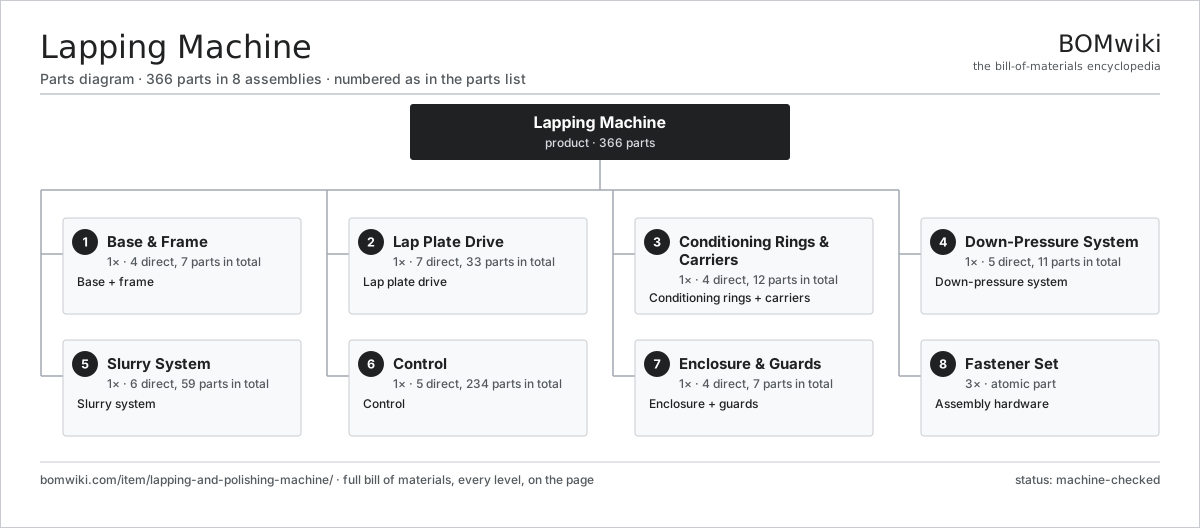
| # | Part | Qty | What it does |
|---|---|---|---|
| 1 | Base & Frame 4 parts | 1× | Base + frame |
| 2 | Lap Plate Drive 7 parts | 1× | Lap plate drive |
| 3 | Conditioning Rings & Carriers 4 parts | 1× | Conditioning rings + carriers |
| 4 | Down-Pressure System 5 parts | 1× | Down-pressure system |
| 5 | Slurry System 6 parts | 1× | Slurry system |
| 6 | Control 5 parts | 1× | Control |
| 7 | Enclosure & Guards 4 parts | 1× | Enclosure + guards |
| 8 | Fastener Set | 3× | Assembly hardware |
3D model
No 3D model yet. Have a CAD file of this? Add a 3D model — STL renders right on this page; STEP, FreeCAD, and OpenSCAD sources are welcome too (openly licensed, like all 3D models on BOMwiki).
Build & assembly graph
expand / collapse · shared sub-assemblies converge · links to related products · est. labourTap an assembly to expand/collapse · tap a part to open it · use “Open page” for any node · drag to pan, scroll to zoom.
Bill of materials for Lapping Machine
8 top-level lines · 69 rows shown · 366 parts total · indented to 3 levels| # | Item / sub-assembly | Part no. | Qty/assy | Ext. qty | Parts | Type |
|---|---|---|---|---|---|---|
| 1 | Base & Frame 4 parts | lap-machine-base | 1× | 1 | 7 | assembly |
| 1.1 | Base Casting | lap-base-casting | 1× | 1 | · | part |
| 1.2 | Plate Bearing Housing | lap-plate-bearing-housing | 1× | 1 | · | part |
| 1.3 | Leveling Foot | lap-leveling-foot | 3× | 3 | · | part |
| 1.4 | Fastener Set | fastener-set | 2× | 2 | · | part |
| 2 | Lap Plate Drive 7 parts | lap-plate-drive | 1× | 1 | 33 | assembly |
| 2.1 | Lap Plate | lap-plate | 1× | 1 | · | part |
| 2.2 | Plate Spindle | lap-plate-spindle | 1× | 1 | · | part |
| 2.3 | Plate Gearmotor 5 parts | lap-plate-motor | 1× | 1 | 26 | assembly |
| 2.3.1 | Stator Assembly 3 parts + deeper › | stator-assembly | 1× | 1 | 3 | assembly |
| 2.3.2 | Rotor Assembly 4 parts + deeper › | rotor-assembly | 1× | 1 | 19 | assembly |
| 2.3.3 | Motor Housing | motor-housing | 1× | 1 | · | part |
| 2.3.4 | Ball Bearing | ball-bearing | 2× | 2 | · | part |
| 2.3.5 | Encoder | encoder | 1× | 1 | · | part |
| 2.4 | Gearbox Housing | gearbox-housing | 1× | 1 | · | part |
| 2.5 | Helical Gear Pair | gear-pair | 1× | 1 | · | part |
| 2.6 | Ball Bearing | ball-bearing | 2× | 2 | · | part |
| 2.7 | Oil Seal | oil-seal | 1× | 1 | · | part |
| 3 | Conditioning Rings & Carriers 4 parts | lap-conditioning-rings | 1× | 1 | 12 | assembly |
| 3.1 | Conditioning Ring | lap-conditioning-ring | 3× | 3 | · | part |
| 3.2 | Part Carrier | lap-work-carrier | 3× | 3 | · | part |
| 3.3 | Ring Drive Roller | lap-ring-drive-roller | 3× | 3 | · | part |
| 3.4 | Ring Hold Arm | lap-ring-arm | 3× | 3 | · | part |
| 4 | Down-Pressure System 5 parts | lap-pressure-system | 1× | 1 | 11 | assembly |
| 4.1 | Pressure Head | lap-pressure-head | 3× | 3 | · | part |
| 4.2 | Load Cylinder 1 parts | lap-pneumatic-cylinder | 3× | 3 | · | part |
| 4.2.1 | O-Ring Set | oring-set | 1× | 3 | · | part |
| 4.3 | Pressure Regulator | lap-pressure-regulator | 1× | 1 | · | part |
| 4.4 | Load Cell | lap-load-cell | 3× | 3 | · | part |
| 4.5 | Pressure Sensor | pressure-sensor | 1× | 1 | · | part |
| 5 | Slurry System 6 parts | lap-slurry-system | 1× | 1 | 59 | assembly |
| 5.1 | Slurry Tank | lap-slurry-tank | 1× | 1 | · | part |
| 5.2 | Slurry Mixer 4 parts | lap-slurry-mixer | 1× | 1 | 25 | assembly |
| 5.2.1 | Stator Assembly 3 parts + deeper › | stator-assembly | 1× | 1 | 3 | assembly |
| 5.2.2 | Rotor Assembly 4 parts + deeper › | rotor-assembly | 1× | 1 | 19 | assembly |
| 5.2.3 | Motor Housing | motor-housing | 1× | 1 | · | part |
| 5.2.4 | Ball Bearing | ball-bearing | 2× | 2 | · | part |
| 5.3 | Slurry Pump 5 parts | lap-slurry-pump | 1× | 1 | 26 | assembly |
| 5.3.1 | Stator Assembly 3 parts + deeper › | stator-assembly | 1× | 1 | 3 | assembly |
| 5.3.2 | Rotor Assembly 4 parts + deeper › | rotor-assembly | 1× | 1 | 19 | assembly |
| 5.3.3 | Motor Housing | motor-housing | 1× | 1 | · | part |
| 5.3.4 | Ball Bearing | ball-bearing | 2× | 2 | · | part |
| 5.3.5 | Oil Seal | oil-seal | 1× | 1 | · | part |
| 5.4 | Drip Nozzle | lap-drip-nozzle | 3× | 3 | · | part |
| 5.5 | Loose Abrasive | lap-abrasive-charge | 1× | 1 | · | part |
| 5.6 | Slurry Hose | lap-slurry-hose | 3× | 3 | · | part |
| 6 | Control 5 parts | lap-control | 1× | 1 | 234 | assembly |
| 6.1 | PLC Controller 4 parts | lap-controller | 1× | 1 | 128 | assembly |
| 6.1.1 | Bare PCB | pcb-bare | 1× | 1 | · | part |
| 6.1.2 | Microcontroller | mcu | 1× | 1 | · | part |
| 6.1.3 | Relay | relay | 6× | 6 | · | part |
| 6.1.4 | SMD Passive (R/C/L) | smd-passives | 120× | 120 | · | part |
| 6.2 | Operator Display 4 parts | lap-display | 1× | 1 | 43 | assembly |
| 6.2.1 | Bare PCB | pcb-bare | 1× | 1 | · | part |
| 6.2.2 | LCD Panel | lcd-panel | 1× | 1 | · | part |
| 6.2.3 | Touch Digitizer | touch-digitizer | 1× | 1 | · | part |
| 6.2.4 | SMD Passive (R/C/L) | smd-passives | 40× | 40 | · | part |
| 6.3 | Flatness Monitor 3 parts | lap-flatness-monitor | 1× | 1 | 52 | assembly |
| 6.3.1 | Bare PCB | pcb-bare | 1× | 1 | · | part |
| 6.3.2 | Microcontroller | mcu | 1× | 1 | · | part |
| 6.3.3 | SMD Passive (R/C/L) | smd-passives | 50× | 50 | · | part |
| 6.4 | Wire Bundle | wire-bundle | 1× | 1 | · | part |
| 6.5 | Connector | connector | 10× | 10 | · | part |
| 7 | Enclosure & Guards 4 parts | lap-enclosure | 1× | 1 | 7 | assembly |
| 7.1 | Sheet Metal Panel | sheet-panel | 4× | 4 | · | part |
| 7.2 | Splash Cover | lap-splash-cover | 1× | 1 | · | part |
| 7.3 | Interlock Switch | lap-interlock-switch | 1× | 1 | · | part |
| 7.4 | Emergency Stop | lap-estop | 1× | 1 | · | part |
| 8 | Fastener Set | fastener-set | 3× | 3 | · | part |
Related products
same domain, ranked by shared parts Vertical Boring Mill
265 parts · shares 5 with this page
Bar Chamfering Machine
1,148 parts · shares 5 with this page
Vertical Boring Mill
265 parts · shares 5 with this page
Bar Chamfering Machine
1,148 parts · shares 5 with this page
 Gear Hobbing Machine
540 parts · shares 4 with this page
Gear Hobbing Machine
540 parts · shares 4 with this page
Sourcing: possible vendors
Prices, MOQ, and lead times are algorithmic estimates, not quotes, and not claims about these companies. Company mappings are curated by keyword; est. price band $10k–$1M. How estimates work| Vendor | HQ | Specialty | MOQ | Lead time |
|---|---|---|---|---|
|
🇩🇪DMG MORI
dmgmori.com ↗
|
Bielefeld, DE | Machine tools | 5 units | 12–20 wks |
|
🇯🇵Mazak
mazak.com ↗
|
Oguchi, JP | Machine tools | 5 units | 12–20 wks |
| haascnc.com ↗ | Oxnard, US | CNC machine tools | 5 units | 12–20 wks |
|
🇯🇵Okuma
okuma.com ↗
|
Niwa, JP | Machine tools | 5 units | 12–20 wks |
|
🇩🇪Trumpf
trumpf.com ↗
|
Ditzingen, DE | Laser & sheet-metal machines | 5 units | 12–20 wks |
909-word article