Flat-Die Thread Roller
ProductOverview
A flat-die thread roller forms external threads by squeezing a blank between two flat hardened dies, each carved with the inverse of the thread, and rolling it from one die across to the other. As the blank rolls, the die ridges press into its surface and displace metal up into the thread crests, so the thread is formed by cold flow rather than cut. The whole thread is rolled in a single pass of the slide in well under a second. Because no metal is removed, a rolled thread is stronger than a cut one: the grain follows the thread contour unbroken, the root is work-hardened and smooth, and there is no torn surface to start a fatigue crack. This is how the threads on the vast majority of bolts, screws, and studs are made.
The machine works by pressing a blank between a fixed and a moving die. The Machine Frame carries the dies and takes the side load, the Stationary Die is fixed while the Moving Die Slide slides across, the Blank Feed presents one blank per stroke, the Crank Drive supplies the rolling force, the Coolant System floods coolant, and the Control System times the cycle.
Frame and rolling load
Rolling a thread pushes the two dies hard apart, so the Machine Frame must resist a large steady side thrust without spreading. The Bed Casting anchors both die mounts and the Slide Way the slide rides on, while Tie Rod pre-load keeps the frame stiff so the die gap stays constant. Any spread in the frame shows up as an undersized or out-of-round thread, so frame rigidity directly sets thread quality. A Rolling Guard encloses the die gap, which throws blanks if a feed fault jams it.
The two dies
The thread is made by the matched pair of dies. The Stationary Die holds a hardened Fixed Flat Die plate in a Die Holder, with a Match Shim to bring its thread form into phase with the moving die and an Adjusting Wedge to set the gap for the thread size. Facing it, the Moving Die Slide carries a Moving Flat Die on a Slide Body that rides on Slide Gib strips, backed by a Thrust Plate. The two dies are not identical: the moving die is longer and offset so that a blank entered at one end is fully rolled by the time it leaves the other. Matching their threads in phase is the critical setup, since a mismatch rolls a doubled or shaved thread.
Blank feed and starting
Each thread is rolled on one blank, so the Blank Feed must deliver exactly one blank per stroke, square and on time. A Vibratory Hopper vibratory bowl orients the blanks and feeds them in a line down the Feed Rail. A Starter Finger, timed by the Feed Cam and sprung by Coil Spring return, pushes the next blank into the start of the die gap as the slide returns. Starting is the delicate moment: the blank must enter exactly at the thread phase or the first turn forms wrong and spoils the whole thread, so the starter timing is set precisely against the slide.
Drive and coolant
The Crank Drive reciprocates the slide with a Crankshaft turned by the Main Motor through a Helical Gearbox and Drive Belt pairs, with a Flywheel smoothing the rolling load and a Pitman Arm converting rotation to the straight stroke, all on Ball Bearing supports. Cold rolling generates heat at the die surface, so the Coolant System system runs a Coolant Pump that floods soluble oil from the Coolant Tank through Coolant Nozzle jets at the die gap and back through a Coolant Filter. The coolant lubricates the forming, washes chips of nothing since none are made, and chiefly carries away heat so the dies hold their form.
Control and feed monitoring
The Control System cabinet sets stroke rate and guards the cycle. An Microcontroller on a Bare PCB times the feed to the slide, a Power Supply feeds the logic, and Relay safety chains tie in the guard. A Feed Sensor confirms one blank per stroke, since a double feed jams the dies and a missed feed wastes a stroke, and stops the machine on either fault. The operator sets rate and watches feed status at the Operator Panel.
Blanks, dies, and use
Flat-die rolling needs a blank turned or headed to the thread pitch diameter, since the rolling adds height to the crests and cannot remove metal: too large a blank overfills the dies, too small leaves a flat-topped thread. The same blanks usually arrive headed from a Bolt Heading Machine, making the two machines a natural pair on a fastener line. Flat-die rollers are simplest and fastest for screws and small bolts up to about M12; larger work and special forms move to cylindrical two-die or planetary rollers, but the forming principle is identical to the internal version used by the Roll Tapping Machine. Rolled threads dominate fastener production because, at volume, they are faster, stronger, and waste less metal than cutting.
Flat-Die Thread Roller parts and their functions
7 top-level parts · 65 parts in total · full bill of materials below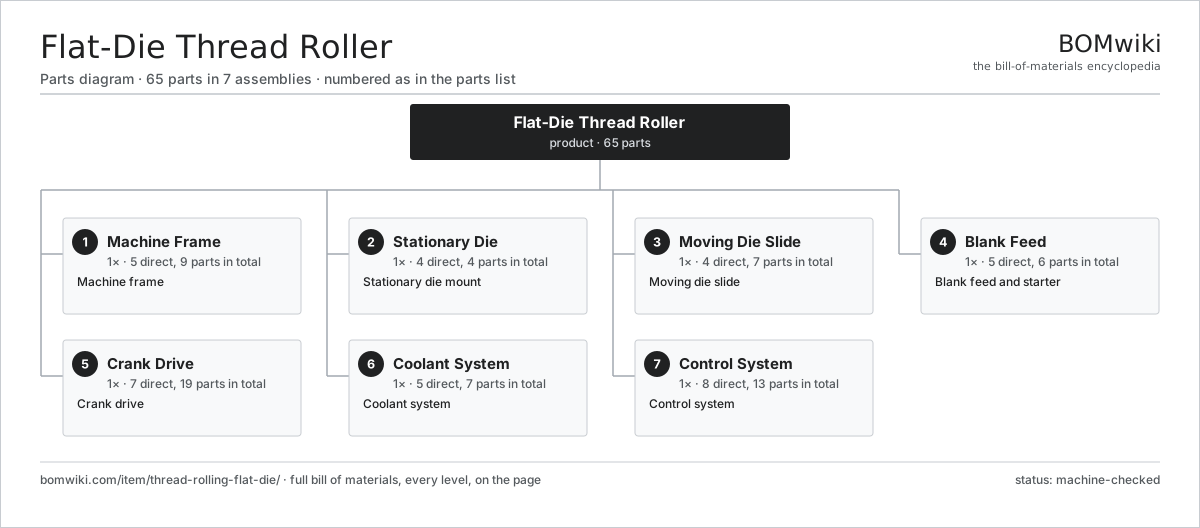
| # | Part | Qty | What it does |
|---|---|---|---|
| 1 | Machine Frame 5 parts | 1× | Machine frame |
| 2 | Stationary Die 4 parts | 1× | Stationary die mount |
| 3 | Moving Die Slide 4 parts | 1× | Moving die slide |
| 4 | Blank Feed 5 parts | 1× | Blank feed and starter |
| 5 | Crank Drive 7 parts | 1× | Crank drive |
| 6 | Coolant System 5 parts | 1× | Coolant system |
| 7 | Control System 8 parts | 1× | Control system |
3D model
No 3D model yet. Have a CAD file of this? Add a 3D model — STL renders right on this page; STEP, FreeCAD, and OpenSCAD sources are welcome too (openly licensed, like all 3D models on BOMwiki).
Build & assembly graph
expand / collapse · shared sub-assemblies converge · links to related products · est. labourTap an assembly to expand/collapse · tap a part to open it · use “Open page” for any node · drag to pan, scroll to zoom.
Bill of materials for Flat-Die Thread Roller
7 top-level lines · 49 rows shown · 65 parts total · indented to 3 levels| # | Item / sub-assembly | Part no. | Qty/assy | Ext. qty | Parts | Type |
|---|---|---|---|---|---|---|
| 1 | Machine Frame 5 parts | thread-rolling-flat-die-frame | 1× | 1 | 9 | assembly |
| 1.1 | Bed Casting | thread-rolling-flat-die-bed | 1× | 1 | · | part |
| 1.2 | Slide Way | thread-rolling-flat-die-ways | 2× | 2 | · | part |
| 1.3 | Tie Rod | thread-rolling-flat-die-tie-rod | 4× | 4 | · | part |
| 1.4 | Rolling Guard | thread-rolling-flat-die-guard | 1× | 1 | · | part |
| 1.5 | Fastener Set | fastener-set | 1× | 1 | · | part |
| 2 | Stationary Die 4 parts | thread-rolling-flat-die-stationary-die | 1× | 1 | 4 | assembly |
| 2.1 | Fixed Flat Die | thread-rolling-flat-die-fixed-die | 1× | 1 | · | part |
| 2.2 | Die Holder | thread-rolling-flat-die-die-holder | 1× | 1 | · | part |
| 2.3 | Match Shim | thread-rolling-flat-die-shim-set | 1× | 1 | · | part |
| 2.4 | Adjusting Wedge | thread-rolling-flat-die-wedge | 1× | 1 | · | part |
| 3 | Moving Die Slide 4 parts | thread-rolling-flat-die-moving-die | 1× | 1 | 7 | assembly |
| 3.1 | Slide Body | thread-rolling-flat-die-slide-body | 1× | 1 | · | part |
| 3.2 | Moving Flat Die | thread-rolling-flat-die-roll-die | 1× | 1 | · | part |
| 3.3 | Slide Gib | thread-rolling-flat-die-slide-gib | 4× | 4 | · | part |
| 3.4 | Thrust Plate | thread-rolling-flat-die-thrust-plate | 1× | 1 | · | part |
| 4 | Blank Feed 5 parts | thread-rolling-flat-die-feed | 1× | 1 | 6 | assembly |
| 4.1 | Vibratory Hopper | thread-rolling-flat-die-hopper | 1× | 1 | · | part |
| 4.2 | Feed Rail | thread-rolling-flat-die-feed-rail | 1× | 1 | · | part |
| 4.3 | Starter Finger | thread-rolling-flat-die-starter-finger | 1× | 1 | · | part |
| 4.4 | Feed Cam | thread-rolling-flat-die-feed-cam | 1× | 1 | · | part |
| 4.5 | Coil Spring | coil-spring | 2× | 2 | · | part |
| 5 | Crank Drive 7 parts | thread-rolling-flat-die-drive | 1× | 1 | 19 | assembly |
| 5.1 | Main Motor | thread-rolling-flat-die-main-motor | 1× | 1 | · | part |
| 5.2 | Flywheel | thread-rolling-flat-die-flywheel | 1× | 1 | · | part |
| 5.3 | Crankshaft | thread-rolling-flat-die-crankshaft | 1× | 1 | · | part |
| 5.4 | Pitman Arm | thread-rolling-flat-die-pitman | 1× | 1 | · | part |
| 5.5 | Drive Belt | drive-belt | 2× | 2 | · | part |
| 5.6 | Ball Bearing | ball-bearing | 4× | 4 | · | part |
| 5.7 | Helical Gearbox 4 parts | gearbox | 1× | 1 | 9 | assembly |
| 5.7.1 | Helical Gear Pair | gear-pair | 2× | 2 | · | part |
| 5.7.2 | Gearbox Housing | gearbox-housing | 1× | 1 | · | part |
| 5.7.3 | Ball Bearing | ball-bearing | 4× | 4 | · | part |
| 5.7.4 | Oil Seal | oil-seal | 2× | 2 | · | part |
| 6 | Coolant System 5 parts | thread-rolling-flat-die-lube | 1× | 1 | 7 | assembly |
| 6.1 | Coolant Pump | thread-rolling-flat-die-coolant-pump | 1× | 1 | · | part |
| 6.2 | Coolant Tank | thread-rolling-flat-die-coolant-tank | 1× | 1 | · | part |
| 6.3 | Coolant Nozzle | thread-rolling-flat-die-nozzle | 2× | 2 | · | part |
| 6.4 | Coolant Filter | thread-rolling-flat-die-filter | 1× | 1 | · | part |
| 6.5 | Oil Seal | oil-seal | 2× | 2 | · | part |
| 7 | Control System 8 parts | thread-rolling-flat-die-control | 1× | 1 | 13 | assembly |
| 7.1 | Bare PCB | pcb-bare | 1× | 1 | · | part |
| 7.2 | Microcontroller | mcu | 1× | 1 | · | part |
| 7.3 | Power Supply | power-supply | 1× | 1 | · | part |
| 7.4 | Relay | relay | 4× | 4 | · | part |
| 7.5 | Feed Sensor | thread-rolling-flat-die-feed-sensor | 1× | 1 | · | part |
| 7.6 | Operator Panel | thread-rolling-flat-die-hmi | 1× | 1 | · | part |
| 7.7 | Wire Bundle | wire-bundle | 1× | 1 | · | part |
| 7.8 | Connector | connector | 3× | 3 | · | part |
Related products
same domain, ranked by shared parts Rotary Draw Bender
821 parts · shares 4 with this page
Rotary Draw Bender
821 parts · shares 4 with this page
 Keyseating Machine
55 parts · shares 4 with this page
Slotting Machine
58 parts · shares 4 with this page
Strip Tension Leveler
513 parts · shares 4 with this page
Keyseating Machine
55 parts · shares 4 with this page
Slotting Machine
58 parts · shares 4 with this page
Strip Tension Leveler
513 parts · shares 4 with this page
Sourcing: possible vendors
Prices, MOQ, and lead times are algorithmic estimates, not quotes, and not claims about these companies. Company mappings are curated by keyword; est. price band $10k–$1M. How estimates work| Vendor | HQ | Specialty | MOQ | Lead time |
|---|---|---|---|---|
|
🇩🇪DMG MORI
dmgmori.com ↗
|
Bielefeld, DE | Machine tools | 5 units | 12–20 wks |
|
🇯🇵Mazak
mazak.com ↗
|
Oguchi, JP | Machine tools | 5 units | 12–20 wks |
| haascnc.com ↗ | Oxnard, US | CNC machine tools | 5 units | 12–20 wks |
|
🇯🇵Okuma
okuma.com ↗
|
Niwa, JP | Machine tools | 5 units | 12–20 wks |
|
🇩🇪Trumpf
trumpf.com ↗
|
Ditzingen, DE | Laser & sheet-metal machines | 5 units | 12–20 wks |
990-word article