Forging Roll Machine
ProductOverview
A forging roll machine, also called a reducer roll or roll forging machine, shapes a hot billet by passing it between two counter-rotating rolls that carry shaped die segments. The dies cover only part of each roll's circumference, so the gap opens once per revolution to admit the billet and closes to roll it. As the gripped end is pushed in, the closing dies bite and draw the billet through, spreading and lengthening it while reducing the cross-section. The machine does not finish a part on its own; it produces a preform whose mass is distributed along the length to suit the next die-forging step, typically on a press or hammer. Roll forging is common for connecting rods, axle beams, crankshaft blanks, hand tools, and turbine blade preforms, where moving metal ahead of the final forging cuts press tonnage and saves material.
Roll stand and dies
The heart of the machine is the Roll Stand, a pair of Roll Shaft units held in heavy Stand Housing castings. Each shaft carries one or more Die Segment blocks bolted around part of its circumference and locked by a Die Clamp. Because the segments span only a sector of the turn, the rest of the rotation leaves the gap open so the billet can enter freely. A row of grooves side by side lets the operator move the billet from one pass to the next, taking it down in steps. The Screw-Down Unit sets the gap and so fixes the section each pass leaves, while the Thrust Block absorbs the axial load from any asymmetry in the grooves. The roll necks run in Ball Bearing sets sealed by Oil Seal elements against scale and spray.
Drive train
Rolling a hot billet draws a large but intermittent torque, because the dies engage only part of each turn. The Drive Train handles this with a Main Drive Motor of 75 to 400 kW backed by a Flywheel that stores energy between bites and keeps roll speed steady through the stroke. A Pinion Stand splits the drive into two equal outputs so both rolls turn at the same surface speed and stay in phase, which matters because the upper and lower die segments must meet the billet at the same instant. Drive reaches each roll through a Spindle Coupling and a universal-joint Drive Spindle that allows the gap to change without binding. A Helical Gear Pair in a Gearbox Housing sets the reduction, and an Encoder on each roll reports angular position to the control so the manipulator can time billet entry to the open gap.
Manipulator and handling
The billet is held by the Billet Manipulator, whose water-cooled Gripping Tongs grip the cool tail while the hot end is presented to the rolls. The Tong Arm keeps the part in line with the chosen pass, and the Traverse Slide advances and retracts it and shifts it sideways to the next groove. Between passes the Billet Rotator turns the billet about its own axis so the section is worked evenly all the way around, which is what produces a clean round or oval preform rather than a flattened one. The Grip Cylinder closes the tongs hard enough to resist the pull-out drag as the rolls draw the billet in, and a Pressure Sensor confirms the grip is holding. On automated lines the slide runs on a Linear Guide Rail pair driven by a Servo Motor.
Lubrication, cooling, and hydraulics
Hot forging is hard on dies, so the Die Lubrication and Cooling system sprays a graphite or water-based release agent from a Spray Header onto each die segment as it rotates past, between billets. The Lubricant Pump meters it from an agitated Lubricant Mix Tank, and a Roll Coolant Circuit circuit pulls heat from the rolls so the die grooves keep their hardness. The Scale Blow-Off clears furnace scale off the billet before it can roll into the surface. The Hydraulic Power Unit feeds the grip and traverse cylinders: a Hydraulic Pump supplies 160 to 210 bar, a Valve Manifold sequences the motions, an Accumulator steadies pressure, and the Oil Cooler holds oil temperature down near the hot stand.
Control and integration
The Control Cabinet cabinet houses a PLC/CNC Control that ties roll angular position to manipulator advance, so the billet end enters at the moment the die segment opens the gap. The Operator HMI holds pass schedules, spray timing, and roll-gap recipes per part number, and a Drive Module feeds the main and servo motors. Power runs through a Power Supply, an IGBT Power Module stage, and a Relay bank, all wired by a Wire Bundle to a Connector panel. The whole stand sits on the Guarding and Base base, where a Scale Chute carries away scale and offcuts and Guard Panels shield operators from spray and the rotating dies.
Materials and use
Rolls and shafts are forged alloy steel such as 34CrNiMo6, while die segments are hot-work tool steel like H13 or 5CrNiMo hardened to resist the heat and abrasion of repeated hot contact. Billets enter at 1050 to 1250 deg C for carbon and alloy steels, lower for aluminium and copper alloys. A single machine may carry two to six grooves across its width, taking a part down in steps with up to about 40 percent area reduction per pass. Roll forging suits medium and high volume preforms where the saving in downstream press tonnage and stock weight repays the tooling, and it is often the first station on an automated forging line feeding a Billet Manipulator handoff to a press.
Forging Roll Machine parts and their functions
7 top-level parts · 135 parts in total · full bill of materials below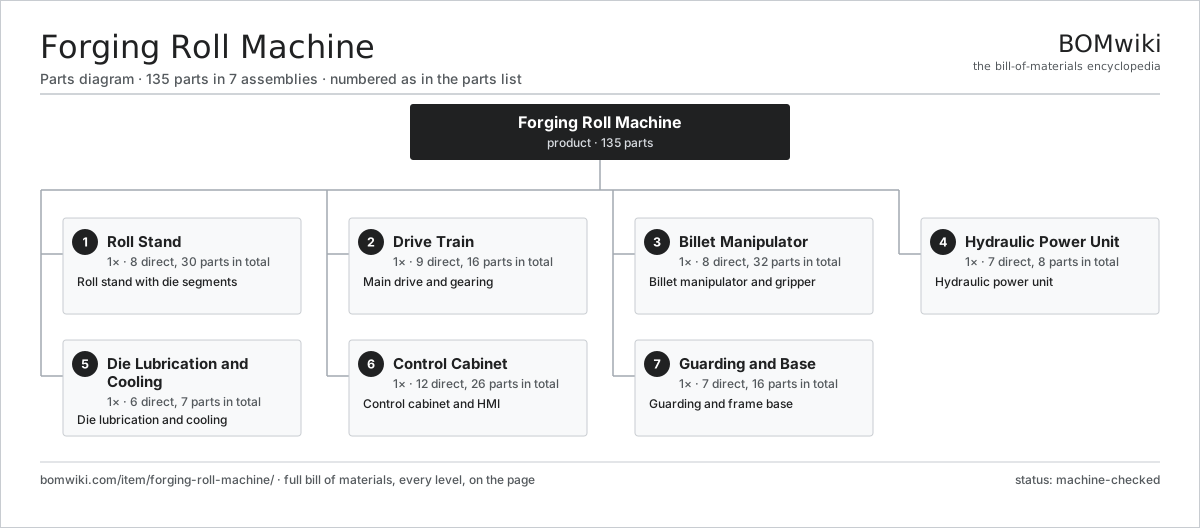
| # | Part | Qty | What it does |
|---|---|---|---|
| 1 | Roll Stand 8 parts | 1× | Roll stand with die segments |
| 2 | Drive Train 9 parts | 1× | Main drive and gearing |
| 3 | Billet Manipulator 8 parts | 1× | Billet manipulator and gripper |
| 4 | Hydraulic Power Unit 7 parts | 1× | Hydraulic power unit |
| 5 | Die Lubrication and Cooling 6 parts | 1× | Die lubrication and cooling |
| 6 | Control Cabinet 12 parts | 1× | Control cabinet and HMI |
| 7 | Guarding and Base 7 parts | 1× | Guarding and frame base |
3D model
No 3D model yet. Have a CAD file of this? Add a 3D model — STL renders right on this page; STEP, FreeCAD, and OpenSCAD sources are welcome too (openly licensed, like all 3D models on BOMwiki).
Build & assembly graph
expand / collapse · shared sub-assemblies converge · links to related products · est. labourTap an assembly to expand/collapse · tap a part to open it · use “Open page” for any node · drag to pan, scroll to zoom.
Bill of materials for Forging Roll Machine
7 top-level lines · 68 rows shown · 135 parts total · indented to 3 levels| # | Item / sub-assembly | Part no. | Qty/assy | Ext. qty | Parts | Type |
|---|---|---|---|---|---|---|
| 1 | Roll Stand 8 parts | forging-roll-machine-roll-stand | 1× | 1 | 30 | assembly |
| 1.1 | Roll Shaft | forging-roll-machine-roll-shaft | 2× | 2 | · | part |
| 1.2 | Die Segment | forging-roll-machine-die-segment | 4× | 4 | · | part |
| 1.3 | Die Clamp | forging-roll-machine-die-clamp | 4× | 4 | · | part |
| 1.4 | Stand Housing | forging-roll-machine-stand-housing | 2× | 2 | · | part |
| 1.5 | Screw-Down Unit | forging-roll-machine-screw-down | 2× | 2 | · | part |
| 1.6 | Thrust Block | forging-roll-machine-thrust-block | 2× | 2 | · | part |
| 1.7 | Ball Bearing | ball-bearing | 8× | 8 | · | part |
| 1.8 | Oil Seal | oil-seal | 6× | 6 | · | part |
| 2 | Drive Train 9 parts | forging-roll-machine-drive-train | 1× | 1 | 16 | assembly |
| 2.1 | Main Drive Motor | forging-roll-machine-main-motor | 1× | 1 | · | part |
| 2.2 | Flywheel | forging-roll-machine-flywheel | 1× | 1 | · | part |
| 2.3 | Pinion Stand | forging-roll-machine-pinion-stand | 1× | 1 | · | part |
| 2.4 | Spindle Coupling | forging-roll-machine-coupling | 2× | 2 | · | part |
| 2.5 | Drive Spindle | forging-roll-machine-spindle | 2× | 2 | · | part |
| 2.6 | Helical Gear Pair | gear-pair | 2× | 2 | · | part |
| 2.7 | Gearbox Housing | gearbox-housing | 1× | 1 | · | part |
| 2.8 | Encoder | encoder | 2× | 2 | · | part |
| 2.9 | Oil Seal | oil-seal | 4× | 4 | · | part |
| 3 | Billet Manipulator 8 parts | forging-roll-machine-manipulator | 1× | 1 | 32 | assembly |
| 3.1 | Gripping Tongs | forging-roll-machine-tongs | 1× | 1 | · | part |
| 3.2 | Tong Arm | forging-roll-machine-tong-arm | 1× | 1 | · | part |
| 3.3 | Traverse Slide | forging-roll-machine-traverse-slide | 1× | 1 | · | part |
| 3.4 | Billet Rotator | forging-roll-machine-rotator | 1× | 1 | · | part |
| 3.5 | Grip Cylinder | forging-roll-machine-grip-cylinder | 1× | 1 | · | part |
| 3.6 | Linear Guide Rail | linear-guide | 2× | 2 | · | part |
| 3.7 | Servo Motor 4 parts | servo-motor | 1× | 1 | 24 | assembly |
| 3.7.1 | Stator Assembly 3 parts + deeper › | stator-assembly | 1× | 1 | 3 | assembly |
| 3.7.2 | Rotor Assembly 4 parts + deeper › | rotor-assembly | 1× | 1 | 19 | assembly |
| 3.7.3 | Encoder | encoder | 1× | 1 | · | part |
| 3.7.4 | Motor Housing | motor-housing | 1× | 1 | · | part |
| 3.8 | Pressure Sensor | pressure-sensor | 1× | 1 | · | part |
| 4 | Hydraulic Power Unit 7 parts | forging-roll-machine-hpu | 1× | 1 | 8 | assembly |
| 4.1 | Hydraulic Pump | forging-roll-machine-hyd-pump | 1× | 1 | · | part |
| 4.2 | Oil Reservoir | forging-roll-machine-hyd-tank | 1× | 1 | · | part |
| 4.3 | Valve Manifold | forging-roll-machine-hyd-manifold | 1× | 1 | · | part |
| 4.4 | Accumulator | forging-roll-machine-accumulator | 1× | 1 | · | part |
| 4.5 | Oil Cooler | forging-roll-machine-hyd-cooler | 1× | 1 | · | part |
| 4.6 | Pressure Sensor | pressure-sensor | 2× | 2 | · | part |
| 4.7 | O-Ring Set | oring-set | 1× | 1 | · | part |
| 5 | Die Lubrication and Cooling 6 parts | forging-roll-machine-lubrication | 1× | 1 | 7 | assembly |
| 5.1 | Spray Header | forging-roll-machine-spray-header | 2× | 2 | · | part |
| 5.2 | Lubricant Pump | forging-roll-machine-spray-pump | 1× | 1 | · | part |
| 5.3 | Lubricant Mix Tank | forging-roll-machine-lube-tank | 1× | 1 | · | part |
| 5.4 | Roll Coolant Circuit | forging-roll-machine-roll-coolant | 1× | 1 | · | part |
| 5.5 | Scale Blow-Off | forging-roll-machine-scale-blowoff | 1× | 1 | · | part |
| 5.6 | Pressure Sensor | pressure-sensor | 1× | 1 | · | part |
| 6 | Control Cabinet 12 parts | forging-roll-machine-controls | 1× | 1 | 26 | assembly |
| 6.1 | PLC/CNC Control | forging-roll-machine-plc | 1× | 1 | · | part |
| 6.2 | Operator HMI | forging-roll-machine-hmi | 1× | 1 | · | part |
| 6.3 | Drive Module | forging-roll-machine-drive-module | 2× | 2 | · | part |
| 6.4 | Power Supply | power-supply | 1× | 1 | · | part |
| 6.5 | IGBT Power Module | igbt-module | 2× | 2 | · | part |
| 6.6 | Relay | relay | 6× | 6 | · | part |
| 6.7 | Bare PCB | pcb-bare | 1× | 1 | · | part |
| 6.8 | Microcontroller | mcu | 1× | 1 | · | part |
| 6.9 | SMD Passive (R/C/L) | smd-passives | 1× | 1 | · | part |
| 6.10 | Connector | connector | 8× | 8 | · | part |
| 6.11 | Wire Bundle | wire-bundle | 1× | 1 | · | part |
| 6.12 | LCD Panel | lcd-panel | 1× | 1 | · | part |
| 7 | Guarding and Base 7 parts | forging-roll-machine-guarding | 1× | 1 | 16 | assembly |
| 7.1 | Base Frame | forging-roll-machine-base-frame | 1× | 1 | · | part |
| 7.2 | Scale Chute | forging-roll-machine-scale-chute | 1× | 1 | · | part |
| 7.3 | Guard Panels | forging-roll-machine-guard-panels | 1× | 1 | · | part |
| 7.4 | Leveling Mount | forging-roll-machine-leveling | 6× | 6 | · | part |
| 7.5 | Sheet Metal Panel | sheet-panel | 4× | 4 | · | part |
| 7.6 | Coil Spring | coil-spring | 2× | 2 | · | part |
| 7.7 | Fastener Set | fastener-set | 1× | 1 | · | part |
Related products
same domain, ranked by shared parts Radial Forging Machine
288 parts · shares 9 with this page
Radial Forging Machine
288 parts · shares 9 with this page
 Rotary-Table Surface Grinder
172 parts · shares 9 with this page
Spline Rolling Machine
138 parts · shares 9 with this page
Rotary-Table Surface Grinder
172 parts · shares 9 with this page
Spline Rolling Machine
138 parts · shares 9 with this page
 Bevel Gear Generator
201 parts · shares 8 with this page
Bevel Gear Generator
201 parts · shares 8 with this page
 Forging Trim Press
190 parts · shares 8 with this page
Forging Trim Press
190 parts · shares 8 with this page
Sourcing: possible vendors
Prices, MOQ, and lead times are algorithmic estimates, not quotes, and not claims about these companies. Company mappings are curated by keyword; est. price band $10k–$1M. How estimates work| Vendor | HQ | Specialty | MOQ | Lead time |
|---|---|---|---|---|
|
🇩🇪DMG MORI
dmgmori.com ↗
|
Bielefeld, DE | Machine tools | 5 units | 12–20 wks |
|
🇯🇵Mazak
mazak.com ↗
|
Oguchi, JP | Machine tools | 5 units | 12–20 wks |
| haascnc.com ↗ | Oxnard, US | CNC machine tools | 5 units | 12–20 wks |
|
🇯🇵Okuma
okuma.com ↗
|
Niwa, JP | Machine tools | 5 units | 12–20 wks |
|
🇩🇪Trumpf
trumpf.com ↗
|
Ditzingen, DE | Laser & sheet-metal machines | 5 units | 12–20 wks |
1,030-word article