Downpipe Rollforming Machine
ProductOverview
A downpipe rollforming machine turns a flat coil of thin steel strip into round rainwater downpipe in one continuous pass. It is a cold process: the strip is never heated. Instead it runs through a line of forming stands, and each stand bends it a little more, so that a flat ribbon leaves the decoiler and a closed round tube comes off the far end. The machine then cuts that tube to length and drops the finished pieces on a table for the operator to stack. Because the work is continuous and the only consumable is the coil, a rollformer makes downpipe far faster and cheaper than bending or welding tube one piece at a time, which is why roofing and rainwater fabricators run these lines to stock standard sizes.
The strip starts on the Decoiler, passes through the Strip Feed and Guide that levels and guides it, and enters the Roll-Forming Stations where it is bent into a round. The Seam Closing Unit closes the two edges, the Drive System turns every stand together, the Cutoff Unit crops each length, and the Run-out Table catches it. The PLC Control Panel paces the whole line, the Lubrication System keeps the bearings and chain oiled, and the Machine Frame holds every stand on one straight axis.
How rollforming makes a round
Rollforming works by spreading one large bend over many small ones. A downpipe is a closed circle, which is a hard shape to make in a single press, so the line makes it gradually. The first stands lift the two edges of the strip only a few degrees. The middle stands keep curling the section, raising the edges higher and pulling the centre down, so the cross-section moves from a flat strip toward a U, then toward a deep C. The last stands close the C into a round and bring the two edges together at the top. Forming the metal in small steps keeps it from wrinkling, splitting, or tearing at the edge, which is the failure that happens when a thin strip is bent too far at once.
Each pass is set by a pair of profiled rolls. A Top Forming Roll pushes the strip down into the curve while a Bottom Forming Roll carries it and forms the lower part of the section. Once the section is deep enough that the edges stand up, a Side Forming Roll works from the side to bend those edges inward. The final passes use a Sizing Roll that rounds the tube to the exact diameter and squeezes out the spring-back, the small amount by which cold-formed steel tries to open back up after each bend. The rolls are hardened bearing steel because thin galvanized strip is abrasive and the profile has to hold its shape over long runs.
Decoiler and strip feed
The line cannot pull from a loose coil, so the Decoiler holds the coil on an Expanding Mandrel that expands into the coil bore to centre and grip it. A Tension Brake keeps back-tension on the strip so it pays off smoothly instead of overrunning, and a Coil Keeper Arm presses on the outer wrap so the coil does not spring open when the strapping is cut.
From there the Strip Feed and Guide takes over. A pair of driven Pinch Roll draws the strip off the coil and into the line. The strip carries coil set, a curve left from being wound, and sometimes edge wave, so it passes through a Strip Leveller, a bank of small offset rolls that flex the strip back and forth until it lies flat. An Edge Guide keeps the strip tracking on the line centre, because a strip that wanders even a millimetre will form an out-of-round or crooked-seam pipe.
Seam, drive, and cutoff
Closing the round is not enough on its own, because the two edges have to be held together. The Seam Closing Unit does this with a Seam Closing Roll that folds the two raised edges over each other and a Lock-Seam Roll that presses the fold flat into a lock seam. The seam is what keeps the pipe round and sheds water, so on a downpipe it is a mechanical fold rather than a weld, which suits the thin coated strip and needs no power.
Every stand has to turn at the same surface speed or the strip would stretch or bunch between stations, so the Drive System drives them all from one source. A Drive Motor feeds the Reduction Gearbox, which drops the speed and raises torque, and a single Roller Chain runs along the line driving a Shaft Sprocket on each bottom shaft.
Cutting a moving tube is the last problem. The Cutoff Unit solves it with a flying head: a Round Cutting Die grips and supports the round so it is not crushed, a Cutting Cylinder driven by the Hydraulic Power Pack pushes the Cutoff Blade through the wall, and the whole head rides a Flying Carriage that moves with the pipe during the cut, then returns. A Length Encoder measures length so the cut fires at the set point.
Control, materials, and use
The PLC Control Panel runs the line. The operator enters a length and a quantity on the Operator HMI, the PLC counts the length from the encoder, paces the Variable Frequency Drive that sets line speed, and fires the cut, so a batch runs without a hand on the controls. The Servo Motor trims feed position so each piece lands within about a millimetre and a half.
Downpipe strip is thin galvanized or colour-coated steel, usually 0.3 to 0.6 mm, chosen because the coating gives the rust protection a rainwater pipe needs while the metal stays light. The forming rolls and the cut tooling are sized to one profile, so a line set for 90 mm round pipe makes only that size until the rolls are changed. A typical line carries 12 to 16 stands and runs at 15 to 25 metres a minute, and the same machine layout makes square downpipe or different diameters by swapping the roll sets and the cut die. The output stocks the round downpipe that hangs from gutters on houses and sheds, sold in standard lengths and cut to fit on site.
Downpipe Rollforming Machine parts and their functions
10 top-level parts · 414 parts in total · full bill of materials below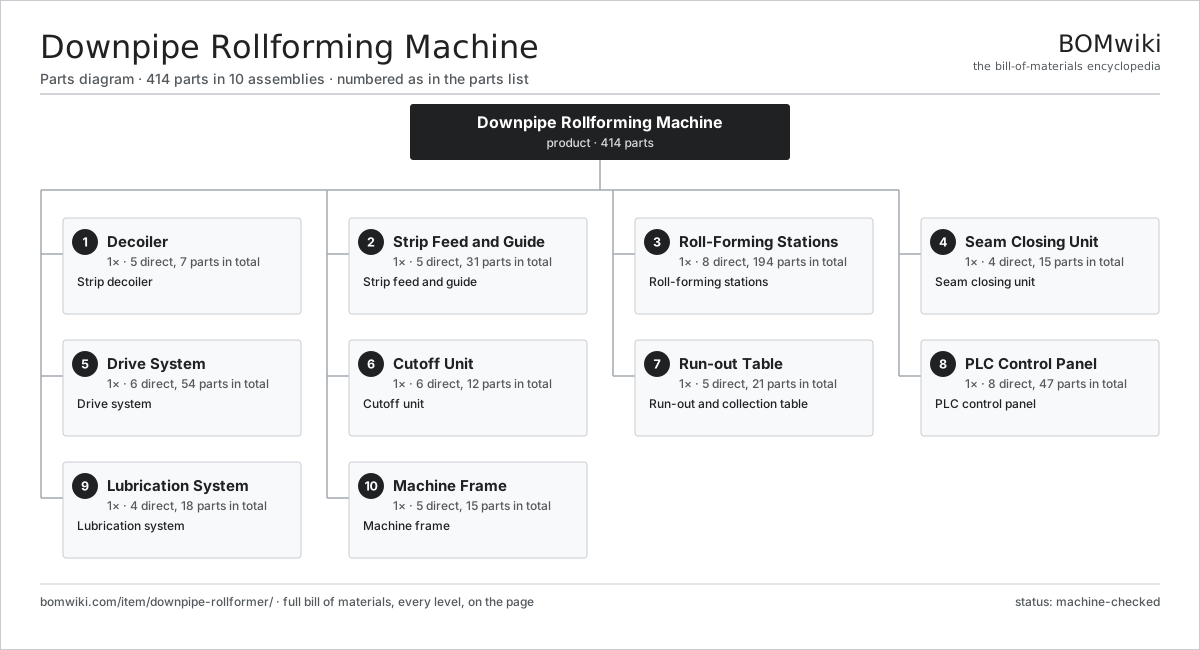
| # | Part | Qty | What it does |
|---|---|---|---|
| 1 | Decoiler 5 parts | 1× | Strip decoiler |
| 2 | Strip Feed and Guide 5 parts | 1× | Strip feed and guide |
| 3 | Roll-Forming Stations 8 parts | 1× | Roll-forming stations |
| 4 | Seam Closing Unit 4 parts | 1× | Seam closing unit |
| 5 | Drive System 6 parts | 1× | Drive system |
| 6 | Cutoff Unit 6 parts | 1× | Cutoff unit |
| 7 | Run-out Table 5 parts | 1× | Run-out and collection table |
| 8 | PLC Control Panel 8 parts | 1× | PLC control panel |
| 9 | Lubrication System 4 parts | 1× | Lubrication system |
| 10 | Machine Frame 5 parts | 1× | Machine frame |
3D model
No 3D model yet. Have a CAD file of this? Add a 3D model — STL renders right on this page; STEP, FreeCAD, and OpenSCAD sources are welcome too (openly licensed, like all 3D models on BOMwiki).
Build & assembly graph
expand / collapse · shared sub-assemblies converge · links to related products · est. labourTap an assembly to expand/collapse · tap a part to open it · use “Open page” for any node · drag to pan, scroll to zoom.
Bill of materials for Downpipe Rollforming Machine
10 top-level lines · 93 rows shown · 414 parts total · indented to 3 levels| # | Item / sub-assembly | Part no. | Qty/assy | Ext. qty | Parts | Type |
|---|---|---|---|---|---|---|
| 1 | Decoiler 5 parts | downpipe-rollformer-decoiler | 1× | 1 | 7 | assembly |
| 1.1 | Expanding Mandrel | downpipe-rollformer-decoiler-mandrel | 1× | 1 | · | part |
| 1.2 | Decoiler Frame | downpipe-rollformer-decoiler-frame | 1× | 1 | · | part |
| 1.3 | Tension Brake | downpipe-rollformer-decoiler-brake | 1× | 1 | · | part |
| 1.4 | Coil Keeper Arm | downpipe-rollformer-coil-keeper | 2× | 2 | · | part |
| 1.5 | Ball Bearing | ball-bearing | 2× | 2 | · | part |
| 2 | Strip Feed and Guide 5 parts | downpipe-rollformer-feed | 1× | 1 | 31 | assembly |
| 2.1 | Pinch Roll | downpipe-rollformer-pinch-roll | 2× | 2 | · | part |
| 2.2 | Strip Leveller 3 parts | downpipe-rollformer-leveller | 1× | 1 | 22 | assembly |
| 2.2.1 | Leveller Roll | downpipe-rollformer-leveller-roll | 7× | 7 | · | part |
| 2.2.2 | Leveller Frame | downpipe-rollformer-leveller-frame | 1× | 1 | · | part |
| 2.2.3 | Ball Bearing | ball-bearing | 14× | 14 | · | part |
| 2.3 | Edge Guide | downpipe-rollformer-edge-guide | 2× | 2 | · | part |
| 2.4 | Entry Table | downpipe-rollformer-entry-table | 1× | 1 | · | part |
| 2.5 | Ball Bearing | ball-bearing | 4× | 4 | · | part |
| 3 | Roll-Forming Stations 8 parts | downpipe-rollformer-forming | 1× | 1 | 194 | assembly |
| 3.1 | Forming Stand | downpipe-rollformer-form-stand | 14× | 14 | · | part |
| 3.2 | Top Forming Roll | downpipe-rollformer-top-roll | 14× | 14 | · | part |
| 3.3 | Bottom Forming Roll | downpipe-rollformer-bottom-roll | 14× | 14 | · | part |
| 3.4 | Side Forming Roll | downpipe-rollformer-side-roll | 8× | 8 | · | part |
| 3.5 | Sizing Roll | downpipe-rollformer-sizing-roll | 4× | 4 | · | part |
| 3.6 | Roll Shaft | downpipe-rollformer-roll-shaft | 28× | 28 | · | part |
| 3.7 | Roll Spacer | downpipe-rollformer-roll-spacer | 56× | 56 | · | part |
| 3.8 | Ball Bearing | ball-bearing | 56× | 56 | · | part |
| 4 | Seam Closing Unit 4 parts | downpipe-rollformer-seam | 1× | 1 | 15 | assembly |
| 4.1 | Seam Closing Roll | downpipe-rollformer-seam-roll | 4× | 4 | · | part |
| 4.2 | Lock-Seam Roll | downpipe-rollformer-lock-roll | 2× | 2 | · | part |
| 4.3 | Seam Guide Shoe | downpipe-rollformer-seam-guide | 1× | 1 | · | part |
| 4.4 | Ball Bearing | ball-bearing | 8× | 8 | · | part |
| 5 | Drive System 6 parts | downpipe-rollformer-drive | 1× | 1 | 54 | assembly |
| 5.1 | Drive Motor 4 parts | downpipe-rollformer-drive-motor | 1× | 1 | 25 | assembly |
| 5.1.1 | Stator Assembly 3 parts + deeper › | stator-assembly | 1× | 1 | 3 | assembly |
| 5.1.2 | Rotor Assembly 4 parts + deeper › | rotor-assembly | 1× | 1 | 19 | assembly |
| 5.1.3 | Ball Bearing | ball-bearing | 2× | 2 | · | part |
| 5.1.4 | Motor Cooling Fan | downpipe-rollformer-motor-fan | 1× | 1 | · | part |
| 5.2 | Reduction Gearbox 4 parts | downpipe-rollformer-gearbox | 1× | 1 | 8 | assembly |
| 5.2.1 | Helical Gear Pair | gear-pair | 1× | 1 | · | part |
| 5.2.2 | Gearbox Housing | gearbox-housing | 1× | 1 | · | part |
| 5.2.3 | Ball Bearing | ball-bearing | 4× | 4 | · | part |
| 5.2.4 | Oil Seal | oil-seal | 2× | 2 | · | part |
| 5.3 | Shaft Sprocket | downpipe-rollformer-drive-sprocket | 16× | 16 | · | part |
| 5.4 | Roller Chain | downpipe-rollformer-drive-chain | 1× | 1 | · | part |
| 5.5 | Chain Tensioner | downpipe-rollformer-chain-tensioner | 2× | 2 | · | part |
| 5.6 | Shaft Coupling | downpipe-rollformer-coupling | 2× | 2 | · | part |
| 6 | Cutoff Unit 6 parts | downpipe-rollformer-cutoff | 1× | 1 | 12 | assembly |
| 6.1 | Round Cutting Die | downpipe-rollformer-cut-die | 1× | 1 | · | part |
| 6.2 | Cutoff Blade | downpipe-rollformer-cut-blade | 1× | 1 | · | part |
| 6.3 | Cutting Cylinder | downpipe-rollformer-cut-cylinder | 1× | 1 | · | part |
| 6.4 | Flying Carriage | downpipe-rollformer-cut-carriage | 1× | 1 | · | part |
| 6.5 | Hydraulic Power Pack 6 parts | downpipe-rollformer-hpu | 1× | 1 | 7 | assembly |
| 6.5.1 | Hydraulic Pump | downpipe-rollformer-hyd-pump | 1× | 1 | · | part |
| 6.5.2 | Pump Motor | downpipe-rollformer-hyd-motor | 1× | 1 | · | part |
| 6.5.3 | Oil Tank | downpipe-rollformer-hyd-tank | 1× | 1 | · | part |
| 6.5.4 | Directional Valve | downpipe-rollformer-hyd-valve | 2× | 2 | · | part |
| 6.5.5 | Pressure Sensor | pressure-sensor | 1× | 1 | · | part |
| 6.5.6 | O-Ring Set | oring-set | 1× | 1 | · | part |
| 6.6 | Length Encoder | downpipe-rollformer-cut-encoder | 1× | 1 | · | part |
| 7 | Run-out Table 5 parts | downpipe-rollformer-runout | 1× | 1 | 21 | assembly |
| 7.1 | Run-out Frame | downpipe-rollformer-runout-frame | 1× | 1 | · | part |
| 7.2 | Support Roller | downpipe-rollformer-runout-roller | 6× | 6 | · | part |
| 7.3 | End Stop | downpipe-rollformer-runout-stop | 1× | 1 | · | part |
| 7.4 | Collection Cradle | downpipe-rollformer-runout-cradle | 1× | 1 | · | part |
| 7.5 | Ball Bearing | ball-bearing | 12× | 12 | · | part |
| 8 | PLC Control Panel 8 parts | downpipe-rollformer-control | 1× | 1 | 47 | assembly |
| 8.1 | PLC 3 parts | downpipe-rollformer-plc | 1× | 1 | 3 | assembly |
| 8.1.1 | Bare PCB | pcb-bare | 1× | 1 | · | part |
| 8.1.2 | Microcontroller | mcu | 1× | 1 | · | part |
| 8.1.3 | SMD Passive (R/C/L) | smd-passives | 1× | 1 | · | part |
| 8.2 | Operator HMI 3 parts | downpipe-rollformer-hmi | 1× | 1 | 3 | assembly |
| 8.2.1 | LCD Panel | lcd-panel | 1× | 1 | · | part |
| 8.2.2 | Bare PCB | pcb-bare | 1× | 1 | · | part |
| 8.2.3 | Microcontroller | mcu | 1× | 1 | · | part |
| 8.3 | Variable Frequency Drive | downpipe-rollformer-vfd | 1× | 1 | · | part |
| 8.4 | Servo Motor 4 parts | servo-motor | 1× | 1 | 24 | assembly |
| 8.4.1 | Stator Assembly 3 parts + deeper › | stator-assembly | 1× | 1 | 3 | assembly |
| 8.4.2 | Rotor Assembly 4 parts + deeper › | rotor-assembly | 1× | 1 | 19 | assembly |
| 8.4.3 | Encoder | encoder | 1× | 1 | · | part |
| 8.4.4 | Motor Housing | motor-housing | 1× | 1 | · | part |
| 8.5 | Relay | relay | 6× | 6 | · | part |
| 8.6 | Power Supply | power-supply | 1× | 1 | · | part |
| 8.7 | Connector | connector | 8× | 8 | · | part |
| 8.8 | Wire Bundle | wire-bundle | 1× | 1 | · | part |
| 9 | Lubrication System 4 parts | downpipe-rollformer-lube | 1× | 1 | 18 | assembly |
| 9.1 | Lube Pump | downpipe-rollformer-lube-pump | 1× | 1 | · | part |
| 9.2 | Distribution Manifold | downpipe-rollformer-lube-manifold | 1× | 1 | · | part |
| 9.3 | Lube Line | downpipe-rollformer-lube-line | 12× | 12 | · | part |
| 9.4 | Oil Seal | oil-seal | 4× | 4 | · | part |
| 10 | Machine Frame 5 parts | downpipe-rollformer-frame | 1× | 1 | 15 | assembly |
| 10.1 | Base Beam | downpipe-rollformer-base-beam | 2× | 2 | · | part |
| 10.2 | Stand Mounting Rail | downpipe-rollformer-stand-rail | 2× | 2 | · | part |
| 10.3 | Guard Panel | downpipe-rollformer-guard-panel | 4× | 4 | · | part |
| 10.4 | Levelling Foot | downpipe-rollformer-leveling-foot | 6× | 6 | · | part |
| 10.5 | Fastener Set | fastener-set | 1× | 1 | · | part |
Related products
same domain, ranked by shared parts Bed-Type Milling Machine
151 parts · shares 5 with this page
Bed-Type Milling Machine
151 parts · shares 5 with this page
 Bevel Gear Generator
201 parts · shares 5 with this page
Centering and Facing Machine
1,419 parts · shares 5 with this page
Bevel Gear Generator
201 parts · shares 5 with this page
Centering and Facing Machine
1,419 parts · shares 5 with this page
 Creep-Feed Grinder
571 parts · shares 5 with this page
Cut-to-Length Line
500 parts · shares 5 with this page
Drag Finishing Machine
735 parts · shares 5 with this page
Creep-Feed Grinder
571 parts · shares 5 with this page
Cut-to-Length Line
500 parts · shares 5 with this page
Drag Finishing Machine
735 parts · shares 5 with this page
Sourcing: possible vendors
Prices, MOQ, and lead times are algorithmic estimates, not quotes, and not claims about these companies. Company mappings are curated by keyword; est. price band $10k–$1M. How estimates work| Vendor | HQ | Specialty | MOQ | Lead time |
|---|---|---|---|---|
|
🇩🇪DMG MORI
dmgmori.com ↗
|
Bielefeld, DE | Machine tools | 5 units | 12–20 wks |
|
🇯🇵Mazak
mazak.com ↗
|
Oguchi, JP | Machine tools | 5 units | 12–20 wks |
| haascnc.com ↗ | Oxnard, US | CNC machine tools | 5 units | 12–20 wks |
|
🇯🇵Okuma
okuma.com ↗
|
Niwa, JP | Machine tools | 5 units | 12–20 wks |
|
🇩🇪Trumpf
trumpf.com ↗
|
Ditzingen, DE | Laser & sheet-metal machines | 5 units | 12–20 wks |
1,106-word article