Heat Treatment Furnace
ProductOverview
A heat treatment furnace heats metal parts to a controlled temperature, holds them there, and then cools them in a controlled way to change their internal structure and so their hardness, strength, and toughness. The same machine can run several processes by changing the temperature profile and the cooling step. Heating steel above its transformation point and quenching it makes it hard but brittle, reheating to a lower temperature in a tempering step trades some hardness back for toughness, and a slow furnace cool anneals the part to soften it for machining. Whatever the recipe, the furnace exists to hold the work at a known temperature for a known time, because the structure that results depends on temperature and time.
The machine is built from the Furnace Chamber that holds the heat, the Heating System that makes it, the Charging Door that seals and opens the chamber, the Atmosphere System system that protects the part surface, the Quench Tank tank that cools the work fast, the Charge Handling that moves loads through, and the Control System system that runs the cycle and enforces the safety limits.
Chamber and insulation
The Furnace Chamber keeps the heat where the work is. A welded Furnace Shell carries layers of insulation: a hot face of lightweight Firebrick that resists the temperature and stores little heat, backed by Fibre Blanket that blocks loss through the shell so the outside stays cool and the furnace heats and cools quickly. The load rests on alloy Hearth Plate pieces. For atmosphere work the chamber holds an Alloy Muffle, a sealed alloy box that puts the heating elements outside the work space so the gas around the parts can be controlled. Low thermal mass matters because it sets how fast the furnace can ramp and recover after a cold load goes in.
Heating and temperature control
Heat comes from the Heating System. Banks of Heating Element resistance wire or strip, held by ceramic Element Holder supports and fed through Bus Bar conductors and Terminal Block connections, glow and radiate heat to the chamber. Nickel-chromium wire is used up to about 1150 C and iron-chromium- aluminium for higher ranges. The temperature is read by sheathed Thermocouple sensors and held by the Programmable Controller, which compares the reading to the recipe and adjusts the power. Rather than switching elements fully on and off, the SCR Power Unit thyristors vary the power smoothly, which holds the set point closely and keeps the temperature uniform across the load. Good uniformity, on the order of plus or minus 5 C, is what makes every part in a batch come out the same.
Door and charge handling
The Charging Door seals the chamber against heat and atmosphere loss. An insulated Door Plug fills the opening and seats against the Door Frame on a ceramic Door Seal rope. Because the door is heavy and hot, the Door Lift uses a Servo Motor and a Ball Screw running on Linear Guide Rail rails, with Coil Spring counterbalances, to raise it. Work moves through on the Charge Handling system: parts ride in alloy Charge Tray baskets that the Pusher indexes along Roller Rail rails one position at a time, driven by the Hydraulic Pump feeding the Pusher Cylinder.
Protective atmosphere
At red heat, bare steel reacts with air: it scales and loses carbon from the surface, which ruins the case on a hardened part. The Atmosphere System system stops that. A Gas Inlet manifold feeds gas set by Flow Meter meters, and a high-temperature Circulation Fan with an alloy Fan Wheel stirs it so every part sees the same gas and heat. A plain protective atmosphere of nitrogen or endothermic gas keeps the surface clean. For case hardening, hydrocarbon gas is added to raise the carbon potential so carbon diffuses into the steel surface, and a zirconia Carbon Probe measures that potential in real time so the controller can hold it. When the door opens, a Flame Curtain burns off escaping gas and blocks air from entering.
Quenching
For hardening, the part must be cooled fast enough to trap the hard structure before it can transform back, and that is the job of the Quench Tank. In a sealed-quench furnace the hot load drops on the Quench Elevator straight into the Quench Tank Body without ever touching air. The Quench Agitator drives quenchant past the work so the cooling is fast and even, and a Quench Cooler removes the heat the load dumps in so the bath stays at temperature; Heating Element pre-heaters bring cold oil up to working temperature before a run. The choice of quenchant, fast oil, slow oil, or a water-based polymer, sets the cooling rate to match the steel, since too slow leaves the part soft and too fast can crack it.
Processes, materials, and limits
This furnace runs the common steel heat treatments: hardening then tempering of tool and alloy steels, gas carburising of low-carbon steel for a hard wear surface over a tough core, annealing and normalising to soften and refine, and stress relief of weldments. It handles carbon and alloy steels, tool steels, and many stainless grades, with the temperature and atmosphere set per recipe. The limits come from physics and chemistry. Maximum temperature is fixed by the elements and the lining, so very high temperature work needs a different element type or a vacuum furnace. Heavy or oddly shaped parts heat and quench unevenly, which can warp or crack them, so loading and fixturing matter. The Atmosphere System must be tight, since a leak scales the parts and wastes gas. Because a runaway furnace is dangerous, an independent Over-temperature Cutout on a separate thermocouple cuts power if the chamber overheats, working apart from the main controller so a single fault cannot defeat it. Within these limits the furnace is the standard tool for giving steel parts the hardness and toughness their service demands.
Heat Treatment Furnace parts and their functions
7 top-level parts · 299 parts in total · full bill of materials below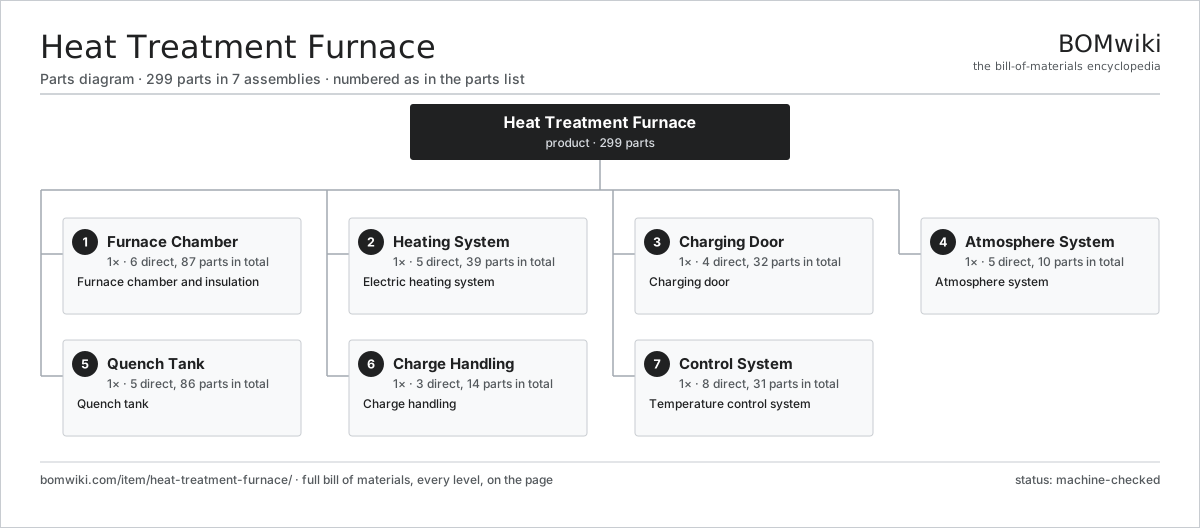
| # | Part | Qty | What it does |
|---|---|---|---|
| 1 | Furnace Chamber 6 parts | 1× | Furnace chamber and insulation |
| 2 | Heating System 5 parts | 1× | Electric heating system |
| 3 | Charging Door 4 parts | 1× | Charging door |
| 4 | Atmosphere System 5 parts | 1× | Atmosphere system |
| 5 | Quench Tank 5 parts | 1× | Quench tank |
| 6 | Charge Handling 3 parts | 1× | Charge handling |
| 7 | Control System 8 parts | 1× | Temperature control system |
3D model
No 3D model yet. Have a CAD file of this? Add a 3D model — STL renders right on this page; STEP, FreeCAD, and OpenSCAD sources are welcome too (openly licensed, like all 3D models on BOMwiki).
Build & assembly graph
expand / collapse · shared sub-assemblies converge · links to related products · est. labourTap an assembly to expand/collapse · tap a part to open it · use “Open page” for any node · drag to pan, scroll to zoom.
Bill of materials for Heat Treatment Furnace
7 top-level lines · 67 rows shown · 299 parts total · indented to 3 levels| # | Item / sub-assembly | Part no. | Qty/assy | Ext. qty | Parts | Type |
|---|---|---|---|---|---|---|
| 1 | Furnace Chamber 6 parts | heat-treatment-furnace-chamber | 1× | 1 | 87 | assembly |
| 1.1 | Furnace Shell | heat-treatment-furnace-shell | 1× | 1 | · | part |
| 1.2 | Firebrick | heat-treatment-furnace-firebrick | 60× | 60 | · | part |
| 1.3 | Fibre Blanket | heat-treatment-furnace-fibre-blanket | 20× | 20 | · | part |
| 1.4 | Hearth Plate | heat-treatment-furnace-hearth-plate | 4× | 4 | · | part |
| 1.5 | Alloy Muffle | heat-treatment-furnace-muffle | 1× | 1 | · | part |
| 1.6 | Fastener Set | fastener-set | 1× | 1 | · | part |
| 2 | Heating System 5 parts | heat-treatment-furnace-heating-system | 1× | 1 | 39 | assembly |
| 2.1 | Heating Element | heating-element | 12× | 12 | · | part |
| 2.2 | Element Holder | heat-treatment-furnace-element-holder | 12× | 12 | · | part |
| 2.3 | Bus Bar | heat-treatment-furnace-bus-bar | 6× | 6 | · | part |
| 2.4 | Terminal Block | heat-treatment-furnace-terminal-block | 6× | 6 | · | part |
| 2.5 | Thermocouple | heat-treatment-furnace-thermocouple | 3× | 3 | · | part |
| 3 | Charging Door 4 parts | heat-treatment-furnace-door | 1× | 1 | 32 | assembly |
| 3.1 | Door Plug | heat-treatment-furnace-door-plug | 1× | 1 | · | part |
| 3.2 | Door Frame | heat-treatment-furnace-door-frame | 1× | 1 | · | part |
| 3.3 | Door Lift 4 parts | heat-treatment-furnace-door-lift | 1× | 1 | 29 | assembly |
| 3.3.1 | Servo Motor 4 parts + deeper › | servo-motor | 1× | 1 | 24 | assembly |
| 3.3.2 | Ball Screw | ball-screw | 1× | 1 | · | part |
| 3.3.3 | Linear Guide Rail | linear-guide | 2× | 2 | · | part |
| 3.3.4 | Coil Spring | coil-spring | 2× | 2 | · | part |
| 3.4 | Door Seal | heat-treatment-furnace-door-seal | 1× | 1 | · | part |
| 4 | Atmosphere System 5 parts | heat-treatment-furnace-atmosphere | 1× | 1 | 10 | assembly |
| 4.1 | Gas Inlet | heat-treatment-furnace-gas-inlet | 1× | 1 | · | part |
| 4.2 | Flow Meter | heat-treatment-furnace-flow-meter | 2× | 2 | · | part |
| 4.3 | Circulation Fan 4 parts | heat-treatment-furnace-circulation-fan | 1× | 1 | 5 | assembly |
| 4.3.1 | Fan Wheel | heat-treatment-furnace-fan-wheel | 1× | 1 | · | part |
| 4.3.2 | Fan Shaft | heat-treatment-furnace-fan-shaft | 1× | 1 | · | part |
| 4.3.3 | Ball Bearing | ball-bearing | 2× | 2 | · | part |
| 4.3.4 | Oil Seal | oil-seal | 1× | 1 | · | part |
| 4.4 | Carbon Probe | heat-treatment-furnace-oxygen-probe | 1× | 1 | · | part |
| 4.5 | Flame Curtain | heat-treatment-furnace-flame-curtain | 1× | 1 | · | part |
| 5 | Quench Tank 5 parts | heat-treatment-furnace-quench | 1× | 1 | 86 | assembly |
| 5.1 | Quench Tank Body | heat-treatment-furnace-quench-tank | 1× | 1 | · | part |
| 5.2 | Quench Agitator 3 parts | heat-treatment-furnace-quench-agitator | 2× | 2 | 27 | assembly |
| 5.2.1 | Agitator Impeller | heat-treatment-furnace-agitator-impeller | 1× | 2 | · | part |
| 5.2.2 | Servo Motor 4 parts + deeper › | servo-motor | 1× | 2 | 24 | assembly |
| 5.2.3 | Ball Bearing | ball-bearing | 2× | 4 | · | part |
| 5.3 | Quench Cooler | heat-treatment-furnace-quench-cooler | 1× | 1 | · | part |
| 5.4 | Quench Elevator 4 parts | heat-treatment-furnace-quench-elevator | 1× | 1 | 28 | assembly |
| 5.4.1 | Elevator Platform | heat-treatment-furnace-elevator-platform | 1× | 1 | · | part |
| 5.4.2 | Ball Screw | ball-screw | 1× | 1 | · | part |
| 5.4.3 | Servo Motor 4 parts + deeper › | servo-motor | 1× | 1 | 24 | assembly |
| 5.4.4 | Linear Guide Rail | linear-guide | 2× | 2 | · | part |
| 5.5 | Heating Element | heating-element | 2× | 2 | · | part |
| 6 | Charge Handling 3 parts | heat-treatment-furnace-charge-handling | 1× | 1 | 14 | assembly |
| 6.1 | Charge Tray | heat-treatment-furnace-charge-tray | 6× | 6 | · | part |
| 6.2 | Pusher 4 parts | heat-treatment-furnace-pusher | 1× | 1 | 4 | assembly |
| 6.2.1 | Pusher Cylinder | heat-treatment-furnace-pusher-cylinder | 1× | 1 | · | part |
| 6.2.2 | Hydraulic Pump | heat-treatment-furnace-hydraulic-pump | 1× | 1 | · | part |
| 6.2.3 | O-Ring Set | oring-set | 1× | 1 | · | part |
| 6.2.4 | Pressure Sensor | pressure-sensor | 1× | 1 | · | part |
| 6.3 | Roller Rail | heat-treatment-furnace-roller-rail | 4× | 4 | · | part |
| 7 | Control System 8 parts | heat-treatment-furnace-control | 1× | 1 | 31 | assembly |
| 7.1 | Programmable Controller 3 parts | heat-treatment-furnace-controller | 1× | 1 | 3 | assembly |
| 7.1.1 | Bare PCB | pcb-bare | 1× | 1 | · | part |
| 7.1.2 | Microcontroller | mcu | 1× | 1 | · | part |
| 7.1.3 | SMD Passive (R/C/L) | smd-passives | 1× | 1 | · | part |
| 7.2 | SCR Power Unit | heat-treatment-furnace-scr-unit | 3× | 3 | · | part |
| 7.3 | Operator Panel 2 parts | heat-treatment-furnace-operator-panel | 1× | 1 | 2 | assembly |
| 7.3.1 | LCD Panel | lcd-panel | 1× | 1 | · | part |
| 7.3.2 | Membrane Keypad | heat-treatment-furnace-membrane-keypad | 1× | 1 | · | part |
| 7.4 | Over-temperature Cutout | heat-treatment-furnace-overtemp-relay | 1× | 1 | · | part |
| 7.5 | Power Supply | power-supply | 1× | 1 | · | part |
| 7.6 | Relay | relay | 8× | 8 | · | part |
| 7.7 | Wire Bundle | wire-bundle | 1× | 1 | · | part |
| 7.8 | Connector | connector | 12× | 12 | · | part |
Related products
same domain, ranked by shared parts Crankshaft Grinder
511 parts · shares 7 with this page
Crankshaft Grinder
511 parts · shares 7 with this page
 Rotary-Table Surface Grinder
172 parts · shares 7 with this page
Rotary-Table Surface Grinder
172 parts · shares 7 with this page
 Profile Grinding Machine
815 parts · shares 6 with this page
Profile Grinding Machine
815 parts · shares 6 with this page
 Nitriding Furnace
105 parts · shares 5 with this page
Nitriding Furnace
105 parts · shares 5 with this page
 Aluminum Extrusion Press
365 parts · shares 5 with this page
Aluminum Extrusion Press
365 parts · shares 5 with this page
Sourcing: possible vendors
Prices, MOQ, and lead times are algorithmic estimates, not quotes, and not claims about these companies. Company mappings are curated by keyword; est. price band $10k–$1M. How estimates work| Vendor | HQ | Specialty | MOQ | Lead time |
|---|---|---|---|---|
|
🇩🇪DMG MORI
dmgmori.com ↗
|
Bielefeld, DE | Machine tools | 5 units | 12–20 wks |
|
🇯🇵Mazak
mazak.com ↗
|
Oguchi, JP | Machine tools | 5 units | 12–20 wks |
| haascnc.com ↗ | Oxnard, US | CNC machine tools | 5 units | 12–20 wks |
|
🇯🇵Okuma
okuma.com ↗
|
Niwa, JP | Machine tools | 5 units | 12–20 wks |
|
🇩🇪Trumpf
trumpf.com ↗
|
Ditzingen, DE | Laser & sheet-metal machines | 5 units | 12–20 wks |
1,110-word article