Decoiler-Straightener-Feeder
ProductOverview
A decoiler-straightener-feeder is the supply system for high-speed punch presses, automated stamping lines, and progressive dies. It unwinds a coil of sheet or strip stock, removes the coil set (permanent bend from storage), and feeds the material to the downstream press in precise increments, typically 50–300 mm per stroke. The servo feeder synchronizes with the press ram: when the press opens, the feeder advances the strip by one programmed length; when the press closes, the feeder is stationary. This ensures every part is stamped at the same location with no overlap or gap, allowing production at 30–100 strokes per minute depending on material thickness and tool geometry.
The Motorized Decoiler pays out the coil at constant tension under load-cell feedback. The strip then passes through the Straightening Roll Nest nest, a series of 5–9 alternating horizontal and vertical rolls that flex out the coil curvature. Finally, the Servo Feeder Assembly grips the strip and advances it in synchronized pulses. The entire Servo & Tension Control Cabinet cabinet coordinates the uncoiler tension setpoint, straightener speed, and feeder increment based on incoming encoder signals from the press or a master timer.
Coil set and straightening
Coils stored flat develop permanent curvature, the coil set. When unwound and laid flat, they refuse to lie perfectly flat and instead curl like a scroll. This curvature fed directly into a press die creates uneven contact: one edge stamps deeply, the other misses. The Straightening Roll Nest assembly corrects this. Its 5–9 rolls alternate horizontal (bending the coil upward) and vertical (side-to-side), each pair applying gentle, incremental reverse bends. The material work-hardens slightly during straightening, but the benefit (flat, predictable feeding) far outweighs the hardness gain. The Roll Pressure Adjuster spring cartridge on the upper rolls is manually tuned based on material hardness: a stiffer spring for mild steel, lighter for high-strength grades.
Servo feeder precision
The Servo Feeder Motor is a brushless servo motor with an Encoder on its shaft. The Servo & Tension Control Cabinet PLC runs a tight feedback loop: the encoder counts pulses and commands the servo to stop at an exact position (e.g., 75 mm of rotation = 75 mm of linear feed, assuming a 1:1 mechanical ratio). Servo repeatability is ±0.3 mm, so every part fed to the press is positioned identically.
The Feed Roller surfaces are knurled (crosshatch pattern) to grip the strip without slipping. The Feed Pressure Arm arm (driven by a spring cartridge) applies enough normal force to prevent slip but not so much that it deforms thin material. For very thin stock (< 0.5 mm), some machines use air pressure instead of a spring to reduce nip force.
Uncoiler tension feedback
The Tension Dancer is a weighted or spring-loaded roller arm that lightly supports the strip and signals the Servo & Tension Control Cabinet of changes in web tension. If the coil diameter shrinks (OD dropping from 1.5 m to 0.5 m), the Decoiler Motor naturally speeds up because it is a fixed-torque DC motor; this would cause tension to rise. The Pressure Sensor on the dancer detects the rising tension and the PLC backs off the motor, holding tension at the setpoint. Conversely, if a jam downstream slows the feeder, tension drops, and the motor speeds up slightly to compensate. This closed-loop tension control is essential for consistent forming and minimal gauge band formation.
Synchronization with the press
Older presses are standalone, the feeder runs at a fixed speed and the press operator times the feed to the press cycle. Newer stamping lines use a Encoder input from the press (a proximity switch or resolver on the press ram) wired to the Servo & Tension Control Cabinet. The feeder waits for the press-open signal, advances by the programmed increment, and then idles while the press closes and stamps. The next cycle advances again. This synchronization eliminates scrap from over-feed (material not fully seated in the die) and under-feed (stamping air).
Material-specific considerations
Mild steel (< 200 MPa) is easiest to straighten and feed. High-strength grades (HSLA, 500–800 MPa) require stiffer straightening roll springs and slow feed because they resist bending and the tension needed to keep them straight is high. Stainless steel (304, 316) work-hardens during straightening; the Straightening Roll Nest rolls must be harder (tungsten-carbide faced) and the machine requires more motor power. Aluminium (1100 H14, 3105 H14) is soft but scratches easily; the roll surfaces are polished and the feeder nip is light to avoid edge damage.
Recipe storage and changeover
The Control Touchpanel stores recipes with parameters: coil width, material thickness, setpoint tension, straightener roll pressure, feed increment, and ramp-up time. Changing from one part to another (e.g., stamping a different tab width) is a 10-minute download from the touchscreen: the operator selects the new recipe, the straightener pressure adjuster is manually reset, and the feeder increment is uploaded to the servo drive. The straightening roll pressure is usually the only manual tweak, a knob turning a spring cartridge or proportional solenoid.
Maintenance and wear
The straightening rolls wear under heavy use: the contact surface erodes and the roundness degrades, causing chatter and wavy edges. Roll life is 5–20 million parts depending on material hardness. When wear exceeds 0.5 mm radial run-out, the rolls are exchanged, a 2-hour job done with the straightening assembly on a separate rework bench. The Feed Roller knurling also wears smooth after millions of cycles and loses grip; resharpening the knurl pattern is done in-place using a specialized burnishing tool.
Decoiler-Straightener-Feeder parts and their functions
5 top-level parts · 167 parts in total · full bill of materials below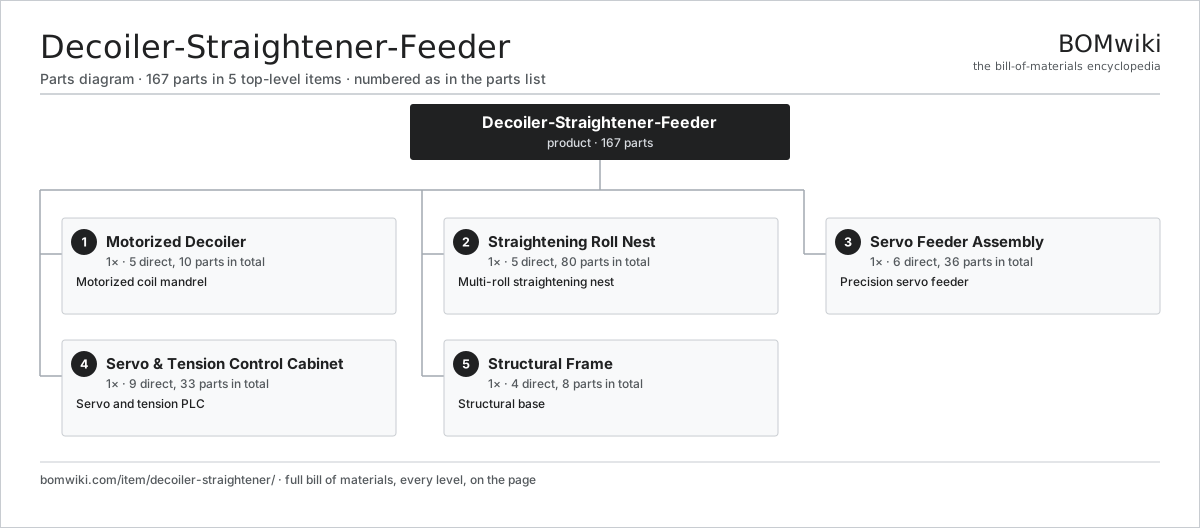
| # | Part | Qty | What it does |
|---|---|---|---|
| 1 | Motorized Decoiler 5 parts | 1× | Motorized coil mandrel |
| 2 | Straightening Roll Nest 5 parts | 1× | Multi-roll straightening nest |
| 3 | Servo Feeder Assembly 6 parts | 1× | Precision servo feeder |
| 4 | Servo & Tension Control Cabinet 9 parts | 1× | Servo and tension PLC |
| 5 | Structural Frame 4 parts | 1× | Structural base |
3D model
No 3D model yet. Have a CAD file of this? Add a 3D model. STL renders right on this page; STEP, FreeCAD, and OpenSCAD sources are welcome too (openly licensed, like all 3D models on BOMwiki).
Build & assembly graph
expand / collapse · shared sub-assemblies converge · links to related products · est. labourTap an assembly to expand/collapse · tap a part to open it · use “Open page” for any node · drag to pan, scroll to zoom.
Bill of materials for Decoiler-Straightener-Feeder
5 top-level lines · 44 rows shown · 167 parts total · indented to 3 levels| # | Item / sub-assembly | Part no. | Qty/assy | Ext. qty | Parts | Type |
|---|---|---|---|---|---|---|
| 1 | Motorized Decoiler 5 parts | decoiler-straightener-uncoiler | 1× | 1 | 10 | assembly |
| 1.1 | Decoiler Motor | decoiler-straightener-uncoiler-motor | 1× | 1 | · | part |
| 1.2 | Decoiler Mandrel | decoiler-straightener-mandrel | 1× | 1 | · | part |
| 1.3 | Spring-Applied Brake | decoiler-straightener-spring-brake | 1× | 1 | · | part |
| 1.4 | Ball Bearing | ball-bearing | 4× | 4 | · | part |
| 1.5 | Tension Dancer 3 parts | decoiler-straightener-dancer | 1× | 1 | 3 | assembly |
| 1.5.1 | Roller | decoiler-straightener-roller | 1× | 1 | · | part |
| 1.5.2 | Pressure Sensor | pressure-sensor | 1× | 1 | · | part |
| 1.5.3 | Dancer Pivot | decoiler-straightener-dancer-pivot | 1× | 1 | · | part |
| 2 | Straightening Roll Nest 5 parts | decoiler-straightener-straightening | 1× | 1 | 80 | assembly |
| 2.1 | Straightening Motor | decoiler-straightener-straighten-motor | 1× | 1 | · | part |
| 2.2 | Straightening Roll Unit 4 parts | decoiler-straightener-straighten-roll-assembly | 7× | 7 | 10 | assembly |
| 2.2.1 | Roll Shaft | decoiler-straightener-roll-shaft | 2× | 14 | · | part |
| 2.2.2 | Straightening Roll | decoiler-straightener-roll | 2× | 14 | · | part |
| 2.2.3 | Ball Bearing | ball-bearing | 4× | 28 | · | part |
| 2.2.4 | Coil Spring | coil-spring | 2× | 14 | · | part |
| 2.3 | Straightening Gearbox | decoiler-straightener-straighten-gearbox | 1× | 1 | · | part |
| 2.4 | Bearing Block | decoiler-straightener-straighten-bearing-blocks | 7× | 7 | · | part |
| 2.5 | Roll Pressure Adjuster | decoiler-straightener-pressure-adj | 1× | 1 | · | part |
| 3 | Servo Feeder Assembly 6 parts | decoiler-straightener-servo-feed | 1× | 1 | 36 | assembly |
| 3.1 | Servo Feeder Motor 3 parts | decoiler-straightener-servo-feeder-motor | 1× | 1 | 23 | assembly |
| 3.1.1 | Stator Assembly 3 parts + deeper › | stator-assembly | 1× | 1 | 3 | assembly |
| 3.1.2 | Rotor Assembly 4 parts + deeper › | rotor-assembly | 1× | 1 | 19 | assembly |
| 3.1.3 | Encoder | encoder | 1× | 1 | · | part |
| 3.2 | Feed Roller | decoiler-straightener-feed-roller | 2× | 2 | · | part |
| 3.3 | Feed Roller Bearing | decoiler-straightener-feed-bearing | 4× | 4 | · | part |
| 3.4 | Feed Pressure Arm | decoiler-straightener-feed-pressure | 2× | 2 | · | part |
| 3.5 | Encoder | encoder | 1× | 1 | · | part |
| 3.6 | Ball Bearing | ball-bearing | 4× | 4 | · | part |
| 4 | Servo & Tension Control Cabinet 9 parts | decoiler-straightener-controls | 1× | 1 | 33 | assembly |
| 4.1 | Bare PCB | pcb-bare | 2× | 2 | · | part |
| 4.2 | Microcontroller | mcu | 1× | 1 | · | part |
| 4.3 | Control Touchpanel | decoiler-straightener-hmi-panel | 1× | 1 | · | part |
| 4.4 | Servo Motion Controller | decoiler-straightener-servo-drive | 1× | 1 | · | part |
| 4.5 | Relay | relay | 8× | 8 | · | part |
| 4.6 | Pressure Sensor | pressure-sensor | 2× | 2 | · | part |
| 4.7 | Encoder | encoder | 1× | 1 | · | part |
| 4.8 | Connector | connector | 16× | 16 | · | part |
| 4.9 | Power Supply | power-supply | 1× | 1 | · | part |
| 5 | Structural Frame 4 parts | decoiler-straightener-frame | 1× | 1 | 8 | assembly |
| 5.1 | Base Frame Weldment | decoiler-straightener-base-frame | 1× | 1 | · | part |
| 5.2 | Straightening Guard | decoiler-straightener-straightening-guard | 1× | 1 | · | part |
| 5.3 | Fastener Set | fastener-set | 2× | 2 | · | part |
| 5.4 | Sheet Metal Panel | sheet-panel | 4× | 4 | · | part |
Something wrong in this list? Report a problem with this BOM.
Related products
same domain, ranked by shared parts Centrifugal Disc Finishing Machine
326 parts · shares 2 with this page
Chain Link Welding Machine
440 parts · shares 2 with this page
CNC Wire Forming Machine
1,438 parts · shares 2 with this page
Centrifugal Disc Finishing Machine
326 parts · shares 2 with this page
Chain Link Welding Machine
440 parts · shares 2 with this page
CNC Wire Forming Machine
1,438 parts · shares 2 with this page
Sourcing: possible vendors
Browse the supplier directory → Prices, MOQ, and lead times are algorithmic estimates, not quotes, and not claims about these companies. Company mappings are curated by keyword; est. price band $10k–$1M. How estimates work| Vendor | HQ | Specialty | MOQ | Lead time |
|---|---|---|---|---|
|
🇩🇪DMG MORI
dmgmori.com ↗
|
Bielefeld, DE | Machine tools | 5 units | 12–20 wks |
|
🇯🇵Mazak
mazak.com ↗
|
Oguchi, JP | Machine tools | 5 units | 12–20 wks |
| haascnc.com ↗ | Oxnard, US | CNC machine tools | 5 units | 12–20 wks |
|
🇯🇵Okuma
okuma.com ↗
|
Niwa, JP | Machine tools | 5 units | 12–20 wks |
|
🇩🇪Trumpf
trumpf.com ↗
|
Ditzingen, DE | Laser & sheet-metal machines | 5 units | 12–20 wks |
955-word article