EPS Foam Molding Machine
ProductOverview
An EPS foam molding machine, also called a shape molding machine, turns pre-expanded polystyrene beads into rigid shaped foam parts using steam. The beads arrive already puffed to a fraction of their final volume; the machine packs them into a closed cavity, floods that cavity with steam so the beads expand the last bit and weld to their neighbors, then cools and ejects a finished part. This is how packaging cushions, fish boxes, helmet liners, insulation blocks, and lost-foam casting patterns are made. The process is fast, the parts are very light, and the same machine runs many shapes by swapping the Steam Chamber tooling.
The machine works in a clear sequence: clamp the mold, blow beads in, steam to fuse them, cool to set the part, pull vacuum to dry it, then open and eject. The Machine Frame carries the platens, the Mold Clamping Unit closes the mold against steam pressure, the Bead Fill System charges the cavity with beads, the Steam and Vacuum System runs the steam and vacuum, and the Control System sequences it all.
Clamping and chambers
Each mold half sits in front of a Steam Chamber, a steel chest that holds steam behind the mold. The mold wall itself is pierced with hundreds of Steam Vent Nozzle inserts, slotted vents fine enough to pass steam but too narrow to let beads escape. The Mold Clamping Unit presses the two halves together through a hydraulic Clamp Cylinder fed by the Hydraulic Power Unit unit, and the Tie Bar rods react the force. The clamp must hold the mold shut firmly because the chambers pressurize with steam during the fuse step; a Clamp Position Sensor confirms the mold is fully closed before steam is admitted.
Filling with beads
With the mold shut, the Bead Fill System blows pre-expanded beads into the cavity. Beads flow from the Bead Hopper to several Fill Gun injectors that fire air-conveyed shots into the closed mold, packing it from multiple points so every corner of a complex shape gets filled. The Fill Blower supplies the conveying air, and a Level Sensor keeps the hopper charged. Fill quality decides part quality: under-fill leaves voids and weak spots, over-fill leaves the part too dense and hard to eject. On thin or intricate parts the mold can be cracked open a few millimetres during fill, then closed to compress the beads, a step called pressure fill that improves the weld.
Steaming and fusing
Fusing is the heart of the process. The Steam and Vacuum System admits steam through Steam Valve units, usually first from one side then the other in a cross-steam step that drives steam through the whole bead bed, then in a final all-around autoclave step. The steam heats the beads above their softening point; the blowing agent and trapped air left in each bead expand it the last fraction, the beads press hard against each other, and their surfaces weld into a continuous foam. Steam pressure sits around 0.7 to 1.5 bar gauge depending on the resin grade and density target, read by Pressure Sensor units. Condensate is pulled off through Drain Valve and Steam Trap hardware so it does not chill spots and leave unfused beads.
Cooling, vacuum, and ejection
The part comes out of the steam step hot, soft, and full of water. The Cooling System system sprays water on the chamber backs through the Cooling Spray Manifold manifolds to pull heat out of the mold, then the Vacuum Pump draws vacuum on the chambers. The vacuum does two jobs: it flash-boils the residual water so it carries heat away as it leaves, and it stabilizes the part by reducing the internal pressure left from steaming, so the part does not swell or warp after it leaves the mold. Once a Mold Temperature Sensor shows the mold cool enough, the clamp opens and the Part Ejection System system acts: Air Blow Valve units puff air through the vent nozzles and Ejector Pin hardware lifts the part clear.
Control and use
The Control System system ties the steps together. A PLC times the fill, the cross-steam and autoclave steam steps, the cool spray, the vacuum, and the ejection, driving the actuators through a Pneumatic Valve Bank. Recipes per part are stored on the Operator Panel so density and cycle time stay consistent. The machines run in packaging plants, fish and produce box lines, helmet and seat foam shops, and building insulation factories. Their strengths are very light parts, fast cycles, and cheap tooling that runs many shapes; their limits are the need for steam and vacuum utilities, sensitivity to bead quality and fill uniformity, and a finished part that must dry and age before it reaches full strength and stable dimensions.
EPS Foam Molding Machine parts and their functions
8 top-level parts · 169 parts in total · full bill of materials below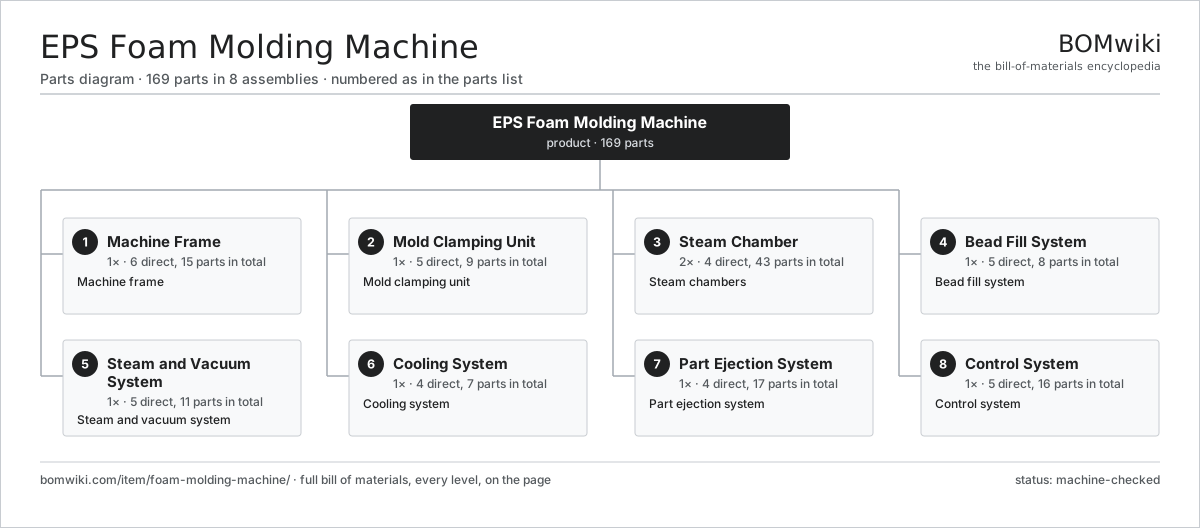
| # | Part | Qty | What it does |
|---|---|---|---|
| 1 | Machine Frame 6 parts | 1× | Machine frame |
| 2 | Mold Clamping Unit 5 parts | 1× | Mold clamping unit |
| 3 | Steam Chamber 4 parts | 2× | Steam chambers |
| 4 | Bead Fill System 5 parts | 1× | Bead fill system |
| 5 | Steam and Vacuum System 5 parts | 1× | Steam and vacuum system |
| 6 | Cooling System 4 parts | 1× | Cooling system |
| 7 | Part Ejection System 4 parts | 1× | Part ejection system |
| 8 | Control System 5 parts | 1× | Control system |
3D model
No 3D model yet. Have a CAD file of this? Add a 3D model — STL renders right on this page; STEP, FreeCAD, and OpenSCAD sources are welcome too (openly licensed, like all 3D models on BOMwiki).
Build & assembly graph
expand / collapse · shared sub-assemblies converge · links to related products · est. labourTap an assembly to expand/collapse · tap a part to open it · use “Open page” for any node · drag to pan, scroll to zoom.
Bill of materials for EPS Foam Molding Machine
8 top-level lines · 50 rows shown · 169 parts total · indented to 3 levels| # | Item / sub-assembly | Part no. | Qty/assy | Ext. qty | Parts | Type |
|---|---|---|---|---|---|---|
| 1 | Machine Frame 6 parts | foam-molding-machine-frame | 1× | 1 | 15 | assembly |
| 1.1 | Base Frame | foam-molding-machine-base-frame | 1× | 1 | · | part |
| 1.2 | Fixed Platen | foam-molding-machine-fixed-platen | 1× | 1 | · | part |
| 1.3 | Moving Platen | foam-molding-machine-moving-platen | 1× | 1 | · | part |
| 1.4 | Tie Bar | foam-molding-machine-tie-bar | 4× | 4 | · | part |
| 1.5 | Linear Guide Rail | linear-guide | 4× | 4 | · | part |
| 1.6 | Fastener Set | fastener-set | 4× | 4 | · | part |
| 2 | Mold Clamping Unit 5 parts | foam-molding-machine-mold-clamp | 1× | 1 | 9 | assembly |
| 2.1 | Clamp Cylinder | foam-molding-machine-clamp-cylinder | 1× | 1 | · | part |
| 2.2 | Hydraulic Power Unit 4 parts | foam-molding-machine-hydraulic-power | 1× | 1 | 4 | assembly |
| 2.2.1 | Hydraulic Pump | foam-molding-machine-hyd-pump | 1× | 1 | · | part |
| 2.2.2 | Pump Motor | foam-molding-machine-hyd-motor | 1× | 1 | · | part |
| 2.2.3 | Oil Reservoir | foam-molding-machine-hyd-tank | 1× | 1 | · | part |
| 2.2.4 | Relief Valve | foam-molding-machine-relief-valve | 1× | 1 | · | part |
| 2.3 | Clamp Control Valve | foam-molding-machine-clamp-valve | 1× | 1 | · | part |
| 2.4 | Clamp Position Sensor | foam-molding-machine-position-sensor | 1× | 1 | · | part |
| 2.5 | O-Ring Set | oring-set | 2× | 2 | · | part |
| 3 | Steam Chamber 4 parts | foam-molding-machine-steam-chamber | 2× | 2 | 43 | assembly |
| 3.1 | Chamber Shell | foam-molding-machine-chamber-shell | 1× | 2 | · | part |
| 3.2 | Steam Core Plate | foam-molding-machine-steam-core | 1× | 2 | · | part |
| 3.3 | Steam Vent Nozzle | foam-molding-machine-vent-nozzle | 40× | 80 | · | part |
| 3.4 | Chamber Gasket | foam-molding-machine-chamber-gasket | 1× | 2 | · | part |
| 4 | Bead Fill System 5 parts | foam-molding-machine-fill-system | 1× | 1 | 8 | assembly |
| 4.1 | Bead Hopper | foam-molding-machine-bead-hopper | 1× | 1 | · | part |
| 4.2 | Fill Gun | foam-molding-machine-fill-gun | 4× | 4 | · | part |
| 4.3 | Fill Blower | foam-molding-machine-fill-blower | 1× | 1 | · | part |
| 4.4 | Level Sensor | foam-molding-machine-level-sensor | 1× | 1 | · | part |
| 4.5 | Wire Bundle | wire-bundle | 1× | 1 | · | part |
| 5 | Steam and Vacuum System 5 parts | foam-molding-machine-steam-system | 1× | 1 | 11 | assembly |
| 5.1 | Steam Valve | foam-molding-machine-steam-valve | 4× | 4 | · | part |
| 5.2 | Drain Valve | foam-molding-machine-drain-valve | 2× | 2 | · | part |
| 5.3 | Vacuum Pump | foam-molding-machine-vacuum-pump | 1× | 1 | · | part |
| 5.4 | Steam Trap | foam-molding-machine-steam-trap | 2× | 2 | · | part |
| 5.5 | Pressure Sensor | pressure-sensor | 2× | 2 | · | part |
| 6 | Cooling System 4 parts | foam-molding-machine-cooling | 1× | 1 | 7 | assembly |
| 6.1 | Cooling Spray Manifold | foam-molding-machine-cool-spray | 2× | 2 | · | part |
| 6.2 | Cooling Water Pump | foam-molding-machine-cool-pump | 1× | 1 | · | part |
| 6.3 | Cooling Valve | foam-molding-machine-cool-valve | 2× | 2 | · | part |
| 6.4 | Mold Temperature Sensor | foam-molding-machine-temp-sensor | 2× | 2 | · | part |
| 7 | Part Ejection System 4 parts | foam-molding-machine-ejection | 1× | 1 | 17 | assembly |
| 7.1 | Ejector Plate | foam-molding-machine-ejector-plate | 1× | 1 | · | part |
| 7.2 | Ejector Pin | foam-molding-machine-ejector-pin | 8× | 8 | · | part |
| 7.3 | Air Blow Valve | foam-molding-machine-blow-valve | 4× | 4 | · | part |
| 7.4 | Coil Spring | coil-spring | 4× | 4 | · | part |
| 8 | Control System 5 parts | foam-molding-machine-control | 1× | 1 | 16 | assembly |
| 8.1 | PLC | foam-molding-machine-plc | 1× | 1 | · | part |
| 8.2 | Operator Panel | foam-molding-machine-hmi | 1× | 1 | · | part |
| 8.3 | Power Supply | power-supply | 1× | 1 | · | part |
| 8.4 | Relay | relay | 12× | 12 | · | part |
| 8.5 | Pneumatic Valve Bank | foam-molding-machine-valve-bank | 1× | 1 | · | part |
Related products
same domain, ranked by shared parts Rubber Extrusion Line
524 parts · shares 6 with this page
Spin Welding Machine
91 parts · shares 6 with this page
Wax Pattern Injection Press
107 parts · shares 6 with this page
Casting Fettling Machine
802 parts · shares 5 with this page
Shell Molding Machine
116 parts · shares 5 with this page
Rubber Extrusion Line
524 parts · shares 6 with this page
Spin Welding Machine
91 parts · shares 6 with this page
Wax Pattern Injection Press
107 parts · shares 6 with this page
Casting Fettling Machine
802 parts · shares 5 with this page
Shell Molding Machine
116 parts · shares 5 with this page
Sourcing: possible vendors
Prices, MOQ, and lead times are algorithmic estimates, not quotes, and not claims about these companies. Company mappings are curated by keyword; est. price band $5k–$2M. How estimates work| Vendor | HQ | Specialty | MOQ | Lead time |
|---|---|---|---|---|
| atlascopco.com ↗ | Stockholm, SE | Compressors & industrial | 10 units | 12–20 wks |
|
🇦🇹Andritz
andritz.com ↗
|
Graz, AT | Process plants & machinery | 10 units | 12–20 wks |
| buhlergroup.com ↗ | Uzwil, CH | Food & materials processing | 10 units | 12–20 wks |
| gea.com ↗ | Düsseldorf, DE | Process technology | 10 units | 12–20 wks |
| mhi.com ↗ | Tokyo, JP | Heavy machinery | 10 units | 12–20 wks |
880-word article