Ingot Casting Machine
ProductOverview
An ingot casting machine turns a continuous stream of molten metal from a furnace into a steady output of solid, stackable ingots. It does this with an endless loop of cast-iron molds that ride on two strand chains. The chain carries the open molds under a fixed pour point, each mold fills with a measured slug of metal, the metal solidifies as the mold travels over a water-cooled stretch, and the cooled ingot tips out at the far end. The empty mold then gets a fresh wash coating and returns underneath for the next pass. The machine runs cast houses in aluminium smelters, zinc and lead refineries, and copper-alloy foundries, anywhere metal must leave the plant as uniform ingots rather than as large slabs or billets.
The machine is built around the Mold Chain, which is filled at the Pouring Station and moved by the Drive Frame. The Cooling System freezes the metal in place, the Demold Station strips and stacks the ingots, the Mold Wash Station recoats the molds, and the Control Cabinet times the whole cycle and logs ingot weights.
The mold chain
The heart of the machine is a long conveyor made of cast-iron molds, each one an open-top pan that shapes a single ingot. The molds are bolted to two parallel Strand Chain runs, joined by hardened Chain Pin links that carry the pull. A typical strand holds 80 to 120 molds, so a long machine can have several hundred ingots in process at once. Each mold rides on a Carrier Roller that supports it on the Track Rail along the upper casting run and the lower return run.
Grey cast iron is chosen for the Ingot Mold because it conducts heat well, tolerates the repeated thermal cycling between molten metal and water spray, and is cheap to recast when a mold cracks. Molds wear out from thermal fatigue and from the abrasion of ingots dropping free, so they are a routine spare. The pour cavity is shaped with a slight draft and rounded corners so the ingot releases without sticking.
Pouring and metering
Metal reaches the machine through a refractory Launder that runs from the holding furnace to the Tundish. The tundish acts as a buffer, holding a steady head of metal so the pour stream does not surge when the furnace tilts. A Stopper Rod seats in the pour nozzle and is lifted by the Stopper Actuator to release metal into each mold as it indexes underneath. The Tundish Lining lining contains the melt and resists the thermal shock of the first metal each shift.
Dosing matters because the whole point of the machine is uniform ingots. The tundish sits on a set of Load Cell sensors so the control system can weigh the metal it pours and trim the stopper timing to keep each ingot within a tight mass band. Before a cast, the Preheat Burner warms the tundish and launder so the leading metal does not freeze and clog the spout.
Cooling and solidification
Once a mold is filled it travels over the Cooling System. A series of Spray Header manifolds run beneath the strand, each fed by many Spray Nozzle units that throw a flat fan of water onto the mold bottom. Heat is pulled out through the iron mold wall, not by quenching the metal directly, so the ingot surface stays clean. A Cooling Pump recirculates water from the Water Basin, and a Control Valve on each header sets how hard each zone cools. Cooling is staged: gentle near the pour so the skin forms without cracking, then harder downstream to finish solidification before the ingot reaches the demold end. Header pressure is watched so a clogged nozzle bank does not leave a mold of liquid metal.
Demolding and stacking
At the far sprocket the molds roll past a fixed Knockout Cam that turns each mold past vertical so the solid ingot drops out by gravity. A spring-loaded Ejector Pin in the mold floor nudges any ingot that sticks. Released ingots slide down the Discharge Chute to the Stacker, where a Stacker Grip on a pivoting Stacker Arm builds them into a counted, crisscrossed bundle ready for strapping. Automatic stacking is what lets one operator run a machine that produces a continuous ingot stream.
Mold wash and return
An empty mold cannot simply be refilled. Each pass it gets a thin parting layer at the Mold Wash Station station so the next ingot will not weld itself to the iron. A Wash Sprayer lays lime or graphite slurry on the hot empty mold, drawn from the Wash Tank by the Wash Pump. A Wash Agitator keeps the solids suspended so the coat is even, which directly affects how cleanly the next ingot releases.
Control and variants
The Control Cabinet holds the Casting PLC that coordinates chain index, stopper lift, cooling zones, and stacking. A Drive Inverter sets chain and stacker speed, and the Operator HMI shows cast rate, ingot weights, and cooling state. Machines come as single strand for modest output and twin strand for high tonnage, with the same mold and pour design mirrored. Aluminium casters run cool and fast with light molds, while lead and zinc refineries use heavier molds and slower speeds. The drive uses a Drive Gearbox reduction so the motor can hold low, steady casting speeds under the full chain load.
Ingot Casting Machine parts and their functions
7 top-level parts · 690 parts in total · full bill of materials below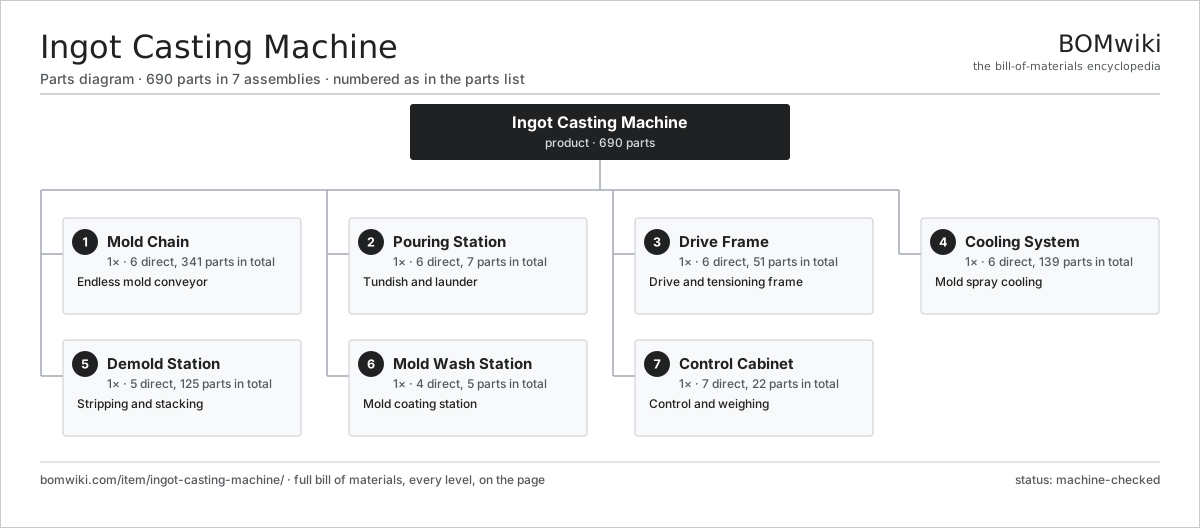
| # | Part | Qty | What it does |
|---|---|---|---|
| 1 | Mold Chain 6 parts | 1× | Endless mold conveyor |
| 2 | Pouring Station 6 parts | 1× | Tundish and launder |
| 3 | Drive Frame 6 parts | 1× | Drive and tensioning frame |
| 4 | Cooling System 6 parts | 1× | Mold spray cooling |
| 5 | Demold Station 5 parts | 1× | Stripping and stacking |
| 6 | Mold Wash Station 4 parts | 1× | Mold coating station |
| 7 | Control Cabinet 7 parts | 1× | Control and weighing |
3D model
No 3D model yet. Have a CAD file of this? Add a 3D model — STL renders right on this page; STEP, FreeCAD, and OpenSCAD sources are welcome too (openly licensed, like all 3D models on BOMwiki).
Build & assembly graph
expand / collapse · shared sub-assemblies converge · links to related products · est. labourTap an assembly to expand/collapse · tap a part to open it · use “Open page” for any node · drag to pan, scroll to zoom.
Bill of materials for Ingot Casting Machine
7 top-level lines · 64 rows shown · 690 parts total · indented to 3 levels| # | Item / sub-assembly | Part no. | Qty/assy | Ext. qty | Parts | Type |
|---|---|---|---|---|---|---|
| 1 | Mold Chain 6 parts | ingot-casting-machine-mold-chain | 1× | 1 | 341 | assembly |
| 1.1 | Ingot Mold | ingot-casting-machine-ingot-mold | 96× | 96 | · | part |
| 1.2 | Strand Chain | ingot-casting-machine-strand-chain | 2× | 2 | · | part |
| 1.3 | Chain Pin | ingot-casting-machine-chain-pin | 192× | 192 | · | part |
| 1.4 | Carrier Roller | ingot-casting-machine-carrier-roller | 48× | 48 | · | part |
| 1.5 | Track Rail | ingot-casting-machine-track-rail | 2× | 2 | · | part |
| 1.6 | Fastener Set | fastener-set | 1× | 1 | · | part |
| 2 | Pouring Station 6 parts | ingot-casting-machine-pouring-station | 1× | 1 | 7 | assembly |
| 2.1 | Tundish | ingot-casting-machine-tundish | 1× | 1 | · | part |
| 2.2 | Launder | ingot-casting-machine-launder | 1× | 1 | · | part |
| 2.3 | Stopper Rod | ingot-casting-machine-stopper-rod | 1× | 1 | · | part |
| 2.4 | Stopper Actuator | ingot-casting-machine-pour-actuator | 1× | 1 | · | part |
| 2.5 | Tundish Lining | ingot-casting-machine-tundish-refractory | 1× | 1 | · | part |
| 2.6 | Preheat Burner | ingot-casting-machine-preheat-burner | 2× | 2 | · | part |
| 3 | Drive Frame 6 parts | ingot-casting-machine-drive-frame | 1× | 1 | 51 | assembly |
| 3.1 | Head Sprocket | ingot-casting-machine-head-sprocket | 2× | 2 | · | part |
| 3.2 | Tail Sprocket | ingot-casting-machine-tail-sprocket | 2× | 2 | · | part |
| 3.3 | Drive Gearbox 4 parts | ingot-casting-machine-gearbox | 1× | 1 | 9 | assembly |
| 3.3.1 | Helical Gear Pair | gear-pair | 2× | 2 | · | part |
| 3.3.2 | Gearbox Housing | gearbox-housing | 1× | 1 | · | part |
| 3.3.3 | Ball Bearing | ball-bearing | 4× | 4 | · | part |
| 3.3.4 | Oil Seal | oil-seal | 2× | 2 | · | part |
| 3.4 | Servo Motor 4 parts | servo-motor | 1× | 1 | 24 | assembly |
| 3.4.1 | Stator Assembly 3 parts + deeper › | stator-assembly | 1× | 1 | 3 | assembly |
| 3.4.2 | Rotor Assembly 4 parts + deeper › | rotor-assembly | 1× | 1 | 19 | assembly |
| 3.4.3 | Encoder | encoder | 1× | 1 | · | part |
| 3.4.4 | Motor Housing | motor-housing | 1× | 1 | · | part |
| 3.5 | Take-up Frame 3 parts | ingot-casting-machine-takeup-frame | 1× | 1 | 6 | assembly |
| 3.5.1 | Take-up Screw | ingot-casting-machine-takeup-screw | 2× | 2 | · | part |
| 3.5.2 | Take-up Slide | ingot-casting-machine-takeup-slide | 2× | 2 | · | part |
| 3.5.3 | Coil Spring | coil-spring | 2× | 2 | · | part |
| 3.6 | Ball Bearing | ball-bearing | 8× | 8 | · | part |
| 4 | Cooling System 6 parts | ingot-casting-machine-cooling-system | 1× | 1 | 139 | assembly |
| 4.1 | Spray Header | ingot-casting-machine-spray-header | 6× | 6 | · | part |
| 4.2 | Spray Nozzle | ingot-casting-machine-spray-nozzle | 120× | 120 | · | part |
| 4.3 | Cooling Pump | ingot-casting-machine-cooling-pump | 2× | 2 | · | part |
| 4.4 | Water Basin | ingot-casting-machine-water-basin | 1× | 1 | · | part |
| 4.5 | Control Valve | ingot-casting-machine-control-valve | 6× | 6 | · | part |
| 4.6 | Pressure Sensor | pressure-sensor | 4× | 4 | · | part |
| 5 | Demold Station 5 parts | ingot-casting-machine-demold-station | 1× | 1 | 125 | assembly |
| 5.1 | Knockout Cam | ingot-casting-machine-knockout-cam | 1× | 1 | · | part |
| 5.2 | Ejector Pin | ingot-casting-machine-ejector-pin | 96× | 96 | · | part |
| 5.3 | Discharge Chute | ingot-casting-machine-discharge-chute | 1× | 1 | · | part |
| 5.4 | Stacker 2 parts | ingot-casting-machine-stacker | 1× | 1 | 3 | assembly |
| 5.4.1 | Stacker Grip | ingot-casting-machine-stacker-grip | 2× | 2 | · | part |
| 5.4.2 | Stacker Arm | ingot-casting-machine-stacker-arm | 1× | 1 | · | part |
| 5.5 | Servo Motor 4 parts | servo-motor | 1× | 1 | 24 | assembly |
| 5.5.1 | Stator Assembly 3 parts + deeper › | stator-assembly | 1× | 1 | 3 | assembly |
| 5.5.2 | Rotor Assembly 4 parts + deeper › | rotor-assembly | 1× | 1 | 19 | assembly |
| 5.5.3 | Encoder | encoder | 1× | 1 | · | part |
| 5.5.4 | Motor Housing | motor-housing | 1× | 1 | · | part |
| 6 | Mold Wash Station 4 parts | ingot-casting-machine-mold-wash | 1× | 1 | 5 | assembly |
| 6.1 | Wash Sprayer | ingot-casting-machine-wash-sprayer | 2× | 2 | · | part |
| 6.2 | Wash Tank | ingot-casting-machine-wash-tank | 1× | 1 | · | part |
| 6.3 | Wash Pump | ingot-casting-machine-wash-pump | 1× | 1 | · | part |
| 6.4 | Wash Agitator | ingot-casting-machine-wash-agitator | 1× | 1 | · | part |
| 7 | Control Cabinet 7 parts | ingot-casting-machine-control-cabinet | 1× | 1 | 22 | assembly |
| 7.1 | Casting PLC | ingot-casting-machine-plc | 1× | 1 | · | part |
| 7.2 | Drive Inverter | ingot-casting-machine-vfd | 2× | 2 | · | part |
| 7.3 | Load Cell | ingot-casting-machine-load-cell | 4× | 4 | · | part |
| 7.4 | Operator HMI | ingot-casting-machine-hmi | 1× | 1 | · | part |
| 7.5 | Power Supply | power-supply | 1× | 1 | · | part |
| 7.6 | Wire Bundle | wire-bundle | 1× | 1 | · | part |
| 7.7 | Connector | connector | 12× | 12 | · | part |
Related products
same domain, ranked by shared parts Rubber Extrusion Line
524 parts · shares 20 with this page
Shell Molding Machine
116 parts · shares 18 with this page
Hammer Mill
790 parts · shares 18 with this page
Strand Pelletizing Line
138 parts · shares 18 with this page
Rubber Extrusion Line
524 parts · shares 20 with this page
Shell Molding Machine
116 parts · shares 18 with this page
Hammer Mill
790 parts · shares 18 with this page
Strand Pelletizing Line
138 parts · shares 18 with this page
Sourcing: possible vendors
Prices, MOQ, and lead times are algorithmic estimates, not quotes, and not claims about these companies. Company mappings are curated by keyword; est. price band $5k–$2M. How estimates work| Vendor | HQ | Specialty | MOQ | Lead time |
|---|---|---|---|---|
| atlascopco.com ↗ | Stockholm, SE | Compressors & industrial | 10 units | 12–20 wks |
|
🇦🇹Andritz
andritz.com ↗
|
Graz, AT | Process plants & machinery | 10 units | 12–20 wks |
| buhlergroup.com ↗ | Uzwil, CH | Food & materials processing | 10 units | 12–20 wks |
| gea.com ↗ | Düsseldorf, DE | Process technology | 10 units | 12–20 wks |
| mhi.com ↗ | Tokyo, JP | Heavy machinery | 10 units | 12–20 wks |
1,020-word article