WPC Profile Extrusion Line
ProductOverview
A wood-plastic composite line makes deck boards, fencing, cladding, and trim from a compound of wood flour and thermoplastic, typically polyethylene or PVC carrying half or more of its weight in wood. The compound is melted in a twin-screw extruder, shaped through a profile die, pulled to exact size against vacuum calibrators, textured to look like wood, and cut to length. The product weathers better than wood and needs no painting, and the process turns sawdust and recycled polymer into a saleable building product, which is much of its appeal.
WPC is harder to extrude than plain plastic for two reasons: the wood is abrasive and wears the machine, and it burns if the melt runs much above 200 C, so the line is built around gentle, well-cooled processing. The Material System doses and feeds the compound, the Conical Twin-Screw Extruder melts it, and the Profile Die shapes it. The Calibration Table sizes the profile, the Cooling Tank cools it through, the Embossing Unit textures it, and the Caterpillar Haul-Off and Flying Cutoff Saw pull and cut it. The Control System holds the recipe and temperatures, which matter more here than on most extrusion lines.
Feeding the compound
The Material System handles a material that does not flow like pellets. Wood flour is light and fluffy, so a Gravimetric Doser blends it with polymer and additives to a precise recipe in the Main Hopper, and a Force Feeder packs the low-bulk mix so the screws stay full. Many lines add fiber downstream through a Side Feeder, whose own Feeder Screw pair forces fiber into the already-melted polymer so it is coated rather than burned in the feed zone. Because heated wood gives off moisture and volatiles, a Degassing Unit vacuum vent pulls them out of the melt; left in, they would foam the profile and weaken it.
Melting without burning
The Conical Twin-Screw Extruder is a conical counter-rotating twin-screw machine, chosen because its two intermeshing screws convey the filled compound positively and mix it well at low shear, so the melt heats gently and evenly. The Conical Screw Pair is wide at the feed and narrow at the die, which compresses the material as it advances, and the figure-eight Twin-Screw Barrel is hard-lined because wood and any mineral filler are abrasive. The Band Heater bands and the Barrel Cooling Circuit circuits hold each zone within a narrow window that every Thermocouple reports, since the difference between a good melt and scorched wood is only a few degrees. The AC Drive Motor turns the screws through a Twin-Shaft Gearbox whose Thrust Bearing Pack carries the heavy axial load, and a Screen Changer strains lumps before the die.
Shaping and sizing
The Profile Die forms the cross section. Its Die Insert is machined to the outer profile of the board, Die Pin pins form the hollow chambers that save weight and material in a deck board, and the Land Plate land plates set the final wall as the melt straightens out. The profile leaves the die soft and slightly oversize, and the Calibration Table brings it to exact dimensions: a series of Calibrator blocks, held under vacuum by the Vacuum Pump units and cooled by water from the Water Pump, pull the soft profile against their walls and freeze the skin to that shape, with Spray Nozzle cooling between stages. The profile then runs through the Cooling Tank, where Cooling Spray Bar bars cool it all the way through on Profile Support supports, because a thick board cooled only on the surface will warp as the core shrinks later.
Finishing and cutting
What makes WPC look like wood is added after cooling. The Embossing Unit presses a grain pattern into the surface with an engraved Embossing Roll while it is still warm enough to take an impression, then a Brush Roll scuffs the surface to expose fiber and break the plastic sheen, giving the matte, sawn look buyers want. The Caterpillar Haul-Off pulls the finished profile with belted Track Belt tracks at the speed that, with the die output, sets the board dimensions, and the Flying Cutoff Saw cuts it to length on the fly: a carbide Saw Blade on a Traverse Carriage runs with the moving board while Clamp Jaw jaws hold it, and a Dust Hood captures the abrasive dust.
Control, materials, and use
The Control System ties the line together. A PLC runs the recipe and speed loops, a Variable Frequency Drive sets each motor, and the Temperature Controller holds the heater and cooling zones, with the operator working from the HMI Panel. The compound itself is the product's defining feature: a base of HDPE, recycled polyethylene, or rigid PVC carries wood flour from pine, oak, or bamboo at loads from 50 to 70 percent, plus coupling agents that bond the polymer to the wood, lubricants that let the filled melt flow, UV stabilizers, and color. Decking is the largest market, followed by fencing, cladding, railing, and window trim. The line shares its layout with the Plastic Pipe Extrusion Line and other profile lines, but its twin-screw extruder, heavy degassing, tight temperature control, and surface finishing are all driven by the demands of running a highly filled, heat-sensitive, abrasive compound.
WPC Profile Extrusion Line parts and their functions
9 top-level parts · 422 parts in total · full bill of materials below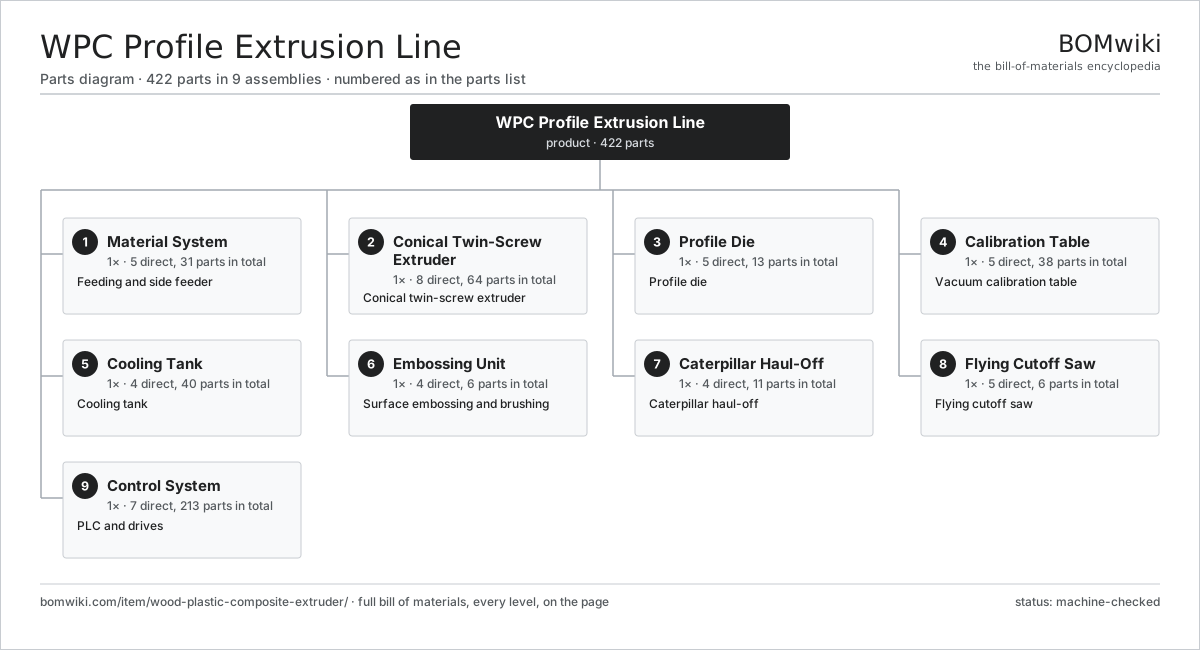
| # | Part | Qty | What it does |
|---|---|---|---|
| 1 | Material System 5 parts | 1× | Feeding and side feeder |
| 2 | Conical Twin-Screw Extruder 8 parts | 1× | Conical twin-screw extruder |
| 3 | Profile Die 5 parts | 1× | Profile die |
| 4 | Calibration Table 5 parts | 1× | Vacuum calibration table |
| 5 | Cooling Tank 4 parts | 1× | Cooling tank |
| 6 | Embossing Unit 4 parts | 1× | Surface embossing and brushing |
| 7 | Caterpillar Haul-Off 4 parts | 1× | Caterpillar haul-off |
| 8 | Flying Cutoff Saw 5 parts | 1× | Flying cutoff saw |
| 9 | Control System 7 parts | 1× | PLC and drives |
3D model
No 3D model yet. Have a CAD file of this? Add a 3D model — STL renders right on this page; STEP, FreeCAD, and OpenSCAD sources are welcome too (openly licensed, like all 3D models on BOMwiki).
Build & assembly graph
expand / collapse · shared sub-assemblies converge · links to related products · est. labourTap an assembly to expand/collapse · tap a part to open it · use “Open page” for any node · drag to pan, scroll to zoom.
Bill of materials for WPC Profile Extrusion Line
9 top-level lines · 81 rows shown · 422 parts total · indented to 3 levels| # | Item / sub-assembly | Part no. | Qty/assy | Ext. qty | Parts | Type |
|---|---|---|---|---|---|---|
| 1 | Material System 5 parts | wpc-material-system | 1× | 1 | 31 | assembly |
| 1.1 | Gravimetric Doser | wpc-gravimetric-doser | 1× | 1 | · | part |
| 1.2 | Main Hopper | wpc-main-hopper | 1× | 1 | · | part |
| 1.3 | Side Feeder 3 parts | wpc-side-feeder | 1× | 1 | 27 | assembly |
| 1.3.1 | Feeder Screw | wpc-feeder-screw | 2× | 2 | · | part |
| 1.3.2 | Feeder Barrel | wpc-feeder-barrel | 1× | 1 | · | part |
| 1.3.3 | Servo Motor 4 parts + deeper › | servo-motor | 1× | 1 | 24 | assembly |
| 1.4 | Force Feeder | wpc-force-feeder | 1× | 1 | · | part |
| 1.5 | Degassing Unit | wpc-degassing-unit | 1× | 1 | · | part |
| 2 | Conical Twin-Screw Extruder 8 parts | wpc-extruder | 1× | 1 | 64 | assembly |
| 2.1 | Twin-Screw Barrel | wpc-barrel | 1× | 1 | · | part |
| 2.2 | Conical Screw Pair | wpc-screw-pair | 1× | 1 | · | part |
| 2.3 | Band Heater | wpc-barrel-heater | 8× | 8 | · | part |
| 2.4 | Barrel Cooling Circuit | wpc-barrel-cooling | 4× | 4 | · | part |
| 2.5 | Thermocouple | wpc-thermocouple | 8× | 8 | · | part |
| 2.6 | Twin-Shaft Gearbox 5 parts | wpc-gearbox | 1× | 1 | 15 | assembly |
| 2.6.1 | Helical Gear Pair | gear-pair | 3× | 3 | · | part |
| 2.6.2 | Gearbox Housing | gearbox-housing | 1× | 1 | · | part |
| 2.6.3 | Ball Bearing | ball-bearing | 6× | 6 | · | part |
| 2.6.4 | Oil Seal | oil-seal | 4× | 4 | · | part |
| 2.6.5 | Thrust Bearing Pack | wpc-thrust-pack | 1× | 1 | · | part |
| 2.7 | AC Drive Motor 5 parts | wpc-drive-motor | 1× | 1 | 26 | assembly |
| 2.7.1 | Stator Assembly 3 parts + deeper › | stator-assembly | 1× | 1 | 3 | assembly |
| 2.7.2 | Rotor Assembly 4 parts + deeper › | rotor-assembly | 1× | 1 | 19 | assembly |
| 2.7.3 | Motor Housing | motor-housing | 1× | 1 | · | part |
| 2.7.4 | Ball Bearing | ball-bearing | 2× | 2 | · | part |
| 2.7.5 | Encoder | encoder | 1× | 1 | · | part |
| 2.8 | Screen Changer | wpc-screen-changer | 1× | 1 | · | part |
| 3 | Profile Die 5 parts | wpc-profile-die | 1× | 1 | 13 | assembly |
| 3.1 | Die Body | wpc-die-body | 1× | 1 | · | part |
| 3.2 | Die Insert | wpc-die-insert | 1× | 1 | · | part |
| 3.3 | Die Pin | wpc-die-pin | 4× | 4 | · | part |
| 3.4 | Die Heater | wpc-die-heater | 6× | 6 | · | part |
| 3.5 | Land Plate | wpc-die-land | 1× | 1 | · | part |
| 4 | Calibration Table 5 parts | wpc-calibration-table | 1× | 1 | 38 | assembly |
| 4.1 | Calibrator | wpc-calibrator | 4× | 4 | · | part |
| 4.2 | Vacuum Pump | wpc-vacuum-pump | 2× | 2 | · | part |
| 4.3 | Water Pump | wpc-water-pump | 1× | 1 | · | part |
| 4.4 | Table Base | wpc-table-base | 1× | 1 | · | part |
| 4.5 | Spray Nozzle | wpc-spray-nozzle | 30× | 30 | · | part |
| 5 | Cooling Tank 4 parts | wpc-cooling-tank | 1× | 1 | 40 | assembly |
| 5.1 | Cooling Shell | wpc-cooling-shell | 1× | 1 | · | part |
| 5.2 | Cooling Spray Bar | wpc-cooling-spray | 30× | 30 | · | part |
| 5.3 | Profile Support | wpc-profile-support | 8× | 8 | · | part |
| 5.4 | Drain Trough | wpc-drain-trough | 1× | 1 | · | part |
| 6 | Embossing Unit 4 parts | wpc-embossing-unit | 1× | 1 | 6 | assembly |
| 6.1 | Embossing Roll | wpc-emboss-roll | 1× | 1 | · | part |
| 6.2 | Brush Roll | wpc-brush-roll | 2× | 2 | · | part |
| 6.3 | Roll Motor | wpc-roll-motor | 2× | 2 | · | part |
| 6.4 | Emboss Frame | wpc-emboss-frame | 1× | 1 | · | part |
| 7 | Caterpillar Haul-Off 4 parts | wpc-haul-off | 1× | 1 | 11 | assembly |
| 7.1 | Track Belt | wpc-track-belt | 4× | 4 | · | part |
| 7.2 | Haul Motor | wpc-haul-motor | 2× | 2 | · | part |
| 7.3 | Clamp Cylinder | wpc-clamp-cylinder | 4× | 4 | · | part |
| 7.4 | Haul-Off Frame | wpc-haul-frame | 1× | 1 | · | part |
| 8 | Flying Cutoff Saw 5 parts | wpc-cutter | 1× | 1 | 6 | assembly |
| 8.1 | Saw Blade | wpc-saw-blade | 1× | 1 | · | part |
| 8.2 | Saw Motor | wpc-saw-motor | 1× | 1 | · | part |
| 8.3 | Traverse Carriage | wpc-traverse-carriage | 1× | 1 | · | part |
| 8.4 | Clamp Jaw | wpc-clamp-jaw | 2× | 2 | · | part |
| 8.5 | Dust Hood | wpc-dust-hood | 1× | 1 | · | part |
| 9 | Control System 7 parts | wpc-control-system | 1× | 1 | 213 | assembly |
| 9.1 | PLC 4 parts | wpc-plc | 1× | 1 | 156 | assembly |
| 9.1.1 | Bare PCB | pcb-bare | 1× | 1 | · | part |
| 9.1.2 | Microcontroller | mcu | 1× | 1 | · | part |
| 9.1.3 | I/O Module | io-module | 4× | 4 | · | part |
| 9.1.4 | SMD Passive (R/C/L) | smd-passives | 150× | 150 | · | part |
| 9.2 | Variable Frequency Drive 4 parts | wpc-vfd | 4× | 4 | 5 | assembly |
| 9.2.1 | Bare PCB | pcb-bare | 1× | 4 | · | part |
| 9.2.2 | IGBT Power Module | igbt-module | 1× | 4 | · | part |
| 9.2.3 | DC-Link Capacitor | dc-link-cap | 2× | 8 | · | part |
| 9.2.4 | Microcontroller | mcu | 1× | 4 | · | part |
| 9.3 | HMI Panel 4 parts | wpc-hmi | 1× | 1 | 4 | assembly |
| 9.3.1 | LCD Panel | lcd-panel | 1× | 1 | · | part |
| 9.3.2 | Touch Digitizer | touch-digitizer | 1× | 1 | · | part |
| 9.3.3 | Bare PCB | pcb-bare | 1× | 1 | · | part |
| 9.3.4 | Microcontroller | mcu | 1× | 1 | · | part |
| 9.4 | Temperature Controller | wpc-temp-controller | 1× | 1 | · | part |
| 9.5 | Power Supply | power-supply | 1× | 1 | · | part |
| 9.6 | Wire Bundle | wire-bundle | 1× | 1 | · | part |
| 9.7 | Connector | connector | 30× | 30 | · | part |
Related products
same domain, ranked by shared parts Twin-Screw Compounding Extruder
595 parts · shares 25 with this page
Blown Film Extrusion Line
436 parts · shares 24 with this page
Underwater Pelletizing System
290 parts · shares 22 with this page
Coil Coating Line
1,767 parts · shares 22 with this page
Acid Pickling Line
1,163 parts · shares 21 with this page
Twin-Screw Compounding Extruder
595 parts · shares 25 with this page
Blown Film Extrusion Line
436 parts · shares 24 with this page
Underwater Pelletizing System
290 parts · shares 22 with this page
Coil Coating Line
1,767 parts · shares 22 with this page
Acid Pickling Line
1,163 parts · shares 21 with this page
Sourcing: possible vendors
Prices, MOQ, and lead times are algorithmic estimates, not quotes, and not claims about these companies. Company mappings are curated by keyword; est. price band $5k–$2M. How estimates work| Vendor | HQ | Specialty | MOQ | Lead time |
|---|---|---|---|---|
| atlascopco.com ↗ | Stockholm, SE | Compressors & industrial | 10 units | 12–20 wks |
|
🇦🇹Andritz
andritz.com ↗
|
Graz, AT | Process plants & machinery | 10 units | 12–20 wks |
| buhlergroup.com ↗ | Uzwil, CH | Food & materials processing | 10 units | 12–20 wks |
| gea.com ↗ | Düsseldorf, DE | Process technology | 10 units | 12–20 wks |
| mhi.com ↗ | Tokyo, JP | Heavy machinery | 10 units | 12–20 wks |
918-word article